
The Theme of the Nuclear Threat in Western Video Games of the 1980s and 1990s
Section: Историческая и политическая имагология
Article in issue: 2 т.31, 2026.
Free access
Introduction. The presented study explores how the theme of nuclear threat was represented in Western video games during the 1980s and 1990s. The research problem is the lack of a conceptualization of the impact of the narrative component and procedural rhetoric of video games of the relevant period on the perception of the threat of nuclear war and the events of the Cold War. Materials and methods. The empirical basis of the study was formed by involving the content of eight video games: Missile Command, Raid over Moscow, Rush’n Attack, Spy vs Spy III: Arctic Antics, Wasteland, Crisis in the Kremlin, Big Red Adventure, and Fallout: A Post Nuclear Role Playing Game. The methodology of the work combines elements of comparative and structural analysis. Analysis. The narrative component of these video games and the specific features of their procedural rhetoric were examined. Results. It was established that the image of the nuclear threat in Western video games of the 1980s and 1990s was initially shaped within the framework of stereotypes of perception of American society, rooted in popular culture from both the Cold War and earlier periods. This image did not reflect the point of view of a specific political force. It was distinguished by high variability, which made it possible to orient the audience towards supporting both aggressive and moderate foreign policy. The influence of popular culture, on the one hand, actualized the content and structure of the image; on the other hand, it displaced it into the realm of fantastic escapism. As a result, it was only occasionally perceived as an existential threat to the USA, which determined a wide range of possibilities in terms of influencing the political thinking and behavior of the target audience.
Short address: https://sciup.org/149151496
IDS: 149151496 | UDC: 94(73).092 | DOI: 10.15688/jvolsu4.2026.2.18
Тема ядерной угрозы в западных видеоиграх 1980–1990-х годов
Введение. Представленное исследование посвящено вопросу репрезентации темы ядерной угрозы в западных видеоиграх 1980–1990-х годов. Научная проблема исследования заключается в отсутствии концептуализации воздействия нарративной составляющей и процедурной риторики видеоигр соответствующего периода на восприятие угрозы атомной войны и событий холодной войны. Методы и материалы. Эмпирическая основа исследования была сформирована за счет привлечения контента восьми видеоигр – Missile Command, Raidover Moscow, Rush’nAttack, Spyvs Spy III: Arctic Antics, Wasteland, Crisisin the Kremlin, Big Red Adventureи Fallout: A Post Nuclear Role Playing Game. Методология работы выстроена путем комбинации элементов сравнительного и структурного анализа. Изучены нарративная составляющая указанных видеоигр и специфика их процедурной риторики. Результаты. Установлено, что образ ядерной угрозы в западных видеоиграх 1980–1990-х гг. первоначально вырабатывался в массовой культуре в рамках стереотипов ее восприятия американским обществом как во время холодной войны, так и более ранний период. Данный образ не отражал точку зрения конкретной политической силы. Его отличала высокая изменчивость, что позволяло ориентировать аудиторию на поддержку как агрессивной, так и умеренной внешней политики. Воздействие массовой культуры, с одной стороны, актуализировало содержательное наполнение и структуру образа, с другой – вытесняло в область фантастического эскапизма. Как следствие, он воспринимался в качестве экзистенциальной угрозы для США лишь спорадически, что детерминировало широкий спектр возможностей с точки зрения воздействия на политическое мышление и поведение целевой аудитории.
Text of the scientific article The Theme of the Nuclear Threat in Western Video Games of the 1980s and 1990s
DOI:
Abstract. Introduction. The presented study explores how the theme of nuclear threat was represented in Western video games during the 1980s and 1990s. The research problem is the lack of a conceptualization of the impact of the narrative component and procedural rhetoric of video games of the relevant period on the perception of the threat of nuclear war and the events of the Cold War. Materials and methods. The empirical basis of the study was formed by involving the content of eight video games: Missile Command, Raid over Moscow, Rush’n Attack, Spy vs Spy III: Arctic Antics, Wasteland, Crisis in the Kremlin, Big Red Adventure, and Fallout: A Post Nuclear Role Playing Game. The methodology of the work combines elements of comparative and structural analysis. Analysis. The narrative component of these video games and the specific features of their procedural rhetoric were examined. Results. It was established that the image of the nuclear threat in Western video games of the 1980s and 1990s was initially shaped within the framework of stereotypes of perception of American society, rooted in popular culture from both the Cold War and earlier periods. This image did not reflect the point of view of a specific political force. It was distinguished by high variability, which made it possible to orient the audience towards supporting both aggressive and moderate foreign policy. The influence of popular culture, on the one hand, actualized the content and structure of the image; on the other hand, it displaced it into the realm of fantastic escapism. As a result, it was only occasionally perceived as an existential threat to the USA, which determined a wide range of possibilities in terms of influencing the political thinking and behavior of the target audience. Funding. The study was funded by RSF, Grant No. 22-18-00305-P, “The images of the enemy in Cold War popular culture: their content, contemporary reception, and usage in Russian and USA symbolic politics”,
Аннотация. Введение. Представленное исследование посвящено вопросу репрезентации темы ядер-ной угрозы в западных видеоиграх 1980–1990-х годов. Научная проблема исследования заключается в отсутствии концептуализации воздействия нарративной составляющей и процедурной риторики видеоигр соответствующего периода на восприятие угрозы атомной войны и событий холодной войны. Методы и материалы. Эмпирическая основа исследования была сформирована за счет привлечения контента восьми видеоигр – Missile Command, Raid over Moscow, Rush’n Attack, Spy vs Spy III: Arctic Antics, Wasteland, Crisis in the Kremlin, Big Red Adventure и Fallout: A Post Nuclear Role Playing Game. Методология работы выстроена путем комбинации элементов сравнительного и структурного анализа. Изучены нарративная составляющая указанных видеоигр и специфика их процедурной риторики. Результаты. Установлено, что образ ядерной угрозы в западных видеоиграх 1980–1990-х гг. первоначально вырабатывался в массовой культуре в рамках стереотипов ее восприятия американским обществом как во время холодной войны, так и более ранний период. Данный образ не отражал точку зрения конкретной политической силы. Его отличала высокая изменчивость, что позволяло ориентировать аудиторию на поддержку как агрессивной, так и умеренной внешней политики. Воздействие массовой культуры, с одной стороны, актуализировало содержательное наполнение и структуру образа, с другой – вытесняло в область фантастического эскапизма. Как следствие, он воспринимался в качестве экзистенциальной угрозы для США лишь спорадически, что детерминировало широкий спектр возможностей с точки зрения воздействия на политическое мышление и поведение целевой аудитории. Финансирование: исследование выполнено за счет гранта Российского научного фонда № 22-18-00305-П «Образы врага в массовой культуре Холодной войны: содержание, современная рецепция и использование в символической политике России и США»,
Цитирование. Белов С. И. Тема ядерной угрозы в западных видеоиграх 1980–1990-х годов // Вестник Волгоградского государственного университета. Серия 4, История. Регионоведение. Международные отношения. – 2026. – Т. 31, № 2. – С. 212–221. – (На англ. яз.). – DOI:
Introduction . The nuclear threat topic is one of the central elements of the mass culture in the 20th and 21st centuries. Public interest remained even after the real threat of direct conflict between the nuclear powers was minimized. A clear manifestation of this phenomenon is the popularity of cinematography with relevant plot elements, such as the feature film Oppenheimer (2023, Christopher Nolan) or the television series Jericho (2006, G.N. Bee), See (2019, Anders Engström), and The 100 (2014, D. White). However, unlike the equally widely exploited pandemic or cybernetic phobias, the threat of using nuclear weapons in most cases includes a clear political labeling of the main culprits of the conflict. Due to this, the images constructed in the mass culture can serve as a framework for political perception among fairly broad segments of the population. A typical example in this case can be the role of the US’s mass culture in shaping the image of the USSR as an existential threat to the United States in the minds of Americans.
The purpose of this research is to address existing gaps in the study of the topic, specifically by examining the representation of the nuclear threat in American video games from the 1980s and 1990s.
Materials and methods. The empirical basis of the study was formed by using the content of eight video games: Missile Command (1980), Raid over Moscow (1983), Rush’n Attack (1985), Spy vs Spy III: Arctic Antics (1988), Wasteland
(1988), Crisis in the Kremlin (1991), Big Red Adventure (1995), and Fallout: A Post Nuclear Role Playing Game (1997).
The methodology of the work combines elements of comparative, structural, and systems analysis. The first one is used in the comparison of options for representing the topic of nuclear threat in the case of specific games and two macro-periods (the Cold War and the post-Soviet era), while the second one is used to identify key elements of the relevant narratives and options for combining them in specific projects, and the third – within the framework of assessing the impact of the socio-cultural environment on game content and the potential influence of the gaming experience on the specific political perception of the target audience.
The theoretical basis of the research is D.V. Olshansky’s concept of political behavior. It suggests that the algorithms of political behavior are formed in the following way: the specific framework of political perception causes a person to have certain feelings, emotions, and affects when receiving socio-political information from the external environment. The influence of these feelings, emotions, and affects leads to adjustments in the individual’s political thinking, which, in turn, provokes the subject to exhibit political behavior [18]. It is important to note that this concept assumes the absence of a consistent (permanent) rationality in the political perception of the majority of individuals within society. This is due to the predominance of the unconscious component of the psyche, particularly in conditions of information scarcity or overload, limited cognitive potential, and high cognitive rigidity.
We consider the impact of the specifics of political perception on political behavior in light of the fundamental principles of cognitive and situational approaches, as well as the social learning theory. This suggests that information signals coming to an individual from the external environment are initially interpreted in accordance with their pre-existing attitudes and beliefs, shaped by stable mental reactions. These interpretations are then adjusted as a result of the influence of the current conditions of the social, natural, and physical environment [3; 11; 16; 21].
A video game has the potential to influence a person’s political perception, thinking, and behavior by promoting images that function as signals from the external environment. The concept of the “image” in this context is used from the subjectivist (constructivist) perspective. It suggests that the image is largely artificial and does not reflect objective reality. Being, on the one hand, the result of perception, it, on the other hand, sets its framework through a system of frames and constructs that determine the categorization of observed social reality. At the same time, a political image always possesses a meaningful (internal) component, which is a system of meanings and values designed to provoke a certain behavioral reaction in the recipient [24; 27].
The purpose of this study is to evaluate the representation of the nuclear threat topic (in terms of its impact on political perception and audience behavior) in video games of the 1980s and 1990s through a system of appropriate images.
Discussion. The existing body of research on the subject is marked by significant gaps. As a rule, researchers focus on the cinema as the most popular segment of popular culture, while the representation of the nuclear threat in other formats is studied in a fragmented manner [10; 14; 22; 26].
A typical example in this case is the video game segment. Most researchers who study it reveal the topic of the nuclear threat either by analyzing modern game franchises (such as Fallout , Call of Duty , or Metro ) or in the context of developing broader or related issues [2; 5; 25]. More often than not, the presence of the nuclear threat theme in game narratives is revealed in the background as part of studies examining the portrayal of the USSR [1; 4; 6–9; 12; 13; 15].
This has led, first of all, to significant gaps in the study of how the theme of nuclear threat was represented in early video games produced in the 1980s and 1990s. Meanwhile, it was the works created during this period that had the greatest impact on contemporary perceptions of the topic. The latter was caused, on the one hand, by the intensification of the confrontation between the USSR and the United States in the first half of the 1980s and, on the other hand, by the spread of fears about the restoration of the Soviet regime in Russia or the transfer of part of its nuclear arsenal to terrorist control in the 1990s.
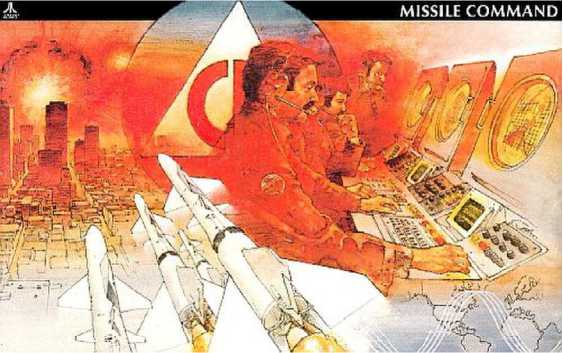
Fig. 1. Poster of the Missile Command game
Analysis . In the 1980s, the topic of nuclear threat in video games was first touched upon in the arcade game Missile Command (1980). The game’s narrative was designed as an imitation of nuclear war (Fig. 1).
In its original version, the game depicted a conflict between the USSR and the USA (later, after several media scandals, the confrontation between these states was replaced by a war between the fictional planets Zardon and Krytol). In accordance with the original concept of the developers, the player solved the task of protecting six Californian cities from nuclear missile attacks. Like all arcade video games, Missile Command had no win condition, i.e., it inevitably ended with the destruction of all cities. It is noteworthy that after the end of the game, instead of the typical Game Over message, the words The End appeared on the screen (Fig. 2) [7, p. 29; 13, p. 43].
It should also be noted that public perception was strongly influenced by references to other works on the topic of nuclear threat (for example, several visuals were borrowed from the movie Damnation Alley (1977, Jack Smight)), as well as by the specific historical context, including the outbreak of the war in Afghanistan, the election of Ronald Reagan, and the subsequent deterioration of relations between the United States and the Soviet Union [12, p. 93].
In American society, Missile Command has attained the status of a cult phenomenon, closely associated with the representation of the nuclear threat in popular culture. For example, in the movie Terminator 2 : Judgment Day (1991, James Cameron), John Connor appears in one of the scenes at the moment of his defeat in Missile Command , which is a clear reference to the theme of the inevitable outbreak of nuclear war (Fig. 3).
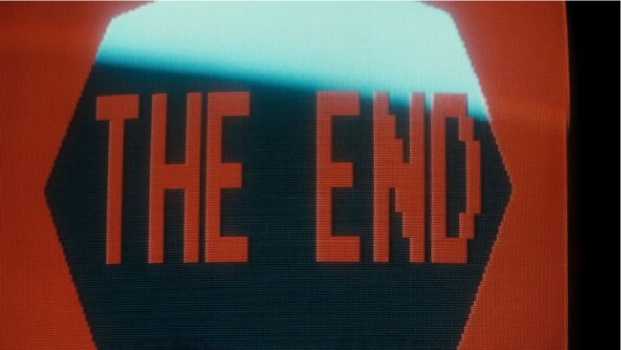
Fig. 2. End screen of Missile Command
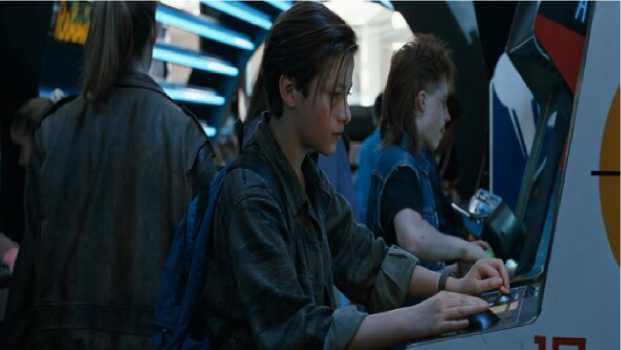
Fig. 3. John Connor playing Missile Command
In addition, a clone of Missile Command is available to gamers on the Pip-Boy interface in the video game Fallout 4 [6, p. 15; 9, p. 505].
In many aspects, Missile Command was the result of cultural and political trends that emerged in the early 1960s. According to E.V. Prosolova, after the first intercontinental ballistic missiles with nuclear warheads were put on alert by both superpowers in 1959–1960, these weapons began to appear increasingly often in visual propaganda as one of the main symbols of war, and the events of the Cuban Missile Crisis only consolidated this trend. As V.I. Zhuravleva noted, the image of the nuclear apocalypse actually turned into a semantic code representing the conflicts between the USA and the USSR in the early 1960s. The events of the “détente” period contributed to certain erosion of the Americans’ “specter of fear” of the nuclear threat from the USSR, but this theme continued to be clearly manifested in U.S. popular culture (including in narratives promoting the idea of the madness of the perpetrators of the nuclear conflict and the re-examination of geopolitical concepts within critical reflection). Its actualization was facilitated, among other things, by the active exploitation of the image of the bomb during anti-war protests against the Vietnam conflict and green actions highlighting the risks associated with the use of atomic energy. However, it should also not be forgotten that the 1980s marked the heyday of the use of the atomic bomb image in many forms of political agitation in the United States (for example, in posters and caricatures) [19; 20; 28].
The theme of the nuclear threat is also reflected in the action game Raid over Moscow (1983). It differs from the previous game primarily in its conditionally positive positioning, which largely corresponds to the traditional American political propaganda from the early Cold War era about the necessity of a “crusade” for freedom against the USSR (Fig. 4) [19; 28]. Whereas the plot of Missile Command assumes the inevitable mutual destruction of the parties to the conflict (since they are portrayed as having parity in terms of nuclear missile weaponry), the developers of Raid over Moscow suggest the possibility of mitigating these risks. The main character of the game is a spaceplane pilot, capable of quickly striking Soviet missile silos in the Leningrad, Minsk, Saratov, and Kiev regions.
The plot also suggests that the United States has the capacity to land troops in Moscow and neutralize the USSR nuclear weapons control system. It should be emphasized separately that according to the plot of this game, the Soviet Union acts as an aggressor, while the actions of the United States are depicted as a retaliatory strike after receiving reliable information about an impending strike from the USSR. Moreover, the plans for a missile attack on the United States are presented as obviously criminal and unjustified, since their implementation follows the complete nuclear disarmament of the United States. Thus, the developers of the game, most likely, unconsciously, under the influence of prevailing media narratives (considering that this is a purely commercial product), promoted images of nuclear war that were, in many ways, identical to the narratives of the Strategic Defense Initiative (SDI) program. The latter, it should be recalled, assumed high risks of a strike on the United States as a result of disarmament efforts during the “détente” period, while also suggesting the technical feasibility of completely neutralizing a nuclear strike from the USSR if the SDI program was successfully implemented [17, p. 21].
The creators of the game Rush’n Attack (1985, known as Green Beret in Europe and Japan) also addressed the theme of the nuclear threat. In the original plot of the game, the main character is a “green beret” who takes part in a mission to rescue American servicemen captured by Soviet troops in Afghanistan (Fig. 5). However, 1987 saw the release of a revised version of the game, in which the player was given the additional task of preventing the launch of missiles armed with nuclear warheads. It is worth noting that, in the game’s instructions, the player is described explicitly as a defender of the “free world.” Thus, the narrative of the game positions the United States and the USSR within the dichotomy of good and evil, with the presence of nuclear weapons in the enemy’s arsenal underscoring its role as an existential threat to the United States. A notable addition to the portrayal of the nuclear threat was the idea that the involvement of great powers in a regional conflict could serve as the prime cause of a nuclear confrontation. Nevertheless, this scenario was presented as conditionally optimistic, since it assumed the possibility of disrupting the launch of Soviet missiles through the use of sabotage and reconnaissance units [23, p. 224].
Thus, whereas in the early 1980s nuclear war was positioned in video games as an existential threat to the United States – one that, in principle, could not be averted in the event of a conflict between the superpowers – later games depicted these risks as relatively insignificant. The narratives of these newer video games incorporated assumptions that an apocalyptic scenario could be avoided, thanks to the scientific, technological, and overall military superiority of the United States. Moreover, these narratives hinted at the perceived necessity of facing similar risks when combating “communist expansion” in other parts, a portrayal likely influenced by both the foreign policy rhetoric of the Reagan administration and cultural constructs – specifically, notions of American exceptionalism and the United States’ quasi-messianic role on the global stage.
During this period, an anti-militarist portrayal of the nuclear threat emerged only in Spy vs Spy III: Arctic Antics (1986) and Wasteland (1988). In Spy vs Spy III: Arctic Antics , the confrontation between two spy saboteurs – symbolically representing the Eastern and Western blocs as equally unscrupulous forces – inevitably resulted in the launch of missiles with nuclear warheads in case of еру success of one of the characters (which caused a disruption of the existing balance of power). In this game (Fig. 6), we observe the developers’ explicit rejection of the traditional portrayal of romanticized “us” and hostile “others” (the “dark doppelgangers” of the West). At the same time, the creators of the game operate within the familiar logic of American political propaganda of the 1980s, which relied on the use of the emotion of fear. They also emphasize the theme of mutual responsibility
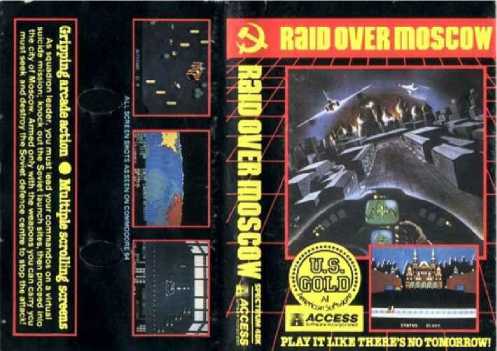
Fig. 4. Cover of the Raid over Moscow edition
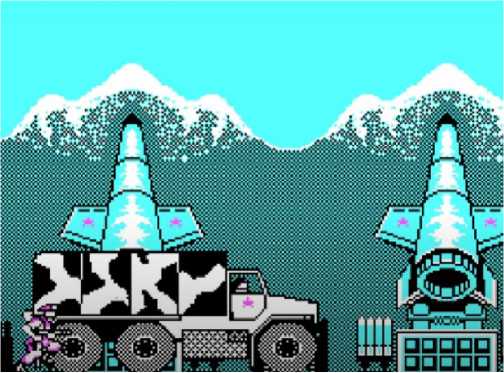
Fig. 5. A frame from Rush’n Attack
between the superpowers, which is characteristic of the political discourse of that decade, by using juxtaposition that underscores the dichotomy of the images presented [19; 20; 28].
The plot of Wasteland , set in a post-apocalyptic world (and, most likely, was influenced by the movie Mad Max 2 (1981, George Miller) and similar works in the genre), also presents a generally negative depiction of the consequences of a nuclear conflict between the United States and the USSR. However, the game is marked by a peculiar romanticization of the post-nuclear world and a lack of portrayal of nuclear weapons as a truly existential threat [4, pp. 61, 62].
In general, within the framework of the “Soviet enemy” image constructed in foreign video games of the 1980s, the theme of the nuclear threat played a key role, since it was the existence of atomic weapons and their delivery systems in the USSR that made it possible to portray the Soviet Union as a genuine existential threat to the United States. This, among other things, facilitated the archetyping and dehumanization of the “Soviet enemy” image, partly by changing its modality through depersonalization [2].
In the games of the 1990s, the theme of the nuclear threat was initially linked to the possibility of restoring the Soviet system with the concomitant remilitarization of the USSR. However, the very possibility of the revived Soviet Union destroying the United States was not directly declared. For example, in the humorous project The Big Red Adventure (1995), the characters encounter the plans of the antagonist (identified as the “mad scientist” Dr. Virago) to literally resurrect Lenin and recreate the USSR as a militarized, expansionist-minded state. However, the representatives of the military elite who sympathize with the antagonist, as well as the conspirators in general, are shown more like comic characters, and the degree of threat within their perception is minimized.
To some extent, one can observe the reanimation of the image of the Soviet nuclear potential as an existential threat to the United States in the game Crisis in the Kremlin (1991), whose plot centers on the struggle between various interest groups for power in the USSR. Notably, both the conventional orthodox communists and the “Russian nationalists” led by the autocratic Boris Yeltsin are depicted as potentially hostile forces towards the United States capable of prolonging the Cold War. Thus, for the first time, the image of the nuclear threat to the United States was reconstructed directly from the
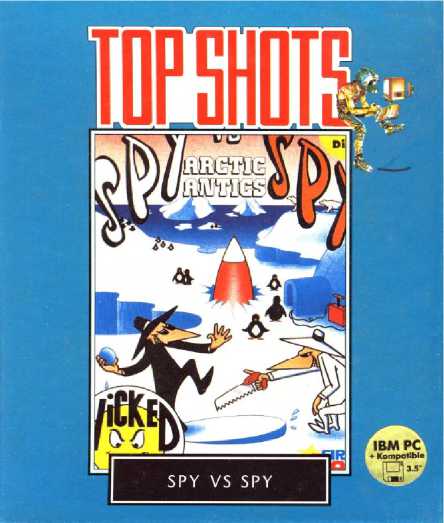
Fig. 6. Poster for Spy vs Spy III: Arctic Antics
perspective of the Soviet Union as a communist state. However, the scale of this threat was not existential, as the USSR was portrayed as a state experiencing a profound internal crisis.
It should also be noted that the positioning of the nuclear threat as a phantom menace – whether associated with the revival of the USSR or the rise of radical nationalists to power in Russia – was not limited to video games but was a feature of foreign popular culture more broadly (as evidenced by the plots of films such as Crimson Tide (1995, Tony Scott), Air Force One (1997, Wolfgang Petersen), and The Peacemaker (1997, Mimi Leder)).
A project such as The Fallout: A Post Nuclear Role Playing Game (1997) played a crucial role in the development of the nuclear threat in video games. In many respects, it echoed the content of Wasteland (1988). However, the plot of Fallout was the first to depict the confrontation of the United States with a power other than the Soviet Union or Russia as the cause of a nuclear conflict. Similarly, the game reinforced the notion that nuclear weapons no longer posed an existential threat; while their use resulted in mass casualties and significant degradation of material culture, it did not entail the extinction of civilization or humanity as a biological species.
Results. Accordingly, there was a gradual evolution in the portrayal of the nuclear threat in video games during the 1980s and 1990s. Initially, the nuclear threat was strictly associated with the Soviet Union, which was depicted as a state adhering to communist ideology and possessing sufficient scientific and technological potential – factors that contributed to the existential nature of the associated risks.
However, then the threat of a nuclear conflict later became associated not only with the possibility of restoring the Soviet system in Russia but also with the rise of an authoritarian regime in the Russian Federation, founded on radical nationalist ideologies. Similarly, China began to be considered a potential adversary of the United States in a nuclear war, as seen in the Fallout franchise.
At the same time, there was a shift in the perceived status of the nuclear conflict threat between the United States and its adversaries. From the mid-1980s onwards, the scenario of mutual and total destruction of the parties during a nuclear conflict was increasingly replaced by alternative narratives – either the prospect of the United States neutralising the enemy’s nuclear missile forces through its scientific, technological, and military superiority or the assumption that a significant part of the population and material culture could survive a nuclear conflict between major powers.
Concurrently, the development of the nuclear threat image was largely shaped by both other formats of mass culture and the official foreign policy discourse of the US authorities. A significant role in the formation of this image was most likely played by sociocultural attitudes inherent in U.S. society, including ideas about American exceptionalism and the messianic role of the United States.
All of this leads to the conclusion that the image of the nuclear threat in Western video games of the 1980s and 1990s was initially shaped largely within the framework of stereotypes prevalent in American society, developed during the Cold War and earlier periods. It didn’t reflect the position of a specific political force and was highly variable, potentially swaying audiences to support both aggressive and moderate foreign policies. This created a wide range of possibilities in terms of the potential to influence the political thinking and behavior of the target audience. This situation was most likely a product of the image-related consequences of the crisis in the Soviet system during the 1980s, as well as the degradation of Russia’s military and economic potential during the 1990s.
