
The Tree and Shrub Vegetation of the Shirvan Plain of Azerbaijan and the Current Status of Relict and Rare Species
Journal: Bulletin of Science and Practice @bulletennauki
Section: Естественные науки
Article in issue: 9 т.12, 2026.
Free access
The vegetation cover of the Shirvan Plain is predominantly represented by semi-desert and steppe plant communities. It has been determined that 11 relict tree and shrub species belonging to 11 families are distributed within the study area. Among these species, the following are included in the Red Data Book of the Republic of Azerbaijan: Punica granatum L. (VU B1ab(i,ii,iii)); Ficus carica L. (F. hyrcana Grossh.) (NT); Platanus orientalis L. (VU A2c+3c); and Vitis vinifera L. (V. sylvestris C.C. Gmel.) (LC). Hedera pastuchovii Woronow is included in the Pink List. In total, 10 rare tree and shrub species occur in the area. For the first time, several forest formation groups have been identified within the Tugay forests along the Kura River and in the area where the Kura and Tartar rivers converge. These include Populeta–Puniceta, Populeta–Pistacieta, Puniceta, Pistacieta, and Querceta. In addition, a class of halophytic shrub formations has been classified and described, including Tamariceta, Halostaceta, Caroxyloneta, Elaeagneta–Tamaricetum, and Paliureta. Field investigations revealed an increase in the abundance of Elaeagnus and Tamarix. It was also established that the area of Tugay forests is decreasing due to anthropogenic impacts, particularly livestock grazing, and that young and middle-aged trees are poorly represented within these ecosystems. Against the background of increasing drought and soil salinization, the riparian territories of the Kura River have long served as refugia for relict species. Therefore, these Tugay forest ecosystems can be regarded as relict refugial areas that play a crucial role in the conservation of biodiversity in the Shirvan Plain.
Short address: https://sciup.org/14139004
IDS: 14139004 | UDC: 581.526.627 | DOI: 10.33619/2414-2948/130/08
Древесная и кустарниковая растительность равнины Ширван в Азербайджане и текущий статус реликтных и редких видов
Растительный покров Ширванской равнины преимущественно представлен полупустынными и степными растительными сообществами. Установлено, что на исследуемой территории распространены 11 реликтовых видов деревьев и кустарников, принадлежащих к 11 семействам. Среди этих видов в Красную книгу Азербайджанской Республики включены следующие: Punica granatum L. (VU B1ab(i,ii,iii)), Ficus carica L. (F. hyrcana Grossh.) (NT), Platanus orientalis L. (VU A2c+3c) и Vitis vinifera L. (V. sylvestris C.C. Gmel.) (LC). Hedera pastuchovii Woronow включена в Розовую книгу. В общей сложности на территории произрастает 10 редких видов деревьев и кустарников. Впервые в пределах тугайных лесов вдоль реки Кура и в районе слияния рек Кура и Тертер выделены несколько групп лесных формаций. К ним относятся Populeta–Puniceta, Populeta–Pistacieta, Puniceta, Pistacieta и Querceta. Кроме того, был классифицирован и описан класс галофитных кустарниковых формаций, включающий Tamariceta, Halostachyetа, Caroxyloneta, Elaeagneta–Tamaricetum и Paliureta. Полевые исследования выявили увеличение численности Elaeagnus и Tamarix. Также было установлено, что площадь тугайных лесов сокращается из-за антропогенного воздействия, особенно выпаса скота, и что молодые и средневозрастные деревья в этих экосистемах представлены слабо. На фоне усиливающейся засухи и засоления почвы прибрежные территории реки Кура долгое время служили убежищами для реликтовых видов. Поэтому эти тугайные лесные экосистемы можно рассматривать как реликтовые убежища, играющие решающую роль в сохранении биоразнообразия на Ширванской равнине.
Text of the scientific article The Tree and Shrub Vegetation of the Shirvan Plain of Azerbaijan and the Current Status of Relict and Rare Species
Бюллетень науки и практики / Bulletin of Science and Practice
УДК 581.526.627
Relict species represent valuable components of forest and shrub vegetation and are among the plant groups most sensitive to anthropogenic impacts and climate change. Therefore, the study of relict plants has become one of the important directions of contemporary botanical research worldwide. Investigations of plant evolutionary history, major evolutionary events occurring during different stages of phylogeny, and the bioecological characteristics, taxonomy, and phytogeographical distribution of relict species within modern forest and shrub vegetation provide an important basis for understanding and predicting future changes in vegetation cover and biodiversity. Plamen Glogov identified 61 relict species belonging to 48 genera and 35 families in the Lozenska Mountain region near Sofia, Bulgaria. The highest number of relict species belonged to the families Salicaceae (9 species) and Ranunculaceae (4 species), while the genera Salix (5 species) and Populus (4 species) were particularly well-represented [11].
Natural ecosystems possess strong self-regulating mechanisms; consequently, ecological niches left vacant by extinct species have often been occupied by other species, and the formation of new species and ecosystems has continued throughout geological history. However, in the present era, in addition to natural processes and climate change, negative human impacts on the environment and atmosphere have become a major factor affecting biodiversity. As a result, many plant species have experienced population decline, increased vulnerability, and a growing risk of extinction. While the natural decline and emergence of species occur over long periods and may compensate for one another, anthropogenic impacts generally operate over much shorter time scales and often lead to irreversible consequences. The factors influencing relict species are diverse and multifaceted. Among the most important are climatic changes, the ecogeographical conditions of relict habitats, and the characteristics of the vegetation types in which relict species occur.
B. B. Namzalov and co-authors reported the occurrence of several mountain Asian relict species belonging to the ancient Mediterranean boreal flora within the mountain forest-steppe vegetation of Southern Siberia. These include Lonicera microphylla Willd. ex Schult., Cotoneaster megalocarpus Popov, Spiraea hypericifolia L., Juniperus sabina L., and other relict taxa [19].
One of the most effective approaches to biodiversity conservation under the conditions of climate change, natural environmental transformations, and increasing anthropogenic pressure is the study of the origin, evolutionary history, current status, and conservation categories of relict species. During long-term natural processes, the ranges of many relict species became fragmented, resulting in geographically isolated populations and the formation of disjunct distribution patterns.
Most relict species are also endemic and rare taxa. Endemic species are generally classified into two categories: paleoendemics and neoendemics. Therefore, the analysis of endemism constitutes an important aspect of botanical and biogeographical research.
Nikiforov A. R. and Nikiforova A. A. investigated the geomorphotopes of relict and endemic species occurring in the mountainous regions of Crimea, which represent relict distribution areas. Among the studied taxa were Heracleum ligusticifolium M. Bieb. (Apiaceae), Lagoseris callicephala Juz. (Asteraceae), Lamium glaberrimum (K. Koch) Taliyev (Lamiaceae), Scrophularia exilis Popl. (Scrophulariaceae), Sobolewskia sibirica (Willd.) P.W. Ball (Brassicaceae), and Silene jailensis N.I. Rubtzov ( Caryophyllaceae ) [20].
Relict plants have proven to be particularly vulnerable to the consequences of both natural climatic fluctuations and human activities. As a result of anthropogenic impacts, many species have become rare or have acquired endangered conservation status. Therefore, the habitat requirements, ecological limitations, responses to climate change, and current conservation status of relict species should be investigated comprehensively and in an integrated manner. Special attention should be paid to their conservation and sustainable management. Studies on plant evolutionary history and paleobotanical investigations provide valuable information on the dynamics of species range changes through time, thereby contributing significantly to the identification and assessment of rare taxa. Khurram Shahzad and co-authors investigated the evolutionary history of the endangered relict tree species Dipteronia sinensis in the Qinling Mountains of Central China and adjacent regions of East Asia in relation to geological and climatic events. Their results indicated that the intraspecific differentiation of D. sinensis occurred during the Paleogene, approximately 39.2 million years ago. This evolutionary divergence was closely associated with the geological development and structural formation of the Qinling Mountains [24].
East Asia occupies a unique position in the world flora due to its exceptionally high plant biodiversity, extensive relict distribution areas, and richness of relict species. The Qinling Mountains of China are considered one of the most important biodiversity hotspots in East Asia. More than 337 endangered plant species occur in this region, the majority of which are relict taxa [26].
Relict species have played an important role in the historical formation of modern biocenoses and ecosystems. They are regarded as significant components of natural ecosystems, contributing to the maintenance of ecological stability and the preservation of the integrity of natural harmony. The relict dendroflora of the Caucasus and Azerbaijan has been investigated by numerous researchers from different scientific perspectives. Safarov I. S. studied the evolutionary stages and distribution ranges of several relict species occurring in the flora of Azerbaijan, including Hedera pastuchovii G. Woronow, Albizia julibrissin Durazz., Gleditsia caspia Desf., Quercus castaneifolia C.A. Mey., Quercus iberica Stev. ex M. Bieb., Parrotia persica C.A. Mey., Ficus carica L., Fagus orientalis Lipsky, Vitis sylvestris C.C. Gmel., and other relict taxa [23].
Relict plants are mostly rare and endangered species and, at the same time, serve as living monuments of natural history. Therefore, there is a growing need to investigate their bioecological characteristics, assess their risk of extinction, and develop scientific foundations for their conservation and restoration. The Hyrcanian forests represent a rich natural museum of relict flora. In general, the Talysh floristic region is considered one of the world's important relict refugia.
The investigation of Azerbaijan’s vegetation cover in relation to altitudinal gradients, ecogeographical conditions, and phytogeographical regions, as well as the study of relict species diversity, remains an important scientific issue. Relict and endemic species constitute a significant component of the dendroflora of the western regions of Azerbaijan. Bayramova A.A. reported that the protected areas of western Azerbaijan contain 21 endemic species of Azerbaijan, 47 Caucasian endemic species, and 54 relict species. During the last 60–70 years, anthropogenic impacts have significantly reduced the natural distribution ranges of several relict species, including Quercus macranthera , Acer trautvetteri , Betula pendula , Betula litwinowii , Ulmus glabra , Padus avium , and Laurocerasus officinalis [6].
Special attention should be devoted to the study of the vegetation cover of Karabakh, which remained under occupation for nearly thirty years. Karabakh is recognized as one of the biodiversity hotspots of the Caucasus in terms of floristic richness. More than 2,000 species of higher plants occur within this region. Asgarov A. M. noted that relict species dominate the forest vegetation of Karabakh: Carpinus caucasica constitutes approximately 44% of the forest cover, Fagus orientalis 31%, while Quercus iberica and Q. macranthera together account for 21%. A forest stand of Zelkova carpinifolia covering approximately 300 hectares has been preserved on the slopes descending toward the Araz River. This represents the only remaining natural stand of this relict species in the Lesser Caucasus region of Azerbaijan [1].
The relict, rare tree and shrub species occurring within the dendroflora of the Kura–Araz Lowland, including the Shirvan Plain, have not yet been comprehensively investigated from a fundamental scientific perspective. Therefore, the main objective of the present study is to classify the relict species occurring in the forest and shrub vegetation of the Shirvan Plain according to their geological age and historical origin, identify rare taxa, determine their distribution ranges, and assess their current conservation status.
Materıals and Methods
The physical and geographical characteristics of a territory play a crucial role in the historical formation of natural flora, the development of forest ecosystems, their species composition, and ecological stability. The territory of the Republic of Azerbaijan is part of the Alpine–Himalayan geosynclinal belt and is situated at the collision zone between the East European Platform and the African–Arabian tectonic plates. Of the seven climatic zones recognized worldwide, Azerbaijan includes two major climatic belts: the subtropical belt, covering approximately 65% of the country's territory, and the temperate belt, occupying about 35%, mainly in the northeastern part of the Greater Caucasus Mountains. The mean annual air temperature reaches 14.5°C in the Kura–Araz Lowland and gradually decreases with altitude, averaging 4–5°C at elevations of around 2,000 m, 1–2°C at 3,000 m, and falling below 0°C in the high-mountain zone. Mountain meadow, mountain forest, meadow-forest, chernozem, brown, chestnut (gray-brown), yellow, and other soil types have been identified within the republic. In total, 25 soil types and 60 subtypes occur in Azerbaijan [4, 7].
The total forest area of Azerbaijan amounts to approximately 1,021 thousand hectares. Of this area, 49% is located within the Greater Caucasus region, 34% in the Lesser Caucasus, 15% in the Talysh Mountains, and 2% in the lowland regions, including the Nakhchivan Autonomous Republic [21].
The Shirvan Plain occupies the left-bank part of the Kura–Araz Lowland between the Mingachevir Reservoir and the Caspian Sea. The territory includes the administrative districts of Shirvan (formerly Ali Bayramli), Hajigabul, Kurdamir, Goychay, Ujar, Agdash, Yevlakh, and Zardab. Absolute elevations generally range from -28 m to 200 m above sea level. The relief is predominantly flat and weakly dissected, creating favorable conditions for agricultural activities [3].
Geologically, the area is dominated by Quaternary alluvial, lacustrine, and marine sediments. The geomorphological formation of the plain has been strongly influenced by the Kura River and by repeated transgressive and regressive phases of the Caspian Sea [10].
The climate of the Shirvan Plain is characterized by high solar radiation and low atmospheric precipitation. The predominant climate type is a warm temperate semi-desert and dry steppe climate with dry summers. This climate is distinguished by limited moisture availability and relatively mild winters. Summers are extremely hot and dry, with daily maximum temperatures often reaching 36– 40°C. A second climatic subtype, represented by a warm temperate semi-desert and dry steppe climate with dry winters, occurs mainly in the western and foothill parts of the plain. It is characterized by low humidity, mild winters with limited precipitation, and relatively warm summers. The annual duration of sunshine ranges from 2,100 to 2,400 hours. Mean annual air temperature is approximately 14–15°C, while the average temperature of January varies between 1 and 3°C and that of July between 26 and 28°C. During summer, maximum temperatures may occasionally rise to 40–42°C. Annual precipitation ranges from 254 to 510 mm. Northern and northwestern winds prevail throughout the region. Strong winds contribute significantly to the development of soil erosion and deflation processes [10].
The rivers flowing through the Shirvan Plain are predominantly transit rivers. They belong to the Kura River basin and originate on the southern slopes of the Greater Caucasus at elevations between 2,000 and 3,500 m. After descending from the mountainous areas onto the plain, rivers such as the Alijanchay, Turyanchay, Goychay, and Girdimanchay divide into several distributaries. The soil cover of the Shirvan Plain varies according to geomorphological conditions. Light chestnut and gray-brown soils predominate in the foothill zone. Light meadow and gray-brown soils occur on alluvial fans, while alluvial-meadow soils and Tugay forest soils are found along the Kura River. Gray, gray-meadow, and saline soils are characteristic of the eastern part of the plain and the peripheral zones of alluvial fans. At present, nearly 70% of the soils of the Shirvan Plain are not utilized for agricultural purposes due to water shortages, secondary salinization, and related environmental problems [16].
According to Asgarov [2], the vegetation of the Shirvan Plain belongs to the Kura–Araz subdistrict of the Kura–Araz Botanical-Geographical Region, whereas Ibadullayeva and Asgarov [14] consider it an independent Kura–Araz Botanical-Geographical Region. The vegetation cover of the Shirvan Plain has developed under the influence of semi-desert and dry-steppe landscapes. Arid climatic conditions, low precipitation, high evaporation rates, and soil salinization have promoted the dominance of xerophytic (drought-resistant) and halophytic (salt-tolerant) plant species. Wormwood (Artemisia) formations are widely distributed in the Karasu, Hajigabul, Padar, Shahsunlu, and Arshali areas. Foothill zones and alluvial fans associated with dry valleys and ravines support communities composed of couch grass, feather grass, wormwood, grasses, and various herbaceous species, together with wild pomegranate, Christ's thorn, blackberry, Russian olive, and other shrubs. In depressions between the alluvial fans of the Turyanchay, Goychay, Girdimanchay, and Agsu rivers, shallow groundwater promotes the development of marsh and halophytic vegetation. Wetland vegetation occurs in stagnant-water habitats, while ridges are occupied by blackberry and willow thickets, wormwood communities, and diverse herbaceous species. Tamarisk, blackberry, and hygrophilous plants are widespread in ravines and gullies. A distinct horizontal zonation of vegetation is observed throughout the region [10].
Halophytic vegetation predominates on saline soils. These plants are adapted to high concentrations of soluble salts in the soil. Tamarix and saline wormwood communities are among the most widespread vegetation types. They occur particularly around Lake Hajigabul and in saline habitats along the lower course of the Kura River [1].
The principal plant formations of the semi-desert landscapes are represented by wormwood, ephemeral, and ephemeroid species. The dominant species of the semi-desert vegetation include wormwood ( Artemisia spp.), Christ's thorn ( Paliurus spina-christi Mill.), camel thorn ( Alhagi spp.), saltwort ( Halocnemum strobilaceum (Pall.) M.Bieb.), and Caroxylon species. During spring, the rapid growth of ephemeral plants creates a dense herbaceous cover across the semi-desert landscapes. However, by early summer, most species complete their vegetation cycle and enter dormancy. Along the Kura River valley, irrigation canals, drainage channels, and other moist habitats, extensive communities of reed ( Phragmites spp.), sedges, and meadow grasses have developed. These plant communities play an important role in the formation and maintenance of wetland ecosystems [17].
Tugay forests have developed along the Kura River in areas where groundwater occurs close to the surface. These forests are considered among the most valuable forest ecosystems of Azerbaijan. The dominant genera in these forests include Elaeagnus , Populus , Salix , Tamarix , Ulmus , and others. Tugay forests play an important role in preventing soil erosion, conserving biodiversity, and maintaining the ecological stability of river ecosystems. Relatively well-preserved Tugay forests are found along the Kura River near Garakhan, Agzibir, Piraza, Korpukend, and Alvand within the Shirvan Plain. The characteristic tree species of these forests are white Populus alba L., Ulmus skabra Mill., Quercus robur L., Salix alba L. , Morus alba L., Elaeagnus angustifolia L., The shrub layer is represented by Tamarix ramosissima Ledeb., Tamarix hohenackeri Bunge., Punica granatum L. and other species. A distinct microzonation pattern is observed with increasing distance from the riverbed. Adjacent to the river is a narrow belt dominated by willow and tamarisk species. This is followed by a broad belt in which white poplar is the dominant tree species. Further away from the river, forests are characterized by elm, oak, and ash ( Fraxinus spp.) communities [18, 22].
The material investigated in the present study consists of rare tree and shrub species, including Tertiary relict taxa, distributed throughout the Shirvan Plain of Azerbaijan. The systematization and classification of forest and shrub vegetation are essential components in vegetation research. One of the most comprehensive and modern classifications of Azerbaijan’s forest and shrub vegetation was proposed by E.M. Gurbanov. According to his classification, the vegetation of the Republic of Azerbaijan is conventionally divided into one forest vegetation type, seven formation classes, and thirty-four formation groups, as well as one shrub vegetation type comprising two formation classes and nine formation groups [13].
This classification system served as the methodological basis for the present study. Several researchers have classified relict species from different perspectives. For the classification of relict taxa according to geological periods and the preparation of a comprehensive species inventory, the works of A. A. Grossheim [12], V. I. Baranov [5], and A. N. Krishtofovich [15] were used as the principal reference sources.
The conservation status and Red List categories of the investigated rare plant species were determined according to the Red Data Book of the Republic of Azerbaijan [15]. The nomenclature of genera and species follows the modern taxonomic treatment adopted by the World Flora Online database .
Dıscussıon and Results
Relict species constitute one of the most important and valuable components of Azerbaijan’s forest and shrub vegetation. In addition to being rare and often endemic, many relict species have played a significant role in the historical formation and development of present-day ecosystems.
During the Paleocene and Eocene epochs of the Tertiary Period (Cenozoic Era), climatic conditions were predominantly warm and humid. The vegetation of that period was represented by the Poltava flora, which was characterized mainly by evergreen plant species. At present, the forest and shrub vegetation of Azerbaijan contains 8 relict species belonging to 8 genera and 7 families of the Poltava flora, 38 species belonging to 28 genera and 16 families of the Turgai flora, and 2 species belonging to 2 genera and 2 families of xerothermic relicts. Relict species originating from the Poltava and Turgai floras of the Tertiary Period are primarily distributed within the forests of the Talysh region, Colchis, and the southern slopes of the Greater Caucasus Mountains [8, 9].
RELICT AND RARE TREE AND SHRUB SPECIES
OF THE DENDROFLORA OF THE SHIRVAN PLAIN (AZERBAIJAN)
Table 1
|
Relict Species Family, Genus and Species |
Species listed in the Red Data Book of Azerbaijan Conservation status according to the National IUCN Red List categories |
|
Relict taxa of the Poltava flora |
|
|
Punicaceae Horan.: Punica granatum L. |
Punicaceae Horan.: Punica granatum L . VU B1ab (I, I, III). |
|
Moraceae Link. Ficus carica L. (F. hyrcana Grossh.) |
Moraceae Link. Ficus carica L. (F.hyrcana Grossh.). NT. |
|
Platanceae Dum.: Platanus orientalis L. |
Platanceae Dum. Platanus orientalis L. VU A2c+3c |
|
Araliaceae Juss.: Hedera pastuchovii Woronow. |
Araliaceae Juss. Hedera pastuchovii Woronow. listed in the Pink List" |
|
Relict taxa of the Turgai flora |
|
|
Vitaceae Juss.: Vitis vinifera L. (V. sylvestris C.C.Gmel.) |
Vitaceae Juss . Vitis vinifera L. (V. sylvestris C.C.Gmel.) LC |
|
Betulaceae S.F.Gray.: Carpinus orientalis Mill. |
|
|
Cornaceae Dumort.: Cornus mas L. |
|
|
Oleaceae Hoffmgg.et Link.: Fraxinus excelsior L. |
|
|
Rosaseae Juss. Cerasus incana (Pall.) Spach. ( C.mahaleb L.) |
|
|
Salicaceae Lindl.: Salix alba L. |
|
|
Ulmaceae Mirb.: Ulmus scabra Mill. |
|
|
Cupressaceae Rich. Ex Bartl .: Juniperus foetidissima Willd. NT |
|
|
Betulaceae S.F.Gray. : Carpinus scauschaensis H.J.Winkl. CR A2abc; C1 |
|
|
Rosaseae Juss.: Cotoneaster saxatilis Pojark. VU D2, Prunus microcarpa C.A.Mey. VU B1 ab(i,iii), |
|
|
Anacardiaceae : (R.Br.) Lindl. Pistacia atlantica Desf. (= P.mutica. et C.A.Mey) NT. |
|
Analysis of the data obtained during the present study revealed that the Shirvan Plain supports 4 relict species belonging to 4 genera and 4 families of the evergreen Poltava flora, as well as 7 relict species belonging to 7 genera and 7 families of the Turgai flora. Among these relict taxa, 5 species are included in the Red Data Book of the Republic of Azerbaijan as rare and threatened plants. In total, 10 species of relict and rare trees and shrubs were recorded within the study area (Table 1).
For the first time, the distribution, taxonomic composition, and conservation status of the relict dendroflora of the Shirvan Plain were assessed in a comprehensive manner. The results indicate that the Tugay forests and riverine habitats of the Kura River constitute important refugial areas for the preservation of Tertiary relict species. Despite the arid climate and widespread soil salinization, these habitats continue to provide suitable ecological conditions for the survival of relict taxa. The current state of several populations, however, reflects increasing anthropogenic pressure. Livestock grazing, agricultural expansion, fragmentation of natural habitats, declining groundwater levels, and climate change have contributed to the reduction of population sizes and the degradation of Tugay forest ecosystems. Consequently, the conservation of relict species and their habitats should be considered a priority for biodiversity protection and ecosystem management within the Shirvan Plain. The obtained results confirm that the Shirvan Plain represents an important refugium for relict tree and shrub species in the Kura–Araz Lowland and contributes significantly to the conservation of Azerbaijan’s floristic diversity and natural heritage.
Table 2
CLASSIFICATION OF FOREST AND SHRUB VEGETATION
|
Formation classes |
Formation groups |
Dominant speci |
|
Vegetation Type: Forest Vegetation |
||
|
1.Formation class of lowland riparian Tugay forests |
Populeta-Puniceta, Populeta-Pistacieta, Puniceta, Pistacieta, Querceta, Populeta, Populeta-Salicetum-Ulmosum, Tamariceta and Ulmeta |
Populus tremula L., P.alba L. P. nigra L., P.canescens ( Ait.) Smith., Punica qranatum L., Pistacia mutica Fisch. et C.A.Mey, Quercus pedunculiflora C. Koch., Salix alba L., Ulmus scabra Mill., Tamarix ramosissima Ledeb. |
|
2. Formation class of arid sparse forests |
Junipereta, Querceta, Crataegeta, Puniceta, Acereta, Ficuseta and Pistacieta |
Juniperus foetidissima Willd. , Quercus pedunculiflora C. Koch., Crataegus eriantha Pojark., Punica qranatum L., Acer campestre L., Ficus carica L., Pistacia mutica Fisch. et C.A.Mey. |
Vegetation Type: Shrub Vegetation Type
Yevlakh–Khaldan Area and Qaraoglan Villagen the territories between Yevlakh and Khaldan, particularly in the area of Qaraoglan village and along irrigation channels, the following tree species were recorded: Prunus cerasifera Ehrh., Ulmus scabra Mill., Punica granatum L., Populus alba L., Populus nigra L., Fraxinus excelsior L., Morus alba L., and Morus rubra L. These species were well developed and produced abundant fruits.
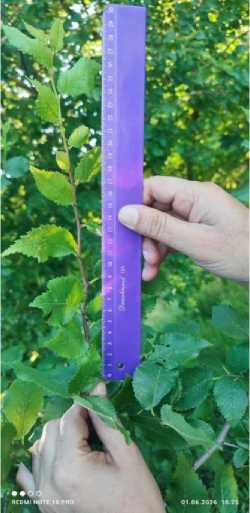
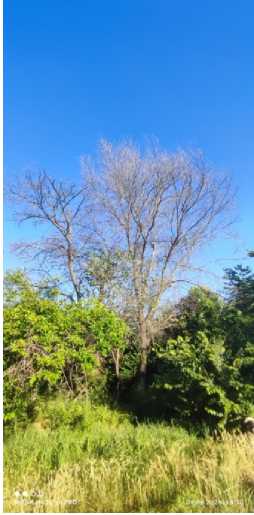
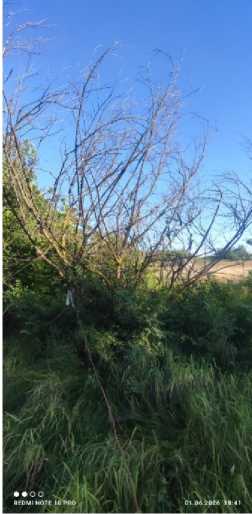
The individuals of Ulmus scabra Mill., a representative of the Turgai relicts, showed good growth and development (annual shoots reaching 25–30 cm) due to favorable rainy weather conditions during early spring of the current year. At the same time, drying of elm trees of different ages was observed in this area. The dried individuals were mainly located in open habitats exposed directly to solar radiation. Similar cases were observed even along irrigation channels. In contrast, trees growing under partial shade and surrounded by other trees did not show signs of drying.
This phenomenon may be explained by the higher accumulation of iron compounds in the leaves and other organs of Ulmus scabra , which may contribute to increased absorption of solar radiation. Therefore, the drying process occurs mainly during July and August, when solar activity and temperature are highest ( Figure 1.)
A
B
C
Figure 1. Ulmus scabra Mill. A.- Growth and development., B, C.-dead trees. Yevlakh district of Azerbaijan. N 40 38 09.4, E 047 13.00.0. Height above sea level 13 m. 01.06.2026
Natural regeneration of Ulmus scabra Mill. is also proceeding successfully in this area. Within an area of 10 m², 20–25 seedlings aged 1–3 years were recorded. Halophytic Shrub Vegetation and Formation Groups in the Shirvan Plain In this area, as well as in other parts of the Yevlakh district and within the territories of Mingachevir, Agdash, and Ujar districts, the Halophytic Shrub Formation
Class is widely distributed. The following formation groups are characteristic of these habitats: Tamariceta, Halostaceta, Caroxyloneta, Elaeagneta–Tamaricetum, and Paliureta. The dominant species within these formations are Tamarix ramosissima Ledeb., Tamarix hohenackeri Bunge, Halostachys caspica (M.Bieb.) C.A.Mey., Caroxylon dendroides Tzvelev., Elaeagnus angustifolia L., and Paliurus spina-christi Mill.
Along the left side of the Yevlakh–Barda road, around the Molla Gullu village area extending toward the Kura River, xerophytic and halophytic vegetation formation classes are widely distributed. The dominant formation groups include Elaeagneta–Tamaricetum, Tamariceta–Rubuetum– Elaeagnosum, Halostaceta, and Caroxyloneta. The dominant species in these communities are Tamarix ramosissima Ledeb., Tamarix hohenackeri Bunge, Rubus anatolicus Focke ex Hausskn., Elaeagnus angustifolia L., Elaeagnus caspica (Sosn.) Grossh., Paliurus spina-christi Mill., Halostachys caspica (M.Bieb.) C.A.Mey., and Caroxylon dendroides Tzvelev.
A
B
C
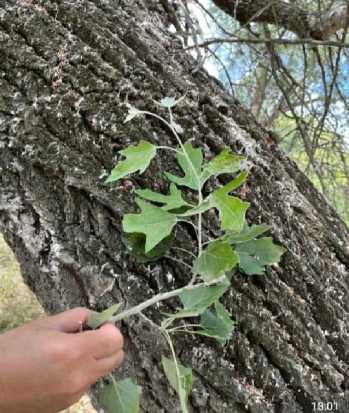
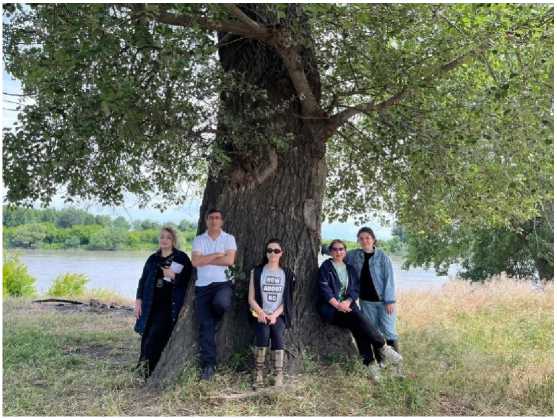
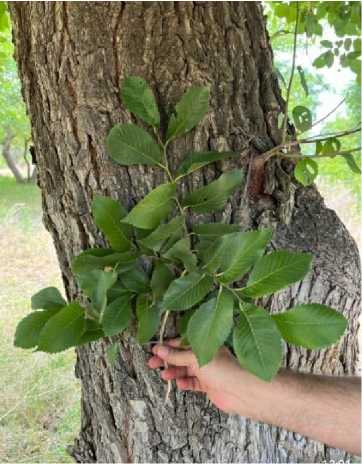
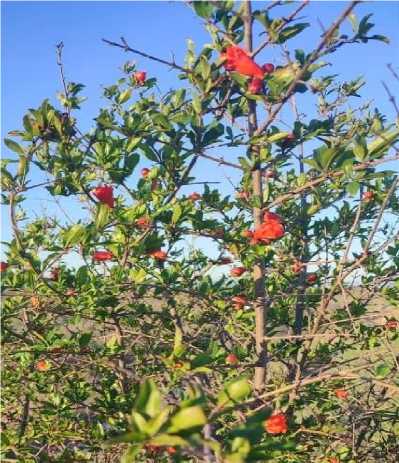
Figure 2. A, B. Populus alba L., C. Ulmus scabra Mill., D. Punica granatum L. Yevlakh region, Azerbaijan, Kura river bank, rare Tuqay forest. N 40 33 00.3 E 047 11.03.4. Height above sea level 19 m. 02.06.2026
D
In general, it should be particularly emphasized that species belonging to the genera Elaeagnus and Tamarix are widely distributed in agricultural lands throughout the study area. A similar phenomenon is also observed in the Nakhchivan Autonomous Republic, where their distribution and abundance are gradually increasing. Near Molla Gullu village, before reaching the Tugay forests along the Kura River, two old pedunculate oak ( Quercus robur L.) trees growing close together were recorded. Their estimated age is between 100 and 150 years. The presence of these old oak individuals indicates that these territories were historically covered by forest vegetation and that oak species had a wider distribution in the past.
Tugay Forests Along the Kura River and the Kura–Tartar River Confluence Area A unique and highly valuable Tugay forest type for the flora of the Republic of Azerbaijan occurs along the banks of the Kura River and in the area where the Kura River joins the Tartar River. Within this territory, the Lowland Riparian Tugay Forest Formation Class and the Arid Sparse Forest Formation Class include the following formation groups: Populeta–Puniceta, Populeta–Pistacieta, Puniceta, Pistacieta, Querceta, Populeta, Populeta–Salicetum–Ulmosum, Tamariceta and elm Ulmeta.
The arid sparse forest communities are represented by juniper formations ( Junipereta ), oak formations ( Querceta ), hawthorn formations ( Crataegeta ), pomegranate formations ( Puniceta ), maple formations ( Acereta ), fig formations ( Ficuseta ), and pistachio formations ( Pistacieta ).
The dominant tree species in these forests are Populus tremula L., Populus alba L., Populus nigra L., Populus canescens (Ait.) Smith, Punica granatum L., Pistacia mutica Fisch. et C.A.Mey., Quercus pedunculiflora C.Koch, Salix alba L., Ulmus scabra Mill., Tamarix ramosissima Ledeb., and Ficus carica L. (Figure 2.)
The trees in this area, especially poplar species, are distinguished by their considerable height (25–30 m) and the abundance of old individuals. Abundant fruiting was observed during the current year. The forest and adjacent areas are used for grazing by sheep, goats, and cattle. This has negatively affected natural regeneration processes. The high proportion of old trees and the scarcity of young and middle-aged individuals indicate that intensive grazing has been occurring in these forests for many decades, resulting in reduced regeneration and gradual degradation of the Tugay forest structure.
Results
As a result of the conducted studies, it was determined that 11 species of relict trees and shrubs belonging to 11 families are distributed within the semi-desert and steppe vegetation of the Shirvan Plain. Among these species, the following are included in the Red Data Book of the Republic of Azerbaijan: Punica granatum L. — classified as Vulnerable (VU B1ab(i, ii, iii)); Ficus carica L. ( F. hyrcana Grossh.) — Near Threatened (NT); Platanus orientalis L. — Vulnerable (VU A2c+3c); Vitis vinifera L. ( V. sylvestris C.C.Gmel.) — Least Concern (LC). Hedera pastuchovii Woronow is included in the Pink List. In total, 10 rare tree and shrub species were recorded within the study area.
For the first time, in the Tugay forests along the Kura River and in the area where the Kura and Tartar rivers merge, the following forest formation groups were identified: Populeta–Puniceta ), Populeta–Pistacieta , Puniceta , Pistacieta , Querceta formations.
In general, within the Shirvan Plain, a Halophytic Shrub Formation Class was classified, including the shrub formation groups that had not previously been described in the scientific literature for this region: Tamariceta , Halostaceta , Caroxyloneta , Elaeagneta–Tamaricetum , Paliureta .
It was established that species belonging to the genera Elaeagnus and Tamarix are expanding in agricultural areas. It was also revealed that Tugay forests are gradually decreasing in area due to anthropogenic impacts, particularly grazing pressure, resulting in a shortage of young and middleaged trees and weakening of natural regeneration processes.
The research results showed that, compared with other botanical-geographical regions of Azerbaijan (Talysh, Nakhchivan, Greater and Lesser Caucasus), the Shirvan Plain contains fewer relict tree and shrub species of the Tertiary Period. Nevertheless, despite the negative effects of aridity and soil salinity, the Kura River floodplain habitats have served as long-term refugia for relict species. Therefore, these areas can be considered important Tugay relict refugial habitats that preserve remnants of ancient vegetation communities.
