
Towards creating a multilingual dictionary of tourist terms
Free access
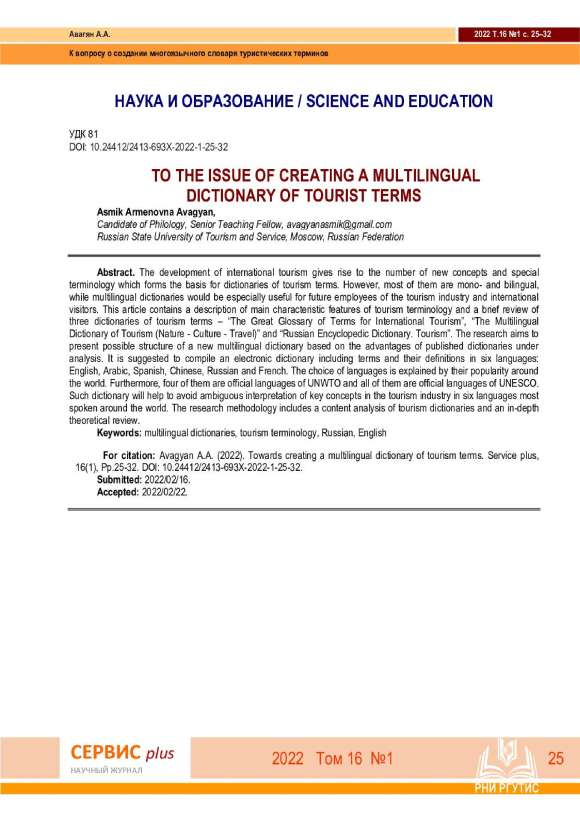
The development of international tourism gives rise to a number of new concepts and special terminology which forms the basis for dictionaries of tourism terms. However, most of them are mono- and bilingual, while multilingual dictionaries would be especially useful for future employees of the tourism industry and international visitors. This article contains a description of main characteristic features of tourism terminology and a brief review of three dictionaries of tourism terms - “The Great Glossary of Terms for International Tourism”, “The Multilingual Dictionary of Tourism (Nature - Culture - Travel)” and “Russian Encyclopedic Dictionary. Tourism”. The research aims to present possible structure of a new multilingual dictionary based on the advantages of published dictionaries under analysis. It is suggested to compile an electronic dictionary including terms and their definitions in six languages: English, Arabic, Spanish, Chinese, Russian and French. The choice of languages is explained by their popularity around the world. Furthermore, four of them are official languages of UNWTO and all of them are official languages of UNESCO. Such dictionary will help to avoid ambiguous interpretation of key concepts in the tourism industry in six languages most spoken around the world. The research methodology includes a content analysis of tourism dictionaries and an in-depth theoretical review.
Similar articles in the section Linguistics and languages
Short address: https://sciup.org/140293587
IDS: 140293587 | UDC: 81
К вопросу о создании многоязычного словаря туристических терминов
Развитие международного туризма способствует появлению ряда новых концептов и специальной терминологии, служащей основой словарей туристических терминов. Однако, большую часть этих словарей составляют одноязычные или двуязычные словари, в то время как многоязычные словари обладали бы особой актуальностью для будущих работников индустрии туризма и иностранных туристов. Данная статья содержит описание основных характеристик туристической терминологии и краткий обзор трёх словарей туристических терминов - «Большой словарь терминов международного туризма», пятиязычный словарь туристских терминов «Туризм: природа-культура-путешествия» и «Российский энциклопедический словарь. Туризм». Цель исследования - представить возможную структуру нового многоязычного словаря, основываясь на достоинствах изданных словарей. Предлагается создать электронный словарь, включающий термины и их дефиниции на шести языках - английском, арабском, испанском, китайском, русском и французском. Выбор языков обусловлен их распространённостью во всём мире. Более того, четыре из них являются официальными языками ВТО ООН и все шесть - официальными языками ЮНЕСКО. Подобный словарь позволит избежать неоднозначной интерпретации ключевых концептов индустрии туризма на шести самых распространённых языках мира. Методология исследования включает содержательный анализ опубликованных туристических словарей и тщательный обзор теоретической литературы.
References Towards creating a multilingual dictionary of tourist terms
- Avagyan, A.A., Koroliov, A.V. (2020). Specific Features of Tourism Discourse Texts. Service plus, 14(1), 3-10. (In Russ.).
- Alkudakh, A.K.M. (2019). Terminology of Tourism in the Modern Russian Language. Dissertation... Candidate of Philological Sciences. Voronezh. (In Russ.).
- Beaver A.A. (2005). Dictionary of Travel and Tourism Terminology. 2nd edition. CABI Publishing.
- Birzhakov, M.B., Nikiforov, V.I. (2005). The Great Glossary of Terms for the International Tourism. 3rd ed. St. Petersburg-Moscow: Nevsky Fond publ. house - Gerda publ. house. (In Russ.).
- Komarova, A.I. (2015). Multilingual Dictionary of Terms "Tourism: Nature-Culture-Travelling". Uchyonye zapiski Natsional'nogo obshchestva prikladnoi lingvistiki [Scientific notes of the National society of applied linguistics], 9, 67-78. (In Russ.).
- Ryabova, I.A., Ismaev, D.K., Putilina, S.N. (2005). Dictionary of International Tourism Terms. Moscow: Knigodel. (In Russ.).
- Sakaeva, L.R., Bazarova, L.V. (2018). The Comparative Analysis of English and Russian Terminological Systems of Tourism. Kazanskii lingvisticheskii zhurnal [Kazan linguistic journal], vol. 1, 1 (1), 16-21. (In Russ.).
- Samigoullina, A.D. (2021). English Coroneologisms: Function and Semantics. Mezhdunarodnyi nauchno-issledovatel'skii zhurnal [International Research Journal], 3 (105), part 3, 166—170. (In Russ.).
- Shilova E.A. (2013). Online Dictionaries of Tourism: Ways of Lexicographic Description of Professional Terminology. Teoriya i praktika inostrannogo yazyka v vysshei shkoly [Theory and practice of foreign language at higher school], no. 9, 1927200.
- Vinogradova, L.V. (2011). Tourism Terminology of the English and Russian Languages in Synchronic and Diachronic Aspects. Abstract of dissertation. Candidate of Philological Sciences. Velikii Novgorod. (In Russ.).
- Vinogradova, L.V. (2009). Russian Tourism Terminology: Structural Characteristic. Vestnik Novgorodskogo gosudarstvennogo universiteta [Bulletin of Novgorod State University], 52, 27-30. (In Russ.).
- Zhitenyov, S.Yu. (2018). Russian Encyclopedic Dictionary. Tourism. Moscow: Heritage Institute. (In Russ.).
