
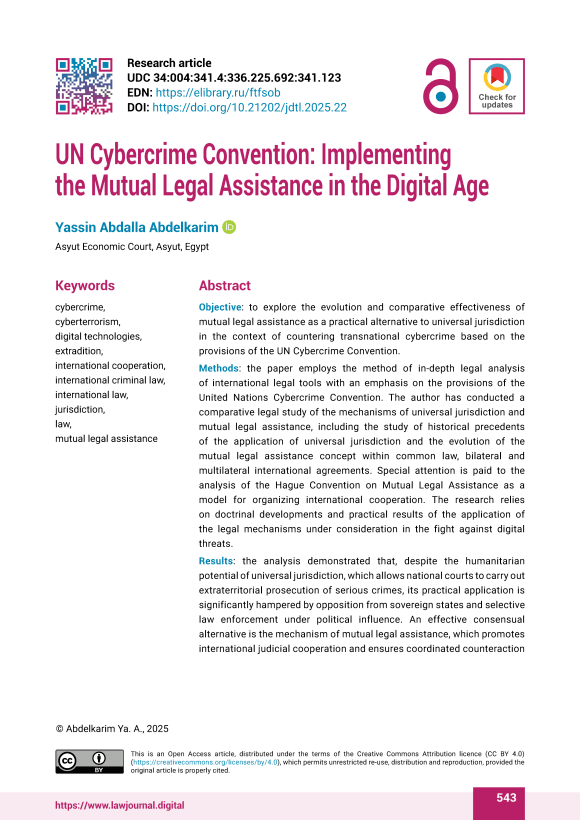
UN Cybercrime Convention: Implementing the Mutual Legal Assistance in the Digital Age
Journal: Journal of Digital Technologies and Law @lawjournal-digital
Article in issue: 3 (4), 2025.
Free access
Objective: to explore the evolution and comparative effectiveness of mutual legal assistance as a practical alternative to universal jurisdiction in the context of countering transnational cybercrime based on the provisions of the UN Cybercrime Convention. Methods: the paper employs the method of in-depth legal analysis of international legal tools with an emphasis on the provisions of the United Nations Cybercrime Convention. The author has conducted a comparative legal study of the mechanisms of universal jurisdiction and mutual legal assistance, including the study of historical precedents of the application of universal jurisdiction and the evolution of the mutual legal assistance concept within common law, bilateral and multilateral international agreements. Special attention is paid to the analysis of the Hague Convention on Mutual Legal Assistance as a model for organizing international cooperation. The research relies on doctrinal developments and practical results of the application of the legal mechanisms under consideration in the fight against digital threats. Results: the analysis demonstrated that, despite the humanitarian potential of universal jurisdiction, which allows national courts to carry out extraterritorial prosecution of serious crimes, its practical application is significantly hampered by opposition from sovereign states and selective law enforcement under political influence. An effective consensual alternative is the mechanism of mutual legal assistance, which promotes international judicial cooperation and ensures coordinated counteraction to cross-border cybercrime while preserving national sovereignty. The author shows that the UN Cybercrime Convention effectively integrates the mutual legal assistance principles through consultations, coordination of jurisdictions, extradition, and transfer of convicted persons and criminal proceedings. Scientific novelty: the study offers an innovative approach to analyzing the relationship between traditional and modern international legal mechanisms under the global digitalization. The author substantiates the conceptual position according to which the mutual legal assistance, conditioned by both common law practice and modern contractual initiatives, represents a unique comprehensive toolkit that allows overcoming the systemic limitations of universal jurisdiction in the digital age. The research demonstrated that mutual legal assistance de facto creates a consensual practice of applying universal jurisdiction based on the voluntary consent of states, which qualitatively distinguishes it from traditional approaches. For the first time, the implementation of the mutual legal assistance principles in a specialized international treaty on cybercrime was systematically analyzed. Practical significance: the results obtained highlight the critical role of mutual legal assistance in strengthening global judicial cooperation and effectively curbing transnational cybercrime. The study demonstrates the practical effectiveness of the UN Cybercrime Convention as an effective international legal tool that ensures a balance between the sovereignty of states and the need for international judicial cooperation.
Similar articles in the section Law. Jurisprudence
Short address: https://sciup.org/14134228
IDS: 14134228 | UDC: 34:004:341.4:336.225.692:341.123 | DOI: 10.21202/jdtl.2025.22
