
An Empirical Study of the Quality of the Cycle Merging Algorithm for the Maximum Traveling Salesman Problem
Section: Программирование
Article in issue: 1 т.19, 2026.
Free access
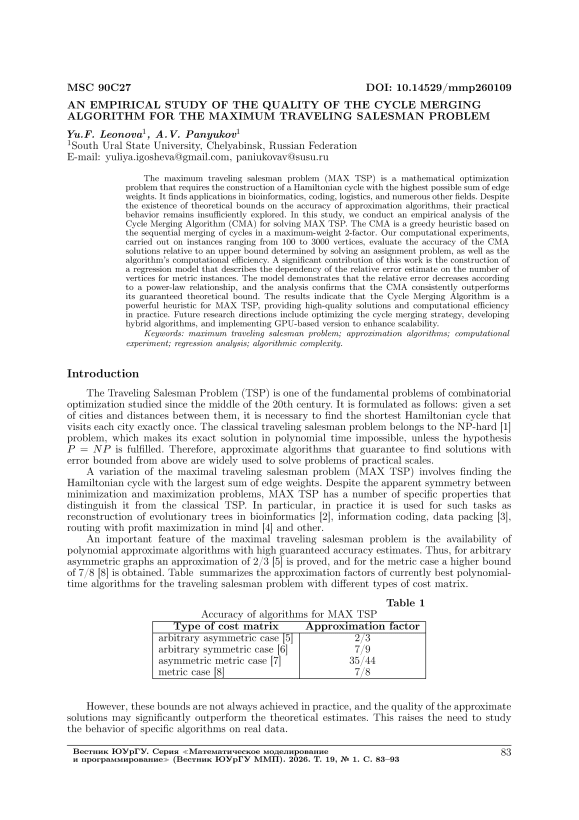
The maximum traveling salesman problem (MAX TSP) is a mathematical optimization problem that requires the construction of a Hamiltonian cycle with the highest possible sum of edge weights. It finds applications in bioinformatics, coding, logistics, and numerous other fields. Despite the existence of theoretical bounds on the accuracy of approximation algorithms, their practical behavior remains insufficiently explored. In this study, we conduct an empirical analysis of the Cycle Merging Algorithm (CMA) for solving MAX TSP. The CMA is a greedy heuristic based on the sequential merging of cycles in a maximum-weight 2-factor. Our computational experiments, carried out on instances ranging from 100 to 3000 vertices, evaluate the accuracy of the CMA solutions relative to an upper bound determined by solving an assignment problem, as well as the algorithm's computational efficiency. A significant contribution of this work is the construction of a regression model that describes the dependency of the relative error estimate on the number of vertices for metric instances. The model demonstrates that the relative error decreases according to a power-law relationship, and the analysis confirms that the CMA consistently outperforms its guaranteed theoretical bound. The results indicate that the Cycle Merging Algorithm is a powerful heuristic for MAX TSP, providing high-quality solutions and computational efficiency in practice. Future research directions include optimizing the cycle merging strategy, developing hybrid algorithms, and implementing GPU-based version to enhance scalability.
Similar articles in the section Combinatorial analysis. Graph theory

Short address: https://sciup.org/147253402
IDS: 147253402 | UDC: 519.16 | DOI: 10.14529/mmp260109
Эмпирическое исследование качества алгоритма соединения циклов для задачи коммивояжёра на максимум
Задача коммивояжера на максимум - это задача комбинаторной оптимизации, заключающаяся в построении гамильтонова цикла с наибольшей суммой весов ребер. Она применяется в биоинформатике, кодировании, логистике и других областях. Несмотря на наличие теоретических границ точности приближенных алгоритмов, их реальное поведение остается недостаточно изученным. В данной работе приводится эмпирический анализ алгоритма соединения циклов (Cycle Merging Algorithm, CMA) для решения задачи коммивояжера на максимум. CMA является жадной эвристикой, основанной на последовательном объединении циклов в 2-факторе максимального веса. В ходе вычислительного эксперимента (на наборах от 100 до 3000 вершин) исследуется точность решений CMA относительно верхней границы, определяемой как решение задачи о назначении, а также вычислительная эффективность метода. Особый вклад работы заключается в построении регрессионной модели, описывающей зависимость оценки относительной погрешности от числа вершин для метрических экземпляров задачи. Модель показывает, что относительная погрешность убывает по степенному закону, а анализ подтверждает, что CMA стабильно превосходит гарантированную теоретическую границу. Полученные результаты свидетельствуют о том, что алгоритм соединения циклов является мощной эвристикой для задачи коммивояжера на максимум, обеспечивая высокое качество решений и вычислительную эффективность на практике. Перспективными направлениями дальнейшей работы являются оптимизация стратегии объединения циклов, разработка гибридных алгоритмов реализация GPU-версии для улучшения масштабируемости.
