
An NLP-Based Framework for Fake News Detection Using Contextual and Engineered Features in Communication Technologies
Journal: International Journal of Engineering and Manufacturing @ijem
Article in issue: 4 vol.16, 2026.
Free access
Fake news detection focuses on identifying and preventing the spread of misleading or false information. It is crucial for maintaining the integrity of public discourse and protecting individuals from the harmful effects of misinformation. By ensuring the correctness and reliability of the information, the fake news detection hinders the loss of trust in the media, institutions, and public communication channels. The fake news detection system suggested is in the process of data acquisition where news stories are either manually or automatically retrieved from the net via web crawlers. The collected data later filters the information so it will use only credible sources. Phase two consists of the pre-processing phase using BERT, wherein the data will be tokenized and mapped into contextual embeddings that reflect the semantic meaning of words. Phase three is about engineering features using methods like TF-IDF and Word2vec to fine-tune the embeddings and label the important textual features. The final Phase of Classification occurs using the engineered features such that BERT-generated outputs are fine-tuned and passed through softmax functions to ascertain whether the news is fake or real. This holistic and all-encompassing approach integrates advanced natural language processing with feature engineering for an effective system concerning detection of fake news accurately. The model achieved remarkable results over various phases. Training accuracy went from 75% up to those above 95% whereas test accuracy tips above 90%, soaring from below 70%. The model's performance was validated with a balanced confusion matrix and a high ROC AUC of 0.94. Throughout different phases, accuracy, precision, recall, and F1-score increased, reaching 97.0%, 96.7%, 96.8%, and 96.9%, respectively, in the final classification phase, demonstrating robust and reliable detection capabilities.
Short address: https://sciup.org/15020584
IDS: 15020584 | DOI: 10.5815/ijem.2026.04.12
Text of the scientific article An NLP-Based Framework for Fake News Detection Using Contextual and Engineered Features in Communication Technologies
The internet has changed interaction and communication to a low cost and simple access. Thus, social media has become the main source of reading and searching for many of the users in Communication Technologies. It replaced the traditional newspaper reading culture. The spread of fake news is growing every day because of the modern technologies. Fake news is one of the most concerning aspects in various facets of society [1]. Misinformation spreading and disinformation has transformed into a weapon, used to manipulate public. One of the biggest dangers of fake news is how it undermines trust in trusted sources like the media, government, and experts. Fake news has become a serious problem in today's digital world, were information spreads quickly and widely [2]. The simple techniques for false information creation and sharing online has made it a powerful tool for misleading people, disrupting societies, and influencing essential decisions. Several technologies are required to tackle the threat of fake news. Also technologies are not enough to handle fake news, public awareness to recognize fake news and think logically about the problem they encounter is necessary [3]. Fake news has also had greater impact on political consequences. It might damage the reputation of the political parties and distort public opinion which leads to unexpected election outcomes. The impact of fake news on innocent people is, it may lead them to unnecessary panic and confusion. For example, if a rumor spread during the health crisis, that can make people to take harmful actions and unnecessary precautions. Over past few years there was a false information about vaccines, largely spread on social media and other online platforms. This was an unverified claim on vaccines causing infertility, autism and other severe side effects [4]. The more lies spread, the more public eyes fall on doctors and other professionals; hence their credibility is diminished. The temporary vaccine hesitancy and refusal further affected vaccination rates. The COVID-19 pandemic has shown several cases of false news regarding the virus and its treatment that affected the hesitancy of vaccines and resistance to public health measures, leading to preventable illness and death. Fake news, as a genre of misinformation, imperils the economy by influencing markets, tarnishing businesses, and swaying consumer opinion. An invented story about a business being financially distressed can see respectable stock prices plummeting, albeit factitious. Such interruptions can have grave ramifications, impacting livelihoods, capital formation, and general viability of an economy. The community gets divided into pro-vaccination and anti-vaccination groups based on lies. The worrying dissemination of false news can cast a blanket of stress, fear, or anxiety over the concerned segment of the population [5].
Fake news is creating havoc in society, affecting individuals' health and the sustenance of democracies. One of the foremost impacts is loss of trust in media and institutions. When people are bombarded with false information all the time, they end up questioning the credibility of all news sources, thereby allowing an atmosphere of generalized mistrust among governments, public health organizations, and other authority figures [6]. Such massive skepticism erodes society's basic structure, complicating societies' coming together during times of crisis. Another grievous threat that fake news facilitates is polarization and division [7]. It usually builds on already existing social and political tensions, deepening fractures in communities [8]. Stories that are either sensationalized or misleading can often lead to muscle-rubbed emotions and create an atmosphere for the booming of extremism and declining civil discourse. Thus, this disheveled state hinders constructive dialogue and yet another amplification of the obstacles in finding a way for people to contend with the option of another viewpoint. In the public health arena, false news can have toxic repercussions. The entire panorama of fake news in itself may also lead to some nebulous legal or ethical quandaries. Governments or social media are now fighting against fake news without encroaching on declaring free speech [9]. Regulations restricting or deleting misinformation drift into discussions about censorship and the role of tech companies in the control of information flow. Additionally, the law itself is slow-going in its response to the digital arena, creating difficulties in holding those responsible for the creation or spread of fake news. One scientific challenge in Fake News Identification is to find an appropriate representation system that supports capturing the contextual semantics and discriminative textual patterns. Traditional feature-based methods like TF-IDF can be used to find out the significance of the terms but cannot model contextual relationship between words. Likewise, Word2Vec creates static representations of words which are not sufficient to reflect context-dependent nuances in meaning. While BERT addresses these shortcomings with its "contextualized embeddings," it is not guaranteed to be able to capture the full value of lexical information that can be useful for classification tasks. Thus, one of the research challenges is to investigate if and how the contextual and engineered textual features together can offer a better representation for detecting fake news. To overcome this issue, this study integrates BERT, TF-IDF and Word2Vec features into a single classification system.
2. Literature Review
Fake news has gained increasing recognition as a sizable threat to democratic transformations, journalism, and free speech. The threat posed by misleading information to democratic transition processes, journalism, and free speech has been especially noted for significant interference in major political events such as the 2016 U.S. presidential electionsand the Brexit referendum. Subsequently, fake news on platforms Facebook, Instagram, Twitter, and other social media generated far more user engagement than authentic news stories from reputable sources [10]. Moreover, this fact highlights how huge misinformation gets traction on social media platforms such as Instagram, Facebook, and Twitter, with its fast-spreading nature. Latest research has demonstrated that fake news has far-reaching implications, even affecting the course of economic activities. Hoaxes such as one claiming former U.S. President Barack Obama was injured in an explosion caused a sharp decrease in the stock market, accentuating the dangers of misinformation at the financial level. Therefore, the total incidence of fake news increased, requiring serious scientific efforts on research into and the fight against this particular gadget [11]. Moreover, developing terms such as "post-truth" has identified the issue's widespread acknowledgment, with Oxford Dictionaries declaring it the Word of the Year in the international category for 2016. One of the early adoptions to detect fake news was rule-based approaches. A series of predefined rules to identify certain patterns or characteristics usually associated with misleading or false information were pre-established. Such rules could check for keywords and phrases characteristic of fake news, e.g. shocking, miracle cure, or you won't believe. Then rule-based approaches may also check for the reputation of the news source in its publishing of credible information [12]. Some linguistic patterns were overuse of capitalization, use of exclamation marks, or emotionally laden language. These were other indicators used for flagging possible fake news articles. Although simple and easy to implement, the rule-based systems had serious shortcomings. The one important limitation was that they were incapable of adapting. Fake news creators could easily modify their language or style to avoid detection by simply avoiding the specific words or phrases flagged by these rules [13]. Moreover, rule-based methods struggled with the nuances of natural language, often failing to distinguish between satire, opinion pieces, and genuinely fake news. As a result, these approaches produced a high number of false positives and false negatives, reducing their overall effectiveness in accurately identifying fake news.
Generally, numerous vital aspects can be related to the formation of fake news. Firstly, conventional media such as television and newspapers can be formed and distributed on the Internet accounts for its broad appeal. In this sense, there is a significant introduction to social media that has create big impact. It should be noted that approximately 68% of Americans said they obtained their news from social media sites such as Instagram, Facebook, and Twitter. Social media serve as echo chambers, where biased information is constantly disseminated and reinforced, accelerating the spread of wrong information [14]. Later, social media distributes fake news quickly and stimulates the users to engage with and spread misinformation. This distribution is enabled by social media platforms such as Facebook, Instagram, and Twitter due to their ability to connect people across enormous distances [15]. These social media can provide various interactive features, such as sharing, commenting, and voting on content. Further, the fake news is extended to their potential for political and economic improvements from spreading fake news has incentivized malicious actors to exploit these platforms for their benefit. For example, teenagers in Veles, Macedonia, became well-known for creating fake news stories during the U.S. presidential election, earning significant profits through online advertising. This example shows how the perceived benefits of spreading fake news often compensate for the perceived costs, further motivating individuals to engage in these activities. Notably, people are affected by social and psychological factors by the spread of fake news on social media [16]. The belief in social media gradually reduces as they affect the mental health of people. According to recent research in social psychology, humans frequently have anxiety distinguishing truth from untruth, especially if they are exposed to deceptive information. It has been shown that the ability to detect deception is only somewhat better than chance, with accuracy rates between 55% and 58% [17]. This susceptibility is particularly troubling in the context of fake news, where the anticipation of genuineness and detachment makes it easier for misinformation to gain public trust. Therefore, it is important to develop fake news detectors to identify the fake news.
Although much progress has been made in the field of fake news detection, there are still some technical challenges that have yet to be addressed. The traditional methods using lexical representations, like TF-IDF [18], do not adequately model the contextual relationships between words and only show the statistics of word frequency [19]. Likewise, static embedding methods such as Word2Vec give the same vector representation to a word irrespective of its meaning in various contexts, and as a result are less effective at capturing nuance in the language used to communicate misinformation. While transformer-based models like BERT are able to learn context-aware representations using their self-attention mechanisms, they may lack sufficient ability to learn discriminative lexical patterns and handcrafted textual features that have been effective in classification tasks. Moreover, there is limited research that investigates the complementary use of contextual embeddings and engineered features in the same framework to the best of our knowledge. This gap indicates that a hybrid fake news detection method that combines both the contextual information and feature level textual information is needed. Hence, the present study suggests an integrated model that integrates BERT based contextual representations with TF-IDF and Word2Vec representations for better robustness and effectiveness of fake news classification.
3. Proposed Methodology
Fig. 1. gives a comprehensive approach to detect fake news. There are four essential phases, data collection, preprocessing, feature engineering, and classification.
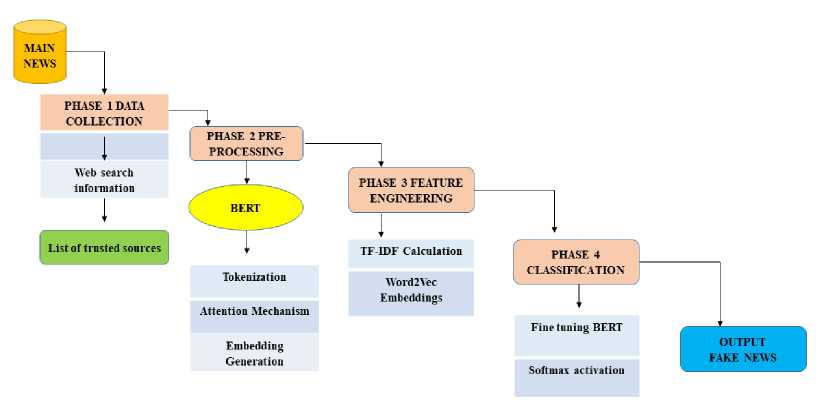
Fig. 1. Block diagram of the proposed architecture
Data collection is the crucial step in phase 1, where news data is obtained from the internet source. After the aforementioned procedure, for the purpose of ensuring that the analysis is built upon different credible data, the content will be filtered using a predetermined reputable list of sources. In this case, the second phase relates to BERT and deals with pre-processing. It involves tokenization, embedding generation, and attention mechanisms with BERT. This step helps to capture the connotation of words and sentences that would determine the efficiency of its subsequent processing. Phase 3 sees the use of feature engineering methods such as TF-IDF and Word2Vec. The embedding generated in Phase 2 will further be adjusted in the feature engineering. Such processes will ensure that the model can account for the importance and semantic relationships among the words, thus performing a more precise analysis. Phase 4 is classified, which has engineered properties for the classification of news. The proposed architecture is a combination of advanced natural language processing techniques with feature engineering. This provides an effective system for fake news detection also handles the complexity of language.
In fake news detection, collection of data is essential. Further the analysis can be carried out with high accuracy and precision based on the effectiveness of data collection. The process will begin with the collection of news article automatically or manually across the web. The search might focus on certain words, sentences or topics that are prone for misleading information. Web crawlers are utilized to retrieve the news articles from news websites, social media and other online sources. Ensuring the sources are from trusted sites is essential as it maintains the integrity of data. This requires referring the historical accuracy and reputation of the sites that are listed as trusted source. Spacy is used to check whether the news articles are from reputed sources. Next the filtering process begins, where the content from trusted source is obtained. This makes sure that the dataset is free from false information. Also this step includes cross-referencing with other multiple sources to evaluate the accuracy of the data collected. The filtered data is now ready to store in a structured format followed by processing. The system must be capable of storing huge amount of data and accessing the data must be easier.
-
3.1. Pre-processing with BERT
BERT is used in phase 2 because of its ability to enhance the pre-processing of text data. This is so much helpful in improving the accuracy and efficiency of detecting fake news. The process begins with tokenization, here the pre-trained BERT tokenizer is utilized. The collected raw data is now split into sub-word tokens by the tokenizer. All the smallest sub word can be processed by BERT. Padding is applied to tokenization in such a way that any text lengths can be handled. Padding is responsible for maintaining the uniformity of text length. If any sequence exceeds the model length, it will lead to truncating of model length.
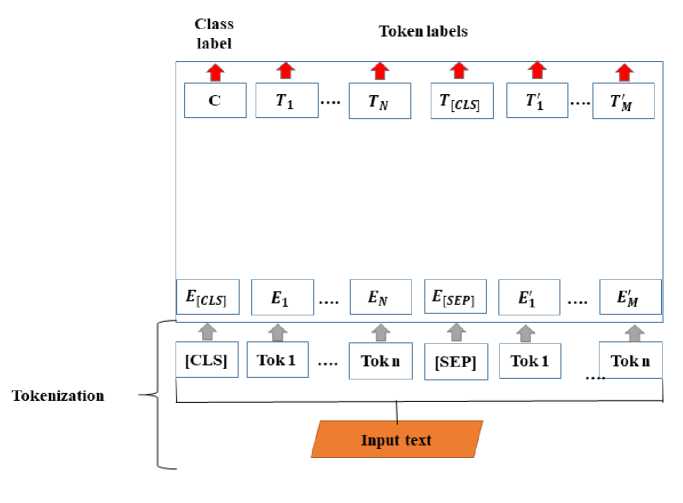
Fig. 2. Tokenization in BERT model
Fig. 2. illustrates the tokenization process within a fake news detection model. The model obtains the input data as news article or a social media post. To determine the whether the input data is genuine or note, the proposed model analyse the raw data. All the received input data are broken into small units called token. These tokens are in the form of words, characters or sub words. [CLS] is a special token which is added at the start of the tokenized sequence. The main purpose of this is used in classification task, where the model generates an output whether the article is fake or real. [SEP] is another special token which is added at the end of the sequence. This basically separate the input into different sentences or segments. It also helps to understand the boundaries of the input text. Followed by tokenization, next is embedding generation. The input obtained from tokenization is fed to the BERT model. The BERT provides contextual embedding for each token. All these embeddings are dense vector, which are capable of capturing the semantic meaning of words based on the context within the sentence. BERT embeddings differ from traditional static embeddings. Because of its bidirectional nature it reflects the meaning of a word in relation to all other words in sequence.
As represented in fig.2 once the tokenization is completed, the tokens are transformed to their corresponding embedding. Embeddings are the numerical representation of tokens, capturing their semantic meanings in a continuous vector space. Two set of output are obtained. One is class label output, next is token label output (T 1 …. T M ′ ). Class label is crucial in classification phase, where it serves as primary output in the detection of fake news. The tokens are processed by the proposed BERT model and token-level predictions are made. This may contribute it identify misleading information. This proposed model is highly efficient to understand the intricacies of the language CLASS. With this technique, a model is enabled to weigh the influences of each token against others in the same sequence. Therefore, selfattention allows BERT to focus much processing on different dynamic tokens, meaning that each token's representation is affected by other relevant tokens' positions in the sequence. This mechanism brings advantages in the context of complex dependencies and their correlation among the words for understanding since it allows for capturing context and meaning in text. In the model implementation, the BERT-base architecture was used to obtain text representations that are contextually engineered. A pre-trained BERT model was used to extract contextual embeddings from the given input text. The model was trained for 20 epochs with 70%/30% split between training and testing phase. The generated contextual embeddings were then passed to the next stage of feature engineering where they were combined with the lexical and semantic representations. The contextual embeddings derived from BERT, combined with the lexical features derived from TF-IDF and the semantic representations derived from Word2Vec, were exploited to make use of the lexical and contextual advantages.
The input is a text snippet–related sharing: A news report, educational material, and the like are some examples. The text instance passes some preprocessing through the BERT tokenizer. It first tokenizes and pads the text, preparing it as numerical input to feed into the BERT model. BERT then forwards tensors of its embeddings as output. An embedding is generated for every token in the input text, which for dense representations is just this side of the fence that it could capture semblance of any semantic meaning that the token has, or should have, in context. The structure can be used for the likes of classification, feature extraction, or similar output.
Algorithm 1: BERT-Embed
-
1. import BertTokenizer and BertModel form transformers
-
2. import torch
-
3. tokenizer = BertTokenizer.from_pretrained('bert-base-uncased')
-
4. model = BertModel.from_pretrained('bert-base-uncased')
#Step 1: Initialize BERT tokenizer and model
-
# Step 2: Function to preprocess text with BERT
-
5. def preprocess_with_bert(text):
-
6. tokens = tokenizer.encode_plus(text, add_special_tokens=True,
-
7. padding='max_length', truncation=True, return_tensors='pt')
-
8. input_ids = tokens['input_ids']
-
# Step 3: Generate embeddingswith torch.no_grad():
-
9. embeddings = model(input_ids)[0]
-
10. return embeddings
-
# Step 4: Example usage
-
11. article = "This is an example news article for BERT pre-processing."
-
12. embeddings = preprocess_with_bert(article)
-
13. print(embeddings)
-
3.2. Feature engineering and classification
The conversion of raw pre-processed text data into structured data for an ML model to use efficiently has its significance in phase 3 feature engineering. Essential characteristics of the text are captured in this phase, which would help the model distinguish between real and fake news. TF-IDF stands for Term Frequency-Inverse Document Frequency, a statistical measure used for estimating the importance of a word in a document compared with that of a set of documents (the corpus). It acts as a balance between how often one word appears and how often that word appears across all documents. Thus, it emphasizes the words that are less common across the entire corpus but are important for a specific document, which would help the model understand the distinguishing patterns easily. Another technique is Word2Vec, which produces word embeddings and dense vector representations of words that can take into consideration their semantic meanings according to the context in the text. It will gain the ability by such embeddings to understand the relations between words that are specifically important to figure out any nuances in the language that might indicate fake news. Features generated using TF-IDF and Word2Vec will later be combined into a richer feature set that a classification model will use to produce the predictions.
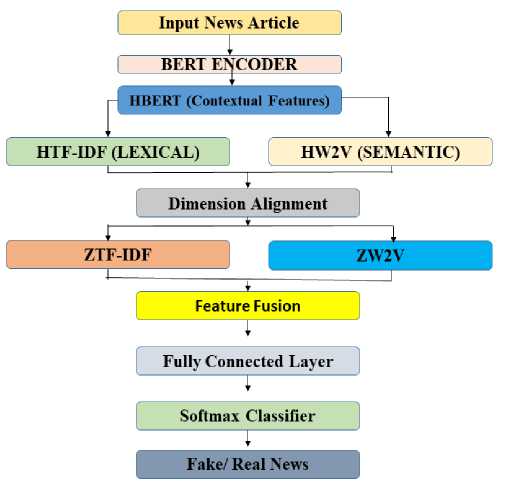
Fig. 3. Hybrid feature fusion framework for fake news detection.
In Fig. 3. illustrates the proposed hybrid feature fusion framework for fake news detection. Initially, the input news article is processed using the BERT encoder to generate contextual feature representations ( HBERT). In parallel, lexical and semantic information is represented through TF-IDF (HTF-IDF) and Word2Vec (HW2V) features, respectively. Since these feature representations exist in different dimensional spaces, a dimension alignment stage is employed to transform them into compatible representations (ZTF-IDF} and (HW2V). The aligned features are subsequently combined through feature fusion to construct a unified representation. Finally, the fused feature vector is forwarded to a fully connected layer and a SoftMax classifier to categorize news articles as either fake or real. The contextual embeddings derived from BERT, combined with the lexical features derived from TF-IDF and the semantic representations derived from Word2Vec, were exploited to make use of the lexical and contextual advantages. The contextual embeddings obtained from BERT were combined with the lexical features extracted using TF-IDF and the semantic representations extracted using Word2Vec for the exploitation of complementary textual features. The resulting feature vectors were concatenated together to form a complete feature vector for each news article. This hybrid representation maintains the contextual information, term importance, and the semantic relationship among the terms, which enhances the discriminative power of the fake news classifier.
F = [hbert' > htf-idf' > H W2V ] (1)
where H BERT , H TF-IDF , and H W2V represent the contextual, lexical, and semantic feature vectors extracted from BERT, TF-IDF, and Word2Vec, respectively. The symbol [ ; ] denotes feature concatenation, and FFF represents the final fused feature vector used for classification.
This process is also supplemented with a special token that constitutes [CLS] at the beginning of the tokenized sequence. For purposes of classification, the function of the [CLS] token is to pool information from the entire sequence, hence allowing the model to produce an output stating whether the article is fake or real. The tokenized input with the addition of [CLS] is then fine-tuning the pre-trained BERT model for the task of fake news detection. Fine-tuning occurs as the model adjusts its parameters into a labeled read corpus to learn what features are critical for pushing further behind the fake news application. The fine-tuning guarantees the modeling capabilities of BERT on really identifying the deceptive or misleading kind of news while leveraging its strongest capabilities in understanding language. After finetuning, the outputs of the model, especially those with respect to the [CLS] token, are passed through a SoftMax activation function. This SoftMax activation function maps the raw output scores to a probability distribution over the possible classes. The output layer of the SoftMax usually represents a probability score concerning the likelihood of a given news item being fake in the case of fake news detection. The class with the highest probability will be taken as the final prediction, thus classifying news as either fake or real. Therefore, this phase intelligently categorizes and tags fake news with very high accuracy, making use of a very careful tokenizing strategy where the [CLS] token is used appropriately, and the deep linguistic understanding of BERT, followed by the softmax probabilistic classification.
Decision-making processes must be transparent when it comes to the detection of fake news models so that these models can gain the trust and understanding of the general public. In pursuit of this goal, the model integrates interpretability techniques such as attention visualization and feature importance analysis, which explain the model's differentiation among real and fake news. The BERT model's self-attention mechanism identifies and emphasizes parts of the text most relevant to the classification. Attention visualization indicates specific words or phrases that influence the decisions made by the model. This exposes linguistic patterns of fake news, for example sensationalist language, contradictions, and biased statements. Terms such as emotionally loaded or polarizing ones often draw greater attention, thus giving us insight into the model's reasoning. In addition, feature importance analysis looks at the contributions of terms and features generated during pre-processing, of which TF-IDF and Word2Vec are two. Words like "scandal," "exclusive," or "shocking," which are used frequently in fake news, usually have higher importance scores. This implies that the model differentiates between fake and real news by using different features and their contextual relevance. The novelty of the proposed framework lies in the integration of contextual embeddings generated by BERT with engineered textual features extracted using TF-IDF and Word2Vec, enabling the model to capture both contextual semantics and lexical characteristics of news content.
4. Results and Discussion
The framework was evaluated using the LIAR dataset containing 12,800 labeled statements together with a publicly available fake news dataset comprising news articles collected from multiple trusted and untrusted sources. Prior to model training, duplicate records, special characters, URLs, and irrelevant symbols were removed from the textual data. Subsequently, tokenization and contextual embedding generation were performed using BERT. The dataset was partitioned into 70% training data and 30% testing data to evaluate the performance of the proposed framework. Classification effectiveness was assessed using Accuracy, Precision, Recall, F1-score, and Area Under the ROC Curve (AUC). The fake news detection model using BERT for optimal performance, training, and inference requires unique specifications on the system. First of all, for rapid training and inference of the model, GPUs such as high-end NVIDIA RTX 3080 can do wonders, having above 12GB VRAM. TPUs can further enhance such computational efficiency, particularly with large datasets. The system must have at least 32GB of RAM to manage very large data and batch processing adequately. The requirements for the storage space must be actualized by SSD (no less than 1TB) for speed access into datasets and model checkpoints, hence fast loading and fast saving times. To guarantee the reproducibility, the recommended containerization tools are those such as Docker which will allow easy deployment in different environments. Also, special library incorporation such as Hugging Face Transformers becomes a necessity of effective text preprocessing and embedding generation. It becomes meaningful when performance measurement tools like Tensor Board are incorporated into the model to visualize training metrics and analyze how the model may be overfitting or underfitting during the training process. One of the significant prerequisites for a model used for fake news detection to generalize is that it contains a rich and varied representative sample of data. Hence, the "LIAR" dataset is the one used in this study and consists of 12,800 labeled short statements that span the entire range of true and false claims. Also, the "Fake News Dataset" is used for this study. This dataset contains news articles collected from a variety of trusted sources such as CNN, BBC, or The New York Times himself. Based on multiple queries or topics, regions, and times, the dataset thus includes both fake and most misleading news. It proves a very broad coverage for making the model robust against fake news detection of different contexts and types.
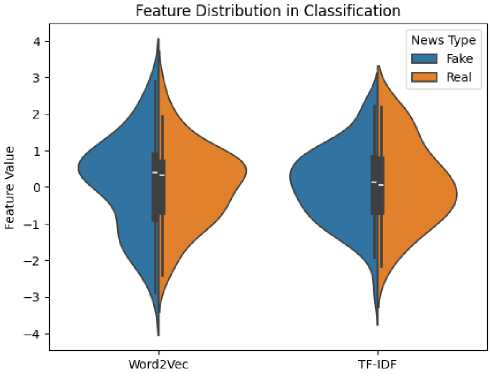
The Fig. 4. shows distributions of ut feature data which result from deriving features through Word2Vec and TF-IDF to classify whether the news is fake or real. Note that this midpoint for this feature data is zero. Thus, the zero point and beyond portions of this data on each side show fakes or real news distributions accordingly. Typically the considered problem is classification-based distribution, the density and spread of the data vary between the two feature types. This feature type indicates the differences in how each method captures information relevant to the classification task. The detailed visualization helps in understanding the efficacy of these feature extraction techniques in differentiating between fake and real news.
Feature Type
Fig. 4. Distribution of Word2Vec and TF-IDF Feature Values in Fake vs. Real News Classification
Epochs
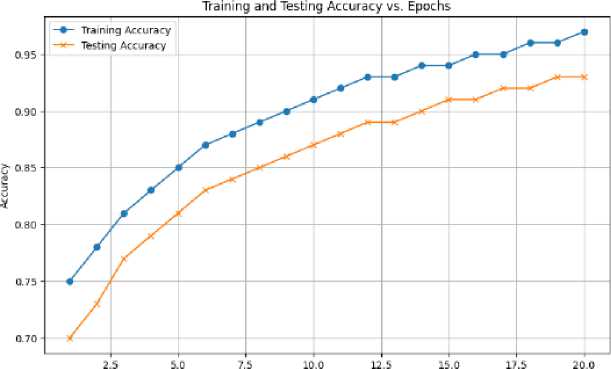
Fig. 5. Performance evaluation of the fake news detection model
To further assess the model's performance by splitting the data into training and testing over 20 epochs. The training data can be taken as 70% and for testing 30% over 20 epochs. Fig. 5. shows the accuracy of the fake news detection model during training. It is noteworthy to mention that the training model increases from 75% to over 95%demonstrating that the model is gradually learning to differentiate the fake and real news during training. Furthermore, the testing accuracy of the detection model also improves from 70% to just above 90%. This shows that the model works well with unseen data. The accuracy of the proposed fake news detection model using BERT improved. In addition, the model using BERT effectively learns the features required for accurate false news. The proposed model further reduces the overfitting of the training data, based on the modest and constant gap between the training and testing accuracy curves.
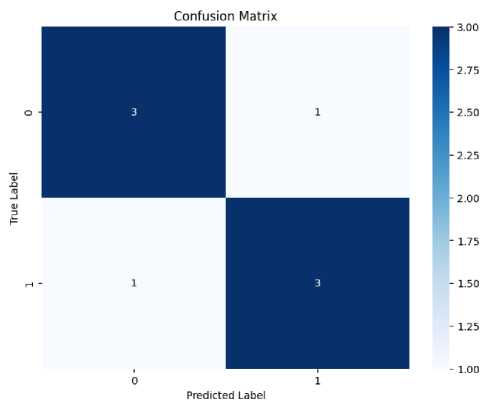
Fig. 6. Confusion matrix of fake news detection model performance
Fig. 6. shows the performance of the proposed fake news detection model using BERT in terms of a confusion matrix. It is observed from the figure that out of four instances of real news denoted as0, the model suitably identified three as real news but one as fake. In the same way, out of four fake news denoted as 1, the model properly detected three but mistakenly classified one as real. This matrix shows that the detection model has a balanced accuracy. Although some minor misclassifications highlight the effectiveness of the proposed model in differentiating fake and real news.
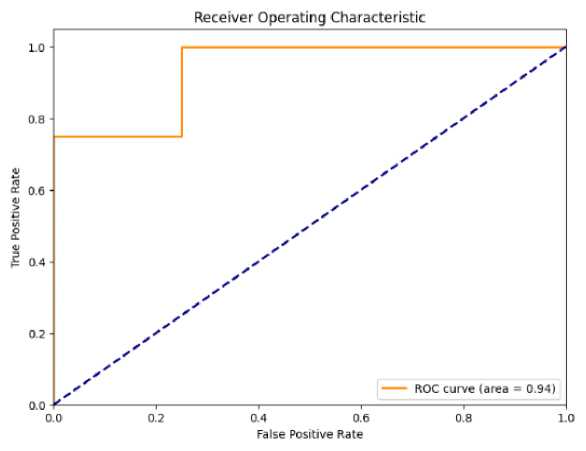
Fig. 7. ROC curve showing the performance of the fake news detection model with an AUC of 0.94
For more clarity, the receiver operating characteristic (ROC) curve, as shown in Fig. 7., demonstrates the fake news detection model performance. The curve shown in Fig. 6 plots the true positive rate (TPR) against the false positive rate (FPR), presenting a graphical measure of the proposed fake news detection model. The proposed fake news detection model using BERT nondifferentiated fake and real news. The proposed model shows a high degree of accuracy in the area under the curve (AUC) of 0.94. Therefore, the proposed model distinguishes false news with a solid balance between sensitivity and specificity. The proposed model further performs substantially better than random guessing, as demonstrated by its performance being well above the baseline.
PCI
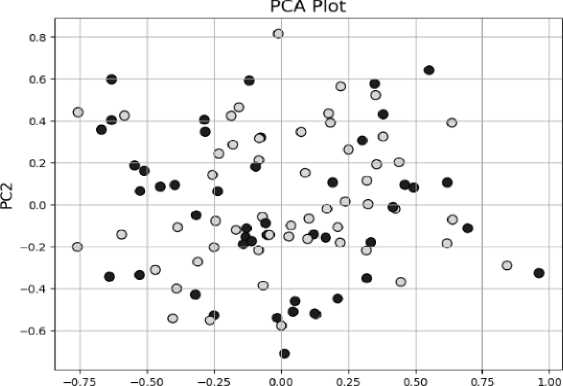
Fig. 8. PCA Visualization for Fake News Detection
The proposed fake news detection model using BERT can be further assessed using Principal Component Analysis (PCA)as shown in Fig. 8. The PCA using the proposed detection model provides a graphical illustration of news articles. That is each point as shown in Fig. 7. represents an article, and the different colors indicate different clusters of news content. This PCA allows a clear difference between fake and genuine news by reducing the high-dimensional data to two principal components such as PC1 and PC2 as depicted in Fig. 7. The spread and overlap in the PCA representation show variation in the degrees of similarity and dissimilarity in the articles. This variation can be vital to identify patterns associated with fake news. Additionally, articles that form closely bound clusters may share similar features. The similar features will be suggested for coordinated misinformation campaigns. In contrast, more dispersed points might represent a variety of genuine news reports. Therefore, it is recommended that PCA visualization is vital in fake news detection models. The PCA helps to identify outliers and patterns that deviate from typical news content, thereby facilitating early detection and intervention.
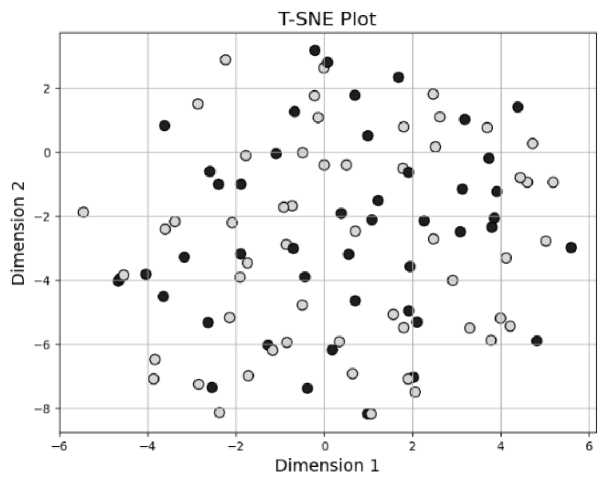
Fig. 9. T-SNE Visualization for Clustering in Fake News Detection
The performance of the proposed fake news detection model using BERT can be further estimated with the help of a T-distributed stochastic neighbor embedding (T-SNE) plot as shown in Fig. 9. It is shown in Fig. 8 that the spread of news articles in a 2D space, with each point representing an article and the colors representing the clusters. The T-SNE is effective in reducing the dimensionality of complex data. Although maintaining local and global structures, making it a valuable tool for detecting fake news. Notably, the clusters of tightly clustered points may specify articles with similar content, possibly pointing to corresponding misinformation campaigns. On the other hand, the distributed points wide across the plot might resemble genuine news articles with more varied content. Therefore, this representation helps to pinpoint the potential fake news clusters and revealing patterns in news content. This is crucial to develop a robust fake news detection model.
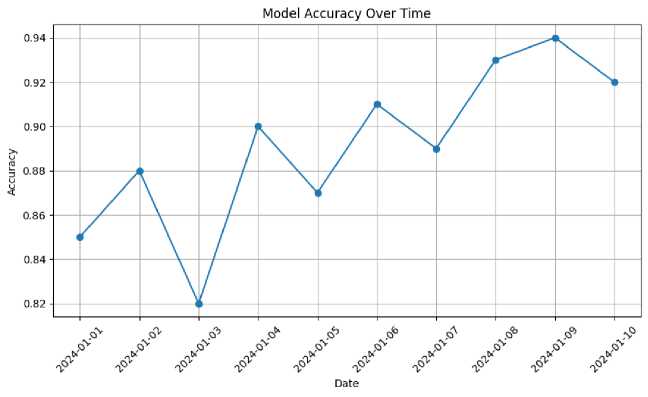
Fig. 10. Trends in Fake News Detection Model Accuracy Over Time
Fig. 10. represents the accuracy of the proposed fake news detection model using BERT over a period from January 1 to January 10, 2024, during testing. The performance of the fake news detection model as depicted in Fig. 9shows the variation in the accuracy from 0.86 on January 1, dropping to approximately 0.83 on January 3, and then gradually increasing over the following days. The accuracy peaks at around 0.94 by January 9, representing significant improvements in the performance of the proposed model to identify whether the news is fake or real. The improvement in the accuracy as shown in Fig. 6 shows that the proposed fake news detection model works well for various conditions. The steady upward trajectory after January 3 highlights the effectiveness of the changes made to the model, resulting in improved accuracy and robustness in distinctive fake and real news content.
The proposed detection model for fake news using BERT validates robust performance across various conditions. The accuracy of the proposed model significantly improves from 75% to over 95% during training, with testing accuracy rising from 70% to above 90%, indicating its effectiveness in distinguishing fake and real news. The confusion matrix shows a balanced performance with minor misclassifications. Although the ROC shows an impressive AUC of 0.94, underscoring the performance of the model has high sensitivity and specificity. Then PCA and T-SNE visualizations further enhance our understanding by clearly differentiating fake and real news through dimensionality reduction, revealing patterns, and clusters that are crucial for detecting misinformation. At last, the accuracy of the proposed model is tested from January 1 to January 10, 2024, highlighting its adaptability and continuous improvement, affirming its reliability and robustness in real-world applications.
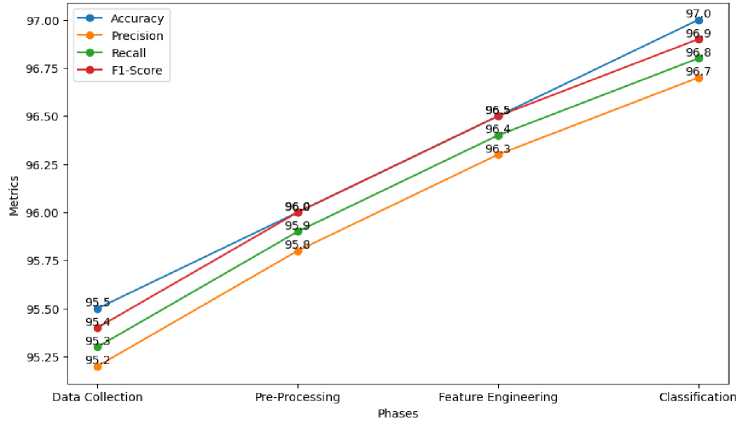
Fig. 11. Model performance for various phases
Table 1 Performance contribution of different processing stages
|
Phase |
Accuracy (%) |
Precision (%) |
Recall (%) |
F1-score (%) |
|
Data-Collection |
95.5 |
95.2 |
95.3 |
95.4 |
|
Pre-Processing |
96.0 |
95.8 |
95.9 |
96.0 |
|
Feature engineering |
96.5 |
96.3 |
96.4 |
96.5 |
|
Classification |
97.0 |
96.7 |
96.8 |
96.9 |
Fig. 11. and Table 1 provide a numerical overview of the model's performance across various phases of fake news detection. In the Data Collection phase, the model achieves an accuracy of 95.5%, with corresponding precision, recall, and F1-score values at 95.2%, 95.3%, and 95.4%, respectively. Starting from the Pre-Processing stage where minor improvements were noted, the accuracy rose to 96.0%, with precision, recall, and F1-score marking values of 95.8%, 95.9%, and 96.0%, respectively. In the Feature Engineering stage, it produced better results with an accuracy of 96.5% against values of precision, recall, and F1-score of 96.3%, 96.4%, and 96.5%, respectively. Finally, in the Classification phase, the model attained its highest performance, showing accuracy of 97.0%, while still being impressive concerning precision, recall, and F1-score at 96.7%, 96.8%, and 96.9%, respectively. These results affirm the gradual improvement and efficacy of the model in refining the detection assistance.
Table 2 Comparison of Fake News Detection Models
|
Metric |
Logistic Regression |
SVM with TF-IDF |
Random Forest |
LSTM-based Model |
Proposed Model (BERT with Interpretability) |
|
AUC-ROC |
0.84 |
0.88 |
0.91 |
0.94 |
0.94 |
|
Calibration |
Poor |
Moderate |
Good |
Good |
Excellent (well-calibrated probabilities) |
|
Log Loss |
0.62 (high) |
0.45(moderate) |
0.45(moderate) |
0.26 (low) |
0.18 (low) |
|
MCC (Matthews Correlation Coefficient) |
0.68 |
0.75 |
0.81 |
0.88 |
0.92 (high Correlation) |
5. Conclusion
The fake news detection system proposed herein detects and counteracts misinformation, thus upholding public trust and integrity over media source credibility. It starts with gathering information from credible sources on the internet, then pre-processing data using BERT, which tokenizes the data and generates contextual embeddings. The dataset is augmented through feature engineering via TF-IDF and Word2Vec, supplying these to the classifier, which applies the SoftMax function. The model has shown tremendous results on different metrics, training accuracy being increased from 75% to more than 95%, whereas testing accuracy underwent an increment from 70% to more than 90%. While the proposed framework demonstrates strong performance, several limitations should be acknowledged. The evaluation was carried out on benchmark datasets, which may not fully capture the evolving nature of misinformation found in real-world settings. Additionally, the framework focuses mainly on textual data and does not incorporate multimodal information, such as images, videos, or social network interactions, all of which can play an important role in the spread of fake news. Future work will aim to address these limitations by expanding the framework to support multilingual fake news detection and by integrating explainable artificial intelligence (XAI) techniques to improve transparency and model interpretability. Further research will also explore the incorporation of multimodal data from both textual and visual sources, enabling more robust and reliable fake news detection in real-world environments.
All the Declarations and StatementsAuthor Contributions Statement
SGK- Conceptualization, Methodology, J.BT- Data preparation, , M.SS- writing-original draft, M.MM- Experiment BB- Review and Editing.,L.SM- Critical review, editing, and supervision
All authors have read and agreed to the published version of the manuscript.
Conflict of Interest Statement
The authors declares that they have no conflict of interest
Funding Declaration
No funding was received to assist with the preparation of this manuscript.
Data Availability Statement
This study analyzed publicly available datasets
Ethical Declarations
This study does not involve human subjects nor animal
Acknowledgments
We genuinely appreciate the experts’ assessment and insightful suggestions, which have enhanced the experiment correctness and the accuracy of its findings.
Declaration of Generative AI in Scholarly Writing
Language polishing and grammar were done with the help of AI. There was no use of a generative AI to create content, generate ideas, analyse data, generate figures, or write scientifically.
Abbreviations
This manuscript uses the following abbreviations:
BERT- Bidirectional Encoder Representations from Transformer
TF-IDF- Term Frequency-Inverse Document Frequency
Word2Vec- Word to Vector
NLP- Natural Language Processing
CLS- Classification
SEP- Separator
FFF- Final Fused Feature
LIAR Dataset- Benchmark Dataset for Fake News Detection
ROC- Receiver Operating Characteristic
AUC-Area Under the Curve
TPR- True Positive Rate
FPR- False Positive Rate
PCA- Principal Component Analysis
T-SNE- T-distributed Stochastic Neighbour Embedding
SVM- Support Vector Machine
Appendix A\B\C…, with appendix tile
None.
