
An Old Mongolian Inscription near the Second (Small) Sulfate Lake in Northern Khakassia as Evidence of Cultural Contacts in the Region in the Middle Ages and Early Modern Age
Journal: Archaeology, Ethnology & Anthropology of Eurasia @journal-aeae-en
Section: The metal ages and medieval period
Article in issue: 4 т.52, 2024.
Free access
We describe a rare Old Mongolian inscription carved on an outcrop of Devonian sandstone near the Second (Small) Sulfate Lake in northern Khakassia. Tentative translation, dating, and cultural attribution are provided. The condition of the inscription and adjacent representations of humans, animals, and tamgas are described. Three groups of signs of which the Old Mongolian inscription consists are identified. Variants of translation to modern Mongolian and Russian are proposed. One group of signs renders the text: “In the Year of the Snake, the second winter month, the 21st day…” Other graphemes, translated from Mongolian, mean: master, elapsed, horseman, give, herd, steppe (talo). Certain words are indistinct and illegible. The lower and upper chronological limits of the inscription are 1204 to early 1720s. Horsemen figures are carved in the same technique. Old Buryat parallels suggest a rather recent date. Pre-Mongolian tamgas are pecked rather than carved. The script belongs to the latest instances of Old Mongolian epigraphy in the region.
Similar articles in the section Mathematical and applied linguistics. Phonetics. Graphemics. Grammar. Semantics. Stylistics
Short address: https://sciup.org/145147477
IDS: 145147477 | DOI: 10.17746/1563-0110.2024.52.4.125-130
Text of the scientific article An Old Mongolian Inscription near the Second (Small) Sulfate Lake in Northern Khakassia as Evidence of Cultural Contacts in the Region in the Middle Ages and Early Modern Age
The written history of Southern Siberia in the Early and High Middle Ages is represented by numerous runic texts on rocks, burial mound slabs, steles, etc., and that of the Late Middle Ages–Early Modern Age by a very small number of epigraphic records on rock, in the Mongolian script. In the south of the Middle Yenisei, despite the recurrent inclusion of this region into various
Mongolian states—those of Genghis Khan, Altyn Khan, Esen Khan, Dzungaria, and the Buryat princes—only few sites are known: the fragmentarily preserved Abakan Mongolian petroglyphs (written in black paint), dated by N.I. Popov to the 16th–17th centuries, as well as lines in Mongolian script at the Shalabolino (in red paint) and Tes (in black paint) rock art sites (Popov, 1874). Information on these inscriptions, provided by Popov, was cited by E.R. Rygdylon (1951). The inscriptions of the Shalabolino
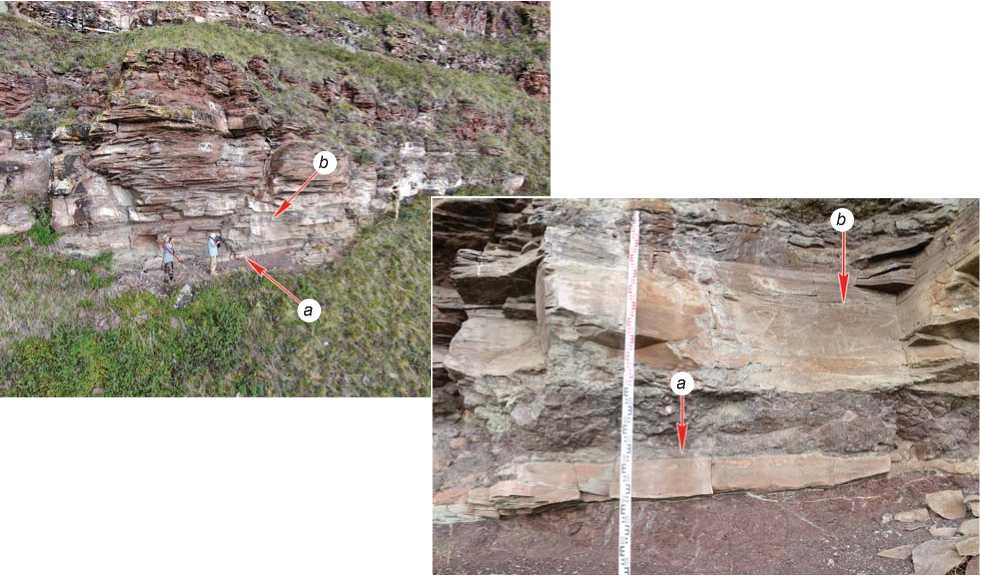
Fig. 1 . General view of location of the inscription and images at the break in the rock outcrop at the Second (Small) Sulfate Lake. a – lower frieze; b – upper frieze.
b
b
а
®v Ж а
ЯИМНияИш rock art site have already been examined by D.D. Vasiliev. Interestingly, this site contains several Chinese characters, in addition to the Mongolian text.
Generally, Mongolian inscriptions occur very rarely on rock surfaces in Southern Siberia and
Mongolia, and those made by pecking or stonecarving technique have been unknown until now.
This fact hampers the analysis of intercultural contacts during the emergence and development of societies in Southern Siberia in the Middle Ages and the Modern Age. Therefore, every newly discovered site of that kind is important. This article provides information about a site with a presumably Old Mongolian inscription carved on a rock outcrop in northern Khakassia. This study intends to describe the spatial context of the inscription, evaluate its condition, read it, give a historical and cultural interpretation, provide details on the accompanying images of people and animals, and establish the chronology of written and imagery records at that rare monument of regional history.
Spatial context of the inscription
The authors of this article examined the surface of a massive outcrop of Devonian sandstone of typical reddish color, located on the steep eastern slope (or rather, on a precipice) of the mountain range, stretching to the north, from the southern end of Mount Sulek to northern shore of Lake Uchum, near the Second (Small) Sulfate Lake. At the suggestion of N.V. Leontiev, they also examined a rock inscription (a text presumably made in the Old Mongolian script) and petroglyphs of various periods.
The site is located 800 m from the southwestern edge of the shore of the Second Sulfate Lake in the Ordzhonikidzevsky District of the Republic of Khakassia,
Fig. 2 . Location of the images and inscription. a – lower frieze; b – upper frieze.
in the places of residence of the modern Kyzyl people. One may reach the site by moving from Mount Sulek down the country road along the edge of the field that is bordered on the right by the First Sulfate and Second Sulfate lakes and on the left by a mountain range. At a quick glance from below, the surface of the rock outcrop at the Second Sulfate Lake seems so badly destroyed that there cannot be any petroglyphs on it. However, upon closer examination, small vertical panels (friezes) of different sizes can be found there. Two of the panels contain an inscription and other petroglyphs (Fig. 1). In front of this panel, there is a platform about 1.8 m wide, convenient for working with rock representations. At a height of about 3 m above the platform, there is a small rock overhang, under which, two east-facing panels with several rock compositions are located (Fig. 2).
State of the inscription
The text and some other images are located at a height of about 0.3 m above the said platform, on the lower vertical surface of a layer of Devonian sandstone with a noticeable sun (desert) patina. The frieze, with a total length of about 2.2 m and a width reaching 0.24 m, consists of five sections divided by vertical cracks (Fig. 3). Its surface texture is not the same in the different sections. It is rather coarse and harder in the left part, and soft and smooth in the right part. Layers of crumbled Devonian sandstone, unsuitable for creating petroglyphs, are below and above that layer.
The text consists of characters that form at least 14 vertically arranged rows, up to 18 cm high. In the Old Mongolian script, lines are written from top to bottom, then from left to right. The placement of characters in the inscription corresponds to this type of script. The characters, like the other images present, are made with carved lines using the technique of fine engraving and scratching. The width and depth of their lines are on average slightly more than 1 mm. Some lines are black, since they were covered with a coloring substance (paint) on the inside, while other lines remain in their original light form. The state of preservation of the characters in the inscription varies, depending on the depth and thickness of the lines. Considering the morphology of the frieze and features of its execution, the characters of the inscription can be divided into three groups (parts).
Group 1 consists of four quite clearly visible rows of characters, separated from the rest of the inscription by a vertical crack (Fig. 4). This group is located in the right part of panel 3, third from the left. Group 2 consists of several vertical rows of characters made with very thin and shallow, and therefore poorly visible, lines. Two rows are somewhat more legible than the others (Fig. 5, a). This group is located to the right of group 1, in the left part of panel 4. Group 3 consists of the rightmost seven rows of characters, clearly forming a separate group, since they are located a few centimeters away from the right part of group 2 and are carved with slightly deeper and wider lines (Fig. 5, b).
Parts of the inscription demonstrate different states of preservation. The left part, consisting of four vertical rows of characters, looks as if it was freshly made, almost without desert patina. The central and upper half of the right part of the inscription are very dark and barely legible; only in the lower zone of this part do the characters look as fresh as in the left zone. The two rightmost rows of characters in the right part of the inscription are shorter than the other five rows. In some areas of the surface, the characters of the inscription are hardly distinguishable from weak grooves of natural origin.
State of human and animal representations and tamgas
On the lower frieze, along with the inscription, there are images of riders (two of which have disproportionately
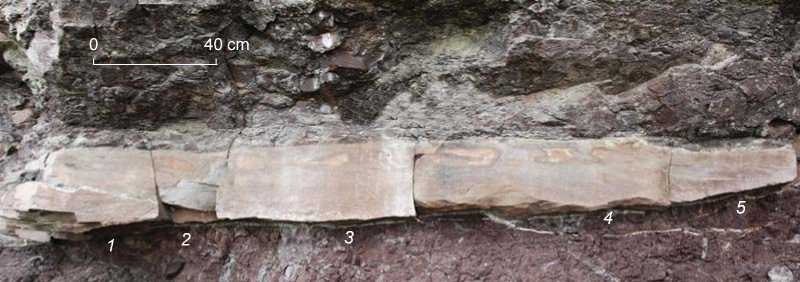
Fig. 3 . Panels of the lower frieze.
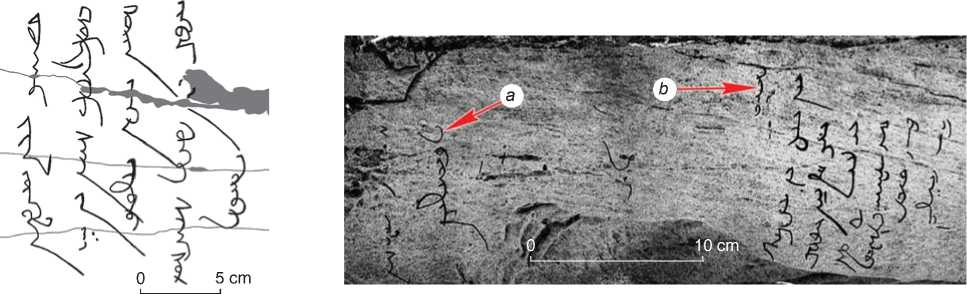
Fig. 5 . Trace-drawing of individual lines of the inscription to the right from the characters of group 1 on the left side of panel 4 ( a ) and seven rightmost lines of the inscription ( b ).
Fig. 4 . Trace-drawing of the leftmost four lines of the inscription on the right side of the third panel from the left.
large round heads), horses, and a camel. The figures were made with carving technique by thin, shallow lines. The composition of a man with a camel was probably not carved, but lightly scratched with a sharp item.
The largest number of images of people and animals are present on panel 3, to the left of the inscription (Fig. 6). A rider, mounted on a horse in a regular position, probably with a quiver shown near his waist, and presumably wearing a helmet on his head, is depicted in the upper part of the composition. The horse, with an unnaturally elongated body and protruding ears, has a loose tail (Fig. 6, 1 ). A figure of another rider, wearing a headdress resembling an inverted mushroom-cap, is slightly lower. The ears of this horse, with a loose tail, are emphasized (Fig. 6, 2 ). A head and part of human body are depicted below the horse of the upper rider (Fig. 6, 3 ). The image of a third horse, with a disproportionately long body, emphasized ears, and a saddle, is shown below this (Fig. 6, 4 ). In the right part of the composition, also below, a fourth horse, with a loose tail and emphasized ears is depicted (Fig. 6, 5 ).
A composition of a rider wearing a helmet, with a bow at his belt, leading what seems to be a camel with two disproportionately small (but clearly marked) humps by the reins, is shown on panel 1 (Fig. 7). A figure of a double circle is depicted with thin carved lines; it is not
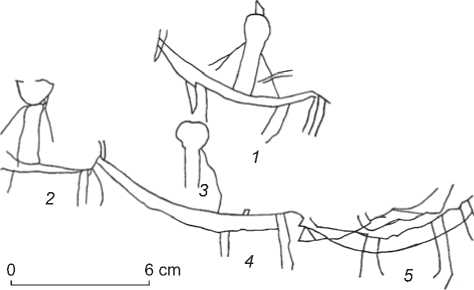
Fig. 6 . Trace-drawings of images of people and horses on the lower frieze.
1 – rider wearing a helmet, with a quiver; 2 – rider wearing a headdress in the form of inverted mushroom cap; 3 – human head and part of body; 4 – image of a horse; 5 – shapeless and illegible composition.
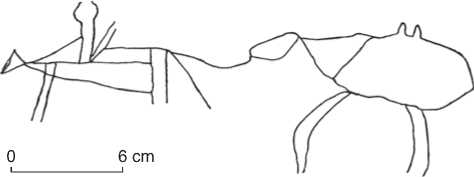
Fig. 7 . Trace-drawing of a separate image of rider leading a two-humped camel by the reins.
yet possible to interpret this. Thin carved lines are above the characters of group 2 of the inscription. These are probably close in time to these figurative images, although they do not form a unified composition with them.
Images of people and animals almost do not overlap the inscription; they possibly illustrate its content. Only the lines of the heads of three people and body of one of the horses were emphasized with black paint.
The images on the lower frieze demonstrate intersections of straight (or close to straight) lines at right angles, which points to a geometric style, widely known from the petroglyphs of the Baikal region (Melnikova, Nikolaev, 2006: 276–277, fig. 9, 10). Thus, a similar pictorial style is now also known from Khakassia.
On the upper frieze, three signs are pecked, which might have been tamgas—two in the form of the number 8 (or an hourglass, but with pointed corners) and one of a circle with a small vertical tongue inside. An unidentifiable image is below the tamgas. These drawings seem to be ancient. However, the leftmost tamga looks lighter and fresher, and its lines are shallow. Such tamgas have no parallels among those discovered in the region and related to the Middle Ages and Modern Age (Kyzlasov, Leontiev, 1980: 22, 27), but are known from the Altai Mountains (Yamaeva, 1999). No paint was used to create the petroglyphs on the upper frieze of the site.
Reading and interpretation of the inscription
D.D. Vasiliev, the Head of the History Department at the Institute of Oriental Studies of the Russian Academy of Sciences, proposed two variants of a translation of the inscription from Old Mongolian into modern Mongolian for this article. The first variant for the initial part of the inscription (group 1) is as follows: Mogoy zhiliyn ovliyn dund sarin khorin negniy odor … The second variant is: Ezhinu zhili ungurle moritonu saryn khorin negniy edur . Both variants have an identical meaning: In the year of the Snake (in another variant, in the year of the Dog ), the second winter month, the 21st day … The remaining graphemes can only hypothetically refer to individual words, which in translation from Mongolian mean: master , elapsed , rider , give , herd , steppe ( talo ). Some words cannot be read because of the poor legibility of their characters. The author’s name cannot be discerned either. The work on clarifying the text is complicated by the fact that in the Mongolian script, including the Oirat todo bicig (‘clear writing’), many graphemes have three variants, depending on their position in the word (initial, middle, or final).
The first part of the inscription* can be read quickly, and is definitely Old Mongolian. Reading the second and third parts caused difficulties in determining the language. Some words could be identified, but they were most likely written in the Uyghur-Mongolian script. A specific feature of the inscription was using the verb stem biti (‘write’), common in the Early Medieval Turkic written records, and the derivative noun bitig (‘writing’): “inscription” in the phonetic form bici-, bicig - (Tugusheva, Klyashtorny, Kubarev, 2014: 81). The word bitidim could be clearly read in the middle part of the inscription under study, which indicated that the text could have been Turkic, but written in a different script. Something similar has been found in the Mongolian inscriptions on the rocks of the Altai Mountains, where a Turkic (Altaian) text was written on a stele in the Mongolian script. It was possible to identify individual Turkic words and lexical blocks therein (Vasiliev, Kara, 2001; Tugusheva, Klyashtorny, Kubarev, 2014). Since the graphical representation somewhat changes the appearance of the word and does not convey some letters that do not correspond to Mongolian orthography, it is necessary to look for similarly sounding foreign words, primarily in the Turkic linguistic environment. Despite the lack of full translation of all parts of the inscription, the available evidence is sufficient to conclude that we are dealing, not with the Oirat todo bicig (‘clear script’), but with some other, yet definitely Old Mongolian, script.
Chronology of the inscription and the images
The relative chronology of the inscription and other images can be established from their mutual arrangement on rock surfaces, differences in their execution technique, and their degree of preservation. Judging by their execution technique, the pecked images of tamgas and the unidentifiable figure on the upper frieze could have been the earliest. Much later, the inscriptions were carved on the lower frieze (possibly, three separate texts; they were created in several stages, but with a short break). The carved figures of riders and animals were the last to be made on free spaces of the panels in the lower frieze; in terms of time, these could have been close to the inscription. The images of riders, horses, and camel do not overlap the inscription, but rather complement and illustrate its content. The same degree of “aging” of lines in the inscription and images, as well as the technique of executing the images, suggest that the characters of the inscription and the carved figures were made at the same time.
The inscription could have been made at any period of use of the Uyghur-Mongolian script, beginning with the reign of Genghis Khan. At that time, the Uyghurs, who voluntarily submitted to him, passed the Old Uyghur script to the Mongols. After significant modification, it became the Old Mongolian script. The Mongols often call it “Uyghur” (Mongolian uyghurzhin bichig) to distinguish it from other Mongolian scripts, and they still use it today (Kara, 1972). The lower boundary of the period when the inscription was made can be determined with an accuracy of several years. According to a legend, the Uyghur-Mongolian script was created by the order of Genghis Khan no earlier than 1204 by the Uyghur scribe Tatatunga (Kychanov, 1995: 139–140). The upper boundary can be considered the beginning of the 1720s, when the presence of the author of the inscription in the Khakass-Minusinsk Basin, after the establishment of the permanent Russian-Qing border, was unlikely. The scribe could have been either a subject of any of the Mongolian states that subjugated the population of the basin from the 13th to the early 18th century, or an indigenous resident who used this script. As is known, at that time, there were people who “knew how to write and read in Mughal” even among the simple “ulus men” (Istoriya Khakasii…, 1993: 166–167).
The assumption on the creation of the images of riders, horses, and a camel on the inscription near the Second Sulfate Lake in the Late Middle Ages or in the Early Modern Age is confirmed by the Buryat (ethnographic) images of the 16th–19th centuries, known from the Baikal region and similar in technique, manner of execution, and subject (Nikolaev, Melnikova, 2002; Melnikova, Nikolaev, 2006). Importantly, the latter are distinguished by sub-rectangular outlines. This rare feature in the rock art was also recorded in the petroglyphs near the Second Sulfate Lake. A.P. Okladnikov considered petroglyphs made with thin engraved lines, graffiti, to be a special variety of late drawings in the Baikal region (1959: 161). At the site under discussion, these include the images of rider with the led camel. Also, note that a Uighur inscription made exclusively in black paint (without carving or scratching) was discovered in the Urkosh area in the Chuya River valley, in the Altai Mountains. The lines of the characters of that inscription are somewhat wider than those in the inscription at the site under discussion in northern Khakassia (Tugusheva, Klyashtorny, Kubarev, 2014: 79), but stylistically both of them are a part of the same phenomenon in the written history of Southern Siberia.
Conclusions
The presence of Mongolian inscriptions in the nonMongol territory may have a number of explanations— from the capture of a Mongolian ruler by the troops (which happened more than once) to the penetration of settlers from Tuva and Mongolia, who brought this script into northern Khakassia (for example, the Beltyr ethnic group of the Khakass people was based on direct descendants of marriages between the local population and migrants from the south). In addition, the Old Mongolian script was used as the main means of interethnic and interstate communication in Southern Siberia, from the Late Middle Ages to the Early Modern Age. It was replaced in this capacity by the Russian language. Noteworthy are the figures of horses and riders, made in a distinctive rectangular pictorial style. Full translation of the text and individual words of the inscription should be the focus of further research aimed at identifying the facts of ethnic and cultural contacts at that time between different groups of population in the region.
Generally, all parts of the inscription and accompanying images of people and animals, made with thin carved lines on the lower frieze at the Second Sulfate Lake, are one of the latest works of epigraphic and fine art known in the region. In terms of their form and execution technique (pecking), tamgas at that lake might have belonged to an earlier time than the written evidence of this site, that is, to the pre-Mongol period.
Acknowledgments
This study was carried out under the state assignment of the Ministry of Science and Higher Education of the Russian Federation (Project No. FSUS-2025-0009 “Aspects of Formation of Intercultural Communications in Siberia— from the Stone Age to the Early Modern Age (According to Archaeological and Written Sources)”).
