
Artificial Intelligence, Social Change, and Sociology Education: Toward Digital Sociology in The Age of Deglobalization
Journal: International Journal of Cognitive Research in Science, Engineering and Education @ijcrsee
Section: Articles
Article in issue: 1 vol.14, 2026.
Free access
This paper investigates the transformative impact of artificial intelligence (AI) and deglobalization processes on contemporary society, with a particular focus on redefining the discipline of sociology and educational paradigms. Through a critical analysis of opposing currents of digital integration and geopolitical fragmentation, and by synthesizing insights from the sociology of technology, education, and digital transformation theory, the study offers a conceptual framework for digital sociology as a new theoretical and methodological domain that examines how algorithms, platforms, and intelligent systems shape social relations. Three key aspects are analyzed: (1) the role of AI in reconfiguring social structures, (2) the consequences of deglobalization on the development of digital technologies, and (3) the necessity of reforming sociology education to prepare future researchers for a critical understanding of these processes. The study adopts an interdisciplinary approach, combining theoretical analysis with case studies. Its primary contribution lies in elaborating strategies for adapting sociological education to the conditions of digital transformation, fostering ethical reasoning, and promoting social responsibility.
Similar articles in the section Organization of instruction
Short address: https://sciup.org/170212429
IDS: 170212429 | UDC: 37.091.39:004.8 | DOI: 10.23947/2334-8496-2026-14-1-049-063
Text of the scientific article Artificial Intelligence, Social Change, and Sociology Education: Toward Digital Sociology in The Age of Deglobalization
Contemporary society stands on the threshold of profound transformations that are reshaping everyday life, social relations, and educational paradigms. We are witnessing an era in which artificial intelligence (AI) and transhumanist technologies are no longer confined to the realm of science fiction, but are increasingly embedded in our daily lives—altering the ways we work, communicate, make decisions, and engage with culture, media, and education ( Selwyn, 2019 ; Slavković et al., 2023; Petrović, 2019 ; Ristić and Marinković, 2019 ; Shi et al., 2020 ; Šuvaković, 2024 ; Zdravković, et. al., 2025 )—and even influencing our understanding of what it means to be human ( Masliković, 2025 ). The magnitude of this impact is anticipated in the prediction of computer scientist Mark Weiser (1991, pp. 94–105) , who foresaw humanity entering an era of ubiquitous computing, in which digital technology would become so interwoven with human life that its pervasive presence would largely go unnoticed.
On the other hand, deglobalization processes lead to geopolitical fragmentation and uneven development of digital technologies, further complicating this concept ( Friedman, 2021 ).
In this context, sociology faces the challenge of integrating new technologies into its theoretical and methodological frameworks. Changes in the ways we consume media and create content, accelerated by the emergence of Web 2.0, have led to the development of computational social sciences —an interdisciplinary field combining sociology, psychology, political science, economics, and computational methods to study social phenomena. AI intersects with this discipline, offering new opportunities for analyzing social networks, predictive modeling, and simulating interactions within digital communities. This synergy enables a deeper understanding of how digital systems shape social communication, group integration, and
-
*Corresponding author: biljanaprodovic@gmail.com

-
© 2026 by the authors. This article is an open access article distributed under the terms and conditions of the Creative Commons Attribution (CC BY) license ( https://creativecommons.org/licenses/by/4.0/ ).
the dissemination of information, thereby opening avenues for applying digital sociology in teaching and researching social change in the era of deglobalization.
Digital sociology , as an emerging branch of sociology, focuses on analyzing the impact of digital technologies on social processes, identities, and institutions ( Van Dijck, 2020 ; Castells, 2010 ). This discipline investigates how algorithms, platforms, and intelligent systems shape social relations and how societies adapt to new digital realities ( Zhao and Wang, 2023 ; Selwyn, 2019a ; Skopek, 2023 ). Jonathan Wynn shares his experiences with the use of digital technology in sociological research and teaching, sharply noting that digital technology has introduced new challenges that sociology must examine and explore in greater depth ( Wynn, 2009, pp. 448–456 ). Digital sociology has developed in response to the growing influence of digital technologies on social processes ( Boyd, 2014 ), recognizing, as many theorists argue, that technology is not neutral; rather, it shapes social relations, power structures, and educational practices ( Wajcman, 2017 ; Floridi, 2019 ; Skopek, 2023 ).
One of the key aspects of this transformation is education. The teaching of sociology, as well as other social sciences, must adapt to the new challenges posed by digitalization. This involves not only the integration of new technologies into the educational process but also the development of critical thinking that enables students to understand and analyze the impact of AI and digital technologies on society ( Floridi, 2019 ).
In this context, the aim of this paper is to investigate how AI and deglobalization affect social communication, group integration, and social inequalities, with a particular focus on sociology education. Through a critical analysis of existing theoretical frameworks and case studies, the study provides a conceptual framework for digital sociology as a new theoretical and methodological approach to examining social change in the digital age. This is done with an attempt to map the rapidly evolving landscape of our digital and posthuman future ( Serpa et al., 2025 ). The study employs an interdisciplinary theoretical framework, combining approaches from the sociology of technology, education, and digital transformation. Methodological support is based on content analysis of the literature and case studies . Since the study is theoretical and analytical in nature, quantitative methods are not applied; instead, a critical synthesis of existing research and conceptual frameworks is conducted. The focus is on three key dimensions:
-
1. Social communication – aimed at exploring how digital technologies and AI shape interactions, discourse, and access to information ( Van Dijck, 2020 ).
-
2. Group integration – analyzing the formation of shared identities and collective networks in digital environments, with attention to potential segregation ( Boyd, 2014 ).
-
3. Social inequalities – encompassing approaches to technology, digital literacy, and the reproduction of social inequalities through algorithmic processes and digital platforms ( UNESCO, 2021 ; OECD, 2022 ).
This combination of theoretical framework and methodological approach enables an understanding of how digital technologies and AI are transforming contemporary society and the educational context, particularly sociology education. Applied in this way, the interdisciplinary approach ensures the integration of critical theory, empirical studies, and practical implications for educational programs.
The Role of Artificial Intelligence in Transforming Social Structures – Toward the Transhumanization of Society
As society approaches the threshold of transhuman development, AI becomes a key factor in transforming social structures, raising new challenges and questions ( Orton-Johnson and Prior, 2013 ; Lupton, 2015 ; Marres, 2017 ; Selwyn, 2019a ; Fussey and Roth, 2020 ). Scholars base their discussion on the fundamental question of societal transhumanization: are we developing artificial intelligence for the benefit of humanity, or are we merely shaping humanity through the evolution of intelligent technology? Today, we are not merely discussing advanced tools but the possibility of a symbiotic relationship between humans and machines—a concept at the heart of Society 5.0, often described as a “technology-driven, human-centered” society ( Masliković, 2025, p. 42 ). At the core of these changes lies a fundamental question: what does it mean to be human in an era when the boundaries between humans and machines are increasingly blurred? The social implications of AI and transhumanism extend beyond technical feasibility, as they touch upon the very essence of democratic values, cultural continuity, and human dignity.
The emergence and development of digital technology represent pivotal moments in the history of human civilization, as their scope and dynamics have exerted a profound impact on all dimensions of social life. The rapid advancement of these technologies has marked the onset of a new era—the digital society—in which not only communication patterns and everyday life are transformed, but deep, systemic changes in social structures are also set in motion. Digital technology, and AI in particular, no longer serves merely as a tool for improving social practices; it has become a key agent in reshaping them. As Helbing (2021) emphasizes, digitalization and intelligent systems will not only shape human discourse and institutional frameworks but will gradually transform the very foundations of the world, paving the way toward a new social and ontological horizon of a transhumanist nature. AI redefines social and economic roles through automation, information personalization, and algorithmic management of interactions. According to Bostrom (2014), algorithmic systems have the potential to transform social structures by influencing access to resources, education, and employment. Algorithms filter the information individuals receive, shape public discourse, and often reproduce existing social inequalities (Van Dijck, 2020), as will be discussed below. As Zeqi Qiu (2022) notes, the digital society, through its networking mechanisms, penetrates traditional divisions of labor and classical forms of organizational structures, positioning the individual as a central node within the digital network (Kovačević, 2024). This creates a new social model in which the individual is simultaneously an independent unit and part of a broader, interconnected whole (Nesterova et al., 2019, pp. 19–27). Such transformation not only changes the position of the individual within society but also leads to a redefinition of the relationship between the individual and the collective, reshaping the logic of social differentiation and reconsidering the fundamental principles underlying social functioning. As digital platforms and AI algorithms shape contemporary social structures, they influence behavior, identities, and perceptions of the world, altering social interactions and information flows. At the same time, the digital divide demonstrates how access to technology and the monetization of personal data can deepen social inequalities and reshape traditional power relations.
Online communities represent new “public squares” of the internet, ranging from niche forums to large fandoms, where social ties as well as rivalries are formed and reinforced. These communities demonstrate how digital spaces enable the construction of identities, collective practices, and new forms of group dynamics, providing sociology with valuable insights into contemporary social structures. Such digital spaces also offer support networks, allowing individuals to share feelings and experiences that they would rarely discuss in real life, offering comfort and solidarity in challenging situations, thereby creating new forms of social connections and communities. These spaces transform traditional social structures by expanding access to support and altering the ways in which groups and individuals organize and connect with one another. Online activist hubs challenge the status quo, reshaping forms of participation and power relations, but they also highlight the risk of performative activism. At the same time, the digital divide and algorithmic shaping of information exacerbate inequalities and introduce new challenges to social structures. Collectively, these phenomena illustrate how digital society changes the ways communities are built, power relations are reinforced, and social life is organized. They impact online identities, which can reflect or shape our “true selves,” creating new forms of social ties and interactions. Within these digital spaces, authentic communities can emerge on one hand, while on the other, performative avatars may dominate, fundamentally altering traditional social structures and the ways people connect.
As we have seen, digital platforms and algorithms strongly influence the shaping of social relationships, creating new opportunities for connection and participation, but also new forms of inequality, echo chambers, and risks to privacy and mental health ( Bjelajac et al., 2023, pp. 519–531 ). A central task that emerges is to study how people can govern digital spaces rather than be governed by them. Research indicates that the internet has shortened the average human attention span from 12 to just 8 seconds, reflecting the growing distraction of contemporary individuals. As communication increasingly occurs behind screens, fundamental interpersonal skills—such as reading body language, facial expressions, and vocal tone—are less frequently developed. Digital sociology, through such examples, demonstrates how technology reshapes social structures, influencing not only our relationships but also the very ways we understand one another.
Thus, the challenge of the contemporary era is not only to learn to live with technology, but also to preserve the capacity for focused, critical thinking despite it. This indicates that digital sociology must examine how social structures are transformed in online environments and how individuals and groups position themselves in relation to the complex and often contradictory effects of digital communication. Consequently, there is a need to develop critical competencies among sociology educators and students for understanding digital power structures, inequalities, and new forms of social engagement (Prodović Milojković, 2012, pp. 187–196; Nesterova et al., 2019).
The Consequences of Deglobalisation for the Development of Digital Technologies
The study of social relations and interactions has long been at the core of sociology; however, the widespread integration of digital technologies is radically transforming their very nature ( Skopek, 2023 ). Considering that existing definitions of AI may be grouped according to thinking and behaviour processes, as well as success criteria ( Prlja et al., 2021, p. 61 ), this becomes particularly relevant when analysing the consequences of deglobalisation for the development of digital technologies and the transformation of human interaction.
Instead of exclusively direct, face-to-face communication, new forms of mediated interactions are emerging that blur the boundaries between presence and absence, creating so-called “connected relationships” ( Licoppe, 2004, pp. 135–156 ). While some authors emphasize that digital media strengthen and expand social ties ( Wajcman, 2015 ), others point to the risk of superficiality and loneliness despite increased connectedness ( Turkle, 2011 ). The common denominator of these perspectives is the recognition that digital media not only shape modes of communication, but also transform the very nature of social relationships ( Baym, 2015 ). Digital platforms and AI enable new forms of social communication and group integration. Group integration in digital environments depends on access to technology, digital literacy, and the algorithmic rules of platforms ( Van Dijck, 2020 ). Through the formation of online communities, users can express their identities in more personalized ways and experience more variable senses of belonging, while simultaneously maintaining and reinforcing offline social networks ( Robards and Bennett, 2011, pp. 303–317 ). Boyd (2014) notes that networks facilitate the creation of shared identities, support, and collaboration within communities. At the same time, algorithmic filtering and recommendation systems may contribute to the emergence of “echo chamber” effects, in which users primarily interact with similar viewpoints, potentially leading to social polarization.
In the context of deglobalisation processes, digital technologies have become key mediators of social relations, as they increasingly shape closed, fragmented, and localised communities rather than globally integrated networks. Digital sociology suggests that mediated interactions enable new forms of connectedness and collective identity formation, yet simultaneously carry risks of superficiality and social isolation. Thus, the consequences of deglobalisation are reflected not only in the economic and political spheres, but also in the transformation of the very nature of social relations and communication, which is becoming increasingly dependent on digital media and their inherent limitations. Digital technologies also transform the boundaries between private and public life. Constant connectivity, the visibility of everyday activities, and behaviours such as clicking and sharing content lead to the “privatisation of the public and the public exposure of the private” ( Van Manen, 2010, pp. 1023–1032 ; Boccia Artieri et al., 2021, pp. 223–230 ). These changes, combined with multitasking and continuous psychological pressure ( Tamme- lin, 2018 ), are redefining the boundaries of personal identity and collective interaction in digital society.
In addition to social and spatial vulnerability, a new and more subtle form has emerged: cognitive vulnerability rooted in the lack of critical reflection. Excessive reliance on AI may reduce individuals’ capacity for critical thinking, anticipation, and ethical judgement, leading to alienation from social interactions, decreased motivation for learning, and increased exposure to harmful content, particularly among younger users. In the context of deglobalisation—where access to technology may be limited or uneven— it is insufficient to address only the social or spatial dimensions of vulnerability; it is also necessary to consider the cognitive and ethical implications of dependence on digital technologies. Building a resilient digital society requires technological progress to be guided by human values, the principle of equity, and a commitment to the common good. Deglobalisation processes are fragmenting technological ecosystems and producing regional disparities in access to digital resources ( Friedman, 2021 ), which directly affect access to information, international cooperation, and the reproduction of social inequalities. Countries with limited technological resources face a widening digital divide, while technologically advanced nations gain an advantage in global competition ( OECD, 2022 ). Deglobalisation also shapes cultural and social networks: the regionalisation of information and the use of localised algorithms may strengthen community identities, yet simultaneously restrict engagement with global discourse ( Castells, 2010 ).
Social media ( Milenkova et al., 2018 ), in addition to strengthening connectedness, also intensify polarization through the formation of “echo chambers” and extremist groups ( Bail, 2021 ), which demonstrates how digital sociology enables the analysis of social networks and identity dynamics within online communities. Digital technology makes it possible to shape collective identity and consciousness in the online space—from preserving cultural ties and memorial spaces to generating collective enthusiasm. It examines how these practices reshape social relations, strengthen the sense of belonging, and connect individuals with a wider social context in the digital age ( Ponzanesi, 2020: 977–993 ; Recuber, 2021: 684–699 ; Gong, 2015: 87–103 ; Lorenzana, 2018 ). It is important to highlight that digitalization has also transformed the nature of work by introducing flexible working hours and remote work, which contributes to a better work–life balance but also raises issues of surveillance, data security (including potential risks such as identity theft, cyber attacks, and data misuse) and social isolation. In the context of deglobalization discussed here, these changes further deepen the fragmentation of the labor market, reduce labor mobility, and reinforce local inequalities, thereby shaping new patterns of social and economic relations ( Demirci et al., 2023 ; Kovačević, 2024 ; Łukasz, et. al., 2019 ).
All these transformations in social relations and communication clearly demonstrate that the consequences of deglobalization have a crucial impact on the development of digital technologies. The fragmentation of networks, regional digital divides, and limited access to technologies shape not only technical ecosystems, but also social structures, identities, and collective consciousness. Through the analysis of these processes, digital sociology provides insight into how AI and digital media create new dynamics of power, connectivity, and vulnerability within society, making it an essential framework for understanding contemporary social change in the era of deglobalization.
Social Inequalities and Algorithmic Discrimination
Sociology’s attention to social inequalities has been present throughout its history, and digital sociology continues this tradition by examining the impact of digital technologies on the reproduction and transformation of social structures, including class, gender, and race ( Zhao and Wang, 2023 ). Particular emphasis is placed on whether digital technologies amplify existing inequalities or generate new forms of algorithmic discrimination.
The application of digital technologies not only reproduces existing social inequalities but also creates new forms of social differentiation ( Hagerty and Rubinov, 2019 ). Initially, the concept of the “first-level digital divide” based on differences in internet access, was introduced ( Castells, 2001 ). The information society has still not succeeded in bridging the gap in technological access or enabling full participation for all citizens. Most technological developments neglect underrepresented members of society, particularly vulnerable groups, thereby deepening existing social inequalities and the risk of algorithmic discrimination ( Wang, 2021 ). As infrastructure developed, the “second-level digital divide” emerged—based on differences in skills and technology usage—and the “third-level digital divide,” based on differences in social outcomes and benefits ( Hargittai, 2001 ; Van Dijk, 2005 ; Wei et al., 2011, pp. 170–187 ). This phenomenon is especially pronounced in areas with less developed infrastructure and among populations with lower socioeconomic status. These inequalities are further reproduced through algorithmic processes and digital technologies. UNESCO (2021) emphasizes that the digital divide is not merely a matter of internet access but also involves skills, resources, and cultural competencies. Algorithms often reflect existing social inequalities in education, employment, and economic power ( Noble, 2018 ). Recommendation systems on social media may favor dominant voices, while marginalized groups remain less visible, further reinforcing social stratification ( Wajcman, 2017 ).
According to van Dijk (Jan A. G. M. van Dijk), one of the earliest theorists of digital sociology, there is a clear distinction between access to digital resources, connectivity, developed competencies, and actual usage skills—revealing deeper layers of the digital divide ( Dijk, 2005 ; Dewey, 2021 ). Excessive use of digital media, particularly among young people, can negatively affect mental health and reduce face-to-face social interactions, thereby limiting the development of social skills. These effects further exacerbate existing social inequalities, as vulnerable groups are simultaneously more exposed to algorithmic discrimination and have less access to support resources1. Within these divides, new inequalities emerge: technol ogically educated users, such as software engineers and tech leaders, constitute a new
“programmer elite,” whose power depends on control over technology ( Burrell and Fourcade, 2021, pp. 213–237 ), while those without digital devices or skills suffer from digital poverty and social marginalization ( Donaghy, 2021, pp. 54–55 ). Even individuals with higher socioeconomic status can become vulnerable due to a lack of digital literacy, including the ability to recognize misinformation and protect privacy ( Lee, 2018, pp. 460–466 ). These processes clearly demonstrate that digital technology and AI are transforming social structures and necessitate that sociology education integrates a digital perspective and critical understanding of new forms of inequality.
Digital technologies, on the other hand, have the potential to facilitate resource sharing and expand access to information, for example through educational platforms such as MOOCs, which reduce costs and provide broader educational opportunities ( Bowen, 2013 ). However, as observed, internet access and usage are not evenly distributed: individuals with higher levels of education are more likely to use digital resources for activities that contribute to social advancement, while others remain on the digital periphery, exacerbating existing social inequalities ( Hargittai and Hinnant, 2008: 602–621 ; Hargittai, 2018 ). Furthermore, digital algorithms can subtly reproduce racial and gender inequalities. For instance, in the U.S. healthcare system, predictive models for medical needs favor white patients due to reliance on healthcare costs rather than the severity of illness (Obermeyer et al., 2019: 447–453). Similarly, advertising and employment algorithms exhibit gender biases: even when gender neutrality is maintained, men are more frequently targeted with STEM-related ads, while women are disadvantaged by the “saturation effect” and higher advertising costs ( Lambrecht and Tucker, 2019: 2966–2981 ; Joyce et al., 2021 )2. Although e-commerce provides economic benefits, certain aspects, such as location-based services, can deepen the digital divide and contribute to growing inequalities, reinforcing the argument that digital sociology must investigate how digital technologies not only create new opportunities but also exacerbate existing social disparities ( Kozić, 2023 ).
As a social aspect of overcoming digital inequality, it is necessary to raise awareness of the importance of acquiring skills—primarily operational, formal, informational, communicative, creative, and strategic—in the use of new technologies, and to encourage vulnerable groups, such as older adults, to engage with these technologies ( Lupton, 2012: 4 ). Indeed, some authors define digital inequality specifically as the gap in possession of these skills ( Dijk, 2014, p. 140 ).
Reducing digital inequality, in turn, contributes to the reduction of broader social inequality (Krištofić, 2007, pp. 165–182).
The Necessity of Reforming Sociology Education
The multidisciplinary nature of AI, stemming from efforts to understand the nature of intelligence ( Prlja et al., 2021: 58 ), simultaneously opens space for sociological investigations of the dynamic changes and new challenges that digital technology introduces into social life ( Kozić, 2023 ). In response to these challenges, digital sociology has emerged, offering new perspectives for studying society. Digital sociology finds its research domain precisely in these transformations, as they raise questions about new forms of social integration, communication, and power in a digitally mediated world. It examines how technology shapes interactions among individuals and the structure of social networks.
Although the significance of public digital sociology is increasingly recognized, sociologists, overall, have devoted less sustained and systematic attention to it compared to their colleagues in communication, media, and cultural studies (Farrell and Petersen, 2010: 114–125). The development of digital sociology is relatively recent—the first scholarly article under this title was published in 20093 (Wynn, 2009: 448–456); the first academic publication entirely devoted to digital sociology appeared in 2013 (Orton-Johnson and Prior, 2013)4; and the first authored monograph was published in 2015 (Lupton, 2015)5. In the same year, the first academic conference dedicated to this discipline was held in New York under the Eastern Sociological Society (Daniels et al., 2015). As a field intersecting with digital humanities and anthropological studies and encompassing phenomena such as wearable technologies, augmented reality, smart objects, and big data (Duggan et al., 2015), digital sociology demonstrates that sociology education must be reformed to respond to the challenges of contemporary society.
Initially, the cited studies focused primarily on online communities, cyberspace, and issues related to the redefinition of identity in virtual environments ( Lupton, 2012: 4 ; Petrović, 2009: 23 ). However, with the penetration of digital technologies into all segments of social life, the focus of sociologists has broadened to encompass increasingly complex questions concerning the social consequences of digitalization ( Marres, 2017 ; Petrović, 2018: 557–582 ; Hristova, 2018, pp. 111–123 ; Dettano, 2023: 389–398 )6. Over slightly more than a decade, digital sociology has experienced rapid development and growth, accompanied by the publication of various specialized works that have significantly expanded its academic and professional audience ( Orton-Johnson and Prior, 2013 ; Lupton, 2015 ; Marres, 2017 ; Selwyn, 2019a ). Simultaneously, sociological associations in various countries began establishing research branches dedicated to digital sociology, while many universities introduced courses and degree programs related to this discipline ( Zhao and Wang, 2023 ) (see Figure 1)7.
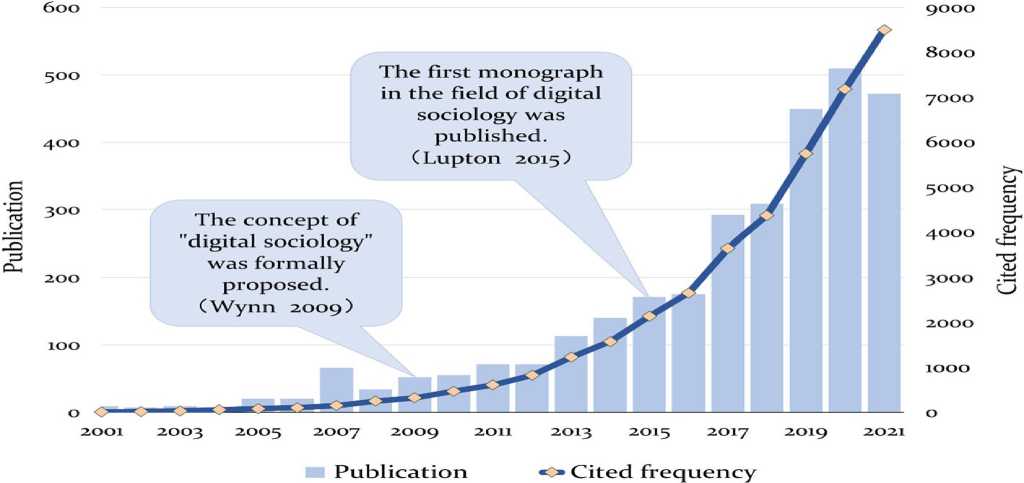
Data source: Web of Science Core Collection. Topic = “The digital”, research field = “Sociology”, publication year = 2001– 2021. A total of 3050 articles were retrieved with a total citation frequency of 39,966. The search was conducted in April 2022. ( Zhao and Wang, 2023 ).
Figure. 1 Distribution of publications and citation frequency related to digital sociology (2001–2021)
Regarding Serbia, the study by Jelisaveta Petrović (2019: 478–496) , which reviews the development of internet social studies and the potential establishment of digital sociology in the country, shows that although the domestic sociological community pays relatively little attention to this field, there are clear advancements and growing trends. These findings, while indicating a certain lag compared to global developments, confirm the need for reform in sociology education so that digital sociology in Serbia can develop in line with contemporary social challenges. The way we approach these endeavors today will shape the future framework of society, its structure, and the very concept of humanity. Over the past decade, a new theme has emerged in the AI research community called “AI for Social Good” (AI4SG), where researchers aim to develop AI methods and tools that can address social problems and improve the quality of life within communities ( Shi et al., 2020 ).
Manuel Castells’ concept of the “network society” (2000, 2001, 2012), along with the theory of “networked individualism” developed by Castells (2001) and Barry Wellman (2001: 227–252) , provides a theoretical framework for understanding the changes digital technologies bring to patterns of social relations. These insights underpin the need for digital sociology to develop as a distinct discipline and for sociology education to be reformed, enabling future researchers and students to critically assess the dynamics of networked social and individual practices in the era of deglobalization. The academic community is gradually building a coherent understanding of digital sociology, yet no single definition of its nature and scope currently exists. Scholars debate two key questions: first, whether digital sociology should be viewed as a comprehensive transformation of sociology in the digital age or as a new, autonomous branch of sociological research; and second, how to precisely define the research domain of digital sociology ( Zhao and Wang, 2023 ). Within the existing debates, some authors emphasize that if sociology aims to remain relevant in the 21st century, it must develop the theoretical capacity to explain the digital revolution and societal transformation. Gregory and colleagues (2017) note that digital sociology does not have a unified agenda and that it is more appropriate to speak of “digital sociologies.” Selwyn (2019a) adds that digital sociology emerged from the research tradition of sociology but has also enabled a shift away from the paradigm of the industrial revolution toward contemporary society. In contrast, Lupton’s (2015) perspective views digital sociology as one branch of sociology, providing a framework for understanding society without encompassing the entire sociological discipline in the digital age. These differing positions highlight the dynamic and plural nature of digital sociology, shaped by changes in social communication, group integration, and the transformation of social structures. Despite these open questions, interest in research in this field continues to grow worldwide, confirming its significance for understanding social change in the era of digitalization ( Marres, 2013 ).
Some authors emphasize that digital sociology transcends the binary relationship between technology and society, encompassing the dimension of knowledge production ( Marres, 2017 ). In this way, not only are patterns of social life shaped, but new opportunities arise for connecting academic analysis with social intervention. In this sense, digital sociology functions not only as a subject of study ( Webster, 2013 ) but also as a methodological framework and research tool that can be integrated into sociology teaching ( Lupton, 2015 ). This approach fosters critical thinking while also encouraging active student engagement in digital environments.
Deborah Lupton identifies four key aspects of digital sociology ( Lupton, 2012 ):
-
1. The first pertains to professional digital practice, where sociologists, initially reluctant, increasingly utilize social and other digital media for teaching and research purposes ( Carrigan, 2013 ). Today, sociological blogs are becoming more common, the presence of sociologists on platforms such as Twitter is growing, and the importance of open access is emphasized—from self-archiving publications, to participation in projects like Wikipedia, to shaping new forms of academic communication ( Lupton, 2013 ). These developments clearly indicate that the reform of sociology education must also include training students for this type of digital practice.
-
2. The second aspect pertains to sociological analyses of digital usage, which includes methods for analyzing “big data,” digital traces, and online communications ( Willis and Tranter, 2006: 43–59 ). This aspect is based on studying how people use digital media and how this shapes their consciousness, identity, and social relationships ( Turkle, 2011a ). All of this necessitates reforming sociology education to familiarize students with new techniques for processing and interpreting digital data.
-
3. The third aspect relates to digital data analysis and encompasses its use for social research, whether quantitative or qualitative (such as ethnographic studies, surveys and interviews with technology users, as well as analyses of data from online interactions and social media) ( Murthy and Bowman, 2014 ). Platforms such as Facebook and Twitter provide researchers with access to demographic and communication data, facilitating the monitoring of public sentiment, discussions on controversial topics, and “problem mapping.” Tools like MentionMapp and Twitter Streamgraph are used for data visualization, showing the popularity of hashtags and the connections between words over time ( Marres and Gerlitz, 2016: 21–46 ). This aspect highlights the need to reform sociology education so that students are equipped to use contemporary digital tools and methods in researching social phenomena.
-
4. Finally, the fourth aspect—so-called critical digital sociology—emphasizes the need to reassess the discipline itself in the context of the digitalization of social relations and academic work ( Lupton,
2012 ; Marres, 2013 ). The development of a “data culture,” the emergence of “big” and “small” data, as well as digital metrics, necessitates a reform of sociology education to equip students for the critical understanding and study of contemporary social processes in a digital environment. At this point, attention should also be drawn to public digital sociology ( Christopher, 2014: 205–224 ), which plays a key role in making sociological knowledge accessible to the broader public and fostering social dialogue in online spaces. By utilizing digital media, it enables faster exchange of ideas, greater visibility of sociological discourse, and active citizen participation in understanding social processes. In this context, the reform of sociology education should encourage students to use digital media as a space for learning, exchanging views, and social engagement, thereby developing competencies for active participation in public life and promoting sociological literacy.
The concept of contemporary teaching in the 21st century is in constant flux, strongly influenced by new technologies that are redefining traditional learning models ( Prodović Milojković, et al., 2024: 247– 262 ). Within sociology education, AI, with its transformative potential, enables the reshaping of classical teaching methods and the orientation of the educational process toward modernization. Modernization involves integrating intelligent techno-pedagogical knowledge, creating opportunities to combine technological competencies with teachers’ pedagogical skills in working with AI. The potential for personalized learning allows educational materials to be adapted to the specific needs and abilities of each student, facilitating the work of teachers and other educational staff, including administrative personnel. This opens the door for the introduction of more contemporary curricula and didactic materials, fostering a more creative and interactive environment for learning sociology. Furthermore, new technologies simplify administrative tasks at all levels, from secondary schools to universities, allowing instructors to devote more time to the quality of teaching and student learning in a digital social context. On the other hand, in education, AI enables personalized lesson plans and tailored resources but can also further marginalize students who lack adequate access to technology ( Selwyn, 2019 ), as previously noted. The open letter “ Pause Giant AI Experiments ” (March 2023)8, signed by numerous global technology leaders and researchers, including Elon Musk and Steve Wozniak, drew public attention to the risks of uncontrolled AI development ( Nikolić and Vučenović, 2024 ). For these reasons, digital sociology must analyze not only the positive effects but also the potential risks and inequalities accompanying AI implementation, highlighting both the need and opportunity for reform in sociology education .
Contemporary research indicates that digital environments, despite offering new opportunities for expressing and re-creating identity, reproduce gender inequalities, double standards, and male dominance (Filipović, 2010: 361–392; Žakelj, 2014: 5–21). At the same time, the emergence of a new pattern of sociality—‘networked individualism’ (Petrović, 2009: 23–44; Petrović, 2013: 417–438)—demonstrates that traditional organizations are no longer essential for collective action in the digital age, as their functions are increasingly assumed by new communication technologies (Petrović and Petrović, 2017: 405–426). These insights confirm that reforming sociology education is necessary to equip digital sociology with the tools to critically analyze both the potentials and limitations of digital social practices. Regarding methodological approaches (Petrović, 2019), traditional sociological methods—such as surveys, interviews, case studies, and content analysis—still predominate, although in some cases they are applied in digitalized forms (online surveys, interviews via platforms like Skype) or to digital content (website analysis). What is noticeably lacking, however, is the broader application of innovative methodologies, such as the analysis and visualization of digitally generated data. Although such practices remain rare even in more developed sociological communities (Petrović, 2018: 557–582), this very gap highlights the need to systematically integrate digital sociology into curricula. This would educate a new generation of digital sociologists, capable of applying contemporary research techniques, including digital network analysis using tools such as Netvizz and Gephi, and of addressing the new questions posed by digital society to sociology. Only within this context would digital technologies create new opportunities for learning and education, particularly in higher education, where they could provide access to rich information resources and flexible forms of instruction. This underscores the necessity of reforming sociology education to incorporate digital tools and develop digital competencies, thereby adapting the educational process to the demands of contemporary society. All of this is closely aligned with the Strategy for the Development of Artificial Intelligence in the Republic of Serbia for the period 2025–2030, which emphasizes the importance of education both in training AI specialists and in adapting to the changes AI brings to the learning environment of students (Official Gazette of RS, No. 30/18). In this context, as part of the reform of sociology education, it is necessary to develop the ability for critical analysis of digital processes and their transformative role in society. This involves examining the relationship between technological and social dimensions, understanding the theoretical foundations of digital sociology, assessing the consequences of digitalization and surveillance capitalism, and recognizing the links between the digital divide and social inequalities in both global and national contexts (Davies, 2014, February 25). All of this aims to ensure that education serves as a leading tool for fostering social cohesion, enabling the prevention of social exclusion and inequality (Nesterova, et al., 2019).
A symbolic turning point in public reflection on the ethics of artificial intelligence was marked by Pope Francis’s address at the G7 summit in 2024, where he for the first time highlighted the risks of AI development without clearly defined moral boundaries. On that occasion, he called for the adoption of an international agreement to ensure its ethical development and application, warning that “technology devoid of human values—compassion, mercy, morality, and forgiveness—is far too dangerous to develop without limits” ( Nikolić and Vučenović, 2024: 11 ). The experiences of certain countries (e.g., Cuba, Iran, North Korea, China, and Saudi Arabia) demonstrate that digital technologies, including AI, can serve as instruments for content filtering, censorship, and surveillance, further underscoring the necessity of protecting human rights in the digital age.In this context, the reform of digital sociology gains particular importance: it must provide a critical framework for understanding the social consequences of AI in the era of deglobalization and be integrated into contemporary sociology education. Pierre Léna also emphasizes the significance of responsible and thoughtful integration of new technologies into the educational process, highlighting that their effectiveness depends not only on adapting curricula but also on the competence and professional quality of teaching staff ( Prlja, et al., 2021 ).
All of this confirms the need for modern sociology education to develop a critical, ethical, and socially responsible perspective on digital sociology, equipping students to understand and critically reflect on the consequences of technological transformations in contemporary society.
Conclusions
Artificial intelligence (AI) is becoming one of the most influential drivers of contemporary social change ( Skopek, 2023 ; Hagerty and Rubinov, 2019 ), thereby creating space for the development of digital sociology as a subdiscipline that examines the mutual shaping of technology and social structures in conditions of deglobalization ( Prlja, et al., 2021 ). AI achievements, shaped by interdisciplinary contributions, demonstrate that it transcends the role of a technological tool and becomes an actor influencing the transformation of social relations, identities, and power structures ( Castells, 2010 ; Wajcman, 2017 ). Literature analysis indicates that the application of AI and digital technologies simultaneously creates opportunities for progress and risks of deepening existing inequalities. Algorithms and digital platforms can either reproduce or mitigate social disparities ( Noble, 2018 ; Van Dijck, 2020 ), placing digital sociology in the position of developing critical theoretical frameworks, ethical reflection, and methodological innovations ( Bojić, 2022: 1040 ). In this sense, digital sociology must remain interdisciplinary, research-oriented, and socially responsible, integrating insights from sociology, philosophy of technology, educational sciences, and ethics ( Edelmann, et al., 2020: 61–81 ).
The reform of sociology education represents a strategic direction of action. In order to prepare future researchers and students to understand the social consequences of AI, it is essential to incorporate digital competencies, algorithm analysis, critical reflection on digital processes, and ethical perspectives on technology into educational programs ( Floridi, 2019 ; Babić and Matović, 2025, pp. 610–634 ). This positions education as a key space for developing digital literacy, social responsibility, and the ability to shape a more just digital society ( Eubanks, 2014; 2018 ).
Sociologists face both a challenge and an opportunity: digital sociology can become a framework for the thoughtful socio-technical transformation of society ( Selwyn, 2019 ; UNESCO, 2021 ; OECD, 2022 ; Joyce, et al., 2021 ). Future research should focus on:
-
1. mapping new forms of digital inequalities and algorithmic discrimination;
-
2. monitoring the social impacts of AI on different social contexts and vulnerable groups;
-
3. developing ethical standards and policies for AI application;
-
4. analyzing educational models that successfully integrate digital sociology into formal education.
Maintaining a balance between technological development and social values will be crucial for the future ( Budić, 2022 ; Prlja, et al., 2021 ). To remain relevant and transformative, sociology must actively participate in shaping technology policies, critically monitor the implications of AI, and promote the development of socially sustainable digital solutions ( Nikolić and Vučenović, 2024 ; Dewey, 2021 ; Kozić, 2023 ).
As Kissinger ( Kissinger, et al., 2022 ) states, “Humans still control the future. We must shape it with our values”—reminding us that the development of AI and digital technologies cannot be left solely to technical or economic forces, but must be guided by social principles and ethics ( Harari, 2024 ). Digital sociology, therefore, is not only a new field of study but also a mission—to ensure that technology contributes to creating an inclusive, just, and humane society in the digital era ( Serpa, et al., 2025 ; Grum and Grum, 2020 ).
As Kate Crawford, principal researcher at Microsoft Research and founder of the AI Now Institute, explains ( Rosenberg, 2017 ): “Data will always carry traces of its history.”
Acknowledgements
The authors received no specific funding for this work and have no acknowledgements to declare.
Conflict of interests
The authors declare no conflict of interest.
Author Contributions
Conceptualization: BPM, DZ, BNC; Methodology: BPM; Investigation: BPM; Formal analysis: BPM; Data collection: BPM, DZ; Writing — original draft preparation: BPM; Writing — review and editing: BPM, DZ, BNC; Supervision: DZ, BNC.
All authors have read and agreed to the published version of the manuscript.
