
Decision support system with a Telegram bot and machine learning methods for the real estate market
Journal: Perm University Herald. Series: Economics @economics-psu
Section: Математические, статистические и инструментальные методы в экономике
Article in issue: 2 т.21, 2026.
Free access
Introduction. The problem of managing investments in residential real estate as a tool for generating income is considered; an investment option with mortgage lending and no additional funds is proposed. A Telegram bot was programmed to automate the investment decision-making process. Purpose. The aim of the study is to develop a decision support system as a Telegram bot, aimed at assessing the investment attractiveness of real estate objects with statistical data analysis and forecasting methods. Materials and methods. The data for the study is taken from the CIAN platform. The methodological framework includes methods for statistical data analysis, machine learning, and user interface design in decision support systems. Primary calculations and research are performed with Python programming language functions; the decision support system was implemented in Google Colab with the pyTelegramBotAPI library. Results. Information was collected, cleaned and pre-processed for cities in Russia, and rental and sales housing prices were studied. The CatBoostRegressor machine learning model was applied to forecast rental price for properties put up for sale, which made it possible to calculate their expected profitability. The possibility of using mortgage lending as a tool for higher investment efficiency was analyzed. A decision support system was implemented as a Telegram bot capable of assessing the profitability of real estate and helping the user make decisions defined by the specified parameters and forecast models. The Telegram bot was tested, and examples of use were demonstrated, confirming the accuracy and usefulness of the calculations obtained. Conclusions. The developed decision support system can provide recommendations based on the analysis of statistical data of the real estate market and a forecast model. The system is easy to use, focused on private investors, offers real objects presented on the market, automates the process of selection and evaluation of objects, and compares purchase strategies with a mortgage and no additional funds.
Short address: https://sciup.org/147254373
IDS: 147254373 | UDC: 519.25 | DOI: 10.17072/1994-9960-2026-2-214-226
Система поддержки принятия решений на рынке недвижимости в виде Telegram-бота с использованием методов машинного обучения
Введение. Рассмотрена задача управления инвестициями в объекты жилой недвижимости как инструмент получения дохода. Предложен вариант инвестирования с ипотечным кредитованием и без привлечения дополнительных средств. Для автоматизации процесса принятия инвестиционного решения создан Telegram-бот. Цель. Разработка системы поддержки принятия решений в виде Telegram-бота, ориентированной на оценку инвестиционной привлекательности объектов недвижимости с использованием методов анализа статистических данных и прогнозирования. Материалы и методы. Информационной базой исследования являются данные с платформы ЦИАН. Методологическая база включает методы анализа статистических данных, машинного обучения, проектирования пользовательских интерфейсов в системах поддержки принятия решений. Первичные расчеты и исследования выполняются с использованием функций языка программирования Python. Реализация системы поддержки принятия решений осуществлена в Google Colab с помощью библиотеки pyTelegramBotAPI. Результаты. Произведены сбор, очистка и предобработка информации по городам России, проведено исследование цен аренды и продажи жилья. С помощью модели машинного обучения CatBoostRegressor получены прогнозы стоимости аренды объектов, выставленных на продажу, что позволило рассчитать их ожидаемую доходность. Проведен анализ возможности использования ипотечного кредитования как инструмента повышения эффективности вложений. Реализована система поддержки принятия решений в виде Telegram-бота, способного выполнять оценку доходности объектов недвижимости и помогать пользователю в принятии решений на основе заданных параметров и прогнозных моделей. Работа Telegram-бота протестирована, продемонстрированы примеры использования, подтверждающие точность и полезность полученных расчетов. Выводы. Разработанная система поддержки принятия решений способна давать рекомендации на основе анализа статистических данных рынка недвижимости и прогнозной модели. Система проста в использовании, ориентирована на частного инвестора, предлагает реальные объекты, представленные на рынке, автоматизирует процесс подбора и оценки объектов, позволяет сравнивать стратегии покупки с использованием ипотеки и без привлечения дополнительных средств.
Text of the scientific article Decision support system with a Telegram bot and machine learning methods for the real estate market
When setting the problem of managing investments in residential real estate, the following main functions must be considered. First, we can highlight the savings function, which preserves capital in tangible form because real estate has a stable value in the long term and is less susceptible to sharp fluctuations compared to other assets. Also, the income function is attractive to the investor, which ensures regular profitability from renting out real estate property. And an equally important function is the protective function, manifested in the ability of real estate to serve as a hedging instrument against inflation. Its value, as a rule, correlates with the price level in the economy, which allows the investor to preserve the purchasing power of capital.
Investment attractiveness of residential real estate means to achieve a balance between the interests and capabilities of the investor. The investor seeks to find an object that matches his financial capabilities and will bring him the greatest return. The investment attractiveness of real estate is influenced by various factors. With many objects on the market, it is a challenge to consider all the factors; therefore, economic and market factors should be highlighted as the most indicative and easily interpreted. Real estate investment generates income from renting out housing, therefore the state of the real estate market in the region is the most important factor influencing both the liquidity of the property and its profitability. The market is characterized by the levels of supply and demand, which, in turn, depend on the income level of the population, the unemployment rate, overall economic growth, and the stability of the region [1–3].
There are many methods and approaches to assessing the investment attractiveness of residential real estate, involving the calculation of the capitalization coefficient, the amount of cash flow, a simple or discounted payback period [4; 5].
Recently, data analysis methods have played a major role in assessing investment attractiveness. The basis for such analysis is data from open sources, such as the CIAN, Avito, Domclick platforms, etc. [6; 7].
Investors can analyze both current listings and historical price data. A filter system allows them to select properties by key parameters: basic ones, such as area and number of rooms, and specific ones, including ceiling height and views. This helps find comparable properties and identify overpriced or underpriced options. Rental rate analysis is a particularly interesting part of the information offered by the CIAN platform. CIAN provides rental price forecasts for listings, thus investors can calculate the potential profitability of a property, compare rates in different areas, and determine the optimal rental type for a specific location.
According to the background information, CIAN’s valuation is based on a set of machine learning methods that calculate the apartment price closest to the market price for a direct sale within the average market timeframe, as well as the property’s rental rate closest to the market. The approach relies on a comparative analysis, which involves reviewing apartments with similar characteristics. The model draws on a database of nine million listings posted on the platform, as well as data from external sources that provide more comprehensive information about the property’s characteristics. The valuation is updated monthly or more frequently if there have been significant market changes.
In international markets, there is a tool called Mashvisor1, a specialized service for assessing the investment attractiveness of residential properties in the United States. Unlike traditional classifieds, this platform is tailored specifically to the needs of investors of all levels, offering comprehensive solutions for profitability analysis based on machine learning algorithms. The platform utilizes aggregated data from various sources to provide information on the real estate market. Mashvisor users have the following options: search for properties by criteria such as price, neighborhood, return on investment; analyze profitability, Cap Rate, and payback; compare profitability for different rental strategies, long-term and short-term; and use heat maps to visualize market hot spots.
Unlike CIAN, Mashvisor focuses on profitability analysis and decision-making assistance for investors, rather than searching for properties to sell or rent. The platform is especially useful for those who view rental housing as their primary source of real estate income. Unlike its competitors, Mashvisor can not only analyze key data but also find the best properties that meet the investor’s criteria and compare rental strategies to determine the optimal one. Mashvisor also offers a variety of educational materials to help users better understand the real estate market and investment strategies.
Technical means and machine learning methods process large arrays of data, identify patterns and use the results for decision-making [8; 9]. Creating a model trained in real data makes the assessment more accurate and reliable, allowing us to consider the current market situation 1 . Since each method separately forms only a part of the assessment, there is a need for a step-by-step combination of different methods to make the investor’s decision more justified. In this paper, the CatBoostRegressor machine learning model was used to obtain forecasts of rental prices and expected profitability for real estate properties.
When solving the problem of investing in real estate, decision support systems (DSS) become useful [10]. Such an intelligent analytical tool helps investors evaluate the profitability of planned investments and find the best objects for investment. In this paper, a decision support system is implemented in the form of a Telegram bot2 that performs two functions: selecting the most profit- able real estate properties according to specified parameters and assessing the profitability by the characteristics of the property entered by the user.
ANALYSIS OF RESIDENTIALREAL ESTATE DATA
To analyze real estate objects, data from the CIAN website on the sale and rental of housing in different cities over the five-year period were used 3 . This data forms two separate datasets. In order to obtain more highly liquid real estate (determined by its demand in local markets), cities with a population of over a million, which are the centers of the constituent entities of the Russian Federation, were taken into account: Moscow, St. Petersburg, Novosibirsk, Yekaterinburg, Kazan, Krasnoyarsk, Nizhny Novgorod, Chelyabinsk, Ufa, Samara, Rostov-on-Don, Krasnodar, Omsk, Voronezh, Perm, Volgograd. Data was collected with a ready-made parser. The following information on real estate was obtained: the author of the ad and its type; floor and number of floors; number of rooms and total area; price; city, district, street, house number; metro station (if there is one in the city).
The data obtained includes studio apartments and apartments with 1 to 3 rooms. To conduct a yield analysis, a new predictive variable was introduced for both datasets – the price per sq. m. for sale or rent, respectively. After all data cleaning procedures, the main datasets contain information on 76,638 listings for sale and 31,284 listings for long-term rent. Each dataset contains 9 columns, not counting the column with links to listings.
The first dataset to be considered is the one containing listing for sale. The average value of the variable is 131,787.34 rub. per sq. m., the median is 120,201.41, which indicates that the distribution has outliers towards larger values. These characteristics are closest to each other in the cities of Krasnoyarsk, Moscow, and Omsk. To get a more accurate understanding of the situation, the data is also divided by the number of rooms. For example, the average value for a one-room apartment is 142,879.37 rub. per sq. m., and the median is 132,249.26 rub. per sq. m. Thus, the average selling price of a one-room apartment with an area of 30–36 sq. m. is in the range from 4,286,381 to 5,143,657 rub. per sq. m. The resulting values are close to statistical data and are average values for Russia.
The average selling price per sq. m. also depends on the city, location of the property and the number of rooms. Moscow stands out noticeably, then, the cities are listed approximately in order of their population size, which in turn can be linked, for example, to the development of their infrastructure and other regional factors. The average price per sq. m. in all cities for one-room apartments is higher than for two-room apartments. Based on these data, an approximate yield value will be calculated considering average rental and sale prices in order to determine investment attractiveness by city.
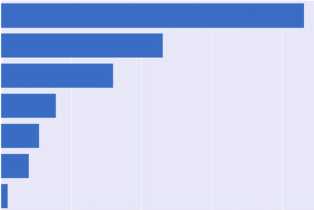
The CatBoostRegressor machine learning model was used to determine the importance of features that influence the selling price per sq. m. (Fig. 1). The feature that makes the greatest contribution was “City”, followed in descending order of importance by the features “Area”, “Number of floors”, “District”, “Number of rooms”, “Metro”, “Floor”. It is interesting that the selling price is significantly influenced by “Number of floors”, not “Floor”, i. e. the height of the building affects the attractiveness of its apartments. The number of rooms makes a smaller contribution, which may be due to the variety of layouts in the real estate market.
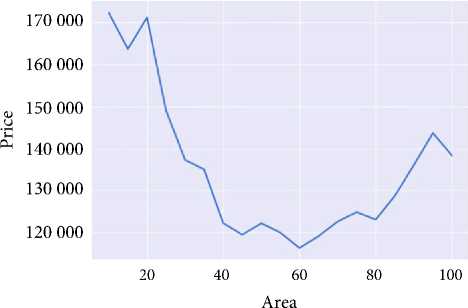
The price per sq. m. of sale depends on the area of the property (Fig. 2). The lowest price per sq. m. is for real estate with an area of 40 to 70 sq. m., which can be a two-room or three-room apartment. The highest values are for studios or apartments;
the latter, according to the law, are not considered residential real estate.
City Area
Number of floors
.ы> District
Number of rooms
Metro
Floor
0 10 20 30 40
Importance
Source : compiled by the authors.
Fig. 1. Correlation between importance of attributes and the selling price
Source : compiled by the authors.
Fig. 2. The dependence of the selling price per sq. m. on the area of the property
Below is a similar analysis for apartment rental ads. The average price per sq. m. was 916.87 rub., the median was 795.05 rub. The same characteristics for one-room apartments were 917.34 and 800 rub., and for two-room apartments – 835.46 and 739.64 rub., respectively. This statistics indicates that one-room apartments are more profitable in terms of renting, while, as shown earlier, they also have higher costs. The average rental price for a one-room apartment of 30–36 sq. m. is in the range from 27,520.40 to 33,024.47 rub. 1 .
A study of the average rental price per sq. m. by city, considering the number of rooms, showed that Moscow and St. Petersburg have the highest values, as was the case with the sales data. However, unlike all other cities, the price for two-room apartments in St. Petersburg, as well as in Krasnodar, is higher than for one-room apartments. In addition, there is a large gap in the average price per sq. m. in Moscow, one-room apartments are 46 % more expensive than two-room apartments. In sales data, this gap is less than 18 %. Otherwise, the situation is visually like the chart for sale ads, but there are differences in the sorting of cities. For example, the rental price in Kazan is approximately at the same level as most cities, but the cost of apartments is noticeably higher.
The graph of the rental cost versus area is similar to the graph of the sale cost versus area: there is a sharp decrease in value to 30 sq. m., and then the situation hardly changes.
The cost per sq. m. of rent and sale of an apartment based on the data on advertisements was predicted with a trained regression model using machine learning methods. Thus, advertisements for the sale of housing could predict the profitability of this property when renting it out after purchase.
The regression model used is the gradient boosting model on decision trees CatBoostRegressor from the catboost library. The independent variables are a city, a district, metro, a floor, the number of floors, the number of rooms, and a total area. Some of the variables are not quantitative, so this machine learning model was chosen to include categorical features. To track the overfitting of the model, the rental data is additionally divided into training and testing samples in a ratio of 9 to 1.
Also, to obtain a model with the best predictive properties, GridSearchCV was used, which selects parameters by examining each combination. The results of the function gave the following model parameters: iterations=1200, learning_rate = 0.2, depth = 6, l2_leaf_reg = 3. The model showed the following metrics: R2training = 0.834, R2testing = 0.771, MAEtesting = 150.441. MAE measures the average absolute deviation of each forecast from the corresponding actual value, i.e., on average, forecasts deviate from actual values by 150 rub. In general, based on the metrics obtained, a conclusion can be made about the applicability of this model.
When developing a DSS, it is possible to enter both the values for collected sales advertisements and your own data for a specific property to predict its rental price.
To assess the profitability of investments, the annual yield of each property was calculated with the values obtained during the model operation. The numerator of the calculation formula records the net income, which is the final income after deducting expenses and taxes (income tax and property tax for individuals). The DSS assumes that the user is an individual, so the value of income tax (personal income tax) is 13 %. To calculate the property tax, the cadastral value is taken to be 80 % of the market value, i.e. the selling price in the ad. This is because in general, the market value of residential real estate is usually higher than the cadastral value. The expenses are taken to be 5 % of the rental price, which means unforeseen expenses that may arise when renting out housing. It is also assumed that utilities are paid by the tenant. The final formula for the profitability of renting out housing is as follows:
(RP x 87%) x 12 - (SP x 80% )x x 0.1%-(RP x 5% )x12 (1)
,
Profitability =
SP
where RP is the rental price, SP is the selling price.
The results of the profitability calculations are presented in Table 1, where 0 is the studio.
Based on the calculations of profitability, we can draw a conclusion about the attractiveness of some cities in terms of capital investment. It is believed that the average annual yield from renting out housing is about 5–7 %, which is confirmed by the results for apartments consisting of 1–3 rooms. Most of the values belong to the range from 4.5 to 6.5 %, which is close to theoretical data. For studios, high yield values were obtained, which may signal the risk of investing in these objects, which should be notified to a potential investor, but these ads in the overall set were quite few.
Table 1. Profitability Values
|
City |
Profitability Depending on the Number of Rooms, % |
City |
Profitability Depending on the Number of Rooms, % |
||||||
|
0 |
1 |
2 |
3 |
0 |
1 |
2 |
3 |
||
|
Volgograd |
14.49 |
6.03 |
5.99 |
5.79 |
Novosibirsk |
10.85 |
6.83 |
7.37 |
6.84 |
|
Voronezh |
10.36 |
5.28 |
4.85 |
4.86 |
Omsk |
12.27 |
6.04 |
5.79 |
5.66 |
|
Yekaterinburg |
10.14 |
6.54 |
6.77 |
6.42 |
Perm |
21.28 |
6.07 |
5.68 |
5.60 |
|
Kazan |
7.25 |
4.43 |
4.23 |
3.72 |
Rostov-on-Don |
8.53 |
6.50 |
6.41 |
6.18 |
|
Krasnodar |
11.40 |
6.12 |
6.17 |
5.52 |
Samara |
15.35 |
5.67 |
5.24 |
4.96 |
|
Krasnoyarsk |
10.61 |
5.89 |
5.71 |
5.29 |
St. Petersburg |
10.57 |
5.77 |
5.69 |
5.51 |
|
Moscow |
8.96 |
5.52 |
5.24 |
5.60 |
Ufa |
10.24 |
5.01 |
4.97 |
4.80 |
|
Nizhny Novgorod |
9.18 |
5.12 |
5.26 |
4.74 |
Chelyabinsk |
13.22 |
6.08 |
5.77 |
5.64 |
Source : compiled by the authors.
It can also be noted that in most cases, investing in one-room apartments is more profitable than in apartments with a larger number of rooms, and renting two-room apartments is more profitable than three-room apartments, i.e. there is a greater demand for smaller apartments.
Investing in real estate requires large initial costs. This can be a challenge for many aspiring investors. However, with sufficient capital, mortgage financing can be used 1 . This option may seem less profitable, but it allows the mortgage to be repaid by renting out the property. Ultimately, the investor obtains ownership of the property for a smaller investment, protecting the investment from depreciation. The paper examines the issue of whether it makes sense to invest in residential real estate with mortgage lending.
In the first half of 2025, the Central Bank’s interest rate was 21 % per annum, and banks accordingly offered mortgages at rates several percentage points higher. According to data from May 2025, available on the DOM.RF website, the rates offered by some Russian banks for apartments on the existing real estate market are as follows, presented in Table 2.
Under these conditions, the interest on a 20-year loan will be more than three times the principal. Subsidized mortgages are also available, with a 6 % interest rate, but this option is not suitable for everyone. Firstly, the potential borrower must qualify for available government-supported programs, such as family mortgages or IT mortgages (for IT employees). Secondly, subsidized mortgages are not available across the entire real estate market and have loan amounts limitations. Furthermore, the purpose of investing with borrowed funds, as already mentioned, is to use rental income to pay off the loan, but this requires bank approval.
Table 2. Mortgage Rate
|
Bank |
Rate, % |
|
Sberbank |
26.70 |
|
VTB |
27.40 |
|
DOM.RF Bank |
25.00 |
|
Alfa-Bank |
27.00 |
|
Sovcombank |
25.49 |
|
T-Bank |
24.00 |
Source : compiled by the authors.
The annuity payment formula is used to calculate the size of the loan payments. This approach is justified for two reasons. Firstly, large credit institutions usually issue loans only under the annuity scheme. Secondly, this scheme gives constant payment amount, i.e. it can be covered by income from renting out the apartment. However, a differentiated scheme requires additional invest- ments at the beginning and smaller payments in the end. The calculation formula for the monthly mortgage payment is as follows:
Monthly payment = S x
r x ( 1 + r ) n ( 1 + r ) n - 1,
where S is the loan amount, r is the monthly interest rate, n is the total loan term in months.
To avoid the need for additional investments when buying an apartment with a mortgage, the rental cost should exceed the loan payment.
Table 3 contains information on the shares of all properties on the real estate market for which monthly payments are covered by rental income.
Each row represents the down payment amount, expressed as a percentage of the total property value. The columns are divided into groups by mortgage terms: 5, 10, and 20 years. The preferential interest rate on a mortgage is 6 % per annum. In general, the interest rate is approximately 25 % per annum. Obtained values show that a 6 % rate allows for mortgage repayment with rent in most cases. This is more difficult with a five-year term, but with a ten-year term, 50 % of the apartment’s value may be sufficient, not to mention a 20-year term. For a standard rate, the results are naturally worse, and only in rare cases does the rental income exceed the required payments.
When applying for a mortgage for an amount equal to 10 % of the full cost of the property, the monthly loan payment is always paid off at the expense of rental income. Although with smaller shares, but with a down payment of 80 %, the debt is also less than the rental cost. Given these values, it makes sense to consider the possibility of using a mortgage even if you have the required amount. Calculations also showed that it makes sense for an investor to consider the option of mortgage lending if a reduced rate is available to him.
DECISION SUPPORT SYSTEM ONTHE TELEGRAM BOT PLATFORM
The developed decision support system is a Telegram bot programmed in Google Colab with the pyTelegramBotAPI library. To use the system, the user needs to launch the bot named @real_ estate_investing_bot in the Telegram messenger.
The choice of the Telegram bot as a platform is due to several reasons:
– Telegram is one of the most popular Internet resources among Russians [11; 12], so the bot is available to a wide range of users and does not require additional registration or software installation;
– the bot can be launched from a phone or tablet, as well as from a computer, which allows you to consider user preferences;
– the bot has a simple interface and clear controls, which reduces the entry threshold for users of any skill level;
– implementing a Telegram bot requires less costs and time resources compared to creating a full-fledged website or mobile application.
Table 3. Shares of objects in the real estate market
|
Amount of down payment, % |
5 years |
10 years |
20 years |
|||
|
6 % |
25 % |
6 % |
25 % |
6 % |
25 % |
|
|
20 |
0.0017 |
0.0001 |
0.0442 |
0.0007 |
0.5012 |
0.0011 |
|
30 |
0.0034 |
0.0003 |
0.1069 |
0.0014 |
0.7172 |
0.0022 |
|
40 |
0.0078 |
0.0008 |
0.2616 |
0.0032 |
0.8801 |
0.0049 |
|
50 |
0.0251 |
0.0023 |
0.5556 |
0.0088 |
0.9625 |
0.0149 |
|
60 |
0.1101 |
0.0073 |
0.8542 |
0.0376 |
0.9945 |
0.065 |
|
70 |
0.4802 |
0.0469 |
0.9775 |
0.2295 |
0.9996 |
0.3456 |
|
80 |
0.9385 |
0.4599 |
0.9995 |
0.8328 |
0.9999 |
0.8967 |
|
90 |
0.9998 |
0.9932 |
1 |
0.9993 |
1 |
0.9997 |
Source : compiled by the authors.
There are several reasons for writing the program code in Google Colab. Firstly, there are no costs for supporting the DSS; since all calculations are performed on Google servers, serious technical means are not required for launching. Secondly, it is easy to develop and test; Colab provides a fully configured environment, because its feature to launch individual cells checks individual bot functions or eliminates errors in certain sections of the code.
The creation of the bot begins with its registration in Telegram. Once you contact the official bot, you can create your own bot, the name “Real Estate Investments” and a username were chosen, by which users can find this bot. The main part of this process was obtaining a token, which is needed to interact with the Telegram API. Then all the work was done in Colab, where an instance of the bot was created using the pyTelegramBotAPI library, initialized with a unique token, and the functions necessary for the DSS were written.
The system consists of the following key components:
– real estate database with information on sales and rentals;
– CatBoostRegressor machine learning model for rental rate forecasting;
– business logic for calculating profitability and analyzing investment scenarios;
– Telegram interface for user interaction.
The database in this case is the datasets, which were analyzed, processed and presented above. The sales data are used completely ready and contain information on the predicted profitability. The rental data is necessary for the implementation of the prediction function and is intended for training the regression model with the optimal parameters found earlier. Both datasets are uploaded to GitHub for the purpose of storage and simplification of their loading into Colab.
The developed bot provides the user with the opportunity to use two main functions:
-
1) selection of the most profitable real estate objects from the database;
-
2) calculation of the predicted profitability for the user object.
In addition, each of these functions can be used when calculating the income that can be obtained in the case of registration of a mortgage. Once you start the bot with the message “/start”, it becomes possible to select one of the functions.
The first function is to select the most profitable real estate properties from a database containing information about real ads for the sale of apartments. When you enter all the characteristics, the data set is filtered and the lines that satisfy the search are sorted from options with higher to lower profitability. The user is offered the first property and information about it. In addition to the previously considered parameters, it also indicates the predicted rental price, the corresponding profitability and a link to the property on the CIAN website. It is possible to go to the site directly from the bot and examine the proposed property in more detail.
After receiving a message about the first property, the user is offered two buttons: “another option” and “stop”. Therefore, if the user does not like the proposed apartment, he can look at the next option from the list. When the user is satisfied with the result, he must click “stop”. Then the user will receive a message with a proposal to check the option of purchasing an object using a mortgage loan: “If you meet the requirements of preferential mortgage programs, then it is worth checking whether you can get a higher income if you do not immediately buy an apartment, but take out a mortgage at a low rate and put the rest of the money in the bank on a savings account.” Using the buttons, the user can agree or refuse.
In case of refusal, the bot returns to the beginning. If the first option is chosen, the user is asked two questions about the rates available to him for a mortgage and a deposit. Based on the entered values, mortgage payments for 5 years and income from a deposit for 5 years are calculated for two down payment options: 80 and 90 %. For each of them, the user receives messages with information about the size of the possible benefit and advice on whether it is worth taking out a mortgage instead of fully paying for the apartment and putting part of the money on a deposit. This completes the first function, and the bot returns the user to the beginning.
The purpose of the second function is to predict the profitability of the user object. It is assumed that the user has a certain apartment, the parameters of which are known to him, and he wants to know its profitability from renting it out. When all the parameters are entered, a forecast is made on the already trained model, based on which the profitability is calculated, and the user receives the following message:
“Calculation results:
Predicted rent: … rub./month
Property cost: … rub.
Predicted profitability: …% per annum”
In the end, the user is also offered the option of considering a mortgage for the described property using buttons. If he is not interested, he can select the option “no, finish” and the bot will return to the beginning.
The following are examples of the bot’s work, performing the implemented functions. The first example demonstrates the selection of the most profitable properties from the database.
One option has the following description:
“City: Samara
District: Oktyabrsky
Metro: Gagarinskaya
Floor: 23 of 25
Rooms: 1
Area: 38.0 sq.m.
Price: 6,620,000 rub.
Predicted rent: 34,417 rub./month
Projected yield: 5.04 % per annum
Link: 153344/”
The model obtained in the work gives the predicted rental cost of 34,417 rub./month, which is close to the estimate of the CIAN website. Since the proposed option turned out to be good, the search was stopped.
Then the bot asked a question about checking the option with a mortgage, and the answer was yes. The information provided for the option with a contribution equal to 80 % looks like this:
“With an initial contribution of 80 %:
Monthly payment: 32,197 rub.
Projected rent: 34,417 rub.
Income from the deposit for 5 years: 2,433,417 rub.
Mortgage payments for 5 years: 1,931,826 rub.
Net benefit: 501,590 rub.
Conclusion: You can take out a mortgage, since the income from the deposit is more than the interest on the mortgage.”
This completes the execution of the first function, and the bot offers to create a new request. Next comes the second function, which helps the user evaluate the profitability of their property. The bot offers the investor the option of placing part of the money in a savings account. Once the information is collected, the bot issues a message about the predicted rental rate, the corresponding profitability, and gives recommendations. When the profitability is calculated, it is suggested to check the mortgage option, the choice is also made with the buttons. The bot asks questions about the rates available to the user and issues two messages with calculations.
CONCLUSIONS
The developed decision support system defined by the analysis of real market data and the forecast model could provide recommendations for managing investment in residential real estate. The advantage of this decision support system is that it is focused on a private investor and is easy to use, offers real objects presented on the market, automates the process of selecting and evaluating objects, and compares purchase strategies with a mortgage and no additional funds.
The significance of the results obtained is that they could be applied in private investment practice and develop similar solutions in the field of real estate market analysis. The obtained results confirm the effectiveness of the application of data analysis methods and decision support systems in
ACKNOWLEDGEMENTS
The authors would like to express their gratitude to V. D. Laricheva for her contribution into preparing the materials.
