
Development of artificial hydraulic lime
Journal: Nanotechnologies in Construction: A Scientific Internet-Journal @nanobuild-en
Section: Construction materials science
Article in issue: 2 Vol.18, 2026.
Free access
Introduction. Lime mortars used for the restoration of historical buildings are characterized by low resistance during operation. The durability of lime solutions can be increased by using hydraulic lime as a binder. However, the share of hydraulic lime in the lime binder production structure is only 19.8%. Given the low volume of production of natural hydraulic lime, it is promising to develop a formulation of artificial hydraulic lime. Materials and methods. To develop the formulation of artificial hydraulic lime, grade 2 slaked lime (pushonka) with an activity of 64% was used, as well as grade 2 air lime with an activity of 84% (GOST 9179-18). The technology for producing artificial hydraulic lime consisted of mixing slaked lime with pozzolan additives, as well as mixing air lime with pozzolan additives during the quenching process. When developing the formulation of the plaster mortar, quartz sand from various deposits was used as a fine filler. The optimal type of sand was selected based on the strength criterion of calcareous composites and sand activity, characterized by the value of free surface energy. Results. It has been established that the most effective is the addition of metakaolin. The compressive strength of the solution at the age of 28 days of hardening is 2.1 MPa when using second-grade quicklime. Increasing the dosage of metakaolin to 40% by weight of lime increases the compressive strength to 2.7–3.1 MPa. Pozzolan additives silica, dehydrated clay, diatomite at a dosage of 10% by weight of lime do not provide the required compressive strength of at least 2.0 MPa. The introduction of Portland cement in the formulation in an amount of 25% by weight of lime contributes to a significant increase in compressive strength, amounting to 2.9–4.0 MPa, depending on the type of additive and type of lime, as well as the technology of binder preparation. The porosity of calcareous stone based on artificial hydraulic lime was determined, amounting to 48–51%, while a decrease in the volume of closed pores was observed. Solutions based on artificial hydraulic lime provide sufficient adhesion strength to the brick substrate, amounting to 0.4–0.55 MPa/kg. It has been established that the use of methakaolin in the amount of 40–50% of the mass of air lime makes it possible to obtain artificial hydraulic lime. The developed compositions of artificial hydraulic lime are proposed to be used for the restoration of buildings of historical buildings, as well as finishing newly erected facilities. Conclusion. It has been established that the use of aerial quicklime in the preparation of artificial hydraulic lime promotes a more durable lime composite structure. The porosity of limestone based on artificial hydraulic lime is lower than that of limestone based on aerial lime, and for limestone based on cement-based compositions, it is lower than that of limestone based on hydraulic lime. HL artificial hydraulic lime and plaster mortar formulations based on it have been developed for the restoration of cultural heritage sites and the finishing of new buildings.
Similar articles in the section Building materials. Building components
Short address: https://sciup.org/142247636
IDS: 142247636 | DOI: 10.15828/2075-8545-2026-18-2-159-166
Text of the scientific article Development of artificial hydraulic lime
Original article
Логанина В.И, Гарькина И.А., Ткач Е.В., Степина И.В. Разработка искусственной гидравлической извести. Нанотехнологии в строительстве. 2026;18(2):159–166. – EDN: WZDOJN.
One of the challenges facing modern society is the global increase in CO2 emissions and the associated rise in temperature. The construction industry is one of the largest sources of CO2 emissions, accounting for over 15% of all greenhouse gas emissions. The cement industry alone accounts for 5–7% of global CO2 pollution. One solution to this problem is the wider use of lime mortars. However, lime mortars are characterized by low durability during operation. To increase strength and durability during operation, various modifying additives are added to lime mortar formulations [1–3].
The durability of lime mortars can be increased by using hydraulic lime as a binder. Demand for hydraulic lime has increased in recent years, particularly in connec-
Nanotechnologies in construction
Нанотехнологии в строительстве
2026; 18 (2): 159–166
Nanob
CONSTRUCTION MATERIALS SCIENCE
tion with the preservation of historic buildings. Natural hydraulic lime is characterized by compatibility with old masonry, low shrinkage, resistance to salt and frost, and higher deformability and vapor permeability [4–6].
However, hydraulic lime accounts for only 19.8% of total lime binder production. Demand for this type of binder remains limited. The lime market’s prospects in the near future will largely be determined by the dynamics of key consumption segments. Considering the low production volume of natural hydraulic lime, the development of a formula for artificial hydraulic lime is promising.
Artificial hydraulic lime can be produced by mixing air-blown lime with pozzolanic additives. Commonly used additives for lime include metakaolin, fly ash, microsilica, ground brick, dehydrated clay, etc. [7–11]. In addition to binary combinations (lime → pozzolan), ternary systems (lime:pozzolan:cement) have proven effective.
The properties of artificial hydraulic lime are influenced by early hardening conditions, including the presence of water, which facilitates the pozzolanic reaction and the transport of CO2 for subsequent carbonation. The synergistic and competitive effect of these two reactions ensures the level of early strength in pozzolanic systems [12, 13].
The properties of artificial hydraulic lime are significantly influenced by the reactivity of lime and pozzolanic additive, as well as their ratio in the formulation [14]. Too much additive can lead to increased drying shrinkage [15]. Furthermore, the application technology of the mortar plays a fundamental role in the optimal curing of the fresh mortar [16, 17].
An analysis of scientific and technical literature shows that, despite the existing research results, many issues require more detailed consideration when developing a formula for artificial hydraulic lime. The aim of the work is to develop a composition of artificial hydraulic lime and plaster mortar based on it for the restoration of historical buildings.
METHODOLOGY
To develop the recipe for artificial hydraulic lime, slaked lime (fluff) of the 2nd grade with an activity of 64%, as well as air lime of the 2nd grade with an activity of 84% (GOST 9179-18) were used. The technology for obtaining artificial hydraulic lime consisted in mixing slaked lime with pozzolanic additives, as well as in mixing air lime with pozzolanic additives during the slaking process. In the work, diatomite of the Inzenskoye deposit, condensed uncompacted microsilica MK-85 (Ssp = 24 000 m2/kg) with the content (in % by mass %) were used as a poz-zolanic additive: SiO2 – 92; Al2O3 – 0.9; C – 1.6; CaO – 0.85; MgO – 0.4; (YDD Corporation LLP, Kazakhstan), highly active metakaolin VMK-45 (Ssp = 1700 m2/kg) with the following content (in % by weight): SiO2 – 53;
Al2O3 – 42 and pozzolanic activity of 1210 mg/g (Sinergo LLC, Russian Federation), as well as clay from the Penza region (Belinskoye deposit) heat-treated at 600 °C. The composition of diatomite is represented by the following oxides, %: SiO2 – 84–87, Al2O3 –5.5–6, Fe2O3 2.5–3, CaO – 0.61. The chemical composition of clays is presented in Table 1.
Table 1. Chemical composition of clay
|
Name of oxides |
Content,% |
|
SiO2 |
59.56 |
|
A12O3 |
11.85 |
|
Fe 2 O 3 |
4.54 |
|
Other |
24.05 |
White cement PCB 1-500 D0 (GOST 965-89) was also used to develop the composition of artificial hydraulic lime. For comparison, natural hydraulic lime “Tamasli” NHL was used in the study. The hydraulic modulus of this lime is M = 2.69.
After molding, the samples were covered with polyethylene film, cured for 7 days, then removed from the mold and conditioned in water for 21 days. The compressive strength of the samples was determined after 28 days of curing in accordance with GOST 9179-2018 “Construction Lime Technical Specifications.”
When developing the plaster mortar formula, quartz sand from various deposits was used as fine aggregate. The optimal sand type was selected based on the strength of limestone composites and the sand’s activity, characterized by its free surface energy [18].
The surface free energy (SFE) was determined using the OVRK method. Glycerin and water, each with known surface tension values and their dispersion and polar components, were used as working fluids. The contact angle was measured on tablet samples prepared by pressing sand into a 20 mm diameter metal mold. By extrapolating the dependence cosӨ = f ( σ ж) to cosӨ = 1, the critical surface tension of a solid surface was obtained. The polar and dispersion components were calculated using linear regression
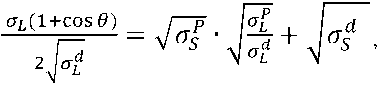
where σL is the surface tension of the working fluids;
σSd is the dispersion component of the surface tension of the working fluids;
σLP is the polar component of the surface tension of the working fluids;
σSd is the dispersion component of the surface tension of the material being studied;
Nanotechnologies in construction
Нанотехнологии в строительстве
2026; 18 (1): 159–166
Nanob
CONSTRUCTION MATERIALS SCIENCE
σSP is the polar component of the surface tension of the material being studied;
θ is the contact angle of the material being studied.
The dispersion component of the surface tension of the studied material (sand) σSd was determined as the tangent of the angle of inclination of the line to the abscissa axis, and the segment intercepted by the line on the ordinate axis is equal to the value of the polar component of the surface tension of sand σSP . At least five measurements were carried out for each sample.
The value of surface energy E was determined by the total surface area of the dispersed sample and was calculated using the following expression
E = σS sp , (2)
where σ is the surface tension of the quartz filler;
Ssp is the specific surface area of the quartz sand.
RESULTS AND DISCUSSION
Table 2 shows the results of the evaluation of the compressive strength of lime mortars.
Data analysis (Table 2) shows that metakaolin is the most effective additive in improving the strength of lime composites. The compressive strength of mortar after 28 days of curing is 2.1 MPa when using second-grade quicklime. Increasing the metakaolin dosage to 40% of the lime weight increases the compressive strength to 2.7– 3.1 MPa, allowing the production of artificial hydraulic lime without the addition of cement. All other pozzolanic additives, when added at a rate of 10% by weight of lime, failed to provide the required compressive strength of at least 2.0 MPa. Adding 25% of Portland cement to the formulation significantly increases compressive strength, ranging from 2.9 to 4.0 MPa, depending on the additive type, the type of lime, and the binder preparation technology. The use of air-blown quicklime in the preparation of artificial hydraulic lime promotes a more durable structure of the lime composite.
Table 3 shows the porosity values for limestone based on artificial hydraulic lime. The results show that the porosity of limestone based on artificial hydraulic lime is lower than that of limestone based on air-blown lime, and for limestone based on cement-based mortars, it is lower than that of limestone based on hydraulic lime.
Table 2. Compressive strength of lime mortar
|
No. |
Type of binder |
Compressive strength, MPa |
|
1 |
Air lime |
|
|
2 |
NHL Hydraulic Lime |
2.05 |
|
3 |
Air lime + Portland cement 25% |
2.9/3.2 |
|
4 |
Air lime + 10% metakaolin |
1.4/2.1 |
|
5 |
Air lime + 40% metakaolin |
2.7/3.1 |
|
6 |
Air lime + 10% microsilica |
1.2/1.6 |
|
7 |
Air lime + 10% microsilica + Portland cement 25% |
3.4/3.7 |
|
8 |
Air lime + diatomite 10% |
1.1/1.4 |
|
9 |
Air lime + dehydrated clay 10% |
1.3/1.5 |
|
10 |
Air lime + diatomite 10% + Portland cement 25% |
3.1/3.5 |
|
11 |
Air lime + 25% cement + 10% metakaolin |
3.7/4.0 |
Note. * Above the line are the values of the compressive strength when using slaked lime, below the line – when using non-slaked lime.
Table 3. Porosity of limestone
|
No. |
Type of binder |
Porosity, % |
Open pore volume, % |
Closed pore volume, % |
Water absorption, % by weight |
|
1 |
Control |
60 |
50 |
10 |
44 |
|
2 |
NHL Hydraulic Lime |
52 |
38 |
14 |
36 |
|
3 |
Air lime + 10% metakaolin |
57 |
46 |
11 |
34.8 |
|
4 |
Air lime + 40% metakaolin |
54 |
41 |
13 |
32.7 |
|
5 |
Air lime + 10% microsilica + 25% Portland cement |
51 |
41 |
10 |
36 |
|
6 |
Air lime + diatomite 10% + Portland cement 25% |
53 |
43 |
10 |
33 |
|
7 |
Air lime + 25% cement + 10% metakaolin |
48 |
39 |
9 |
31 |
Nanotechnologies in construction
Нанотехнологии в строительстве
2026; 18 (2): 159–166
Nanob
CONSTRUCTION MATERIALS SCIENCE
For example, the porosity of limestone based on natural hydraulic lime is 52%, while that of mortars with poz-zolanic additives and cement is 48–51%, with a decrease in closed pore volume observed.
The kinetics of lime binding with CaO during the hardening process was studied (Fig. 1).
An analysis of the experimental data indicates that the amount of free lime decreases over time. Thus, at 7 days, the amount of free CaO in the control sample was 85%, and at 28 days, 79% (Fig. 1, curve 1). In samples with the addition of metakaolin, the free lime content decreased to 64% by the 28th day of curing (Fig. 1, curve 2), and with the addition of metakaolin and cement, it decreased to 60% (curve 4).
The presence of free lime in hydraulic lime mortar ensures the self-healing of small cracks. This occurs as the lime in the mortar dissolves in water and, through evaporation, moves to the surface. The reaction between calcium hydroxide and atmospheric carbon dioxide gas forms calcite, which fills and seals the cracks.
When developing a plaster mortar formulation, the effect of quartz sand type on mortar strength was as- sessed. A thermodynamic method was used. To evaluate the optimal sand type, artificial hydraulic lime containing air-dried slaked lime and 40% metakaolin was used as a binder. The samples were cured in air-dry conditions. The results are presented in Table 4.
Analysis of the data presented in Table 4 indicates that with increasing surface free energy (SFE) values of quartz sand, an increase in the compressive strength of the limestone composite is observed. Thus, the compressive strength of the limestone composite based on Sura sand, characterized by a higher surface free energy (SFE) value of 70.285 mN/m, is 2.4 MPa, while that based on sand from the Chaadaevskoye deposit, whose surface free energy (SFE) is 62.8 mN/m, is 1.92 MPa
To summarize the above, it should be noted that the optimal sand from the energy point of view is the Sura deposit, which provides higher strength of the limestone composite.
Mortars based on artificial hydraulic lime provide sufficient bond strength to the brick substrate, amounting to 0.4–0.55 MPa (Fig. 2). The bond strength of
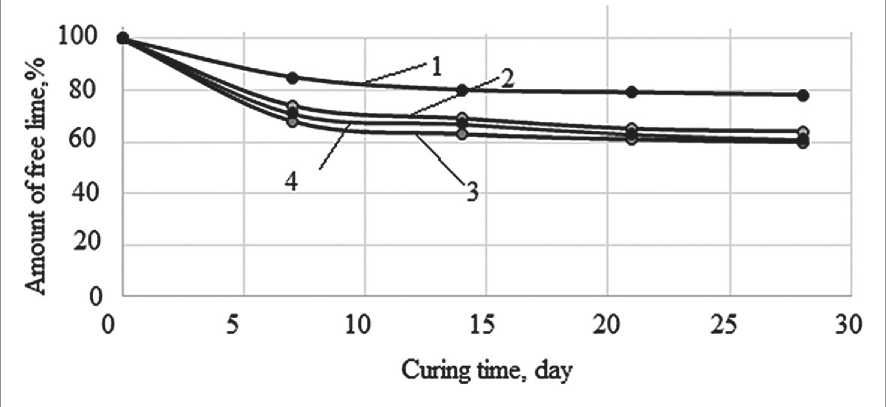
Fig. 1. Kinetics of changes in free CaO concentration in lime compositions: 1 – control lime composition without additives; 2 – artificial hydraulic lime (40% metakaolin additive); 3 – artificial hydraulic lime (10% metakaolin additive + 25% cement); 4 – artificial hydraulic lime (10% microsilica additive + 25% cement)
Table. 4. Surface free energy (SFE) values of quartz sands
|
Name of sand |
Polar component of the SEP, s |
Dispersion component of the SEP, s |
SEP, мДж/м2 |
Surface energy, J/kg |
Compressive strength, MPa |
|
Rtishchevsky |
50.48 |
18.49 |
68.97 |
593.142 |
2.1 |
|
Ramensky |
53.08 |
16 |
69 |
614.1 |
2.3 |
|
Nikolsky |
50.335 |
18.49 |
68.82 |
557.442 |
2.0 |
|
Sursky |
51.79 |
18.49 |
70.285 |
687.106 |
2.4 |
|
Chaadaevsky |
48.36 |
14.44 |
62.8 |
436.46 |
1.92 |
Nanotechnologies in construction
Нанотехнологии в строительстве
2026; 18 (1): 159–166
Nanob
CONSTRUCTION MATERIALS SCIENCE
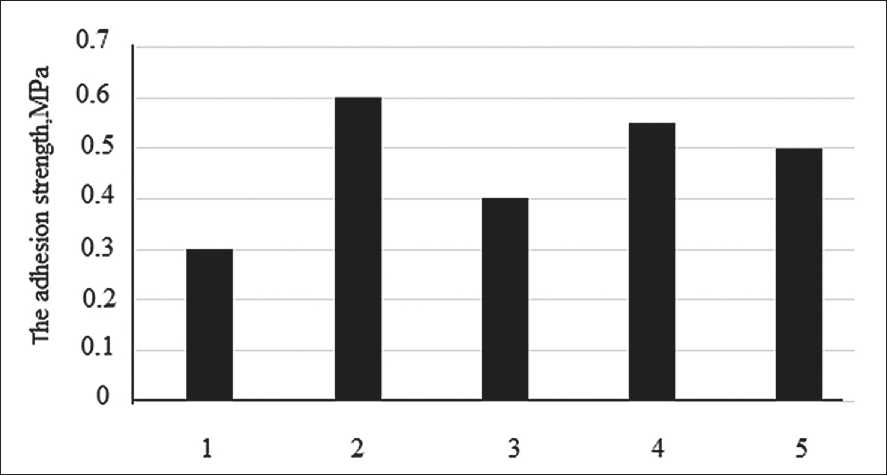
Fig. 2. The adhesion strength of mortar to a brick substrate: 1 – mortar based on air-dried lime; 2 – mortar based on hydraulic lime; 3 – mortar based on air-dried lime + 25% Portland cement; 4 – mortar based on slaked lime + 40% metakaolin; 5 – mortar based on quicklime + 10% metakaolin
mortar based on hydraulic lime is Rad = 0.6 MPa. The increase in adhesion strength is explained by the poz-zolanic reaction of metakaolin, which enhances the formation of calcium silicate hydrous gel (C–S–H), improving the microstructure and adhesive properties of the solution.
A comparison of the properties of a mortar based on artificial hydraulic lime HL with the properties of a mortar based on natural hydraulic lime NHL shows that the proposed formulation of artificial hydraulic lime meets the requirements of national and international regulatory documents (DIN 18550) in terms of achieving a minimum compressive strength of 2.0 MPa.
CONCLUSION
It has been established that the use of air quicklime in the preparation of artificial hydraulic lime contributes to a more durable formation of the structure of the lime composite. It has been revealed that the porosity of calcareous stone based on artificial hydraulic lime is lower than that of air lime–based stone, and for calcareous stone based on cement compositions – less than that based on hydraulic lime. Compositions of artificial hydraulic lime HL and plaster mortar based on it have been developed, intended for the restoration of cultural heritage sites and the finishing of newly constructed facilities.
