
Development of Effective Flame-Retardant Coatings for Textile Materials
Журнал: Вестник Алматинского технологического университета @vestnik-atu
Рубрика: Технология текстиля и одежды, дизайн
Статья в выпуске: 3 (153), 2026 года.
Бесплатный доступ
The article presents data on the development of technology for imparting flame-retardant properties to textile materials at the stages of final finishing. The increase in the functionality of textile materials is ensured through the introduction of effective processing methods using flameretardants and textile auxiliary substances that contribute to reducing flammability and increasing the heat resistance of materials, as well as the use of modern chemical and physical methods of intensification of technological processes. Technological solutions for processing textile materials have been developed, aimed at achieving the required level of flame-retardant characteristics while preserving the physical and mechanical properties of fabrics. Optimal parameters for the preparation of working solutions are selected: flame-retardant concentrations, component ratio, temperature and processing duration. The qualitative characteristics of the treated materials were studied, including uniformity of application and fixing of the flame-retardant coating, efficiency of reducing flammability, as well as changes in physical and mechanical indicators. The methods of processing providing stable fixation of flame retardants on the surface and in the structure of textile fibers are proposed. The introduction of the developed technology will improve the quality of textile materials by improving fire safety indicators, preserving operational and hygienic properties, as well as reducing energy costs and processing time. The results of the study can be used in the creation of modern technological processes for the production of textile materials from natural, chemical fibers and their mixtures with specified flame-retardant characteristics, including for special, protective, technical and household products.
Короткий адрес: https://sciup.org/140316632
IDS: 140316632 | УДК: 64.29.23 | DOI: 10.48184/2304-568X-2026-3-260-266
Разработка эффективных огнезащитных покрытий для текстильных материалов
В статье представлены данные о разработке технологии придания текстильным материалам огнезащитных свойств на этапах заключительной отделки. Повышение функциональности текстильных материалов обеспечено за счёт внедрения эффективных методов обработки с использованием антипиренов и текстильных вспомогательных веществ, способствующих снижению горючести и повышению термостойкости материалов, а также применения современных химических и физических методов интенсификации технологических процессов. Разработаны технологические решения по обработке текстильных материалов, направленные на достижение требуемого уровня огнезащитных характеристик при сохранении физико-механических свойств тканей. Подобраны оптимальные параметры приготовления рабочих растворов: концентрации антипиренов, соотношение компонентов, температура и продолжительность обработки. Исследованы качественные характеристики обработанных материалов, включая равномерность нанесения и закрепления огнезащитного покрытия, эффективность снижения воспламеняемости, а также изменение физико-механических показателей. Предложены методы обработки, обеспечивающие стабильное закрепление огнезащитных веществ на поверхности и в структуре текстильных волокон. Внедрение разработанной технологии позволит повысить качество текстильных материалов за счёт улучшения показателей пожарной безопасности, сохранения эксплуатационных и гигиенических свойств, а также сокращения энергозатрат и времени обработки. Результаты исследования могут быть использованы при создании современных технологических процессов производства текстильных материалов из натуральных, химических волокон и их смесей с заданными огнезащитными характеристиками, в том числе для изделий специального, защитного, технического и бытового назначения.
Текстиль материалдарына арналған тиімді отқа төзімді жабындарды әзірлеу
Мақалада текстиль материалдарына әрлеудің соңғы кезеңдерінде отқа төзімді қасиеттер беру технологиясын әзірлеу бойынша деректер ұсынылған. Текстиль материалдарының функционалдылығын арттыруға, жанғыштығын төмендетуге және термиялық төзімділігін жоғарылатуға ықпал ететін антипирендер мен текстильге арналған көмекші заттарды қолдана отырып, тиімді өңдеу әдістерін енгізу, сондай-ақ, технологиялық процестерді интенсификациялаудың заманауи химиялық және физикалық әдістерін пайдаланумен қамтамасыз етілген. Текстиль материалдарын өңдеу бойынша қажетті отқа төзімділік көрсеткіштеріне қол жеткізе отырып, маталардың физика-механикалық қасиеттерін сақтауға бағытталған технологиялық шешімдер әзірленді. Жұмыс ерітінділерін дайындаудың оңтайлы параметрлері таңдалды: антипирендердің концентрациясы, компоненттердің арақатынасы, температурасы және өңдеу ұзақтығы. Өңделген материалдардың сапалық сипаттамалары, оның ішінде отқа төзімді жабынның біркелкі жағылуы мен бекітілуі, тұтанғыштықтың төмендеу тиімділігі, сондай-ақ, физика-механикалық көрсеткіштердің өзгеруі зерттелді. Текстиль талшықтарының бетінде және құрылымында отқа төзімді заттардың тұрақты бекітілуін қамтамасыз ететін өңдеу әдістері ұсынылды. Әзірленген технологияны енгізу өрт қауіпсіздігі көрсеткіштерін жақсарту арқылы текстиль материалдарының сапасын арттыруға, эксплуатациялық және гигиеналық қасиеттерін сақтауға, сондай-ақ, энергия шығынын және өңдеу уақытын қысқартуға мүмкіндік береді. Зерттеу нәтижелері табиғи, химиялық талшықтардан және олардың қоспаларынан жасалатын, берілген отқа төзімділік сипаттамалары бар заманауи текстиль материалдарын өндірудің технологиялық процестерін әзірлеуде, соның ішінде арнайы, қорғаныш, техникалық және тұрмыстық мақсаттағы бұйымдар үшін қолданылуы мүмкін.
Текст научной статьи Development of Effective Flame-Retardant Coatings for Textile Materials
IRSTI: 64.29.23
Textile materials are widely used in various industries, construction, transport, medicine and the production of personal protective equipment. However, most textile materials, especially those made from natural cellulosic fibers, are characterized by high flammability, which significantly limits their scope and increases the risk of fires. In connection with the tightening of requirements for the safety of textile products, the development of effective methods for improving the fire-retardant properties of materials without worsening their performance is of relevance [1,2].
One of the most promising directions for solving this problem is the creation of flameretardant coatings that reduce flammability, the speed of flame propagation and the intensity of thermal decomposition of textile fibers. Modern flame-retardant coatings are formed based on flame-retardant compositions capable of forming a heat-resistant protective layer on the surface of the material, preventing oxygen access and heat transfer during combustion [3-5].
As flame-retardants for textile materials, special chemical compositions based on phosphorus, nitrogen, boron and silicon-containing compounds, as well as their combined systems, are used. These drugs can change the mechanism of thermal decomposition of textile fibers, reduce the release of combustible gases and contribute to the formation of a protective carbon layer on the surface of the material. The effectiveness of flame retardants is determined by their ability to be evenly distributed throughout the structure of the textile material and firmly fixed on the surface of the fibers, providing a stable protective effect in the operation of products [6-8].
The effectiveness of flame-retardant treatment is determined not only by the chemical composition of flame retardants used, but also by the technological parameters of their application, ensuring uniform distribution and strong fixation of functional components in the structure of the textile material. An important requirement for modern flame-retardant coatings is the preservation of physical and mechanical properties, air permeability and other quality indicators of textiles while increasing their fire resistance [9-11].
At present, considerable attention is being paid to the development of new functional coatings and technologies for modifying textile materials to increase their resistance to high temperatures and open flames. In this regard, an urgent task is to create effective flame-retardant coatings that provide a high level of protection and stability of the operational properties of materials [12-13].
The purpose of this work is to develop an effective flame-retardant coating for textile materials, study its effect on fire resistance indicators and assess the possibility of using the developed technology to obtain textile products with increased protective properties [14,15].
Materials and methods
To impart flame retardant properties to cotton and mixed textile materials (50 % cotton and 50 % polyester), a composition based on liquid glass, melamine and urea was used. The working solution was prepared as follows: in one liter of distilled water dissolved 150-180 g of liquid glass (Na 2 SiO 3 ) with constant stirring until a homogeneous system. Then, 40–60 g of melamine and 20-30 g of urea were sequentially administered, providing intense stirring until a stable suspension was formed. To improve the wetting of the textile material, 0.5-1.0 g of a non-ionic surfactant was additionally introduced into the composition.
The processing of cotton and mixed textile materials was carried out by impregnation until uniform absorption of the working solution was achieved. After impregnation, the samples were pressed to remove the excess composition, then dried at a temperature of 80–100 °C to a constant mass. The final thermofixation was carried out at elevated temperature to form a stable flame-retardant coating on the surface and in the structure of the fibers.
The resulting composition provides the formation of an inorganic protective layer that increases the fire resistance of the textile material due to the synergistic action of the silicate matrix and gas-forming components [16].
Measurement of mass, humidity and control of technological parameters were carried out using laboratory equipment: drying cabinet SHS-80-01 MK SPU, humidity analyzer MA 210.X2.IC.A (RADWAG), analytical balance AS 220.R2 PLUS, as well as hood LAB-1500 SHVN. The air permeability of textile materials was determined on the MT-160 device [17], and the discontinuous characteristics were investigated using the rupture machine RT-250M.
Results and discussion
As a result of the processing of textile materials of various fibrous compositions of the developed flame-retardant composition, the formation of a stable functional coating on the surface and in the structure of the fibers was established.
For cotton material, the original samples were characterized by high flammability, rapid ignition and complete burnout without forming a stable residue. After treatment, there was an increase in ignition time, a decrease in the intensity of combustion and the formation of a carbon residue that preserves the structure of the material.
For the mixed material, the original samples demonstrated the features of thermal behavior, expressed in the combustion of the cotton component and the melting of the polyester phase with the possible formation of melt drops. After applying the flame-retardant composition, a decrease in the speed of flame propagation, a decrease in the severity of drop fall and partial selfextinguishing of the material, table 1.
It is established that the differences in fireretardant effect are due to the peculiarities of the fibrous composition. In the case of cotton, the main mechanism is the formation of a carbon protective layer under the action of an inorganic-organic system. For a mixture material, an additional role is played by the stabilization of the surface of the polyester phase and the reduction of thermal destruction due to the barrier action of the coating.
Table 1. Effects of flame-retardant treatment on the behavior of textile materials
|
No. |
Sample material |
Composition |
Time of ignition, with |
Nature of combustion |
Residue after combustion, % |
Fire protection effect |
|
1 |
100 % cotton |
untreated |
2–4 |
fast ignition, complete burnout |
0–5 |
absent |
|
2 |
100 % cotton |
treated |
15-20 |
slow burning, formation of carbon layer |
50-65 |
pronounced |
|
3 |
50 % cotton / 50 % PE |
untreated |
3–6 |
melting-and-dropping combustion |
5-10 |
absent |
|
4 |
50 % cotton / 50 % PE |
treated |
12-16 |
reducing the intensity of combustion, partial selfextinguishing |
45-60 |
pronounced |
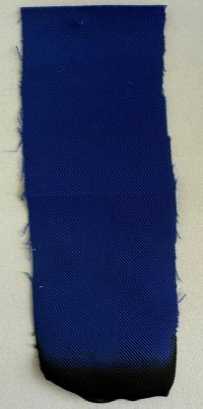
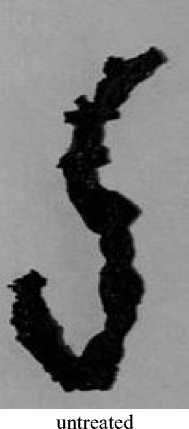
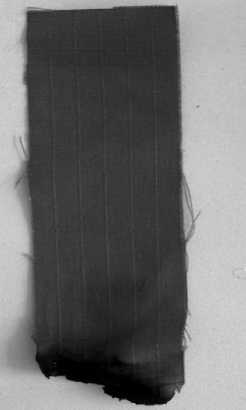
The joint action of liquid glass, melamine and urea provides the formation of a heat-resistant protective layer and gas-phase inhibition of the combustion process, which leads to an increase in the fire resistance of both cellulose and mixed textile materials, figure 1.

untreated
100 % cotton
treated
100 % cotton
50 % cotton / 50 % PE
treated
50 % cotton / 50 % PE
Figure 1. Comparison of burning of processed and untreated samples of textile materials
As follows from the data presented, flame retardant treatment leads to an increase in ignition time, a decrease in the intensity of combustion and an increase in the residue after thermal exposure for both cotton material and for mixed fabric. The most pronounced effect is observed for the cellulose fibrous composition, which is associated with the formation of a carbon protective layer. For a mixture material, a decrease in the effect of droplet polyester phase is additionally noted.
The influence of flame retardant treatment on the fracturing characteristics of textile materials of various fibrous composition, table 2 is investigated.
It is established that after processing there is a change in the mechanical properties of the samples. For cotton material, a slight decrease in burst load was noted, which is associated with the formation of the surface coating and an increase in the rigidity of the fiber structure.
For mixed material, the starting samples demonstrate higher tear load values compared to pure cotton fabrics, due to the contribution of the polyester component. After processing, a decrease in burst load is also recorded, but it remains within the limits that do not have a critical impact on the performance properties of the material.
The decrease in strength indices is explained by a change in the interfiber interaction and a partial limitation of the mobility of macromolecular chains due to the formation of a functional coating on the surface and in the structure of the textile material.
Thus, flame retardant treatment leads to a moderate change in mechanical characteristics while maintaining the structural integrity of the materials, which allows us to consider the developed technology as promising for obtaining functional textile materials.
Table 2. Disaggregated characteristics of textile materials
|
No. |
Sample material |
Composition |
Breaking load, H |
Elongation at rupture, % |
Change after processing |
|
1 |
100 % cotton |
untreated |
320–380 |
8–12 |
- |
|
2 |
100 % cotton |
treated |
290–340 |
7-10 |
decrease of 9-11 % |
|
3 |
50 % cotton / 50 % PE |
untreated |
380–450 |
12-18 |
- |
|
4 |
50 % cotton / 50 % PE |
treated |
350–410 |
10-15 |
decrease of 8-9 % |
As follows from the data presented, flame retardant treatment leads to a slight decrease in burst load and elongation at rupture for all studied textile materials. At the same time, the mixed material demonstrates higher absolute values of strength characteristics compared to the cotton material both before and after processing.
The effect of flame-retardant treatment on the air permeability of cotton and mixed textile materials, table 3 is investigated. It was established that after applying a flame-retardant coating, there is a decrease in the air permeability of all studied samples. This effect is expressed both for cotton material and for mixed fabric.
Raw samples are characterized by higher air permeability values, due to the open porous structure of the textile fabric and the absence of surface barrier layers. After processing, a decrease in this indicator is recorded, which is associated with partial filling of the inter fiber space and the formation of a continuous functional coating on the surface of the fibers.
Table 3. Air permeability of textile materials
|
No. |
Sample material |
Composition |
Permeability, dm3/(m2·s) |
Change after processing |
|
1 |
100 % cotton |
untreated |
180–220 |
- |
|
2 |
100 % cotton |
treated |
160–200 |
decrease of 9-11% |
|
3 |
50 % cotton / 50 % PE |
untreated |
200–240 |
- |
|
4 |
50 % cotton / 50 % PE |
treated |
180-220 |
decrease of 8-10 % |
As follows from the data presented, the most noticeable decrease in air permeability was noted for cotton material, which is due to the high hygroscopicity and developed capillary structure of cellulose fibers, contributing to a more intensive fixation of the flame-retardant layer. In a mixture material, the decrease in the index is expressed to a lesser extent, which is due to the presence of a polyester component that has a smoother and less porous surface.
Despite the decrease in air permeability, the obtained values remain within the limits ensuring satisfactory hygienic and operational properties of textile materials, which indicates a balanced nature of the developed flame-retardant treatment, in which the increase in fire resistance is achieved without critical deterioration of material comfort. Thus, fire retardant treatment leads to a natural decrease in air permeability due to the formation of a protective coating, which confirms the successful consolidation of the functional layer on the surface of textile fibers.
Conclusion
As a result of the studies conducted, the effectiveness of flame-retardant processing of cotton and mixed textile materials was established. It is shown that the application of the developed composition contributes to the formation of a stable protective layer on the surface and in the structure of the fibers, which leads to an increase in the fire resistance of textile materials.
For cotton material, a more pronounced flame-retardant effect is observed compared to the mixed material, which is manifested in a more significant decrease in flammability, an increase in the time to ignition and the formation of a stable carbon residue that preserves the integrity of the structure after thermal exposure.
It was also found that flame retardant treatment leads to a slight decrease in rupture characteristics and air permeability, which is associated with the formation of a surface functional coating and a partial change in the pore structure of the material. At the same time, the main performance properties of textile materials remain at a satisfactory level.
Thus, the developed technology provides a significant increase in fire safety of textile materials with minimal negative impact on their physical, mechanical and hygienic indicators, which confirms the prospects of its practical application for the creation of functional textile materials for various purposes.
Gratitude, conflict of interest (funding)
The research was carried out within the framework of a project funded by the Science Committee of the Ministry of Science and Higher Education of the Republic of Kazakhstan (IRN AP26195961 "Development of technology for obtaining new textile materials with special properties").
