
Ethnoecological traditions in the context of the sustainable development of the modern fashion industry
Journal: Bulletin of Almaty Technological University @vestnik-atu
Section: Технология текстиля и одежды, дизайн
Article in issue: 1 (151), 2026.
Free access
The article is devoted to the study of ethnoecological traditions as an example of harmonious relationship between nature and human for the development of sustainable fashion. The work reveals parallels between traditional practices and modern environmental approaches. The analysis of global and Kazakhstan design solutions related to the actualization of cultural heritage in the context of eco-design is carried out. Particular attention is paid to studying the peculiarities of ethnoecological traditions in designing Kazakh national costume, representing a naturally formed environmentally sustainable system. The philosophical understanding of clothing expressed the creative and contemplative attitude of the Kazakh people to the world. It was based on a deep intuitive awareness of the life value of all elements of the universe. The relevance and consonance of such ecological thinking to the present is noted. In accordance with the purpose of the article, an experimental author's model of a women's shapan in ethnic style has been developed, which is characterized by comfort, versatility, mobility, durability, and deep meaning. The results obtained are aimed at contributing to the global discourse on sustainable fashion based on cultural heritage. It is determined that the preservation, transmission and adaptation of ethnoecological culture, traditional knowledge, and practices is an integral component of sustainability, contributing to the formation of a responsible attitude towards the environment, society, wardrobe, education of aesthetic taste, as well as the actualization of craft traditions.
Similar articles in the section Home economics. Domestic science. Housekeeping




Short address: https://sciup.org/140314168
IDS: 140314168 | UDC: 64.33.14 | DOI: 10.48184/2304-568X-2026-1-210-219
Этноэкологические традиции в контексте устойчивого развития современной индустрии моды
Статья посвящена исследованию этноэкологических традиций как примера гармоничных взаимоотношений между природой и человеком для развития устойчивой моды. В ходе работы выявляются параллели между традиционными практиками и современными экологическими подходами. Проводится анализ мировых и казахстанских дизайнерских решений, связанных с актуализацией культурного наследия в контексте экодизайна. Особое внимание уделяется изучению особенностей этноэкологических традиций проектирования казахского народного костюма, представляющего собой естественно сформированную экологически устойчивую систему. В философском понимании одежды выражалось созидательное и созерцательное отношение казахского народа к миру. Оно основывалось на глубинном интуитивном осознании ценности жизни всех элементов Вселенной. Отмечается актуальность, созвучность подобного экологического мышления настоящему времени. Согласно цели статьи разработана экспериментальная авторская модель женского шапана в этностиле, для которой присущи комфорт, универсальность, мобильность, долговечность, глубокая смысловая нагрузка. Полученные результаты направлены на внесение вклада в глобальный дискурс об устойчивой моде, опирающейся на культурное наследие. Определено, что сохранение, передача и адаптация этноэкологической культуры, традиционных знаний и практик является неотъемлемым компонентом устойчивости, способствующим формированию ответственного отношения к окружающей среде, социуму, собственному гардеробу, воспитанию эстетического вкуса, а также актуализации ремесленных традиций.
Қазіргі сән индустриясының тұрақты дамуы контекстіндегі этноэкологиялық дәстүрлер
Мақала тұрақты сәнді дамыту үшін табиғат пен адам арасындағы үйлесімді қатынастардың мысалы ретінде этноэкологиялық дәстүрлерді зерттеуге арналған. Жұмыс барысында дәстүрлі тәжірибелер мен заманауи экологиялық тәсілдер арасындағы параллельдер анықталады. Экодизайн контекстінде мәдени мұраны жаңғыртуға байланысты әлемдік және қазақстандық дизайн шешімдері талданады. Табиғи қалыптасқан экологиялық тұрақты жүйе болып табылатын қазақ ұлттық костюмін жобалаудың этноэкологиялық дәстүрлерінің ерекшеліктерін зерттеуге ерекше назар аударылады. Киімнің философиялық түсінігінде қазақ халқының әлемге шығармашылық және ойшылдық көзқарасы көрініс тапты. Ол Ғаламның барлық элементтерінің өмірлік құндылығын терең интуитивті түсінуге негізделген. Осындай экологиялық ойлаудың қазіргі заманға өзектілігі мен үйлесімділігі атап көрсетілген. Мақаланың мақсатына сәйкес этностильдегі әйелдерге арналған шапанының эксперименттік авторлық үлгісі жасалды, ол үшін жайлылық, көпқырлылық, қозғалғыштық, беріктік, терең мағына тән. Нәтижелер мәдени мұраға негізделген тұрақты сән туралы жаһандық дискурсқа үлес қосуға бағытталған. Этноэкологиялық мәдениетті, дәстүрлі білім мен тәжірибені сақтау, жеткізу және бейімдеу тұрақтылықтың ажырамас бөлігі болып табылады. Ол қоршаған ортаға, қоғамға, өз гардеробына жауапты көзқарасты қалыптастыруға, эстетикалық талғамды дамытуға және қолөнер дәстүрлерін жаңғыртуға ықпал етеді.
Text of the scientific article Ethnoecological traditions in the context of the sustainable development of the modern fashion industry
IRSTI 64.33.14
In today's rapidly evolving consumer society, the relationship between the fashion industry and the ecosystem continues to be reevaluated. The theme “Towards zero waste in fashion and textiles” of the International Day of Zero Waste 2025, organized by the United Nations Environment Programme (UNEP) and the United Nations Human Settlements Programme (UN-Habitat), highlights “the need for action in the fashion and textile sector to reduce waste and advance circular solutions” [1]. This sector has been a major contributor to the environmental crisis and continues to accelerate the ecological disaster. It has been noted that “the fashion industry is responsible for an estimated 2-8% of global greenhouse gas emissions annually” [2].
According to Uniform Market data, water consumption by industry increased by 20.57 percent between 2015 and 2025, reaching 170 billion cubic meters, while land use amounted to 41 million hectares, which is 7.89 percent higher than in 2015 [3]. In addition, “сonsumers around the world produce 92 million tonnes of textile waste every year” [4].
Laundering of synthetic textiles leads to ocean pollution. For example, according to the IUCN report for 2017, it has become the source of 35 percent of all ocean microplastics [5].
In addition to environmental problems, including biodiversity loss, there is a negative impact on society, which is reflected not only in the culture of single-use, linear “take, make, dispose” model, but also in unsafe working conditions of garment workers, exploitation and genderbased discrimination [6].
In view of existing environmental problems, the development of sustainable fashion is significant. It affects all stages of a product's life cycle and includes “safe and ethical working conditions, responsible consumption of natural resources and fashion products, minimization or elimination of waste, transparency of production information, optimization of logistics, and the search for new technologies” [7]. The most widespread concept of sustainable development is based on the so-called three pillars: social, economic, and environmental [8]. However, some studies consider additional areas related to aesthetic sustainability and longevity, emotional value [9], and cultural resilience [10].
The purpose of this article is to develop an experimental author's model of a shapan based on the study of the ethnocultural traditions of the Kazakh people. The tasks set include the analysis of design solutions related to the actualization of cultural heritage in the context of eco-design. The study reveals aspects of the interaction between eco-and ethno-design, examines the features of the ethnoecological traditions of nomadic peoples, in particular the Kazakhs, as well as their modern interpretation. The work of contemporary international and Kazakhstan designers demonstrates an enduring interest in the application of traditions in the creation of XXI century clothing models. This is due to the creative pursuits of fashion designers, as well as growing consumer demand for ethics, environmental friendliness, preservation of cultural identity, and the desire for self-expression and identification. At the same time, there are open questions and gaps, including insufficient disclosure of the possibilities of using traditional techniques to create unique products and the fragmentary nature of interdisciplinary research, which requires further research and experimentation.
Materials and research methods
“The geographical, climatic, and ecological determinants of the formation and development of ethnic groups suggest that each people develop a specific culture of relations with the environment – an ethnoecological culture. It is one of the most ancient subsystems of culture, encompassing values, norms, and forms of activity directly or indirectly related to the natural environment of a people” [11].
Ethnoecological culture is reflected in traditions that preserve the experience of harmonious coexistence aimed at preserving the ethnic group and the ecological sustainability of the environment. One of the issues related to the analysis of ethnoecological traditions is the applicability of norms, values, and techniques in modern clothing. The study shows obvious parallels between traditional practices and modern environmental approaches, presented in table 1.
Table 1. Parallels between traditional practices and modern environmental approaches
|
Ethnoecological traditions |
Modern environmental approaches |
The general idea |
|
Use of natural materials (linen, wool) and dyes |
Organic materials, biodegradable fabrics, eco-friendly dyes |
Naturalness and environmental safety |
|
Local materials and local production |
Local fashion, reducing transport footprint |
Minimising environmental impact, supporting local artisans |
|
Clothing designed for long-term wear |
Slow fashion, rational wardrobe, emphasis on quality and durability |
Reducing overconsumption |
|
Repair, darning, re-sewing |
Upcycling |
Extending the life of things, adding new value |
|
Recycling of raw materials |
Recycling |
Recycling waste with loss of quality |
|
Full use of fabric, patchwork |
Zero waste |
Waste reduction, conserving resources |
|
Passing down items |
Freecycling |
Preserving the life of things through transfer |
|
Custom tailoring |
Customisation, handmade |
Expressing individuality as opposed to mass production |
|
Clothing suited to the climate and need |
Functional and rational fashion |
Practicality instead of excess |
|
Ethical sourcing of raw materials (full use, respect for natural cycles) |
Ethical animal husbandry, certified materials |
Responsibility towards the environment and animals |
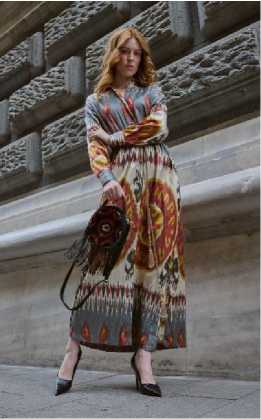
The application of ethnoecological traditions through the modernization of cultural heritage can be seen in the works of world designers (Fig. 1). The characteristic features of African cultural heritage, shaped by conditions such as heat, drought, and seasonal rains, can be seen in the works of Adebayo Oke-Lawal (Orange Culture), Ria Ana Sejpal (Lilabare), and Travis Obeng-Casper (AJABENG). Transforming socially significant stories into clothing, the Orange Culture brand combines universal silhouettes, modern androgynous clothing, and African aesthetics, working with traditional fabrics, prints, and colours. The brand's products are made in Lagos from environmentally friendly fabrics sourced from local
Nigerian manufacturers. The conscious, slow, ethical production of the Lilabare brand, inspired by the cultures of Kenya and India, is reflected in the use of: naturally grown materials; agricultural waste (pineapple and banana leaves, old shells and locks, used coffee grounds); craft traditions (weaving, spinning, dyeing); a zero-waste approach; and digital technologies. Each of the brand's products is a living canvas, woven by the hands of its creators, embodying respect for the value of materials and awareness in creation. AJABENG demonstrates the purity and expressiveness of African culture through a combination of post-colonial optimism and panAfrican spirit. The desire to create a sustainable fashion ecosystem is emphasised by a commitment to fair working conditions and the use of biodegradable materials. The use of environmentally friendly technologies and materials, traditional craftsmanship in ethnic-style clothing, ethical production methods, and support for local farmers and artisans are characteristic of South African brands MaXhosa by Laduma and Sindiso Khumalo, Kenyan brands Lalesso and SOKO, as well as brands KISUA, Lemlem, Studio 189, Maisha Concept, and Mafi Mafi.
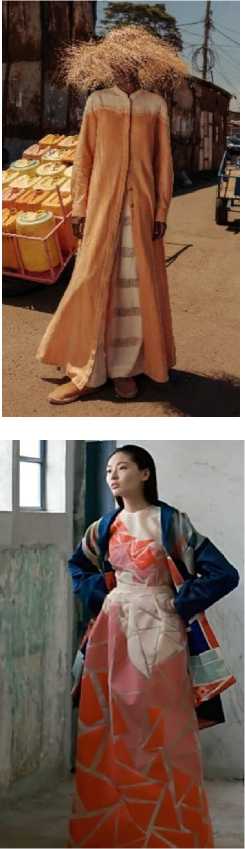
Figure 1. Lilabare, Cecilie Bahnsen, Amaud, Bibi Hanum

The uniqueness of the ethnoecological traditions of the peoples of Denmark, Sweden and Norway is linked to the harsh northern way of life. Contemporary clothing embodies traditional features that are important for eco-friendly fashion, such as comfort, functionality, practicality, conciseness, minimalism, quality, layering and the use of natural materials. The minimalism inherent in this culture is expressed today in the simplicity of forms and cuts, the absence of unnecessary details, and in colour (monochrome) and pattern.
The Swedish brand Fjallraven (polar fox) is an example of how Scandinavian ethnoecological traditions are being transformed into modern ecological practices. The brand is characterised by minimalism, functionality, durability and ecofriendliness. Fjallraven creates clothing for active leisure and everyday wear (Everyday Outdoor), as well as equipment that lasts for decades and harmonises with nature. The brand pays attention to ergonomics, develops innovative materials (G-1000, Eco-Shell, Vinylon F), uses organic and recycled materials (more than 60%), and does not use PFC impregnations. In addition, the brand has developed a programme to extend the life of its products.
Combining French haute couture and Scandinavian restraint, the Cecilie Bahnsen brand creates feminine clothing by hand from unique materials. The brand's key principle is an ecological philosophy of durability: timeless pieces are created to be worn, then passed down and reimagined to reflect the owner's individuality. This approach resonates with the traditional northern view of the value of manual labour and careful treatment of items, extending its life cycle. The Norwegian fashion house Holzweiler creates functional and thoughtful designs with respect for nature, focusing on durability, sustainability and social responsibility, inspired by art, architecture and Norwegian nature. The brand's main categories: outerwear, knitwear and winter accessories reflect its respect for its Norwegian roots. The brand applies the principles of sustainable development, circular design principles and technical innovation, creates decent working conditions, works with partners on social and environmental responsibility, and demonstrates a humane attitude towards animals.
Ideas of harmony with nature, moderation, and the interconnectedness of the world are reflected in Japan's philosophical and worldview principles. A close connection to tradition is one of the defining features of Japanese clothing design, where cultural heritage is reinterpreted through the prism of modern technology and eco-conscious thinking.
The Amaud brand, focused on craftsmanship, design, social and environmental change, pays tribute to the past in the process of creating products for the present and the future. The brand breathes new life into vintage kimonos using the upcycling method. Amaud preserves the beauty of traditional fabrics by reinterpreting them in relevant forms. The products are created with the desire to continue Japanese craftsmanship and pass it on to the next generations, reflecting the timeless design philosophy. The careful creation process includes disassembly, manual cleaning, and transformation. Art, craftsmanship and cultural heritage are united by MUSKAAN. The brand also works with the concept of recycling rare vintage kimonos, creating new values through modern design and traditional material (silk), revising the aesthetic sense inherent in Japanese culture in accordance with the trends of the time. The creativity of Issey Miyake is based on technology and tradition, the principles of versatility, comfort, versatility and long-term use of things. The designer's innovative technology for making pleated fabric has made it possible to create lightweight, durable, comfortable to wear and easy to care for items. His approach to shaping from a single piece of fabric is particularly significant, meeting modern environmental requirements for minimizing waste and embodying the traditional idea of respecting the material.
Ethnoecological traditions are actualized by designers of Uzbekistan. The socially responsible fashion house Bibi Hanum combines the traditional handicraft skills of Uzbekistan with modern principles of sustainable production. Unique products bearing the history, soul of the master and environmental responsibility are created from natural fabrics (silk, cotton), hand-dyed using the ancient ikat technique and woven on a traditional loom. The brand supports women artisans by providing sustainable economic opportunities, preserves cultural and ethnographic heritage. In addition to creating modern handmade designer clothes using natural materials, ikat techniques, and embroidery, the Moel Bosh brand is engaged in textile recycling. Tissue fragments left after the manufacturing process get a second life. With the help of the traditional “kurаk” technique (an analogue of patchwork), these remnants turn into the basis for creating new unique products.
Let us consider the characteristics of ethnoecological traditions reflected in the material and spiritual culture of nomadic peoples, in particular the Kazakhs.
The history of nomadic civilization demonstrates an organic connection and harmonious coexistence with nature, determined by the perception of the surrounding world as a holistic, spiritual space. “The unified Kazakh cosmology was characterized by the absence of opposition between the material and the ideal, in connection with which everyday life and the space surrounding a person, including clothing, were endowed with sacred meaning” [12]. The creation and contemplation of the ever-moving and changing nature in the process of their own movement, adaptation to harsh environmental conditions, as well as to the surrounding peoples, formed the ecological consciousness of nomads. It incorporated such key aspects that determined the peculiarities of their mentality and way of life, such as:
-
- involvement in the cyclical cycle of the universe;
-
- harmony, integrity and inseparability from the universe;
-
- the value of life of all elements that make up the universe;
-
- the importance of caring for the environment and protecting it from destruction caused by economic activity;
-
- the ecological imperative as “the most important socio-cultural regulator of human life” [13];
-
- rational use and conservation of natural resources through continuity in the development of society's ecological culture.
Harmony observed in the surrounding reality was transformed and manifested in the social structure, economic system, interpersonal relations, spiritual values, and inner world of the Kazakh-nomads, forming the basis of national culture. Ecological thinking was reflected in the material culture of the people, including their clothing. The national worldview was clearly established through a special sign system, logically verified structure demonstrating the strong interconnection between human, society and nature. The image of a person in costume, denoting a certain boundary between the microcosm and the macrocosm (the body and the world), was directly related to such fundamental mythopoetic constants as the axis of the world, the Model of the World, the World Tree, and the World Mountain.
Based on the characteristics of three components of environmental design: technological, substantive, and aesthetic, studied in the article by G.I. Petushkova and N.S. Kurilina [14], a model has been developed that reveals the ethnoecological principles of designing national clothing. The principles of traditional Kazakh costume (Fig. 2), created for a mobile lifestyle in difficult natural and climatic conditions, reveal its uniqueness and integrity, adaptability and balance with the steppe ecology, as well as its relevance to the present day.
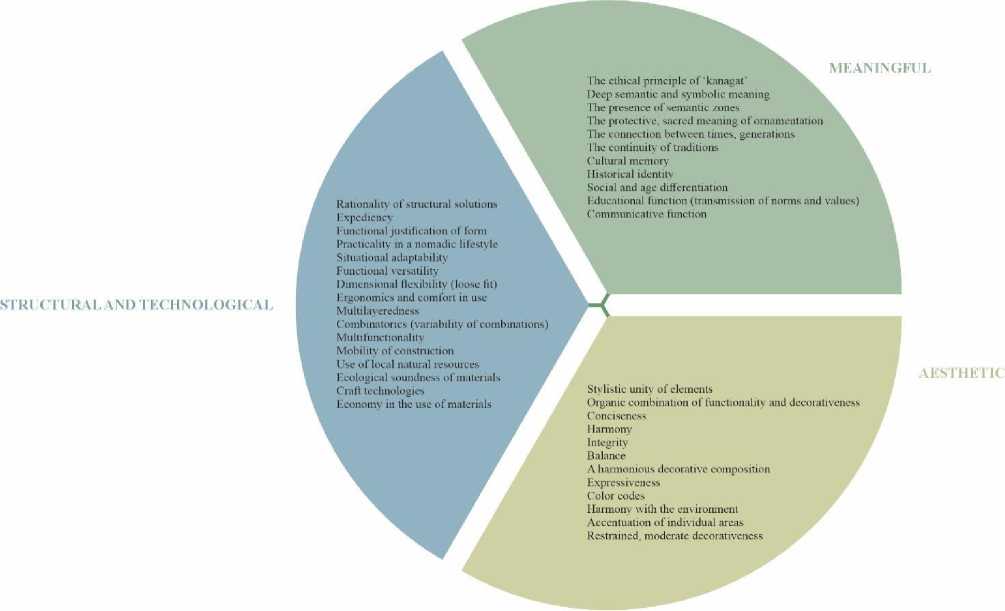
Figure 2. Principles of traditional Kazakh costume
References to certain principles of traditional costume can be seen in the works of domestic designers (Fig. 3), which is natural: ideas of slow fashion oriented towards ecology, conscious consumption and respect for traditions are becoming more important [15].
The modern vision of the nomadic heritage of the Great Steppe by the Global Nomads brand is expressed in the use of symbolic codes, talismans, and a consumption paradigm based on responsibility, meaning, and distinctive style instead of disposability, emptiness, and short-lived fashion. According to the brand’s key concept, all items, even those purchased from different collections, can be easily combined, which is especially important when travelling. This is due to the use of a sustainable signature natural palette and minimalist design. The products are manufactured in a ten-stage cycle at the brand's own factory in Kazakhstan. Supporting the idea of sustainability and environmental friendliness, the brand works with high-density biodegradable materials that are characterised by a longer wear life.
Rare remnants from collections are used for the upcycle line. Global Nomads constructs the image of neo-nomads - “the traveling persons”, who are open to the world, progressive [16], tolerant, freely wandering through the earthly and digital spaces of the future, exploring the world and treating it with care.
The recreation of national motifs and an ecological focus can be seen in the works of Artmasterr.kz. Modern ethnic-style products are developed using upcycling. The use of non-standard cuts, asymmetry, and patchwork techniques, reflecting the traditional eco-friendly quraq technique, is characteristic of the august brand, which creates ethnic-style garments.
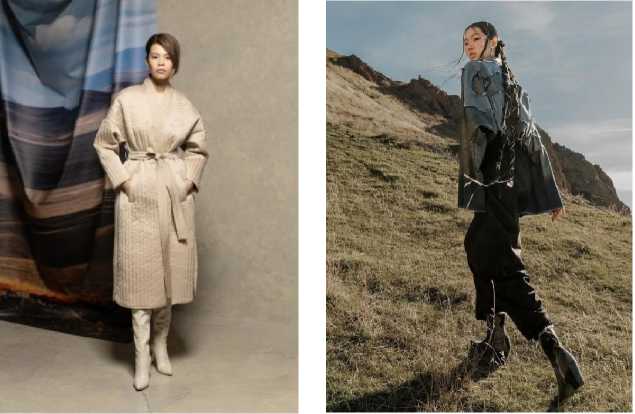
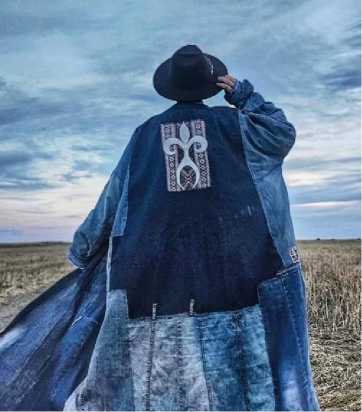
Traditional eco-friendly material – felt, which has low thermal conductivity, good air permeability, abrasion resistance, dimensional stability, plasticity, softness and lightness – is used by brands such as Aya Bapani and Aigul–Line. This material makes it possible to create ergonomic garments without unnecessary waste, with a minimum of construction lines, seams, and edge treatments.
Results and discussion
In the context of this work, a study of the Kazakh national shapan was conducted with a view to its subsequent modernisation.
The shapan is an outer garment that opens at the front. It was widely used and came in different varieties: light, with or without a wool lining, quilted, and broadcloth. It was worn in both warm and cold weather. The spacious, straight-cut shapan had no fastenings (sometimes there were ties at chest level), with an elongated shoulder line and long, wide sleeves that tapered towards the bottom. The length of the garment varied from short (knee-length) to long (mid-calf or ankle-length). The long sleeves covered the hands and could serve as mittens. Early versions of the shapan had a tunic-like cut with an open collar, but later the back and front were cut separately, the length of the shoulders and sleeves was reduced, and the collar was either turn-down or stand-up.
The shapan was characterised by bright colours and a variety of materials: plain, patterned (due to the spread of Russian calico), and striped (under Uzbek influence). The garment was decorated with contrasting fabric around the edges, embroidery, and a strip of fur. Like other components of traditional costume, the shapan was created according to the ‘laws of beauty’ and had a strong aesthetic impact on the wearer [17].
Based on an analysis of this type of product, its modernisation using an environmentally friendly approach has been proposed (Fig. 4): the shapan consists mainly of rectangles, which means minimal waste from cutting; the removable scarf collar allows it to be used for different purposes (formal/casual), extends its service life, and reduces the impact on the environment.

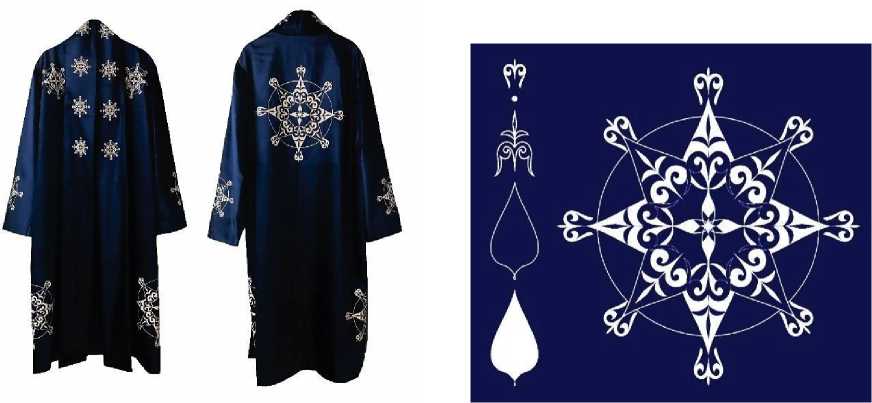
Figure 4. Experimental model. Author's ornamental composition
An experimental model made of velvet, with a straight silhouette, wide straight set-in sleeves, and slightly dropped shoulders.
The garment is designed for young women aged 30-45.
The colour of the garment is blue, symbolising peace, the eternal clear sky [18], and the water element in traditional culture, expressing tranquillity of the soul and well-being, and serving as a talisman against treachery and misfortune.
The collar-scarf has a mobile button connection.
The stylised ornamental composition is a module that is applied on various scales. The distribution of the ornament is linked to the desire to create visual harmony. The module itself consists of several elements that have sacred meaning. Overall, the composition embodies the idea of well-being, prosperity and protection. The white colour used in it has been a sign of noble qualities, purity and justice since ancient times. It is important to understand that studying ornamental heritage cultivates artistic taste, shapes creative potential and contributes to the development of creativity and ingenuity.
The ornament is applied using modern technology – flex printing. Flex is a modern, high-quality method of applying images to textiles and other materials using thermal transfer film. Flex printing resembles appliqué on fabric. The resulting image stands out due to its texture and can be enhanced with optical and tactile effects.
The image application process consists of several stages:
-
1 Layout creation;
-
2 Film cutting;
-
3 Removal of excess elements;
-
4 Thermal transfer to the product.
Advantages of flex technology:
-
– High durability – withstands repeated washing, does not fade or crack over time.
– Bright and saturated colours – the film provides an even coating without streaks or gradients.
– Elasticity – the applied image does not restrict movement and does not deform when the fabric is stretched.
Flex is practically a manual process, so it is used for small print runs. This instant and practical technology allow images to be applied to products quickly and with high quality. The printing process allows working with complex materials: cotton, polyester, nylon, leatherette and other surfaces.
Thus, in the developed experimental model, traditions are transformed through the prism of the author's vision and combined with modern technologies, which opens up new facets in the design of ethnic clothing in the context of ecofashion.
Conclusion
The study reveals the importance of ethnoecological traditions as a valuable resource for sustainable fashion. Analysis of traditional Kazakh costume and its philosophical foundations shows that nomadic ideas about harmony between humans and nature are relevant today, offering models of conscious and responsible consumption that are in tune with our times. The experimental model of a women's shapan developed as part of the study demonstrates the possibility of organically combining cultural heritage and modern technologies in the context of eco-design. The study deepens the understanding of the potential of traditional costume in modern fashion, contributes to the preservation of ethnoecological heritage and the development of ecological culture. The way forward is undoubtedly to rethink consumption patterns, increase attention to environmental friendliness, and create durable products that are functional, expressive, and imbued with important meanings.
