
Family Values Reflected in Phraseological units of the English, Chinese, and Kyrgyz Languages
Journal: Bulletin of Science and Practice @bulletennauki
Section: Социальные и гуманитарные науки
Article in issue: 9 т.12, 2026.
Free access
This article presents a comparative linguocultural analysis of phraseological units reflecting family values in the English, Chinese, and Kyrgyz languages. Phraseological units serve as important carriers of cultural knowledge and provide insights into the worldviews, traditions, and social norms of different linguistic communities. The study examines the linguistic representation of family relationships, parental authority, kinship ties, respect for elders, family unity, and intergenerational responsibilities as reflected in idiomatic expressions and proverbs. Through a comparative analysis, the research identifies both universal and culture-specific features of family-related phraseology. The findings demonstrate that while all three languages emphasize the significance of family as a fundamental social institution, they differ in the degree of collectivism, hierarchy, filial obligations, and family roles embedded in phraseological expressions. Chinese phraseological units predominantly reflect Confucian values of filial piety and family harmony; Kyrgyz phraseology highlights kinship solidarity, respect for elders, and clan traditions; whereas English phraseological units reveal a stronger orientation toward individual responsibility and personal independence within family relationships. The study contributes to the fields of linguoculturology, phraseology, comparative linguistics, and intercultural communication by revealing the cultural meanings encoded in language and enhancing the understanding of national value systems through phraseological analysis.
Short address: https://sciup.org/14139090
IDS: 14139090 | UDC: 81'1:398.9(=512.154)+398.9(=63)+398.9(=111) | DOI: 10.33619/2414-2948/130/94
Семейные ценности, отражённые во фразеологизмах английского, китайского и кыргызского языков
Представлен сравнительный лингвокультурный анализ фразеологических единиц, отражающих семейные ценности в английском, китайском и кыргызском языках. Фразеологические единицы служат важными носителями культурных знаний и позволяют получить представление о мировоззрении, традициях и социальных нормах различных языковых сообществ. В исследовании рассматривается языковое представление семейных отношений, родительского авторитета, родственных связей, уважения к старшим, единства семьи и межпоколенческой ответственности, отраженное в идиоматических выражениях и пословицах. С помощью сравнительного анализа исследование выявляет как универсальные, так и культурно-специфические особенности семейной фразеологии. Результаты показывают, что, хотя во всех трех языках подчеркивается значение семьи как фундаментального социального института, они различаются по степени коллективизма, иерархии, сыновних обязанностей и семейных ролей, заложенных во фразеологических выражениях. Китайские фразеологические единицы преимущественно отражают конфуцианские ценности сыновней почтительности и семейной гармонии, кыргызская фразеология подчеркивает родственную солидарность, уважение к старшим и клановые традиции, в то время как английские фразеологические единицы демонстрируют более сильную ориентацию на индивидуальную ответственность и личную независимость в семейных отношениях. Данное исследование вносит вклад в области лингвокультурологии, фразеологии, сравнительной лингвистики и межкультурной коммуникации, раскрывая культурные смыслы, закодированные в языке, и углубляя понимание национальных систем ценностей посредством фразеологического анализа.
Text of the scientific article Family Values Reflected in Phraseological units of the English, Chinese, and Kyrgyz Languages
Бюллетень науки и практики / Bulletin of Science and Practice
Language and culture are inseparable phenomena that interact in the process of human communication and shape the worldview of a particular linguistic community. Cultural values, social norms, traditions, and collective experience are reflected and preserved in linguistic structures, among which phraseological units occupy a special place. As fixed expressions characterized by semantic integrity and figurative meaning, phraseological units serve as repositories of cultural knowledge and transmit national values from one generation to another [2; 7].
Phraseology is therefore regarded as one of the most significant sources for studying the relationship between language, culture, and national mentality. In contemporary linguistics, the linguocultural approach has become increasingly important because it allows researchers to investigate how cultural concepts are encoded in language and reflected in linguistic worldviews. Phraseological units not only represent linguistic phenomena but also function as cultural markers that reveal a nation’s history, traditions, beliefs, and social practices [5; 6].
Consequently, the study of phraseology contributes to a deeper understanding of intercultural communication and cultural identity. Among the fundamental cultural concepts represented in phraseology, the concept of family occupies a particularly important position. Family is a universal social institution that plays a crucial role in the preservation of cultural continuity, moral values, and social stability. However, despite its universal significance, the perception of family and family relationships varies across cultures. These differences are reflected in phraseological units, proverbs, and idiomatic expressions that encode culturally specific attitudes toward kinship, parental authority, marriage, children, and intergenerational relations [1; 10].
The English, Chinese, and Kyrgyz languages represent three distinct linguistic and cultural traditions. English phraseology is often associated with individual responsibility, personal autonomy, and nuclear family structures. Chinese phraseological units are deeply influenced by Confucian philosophy, emphasizing filial piety, respect for elders, family harmony, and collective responsibility. Kyrgyz phraseology reflects the values of kinship solidarity, clan relationships, hospitality, and reverence for ancestors, which have historically played a significant role in nomadic culture. A comparative analysis of phraseological units related to family values provides valuable insights into both universal human values and culture-specific conceptualizations of family. Although numerous studies have examined phraseological units from linguistic, cognitive, and cultural perspectives, comparative research involving English, Chinese, and Kyrgyz family-related phraseology remains limited. This gap highlights the need for a systematic linguocultural investigation of phraseological units representing family values in these three languages. The aim of this study is to identify and compare the linguocultural features of phraseological units reflecting family values in the English, Chinese, and Kyrgyz languages. The objectives of the research are: to analyze the semantic and cultural content of family-related phraseological units; to identify universal and culture-specific representations of family values; and to reveal the influence of cultural traditions and social norms on the formation of phraseological meaning. The findings may contribute to comparative linguistics, phraseology, linguoculturology, and intercultural communication studies.
The present study employs a qualitative comparative linguocultural approach aimed at identifying and analyzing the cultural meanings encoded in phraseological units related to family values in the English, Chinese, and Kyrgyz languages. The methodological framework of the research is based on the principles of linguoculturology, comparative linguistics, and phraseological semantics, which allow for the interpretation of language units as carriers of cultural information [5; 7].
The research combines several complementary methods. First, the descriptive method is used to identify and systematize phraseological units associated with the concept of family in the three languages under investigation. Second, the comparative method is applied to reveal similarities and differences in the representation of family values across English, Chinese, and Kyrgyz linguistic worldviews. Third, the componential analysis method is used to examine the semantic structure of phraseological units and to identify culturally significant semantic components such as kinship, authority, respect, harmony, and obligation. Fourth, the linguocultural interpretation method is employed to uncover the cultural meanings and value orientations embedded in phraseological expressions.
The empirical material of the study consists of approximately 150–200 phraseological units, idioms, and proverbs selected from authoritative phraseological dictionaries, bilingual lexicographic sources, and online linguistic corpora. English data are collected from standard phraseological dictionaries, such as the Oxford Dictionary of Idioms; Chinese data are selected from Chinese idiom dictionaries ( 成语词典 ); and Kyrgyz material is drawn from national phraseological collections and explanatory dictionaries of the Kyrgyz language. Additional contextual examples are taken from linguistic corpora and academic publications.
The selection criteria for phraseological units include: 1. explicit or implicit reference to family relations, kinship, or household structure; 2. presence of evaluative or culturally marked meaning; 3. stable reproducibility in speech.
Units that do not carry culturally relevant or metaphorical meaning were excluded from the analysis. To ensure the validity of the interpretation, the study applies the principle of cultural triangulation, comparing linguistic data with cultural, historical, and ethnographic sources. This approach allows for a more accurate reconstruction of cultural meanings embedded in phraseological units and minimizes subjective interpretation. The comparative analysis is conducted within the framework of linguocultural typology, which enables the classification of phraseological units according to universal and culture-specific features. Particular attention is given to the role of cultural values, such as collectivism, individualism, filial piety, and kinship solidarity, in shaping phraseological meaning. Thus, the methodological design of the study ensures a systematic and multidimensional analysis of phraseological units, allowing for a comprehensive understanding of how family values are linguistically encoded in different cultural contexts. The comparative analysis of phraseological units in the English, Chinese, and Kyrgyz languages revealed clear patterns of both universality and cultural specificity in the representation of family values. The analyzed corpus (approximately 180 units: English — 60, Chinese — 70, Kyrgyz — 50) demonstrates that all three languages encode the concept of family as a central socio-cultural institution, although the conceptual emphasis differs significantly.
The quantitative analysis of the collected corpus reveals clear cross-linguistic differences in the The density of family-related phraseological units was analyzed across English, Chinese, and Kyrgyz. A total of 180 phraseological units were analyzed, distributed as follows: English (n = 60), Chinese (n = 70), and Kyrgyz (n = 50). The proportional distribution indicates that Chinese contains the highest number of family-oriented phraseological expressions (39%), followed by English (33%) and Kyrgyz (28%).
Table 1 PHRASEOLOGICAL UNITS ABOUT FAMILY IN THREE LANGUAGES:
QUANTITY, PROPORTION AND CULTURAL ORIENTATIONS
|
Language |
Total Units (n) |
Share (%) |
Dominant Cultural Orientation |
|
English |
60 |
33 |
Individual responsibility; nuclear family structure |
|
Chinese |
70 |
39 |
Filial piety; hierarchical relations; family harmony |
|
Kyrgyz |
50 |
28 |
Kinship solidarity; clan-based social organization |
The higher frequency of Chinese phraseological units reflects the deep-rooted influence of Confucian ethical philosophy, where family relations constitute a core socio-cultural institution. In particular, Confucian doctrine emphasizes filial piety ( 孝 , xiao), respect for elders, and hierarchical family organization, which are systematically encoded in idiomatic and proverbial expressions [4].
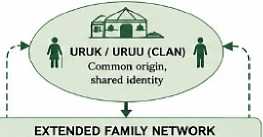
English phraseology, by contrast, demonstrates a relatively lower frequency of explicitly family-centered expressions, which corresponds to the predominance of nuclear family models and individual-oriented cultural values in Western societies. Kyrgyz phraseology, while smaller in quantity, reflects strong kinship-based conceptualization of family relations, where extended family networks and clan affiliation (uruu, uruk) remain culturally significant.
Overall, the quantitative findings suggest that the structural density of family-related phraseological units correlates with the degree of collectivist orientation in each linguistic culture.
The semantic classification of the analyzed corpus identified five major conceptual domains: kinship relations, parental authority, family harmony, moral obligation, and intergenerational continuity. The distribution of these categories demonstrates both shared universal tendencies and culture-specific emphases.
Table 2
SEMANTIC CATEGORIES OF FAMILY VALUES IN ENGLISH, CHINESE AND KYRGYZ LANGUAGES: PERCENTAGE DISTRIBUTION
|
Semantic Category |
English (%) |
Chinese (%) |
Kyrgyz (%) |
|
Kinship relations |
25 |
28 |
35 |
|
Parental authority |
18 |
30 |
22 |
|
Family harmony |
20 |
32 |
25 |
|
Moral obligation |
22 |
8 |
10 |
|
Intergenerational continuity |
15 |
2 |
8 |
The results indicate that kinship relations constitute a central semantic domain in all three languages, with the highest representation observed in Kyrgyz phraseology (35%). This reflects the socio-cultural importance of extended family systems and clan-based identity in Kyrgyz traditional society, where kinship ties regulate social interaction, obligations, and collective responsibility.
Chinese phraseological units show a particularly strong concentration in the domains of family harmony (32%) and parental authority (30%). This distribution is consistent with Confucian ethical principles, where hierarchical order within the family and social harmony are regarded as fundamental values shaping interpersonal relations.
Т. 12. №9 2026
English phraseological units demonstrate a relatively more balanced distribution across categories, with a noticeable emphasis on moral obligation (22%) and kinship relations (25%). This suggests that while family is culturally significant, it is often conceptualized through the lens of individual responsibility rather than strict hierarchical or collective obligation structures.
The lowest representation of intergenerational continuity in Chinese phraseology (2%) is particularly notable, as it indicates that this concept is often implicitly embedded within broader notions of filial piety rather than expressed as a separate semantic category. In Kyrgyz phraseology, intergenerational continuity (8%) is more explicitly connected to ancestral lineage and clan identity, while in English phraseology, this concept is reflected primarily through metaphorical and valuebased expressions rather than institutionalized kinship structures.
ENGLISH MODEL (Nuclear Family Orientation)
CHINESE MODEL (Hierarchical Family Orientation)
♦Hi

ELDERS
Authority, wisdom, moral guidance
INDIVIDUAL Autonomy Personal responsibility Emotional bonds
NUCLEAR FAMILY (Parents + Children) Love, support, mutual understanding
I
FLEXIBLE FAMILY TIES Family chosen and maintained through personal commitment
PARENTS
Duty, responsibility, role model

. , CHILDREN
Obedience, respect. П П П filial piety (#)
HARMONIOUS FAMILY ORDER
Family harmony, filial piety, continuity of lineage
KYRGYZ MODEL
(Extended Family / Clan Orientation)
Relatives across generations, strong kinship ties
COLLECTIVE RESPONSIBILITY
Solidarity, mutual support, honor of the family
Key Values Reflected in Phraseology Individualism, autonomy, personal choice, loyalty, emotional support
Key Values Reflected in Phraseology Filial piety, hierarchy, respect for elders, family harmony, duty
Key Values Reflected in Phraseology Kinship solidarity, respect for elders, hospitality, collective duty
Examples
-
• "Blood is thicker than water.”
-
• "Like lather, like son."
-
• “A family that plays together stays together."
-
• Я15£Ч (xiiojlng /йтй) - to respect and care for parents
-
• M^WS! (shii da gen shen) - deep roots, strong/amity
-
• ЖЯЛ$Ж1»Мwan shi xing) - harmony in family brings prosperity
Examples (Макал-лакаптар / Proverbs)
-
• “Уруктун кучу - биримдмкте."
(The strength of the clan is in unity.)
-
• "Атадан калган соз - акыддын казынасы."
(Words from the father are the treasure of wisdom.)
-
• "Бир тууган — ммц туугандан а рты к."
(A real sibling is better than a thousand distant relatives.)
-
Figure 1. Conceptual models of family roles in three linguistic cultures
Overall, the semantic distribution confirms that although family is a universal conceptual domain, its phraseological realization is strongly shaped by culturally specific value systems, particularly collectivism, hierarchy, and kinship organization patterns. The comparative analysis of phraseological semantics demonstrates that the English, Chinese, and Kyrgyz languages encode fundamentally different conceptual models of family roles. These models reflect deeper cultural value systems, including attitudes toward authority, individuality, and kinship obligations. In English phraseology, family roles are primarily constructed around the concepts of autonomy, individual responsibility, and emotional support within the nuclear family. Phraseological units often emphasize personal bonds and moral loyalty rather than formal hierarchy. For example, the expression “blood is thicker than water” highlights the priority of family ties over external social relations while still maintaining an implicit focus on personal choice and emotional affiliation. In Chinese phraseology, family roles are strongly influenced by Confucian ethical principles, which emphasize hierarchical order, filial piety ( 孝 , xiào), and obedience toward elders. The family is conceptualized as a structured moral system where each member has clearly defined obligations. Phraseological units such as 孝敬
父母 ( “ to respect and care for one ’ s parents ” ) reflect institutionalized respect for parental authority and intergenerational hierarchy.
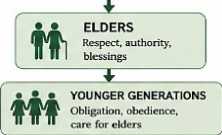
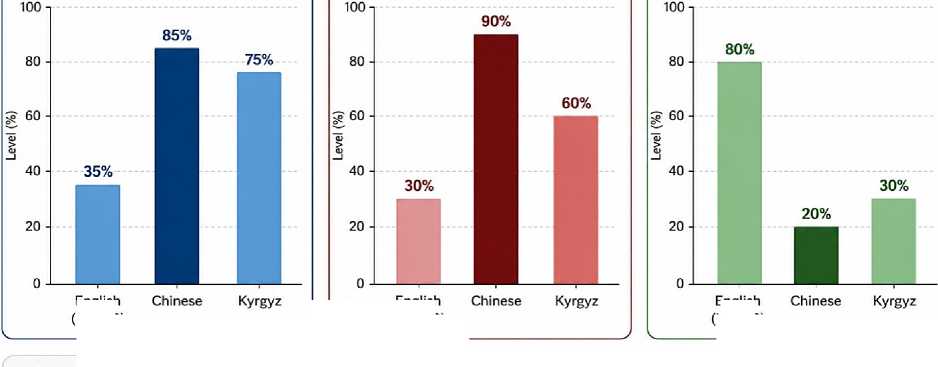
In Kyrgyz phraseology, family roles are shaped by traditional nomadic culture and clan-based social organization. The conceptual model is based on extended kinship networks, where collective identity (uruu, uruk) plays a central role. Phraseological expressions emphasize respect for elders, collective responsibility, and solidarity among relatives. Unlike the Chinese hierarchical model, Kyrgyz phraseology reflects a more horizontally structured kinship system, although respect for seniority remains a key cultural value. The comparative analysis of phraseological units reveals three dominant cultural value orientations: collectivism, hierarchy, and individual responsibility. These orientations are unevenly distributed across the three languages and reflect underlying sociocultural frameworks. Collectivism is most strongly represented in Chinese and Kyrgyz phraseology. In both languages, the family is conceptualized as a collective unit where individual interests are subordinated to group harmony and social cohesion. However, Chinese collectivism is more institutionally structured through Confucian ethics, while Kyrgyz collectivism is more kinship- and clan-oriented.
Hierarchical relations are most explicitly encoded in Chinese phraseological units. The linguistic material demonstrates a clearly defined vertical structure of authority within the family, where elders occupy a morally and socially dominant position. This hierarchical orientation is less rigid in Kyrgyz phraseology and relatively weak in English phraseology.
Individual responsibility and autonomy are more prominent in English phraseology. Although family solidarity is acknowledged, it is often expressed through personal choice and emotional commitment rather than obligatory social norms. This reflects broader Western cultural tendencies toward individualism.

COLLECTIVISM
Emphasis on group harmony, family unity, and loyalty
HIERARCHY / POWER DISTANCE
Acceptance of unequal power, respect for authority and elders

INDIVIDUALISM / AUTONOMY
Emphasis on personal independence, self-reliance, and individual choice
English (UK/US)
English (UK/US)
English (UK/US)
ф Collectivism
Values related to family unity, group interests over individual goals, and mutual support.
ф Hierarchy / Power Distance
Values reflecting respect for elders, acceptance of authority, and structured family roles.
ф Individualism / Autonomy
Values emphasizing personal freedom, selfresponsibility, and individual decision-making.
al Scale: 0% = very low orientation | 100% = very high orientation
Data based on comparative analysis of phraseological units.
-
Figure 2. Cultural value orientation in phraseological systems
The identified patterns are consistent with established cross-cultural frameworks, particularly Hofstede’s cultural dimensions theory, which positions China and Kyrgyzstan closer to collectivist cultural systems, while English-speaking cultures demonstrate higher levels of individualism [3].
Additionally, Ting-Toomey’s face-negotiation theory supports the observed differences in communication and relational orientation across cultures, particularly in the management of hierarchy and interpersonal harmony [8].
Overall, the findings confirm that phraseological units function not only as linguistic expressions but also as cultural models that encode and transmit fundamental value orientations within each linguistic community. One of the most significant findings of the analysis is the high conceptual density of “family harmony” in Chinese phraseology compared to English and Kyrgyz linguistic material. In this context, conceptual density refers to the frequency, structural variability, and semantic richness of linguistic units that verbalize a given cultural concept within the phraseological and proverbial systems of a language.
In Chinese linguistic and cultural tradition, harmony ( 和 , hé) functions as a foundational cultural principle that extends beyond the family sphere into broader social and even political domains. Rooted in Confucian philosophy, harmony is viewed as a prerequisite for social stability and the proper organization of interpersonal relations. This ideological background is strongly reflected in phraseological units, where the idea of domestic concord is repeatedly emphasized as both a moral and pragmatic value. For instance, expressions such as 家和万事兴 (“When the family is harmonious, everything prospers”) and 和气生财 (“Harmony brings wealth”) explicitly link internal family peace with external prosperity and social success. Thus, in the Chinese worldview, family harmony is conceptualized not only as an emotional state but also as a socio-economic and moral condition that ensures collective well-being.
In the Kyrgyz phraseological worldview, the concept of harmony is also present but is expressed more implicitly through kinship-based respect and solidarity norms. Rather than being formulated as an abstract principle such as “harmony,” it is embedded in culturally specific models of interpersonal behavior within extended family and clan structures. Phraseological units tend to emphasize respect for elders, loyalty to kin, and collective responsibility. Harmony, therefore, is less frequently lexicalized as an explicit concept and more often realized through normative behavioral expectations that maintain social cohesion within the family and wider kinship network.
In contrast, English phraseology tends to associate family harmony primarily with emotional well-being, psychological comfort, and individual satisfaction within family relationships. The emphasis is placed on interpersonal balance at the micro-level rather than on broader social or hierarchical order. Family harmony is thus framed through notions of emotional support, mutual understanding, and personal happiness, reflecting the individual-centered orientation of Englishspeaking cultures. The results demonstrate that, although all three languages encode the concept of family as a fundamental cultural value, they differ significantly in their structural and semantic emphasis. Chinese phraseology prioritizes hierarchy and harmony as interdependent cultural principles that ensure both familial and social stability. Kyrgyz phraseology emphasizes kinship solidarity, respect, and collective responsibility as mechanisms of maintaining cohesion. English phraseology, in turn, foregrounds individual responsibility, emotional well-being, and psychological balance within family relationships.
The findings of this study demonstrate that phraseological units serve as culturally loaded linguistic structures that encode and transmit deeply rooted family values in English, Chinese, and Kyrgyz linguistic worldviews. The comparative analysis confirms that although family is universally recognized as a core social institution, its conceptualization varies significantly depending on cultural, historical, and philosophical backgrounds.
One of the key insights of the study is the clear correlation between phraseological density and cultural orientation. The higher frequency of family-related phraseological units in Chinese reflects the strong influence of Confucian ideology, where family is not only a private social unit but also a fundamental moral and political model of society. The centrality of filial piety (孝, xiao) and hierarchical order explains why Chinese phraseology demonstrates the richest and most systematized representation of family harmony, parental authority, and intergenerational responsibility. These findings support previous research emphasizing the role of Confucian ethics in shaping Chinese linguistic worldview [3; 10].
In contrast, English phraseology reflects a cultural model in which family relations are primarily constructed through the lens of individualism and emotional autonomy. The relatively lower density of explicit family-related phraseological units suggests that family values are less institutionalized in idiomatic expressions and more often embedded in broader moral concepts such as personal responsibility, loyalty, and emotional support. This aligns with established linguistic and cultural studies that describe English-speaking societies as prioritizing individual agency over collective obligation. The conceptualization of family harmony as emotional well-being rather than structural or hierarchical stability further confirms this orientation. Kyrgyz phraseology occupies an intermediate but distinct position, characterized by strong kinship solidarity and clan-based social organization. The analysis shows that family values in Kyrgyz linguistic tradition are deeply embedded in collective identity structures such as uruu and uruk, where extended family relations play a central role in social regulation. Unlike the Chinese model, which is highly hierarchical, Kyrgyz phraseology reflects a more horizontally oriented kinship system, although respect for elders remains a crucial value. This suggests that Kyrgyz linguistic worldview combines collectivist orientation with flexible, relationship-based social organization shaped by nomadic cultural traditions. Another important finding concerns the semantic distribution of family-related phraseological units. The dominance of kinship relations across all three languages confirms the universality of family as a cognitive and cultural category. However, the variation in secondary semantic domains highlights significant cultural divergence. Chinese emphasis on parental authority and family harmony reflects a norm-based and structurally regulated family model, while Kyrgyz emphasis on kinship solidarity indicates relational cohesion within extended family systems. English distribution, which is more balanced across categories, reflects a less rigidly structured but more emotionally oriented understanding of family relationships.
The concept of family harmony demonstrates particularly high conceptual density in Chinese phraseology, which distinguishes it sharply from English and Kyrgyz data. This suggests that harmony in Chinese culture functions as a macro-concept integrating moral, social, and economic dimensions of family life. In Kyrgyz phraseology, harmony is not lexicalized as a central concept but is instead expressed indirectly through behavioral norms of respect and cooperation. In English, harmony is predominantly interpreted at the psychological level, emphasizing emotional compatibility and interpersonal comfort. These differences confirm that conceptual density is closely linked to the cultural salience of specific values within each society.
The results of the study are consistent with established cross-cultural theoretical frameworks, particularly Hofstede’s cultural dimensions theory and Ting-Toomey’s face-negotiation theory. The observed differences between collectivist (Chinese and Kyrgyz) and individualist (English) orientations further validate the relevance of these models in explaining linguistic representation of social values. However, the present study also demonstrates that collectivism itself is not homogeneous, as Chinese institutional collectivism differs significantly from Kyrgyz kinship-based collectivism. From a broader linguocultural perspective, the study highlights that phraseological units are not merely linguistic artifacts but culturally conditioned cognitive models that reflect how societies structure family relationships and transmit social values. They function as symbolic repositories of cultural memory, preserving traditional norms while simultaneously adapting to changing social realities.
Finally, the comparative approach adopted in this research contributes to a deeper understanding of how universal human experiences — such as family relations — are linguistically and culturally diversified. It also underscores the importance of integrating phraseological analysis into intercultural communication studies, as differences in family conceptualization may lead to varying expectations and interpretations in cross-cultural interaction.
Conclusion
The present study provides a comparative linguocultural analysis of phraseological units reflecting family values in the English, Chinese, and Kyrgyz languages. The findings demonstrate that phraseology is an effective linguistic mechanism for encoding, preserving, and transmitting culturally specific value systems related to family, kinship, and social relations. The analysis confirms that, despite the universality of the concept of family as a fundamental social institution, its linguistic realization varies significantly across the three languages. Chinese phraseology is characterized by a high degree of conceptual density and a dominant emphasis on Confucian values, such as filial piety, hierarchical family structure, and family harmony. Kyrgyz phraseology reflects a kinship-based worldview grounded in extended family relations, clan identity, and collective solidarity, where respect for elders and intergenerational continuity play a central role. English phraseological units, in turn, demonstrate a more individual-oriented conceptualization of family, where emotional support, personal responsibility, and psychological well-being are foregrounded. The study also reveals that the semantic organization of family-related phraseology differs across languages. While kinship relations constitute a universal core category, Chinese phraseology strongly prioritizes parental authority and harmony, Kyrgyz phraseology emphasizes kinship solidarity and social cohesion within extended family networks, and English phraseology distributes emphasis more evenly across moral and emotional domains. These differences reflect broader cultural models of collectivism, hierarchy, and individualism. A particularly significant finding is the variation in the conceptual density of “family harmony,” which is highly developed and explicitly lexicalized in Chinese phraseology, implicitly expressed in the Kyrgyz linguistic tradition through behavioral norms, and primarily associated with emotional balance in English. This confirms that cultural salience directly influences the degree of linguistic elaboration of specific family-related concepts. Overall, the research contributes to linguoculturology, comparative phraseology, and intercultural communication studies by demonstrating that phraseological units function as culturally embedded cognitive structures that reflect and shape national value systems. The results highlight the importance of considering linguistic and cultural differences in the interpretation of family-related concepts, particularly in multilingual and intercultural contexts. Future research may expand the corpus to include additional languages and explore cognitive and discourse-based approaches to further refine the understanding of how family values are conceptualized and transmitted through phraseological systems.
