
Higher Education Skills and Social Mobility: Evidence from University Students in Uzbekistan
Journal: Bulletin of Science and Practice @bulletennauki
Section: Социальные и гуманитарные науки
Article in issue: 9 т.12, 2026.
Free access
This study analyzes the impact of higher education on the social mobility of young people in Uzbekistan using empirical data. The study is based on semi-structured interviews and a survey of 385 respondents. The results show that a higher education degree enhances social status and expands employment opportunities, but does not guarantee a successful career. Practical skills, digital competencies, participation in international educational programs, and government support were found to significantly increase the social mobility of young people. The findings support Pierre Bourdieu's concept of cultural capital and the need to improve educational policy and strengthen the link between higher education and the labor market.
Short address: https://sciup.org/14139078
IDS: 14139078 | UDC: 378.032:316.44 | DOI: 10.33619/2414-2948/130/82
Навыки, полученные в ходе высшего образования, и социальная мобильность: данные по студентам университетов Узбекистана
В данном исследовании на основе эмпирических данных анализируется влияние высшего образования на социальную мобильность молодежи в Узбекистане. Исследование основано на полуструктурированных интервью и опросе 385 респондентов. Результаты показывают, что высшее образование повышает социальный статус и расширяет возможности трудоустройства, но не гарантирует успешной карьеры. Было установлено, что практические навыки, цифровые компетенции, участие в международных образовательных программах и государственная поддержка значительно повышают социальную мобильность молодежи. Полученные данные подтверждают концепцию культурного капитала Пьера Бурдье и необходимость совершенствования образовательной политики и укрепления связи между высшим образованием и рынком труда.
Text of the scientific article Higher Education Skills and Social Mobility: Evidence from University Students in Uzbekistan
Бюллетень науки и практики / Bulletin of Science and Practice
In the 20th century, the relationship between education and social mobility became a central topic in the social sciences and was widely studied. In particular, Pitirim Sorokin, in his seminal work "Social Mobility" (1927), emphasized that the ability to move between social strata is one of the key indicators of societal development [1].
T. Parsons viewed education as an institution that ensures social integration and stability of society [12].
R. K. Merton viewed education as a mechanism of social stratification and distribution of social opportunities [13]. P. Bourdieu developed the concept of cultural capital, considering higher education as an important tool for strengthening social status [14].
According to the OECD and the World Bank, expanding access to education promotes social mobility for young people, but a shortage of skilled jobs limits the effectiveness of education [2].
According to A. Yunusov, the structural mismatch between the higher education system and the demands of the labor market significantly limits the social mobility of young people in Uzbekistan [3].
Kukhtrina makes a similar conclusion in the Russian context: while acknowledging the positive impact of education on the entry of young people into the labor market and their position in social stratification, she emphasizes that this influence is often limited by a lack of economic and social resources [8].
At the international level, youth social mobility is supported by various educational initiatives. For example, Africa's "Golden Model" integrates education, healthcare, and the labor market to ensure sustainable social development. In Europe, the Eurodesk programme promotes the participation of young people in international exchanges, training programmers and volunteer activities, thereby increasing their social activity and engagement [9].
The United Nations Sustainable Development Goals (SDGs) also identifies education as a key driver of sustainable development, with a particular focus on expanding opportunities for youth [5].
Many countries in Eastern Europe and Asia are implementing government programs aimed at developing education, integrating young people into the labor market, and strengthening their social protection as key conditions for increasing social mobility [10].
In the National Development Strategy of the Republic of Moldova "Moldova 2020", along with the "National Strategy for the Development of the Youth Sector until 2020", improving the social status of young people through education is defined as one of the main priority areas [11].
In Uzbekistan, government programs, including the Umid Foundation, create conditions for young people to gain international experience and strengthen the country's scientific and intellectual potential [1].
Thus, higher education is an important factor in the social mobility of young people, but its effectiveness is determined by additional competencies, government support, and compliance with labor market requirements. This study analyzes this relationship in the context of Uzbekistan.
Social mobility, determined by educational level, has been the focus of numerous researchers since the 20th century. In his seminal work "Social Mobility" (1927), Russian sociologist Pitirim Sorokin described the ability to move between social strata as one of the key indicators of societal development [4].
American sociologist Talcott Parsons viewed education as an institution that promotes integration into society, while his colleague, the American scientist Robert K. Merton, considered it the most important mechanism regulating the processes of selection and stratification. French sociologist Pierre Bourdieu, using his concept of cultural capital, demonstrated the direct role of education in strengthening and improving a person's social position [13-15].
English sociologists also offered various interpretations of this process: Anthony Giddens defined education as a mechanism for the reproduction and maintenance of social systems, While John Goldthorpe empirically studied social stratification and occupational mobility, relying on statistical data [22].
P. Blau and O. D. Duncan in their work "American Occupational Structure" (1967) empirically substantiated the influence of education on occupational structure and intergenerational social mobility [19].
S. M. Lipset and R. Bendix (1960) substantiated the connection between changes in the structure of production and the processes of social mobility in industrial society [21].
British sociologist John Urry, in his book Mobility (2007), put forward the concept of "mobile societies", viewing education and global mobility as integral components of contemporary social transformations [16].
Uzbek and Russian scholars have also made valuable contributions to this area. A. Yunusov identified structural imbalances in Uzbekistan's education system as the main obstacles to social mobility [3].
-
A. G. Abdullaev theoretically developed mechanisms for increasing the social mobility of young people in the context of the modernization of society [17].
Russian researcher M. Kukhtrina, based on empirical analysis, demonstrated a positive, but limited, impact of education on social mobility in the Russian context [8].
Another Russian scholar, V. S. Lyubchenko, analyzed the main trends of social mobility in modern societies, emphasizing the importance of economic and cultural factors [18].
The African "Golden Model" views the integration of education, health, and the labor market as the foundation for sustainable social mobility of youth [9].
Similarly, the Eurodesk programme in Europe supports young people's participation in international exchanges, volunteering and training programmers [4].
The United Nations Sustainable Development Goals (SDGs) framework identifies education as a key driver of global sustainable development, with a particular focus on expanding opportunities for youth [5].
In Eastern European and CIS countries, state programs in the field of education and youth policy are aimed at developing employment and social mobility of young people [10]
The National Development Strategy of the Republic of Moldova "Moldova 2020" and the "National Strategy for the Development of the Youth Sector until 2020" also aim to improve the social status of young people through education [11].
In recent years, modern research on youth social mobility has gone beyond purely economic or educational factors and embraced new aspects. A. Born has empirically proven that social mobility depends not only on economic resources, but also on psychological support and family relationships. A literature review reveals that education is considered a key factor in social mobility. Classic and contemporary studies explore its economic, educational, cultural, and psychological aspects, as well as the relationship between education and the labor market. To empirically study the impact of higher education on youth social mobility, a mixed-methods study was used, combining interviews and questionnaires. This allowed for a combination of qualitative analysis of personal experience and statistical data evaluation, while the triangulation of methods increased the reliability of the results.
The study utilized a mixed method, including semi-structured interviews with 21 undergraduate and graduate students (aged 24‒30) and a questionnaire survey of 385 respondents. The interviews (18 questions) covered motivation for pursuing higher education, employment, social mobility, participation in international programs, and educational plans, while the questionnaire (25 questions) focused on employment, changes in social status, additional competencies, and state support for youth.
Respondents were selected using a combination of random and convenience sampling. The study covered 10 regions of Uzbekistan, with the largest proportion of participants coming from Namangan, Andijan, Tashkent, and Fergana regions.
Interview data were transcribed and analyzed in NVivo 12 using thematic analysis, and survey results were processed in MS Excel using descriptive statistics and the χ² test. To enhance reliability, data triangulation was used, based on a comparison of interview and survey results. Despite certain sample limitations, the integration of qualitative and quantitative methods provided a comprehensive analysis of the relationship between higher education and youth social mobility in Uzbekistan.
Age is a key determinant of social mobility, as the value of a college degree is most evident at the initial stage of entering the labor market. In response to the question "How old are you?", the largest proportion of respondents belonged to the 24-year-old and older age group (67.1%), followed by those aged 22–23 (28.2%). Participants aged 20–21 accounted for 7.1%, while respondents aged 18–19 were not included in the sample. This distribution indicates that the study primarily included undergraduate students and recent graduates.
Age is a key determinant of social mobility, as the value of a college degree is most evident during the initial stages of entering the labor market. In response to the question "How old are you?", the largest proportion of respondents belonged to the 24-year-old and older group (67.1%), followed by those aged 22‒23 (28.2%). Participants aged 20–21 accounted for 7.1%, while respondents aged 18–19 were not included in the sample. This distribution indicates that the study primarily included undergraduate students and recent graduates.
6,90%
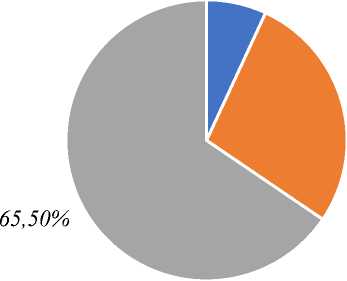
27,60%
Figure 1. Distribution of respondents by age
20-21 years
22-23 years
Older than 23 year
The age and gender structure of the sample was taken into account when analyzing social mobility: of the 385 respondents, 54% were men and 46% were women. Parental education was considered as an indicator of initial social status. According to the survey results, 41.2% of parents had secondary vocational education, 29.4% had higher education, and 28.2% had general secondary education, indicating increased access to higher education for young people compared to the previous generation. The majority of respondents (92.0%) studied at private universities, while 8.0% studied at public universities. According to P. Bourdieu's concept, the type of university influences the formation of cultural capital and the competitiveness of graduates, so employers' assessment of diplomas from various universities remains an important subject of research. Practical training was limited: 44.7% of respondents completed a two-month internship, 10.6% a six-month internship, and 22.4% none at all. However, 98.7% of participants graduated in 2025. An analysis of academic performance revealed that 32.9% of respondents had a GPA below 71, suggesting that academic performance is a factor in determining graduates' competitiveness in the labor market. The results indicate that the majority of respondents have an average level of academic preparation and rely more on practical skills when seeking employment. Furthermore, 90.6% of participants did not receive financial support during their studies, while only 7.1% used grants or scholarships. This indicates limited access to government support mechanisms, which, according to G. Becker's human capital theory, reduces the opportunities for social mobility for young people.
An assessment of employment prospects revealed that 47.1% of respondents considered their chances high, 33.3% average, and 19.6% low. These results confirm the persistent mismatch between the higher education system and labor market demands, where, as noted by A. Yunusov and OECD research, practical experience and additional competencies are crucial alongside a diploma [2].
In this context, practical experience and additional competencies are just as important for young people as the diploma itself. Consequently, higher education programs should place greater emphasis on practical training alongside theoretical instruction. It is noteworthy that one of the most important indicators of the practical value of a higher education diploma is the ability of graduates to find a job.
In response to the question "Did you find a job after completing higher education?" just over half of the respondents (54.0%) reported successful employment after graduation, while 46.0% indicated difficulties in finding a job or complete failure in this.
46% Yes
54,00% ' No
-
Figure 2. Employment status of respondents after graduation
More than half of respondents found employment after graduating, with almost half finding employment immediately after receiving their degree. Currently, 48.3% are working full-time, 17.2% are working part-time, and 34.5% remain unemployed. This confirms that a degree increases employment chances, but does not ensure stable employment for all graduates.
The results demonstrate the need to strengthen university-employer collaboration and improve employment programs. 56.3% of respondents are working in their field of study, 19.5% are partially working in their field of study, and 24.1% are working outside their professional field, confirming the persistent mismatch between the higher education system and labor market demands. 42.5% of respondents are satisfied with their salary level, while 58.6% of graduates earn up to 3 million soums per month, and only 3.4% earn over 5 million soums. Of these, 67.8% have stable employment, 27.6% work in precarious conditions, and 4.6% work seasonally.
Table 1 COMPARATIVE CORRELATION TABLE
|
Indicators |
High income (≥5 million soums) |
Average income (3–5 million soums) |
Low income (≤3 million soums) |
|
Salary satisfaction |
I am 38% satisfied |
My salary is on average 33% |
My salary is low, 29% |
|
Stability of work |
My job is 68% stable |
My job is partially stable, 27% |
My work is not paid at 6% |
|
Reason for dissatisfaction with salary and place of work |
I am 39% satisfied |
High workplace costs 32% |
Working conditions are average, but wages are low |
These results indicate that a diploma increases the likelihood of employment, but does not guarantee high income and stable employment. Correlation analysis revealed a positive relationship between income level, employment stability, and graduate satisfaction. This underscores the need to
Бюллетень науки и практики / Bulletin of Science and Practice Т. 12. №9 2026 strengthen the interaction between education and the labor market, develop career centers, support youth start-ups, and expand the number of highly skilled jobs.
Interpretation of correlations (based on observed patterns): The study results show that a higher education degree contributes to an increase in social status: 79.3% of respondents reported an improvement in their social standing thanks to their education. However, only 23.0% rated their social status as higher than that of their parents, while 58.6% considered it lower, indicating limited intergenerational social mobility. Furthermore, 75.9% of respondents found employment independently, while 24.1% relied on social connections. When asked about the possibility of employment without a diploma, 57.5% responded negatively, confirming its importance, while 42.5% believe that practical skills allow one to work without a formal qualification. This underscores the need to strengthen practical training and collaboration between universities and employers. The final stage of the study revealed that 44.8% of respondents were interested in studying or working abroad, 43.7% expressed a high interest in international programs, and 57.5% planned to continue their education. Meanwhile, 41.4% of respondents rated opportunities for social mobility as sufficient, the same percentage considered them insufficient, and 17.2% considered them partially sufficient [2337] .
Overall, the results confirm that a diploma remains an important factor in the social mobility of young people, but its effectiveness is determined by practical competencies, financial support, international experience, and the relevance of training to labor market requirements.
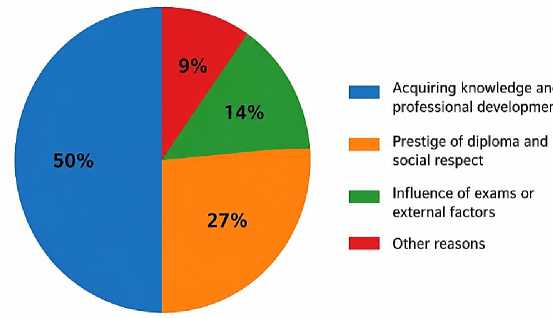
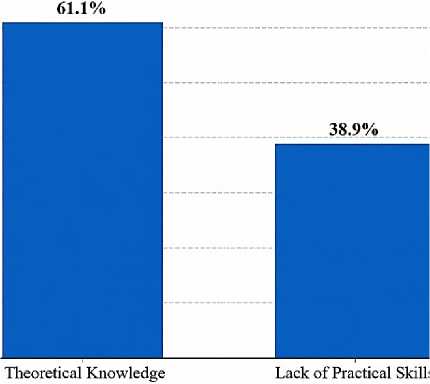
The qualitative phase of the study included semi-structured interviews with 21 respondents, which allowed for the elicitation of subjective assessments of motivation for learning, employment experience, social mobility, attitudes toward international programs, and future plans. The resulting materials were processed using thematic coding, which complemented the results of the quantitative analysis. According to the results of the general analysis obtained during the interview, in relation to motivation for education (figure) and its value, the majority of respondents perceive higher education as the main tool for professional development and improving social status. Some respondents pursued higher education primarily for the purpose of acquiring knowledge and professional qualifications, while others viewed a degree as a "social lift" leading to social respect and higher positions. In the section on the practical value of knowledge (figure), the discrepancy between the theoretical and practical components of higher education was often highlighted.
is Useful
Figure 4. Respondents' opinions on the importance of knowledge
Figure 3. Educational Motivations
Students acknowledged the expansion of their worldview; however, they reported that a lack of practical skills hindered their ability to fully compete in the labor market. Furthermore, in the section on labor market challenges and employment difficulties, most respondents cited a shortage of job openings, low wages, and the constant influence of personal connections ("tanish-bilish"). Some respondents also cited these as major barriers to employment. Some also indicated that they were unable to find work in their field and, therefore, were employed in unrelated sectors.
Our study examined both the influence of generational factors and the impact of education on social status.
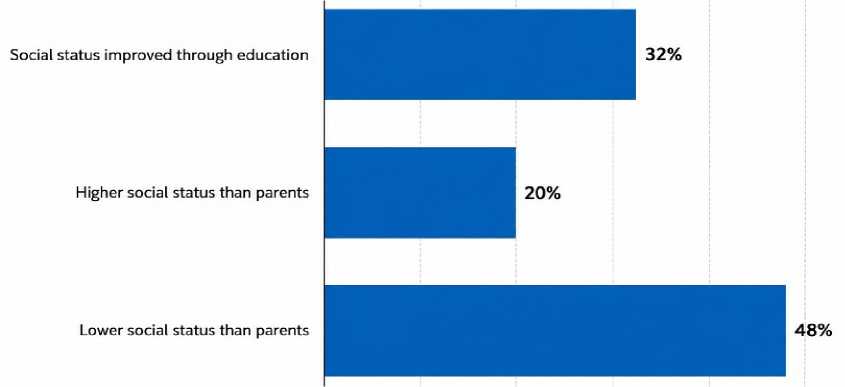
Figure 5. Social status
In the section of the study on social status and intergenerational comparison, most participants reported an improvement in their personal status as a result of education. However, a significant proportion also considered their current status to be lower than that of their parents. This pattern indicates a relatively limited degree of vertical social mobility between generations. In the section on international experience and future prospects, several respondents viewed studying and working abroad as a significant opportunity. A significant number expressed interest in programs such as Erasmus+ and youth mobility. However, not all participants believed that putting such opportunities into practice in real life was easily achievable. The study involved 385 respondents and 21 participants in in-depth interviews. The findings showed that a higher education degree enhances social status and expands employment opportunities, but its effectiveness is limited by insufficient practical training, low wages, limited financial support, and structural problems in the labor market. More than half of respondents rated their social status as lower than their parents', indicating limited intergenerational social mobility. Interviews confirmed that the effectiveness of a diploma depends not only on educational level but also on practical competencies and the state of the labor market. The high interest of young people in further education and international programs indicates a desire to expand opportunities for social mobility. Overall, the study confirms that a diploma is an important but insufficient condition for social advancement, requiring improved practical training, government support, and cooperation between universities and employers. The results obtained are consistent with the theories of P. Sorokin, T. Parsons, and R. Merton, confirming that higher education promotes social mobility, but its effectiveness is limited by structural barriers in the labor market [24].
According to P. Bourdieu and OECD research, social mobility is determined not only by a diploma, but also by cultural capital, practical competencies, knowledge of foreign languages and international experience [2].
The results of the study confirm the findings of A. Yunusov and T. Norboeva that higher education expands professional opportunities, especially for women, but does not in itself guarantee successful employment. International experience confirms the importance of education for youth social mobility. The African Golden Model, the EURODESK program, and the UN Sustainable Development Goals view education as a key tool for youth empowerment and sustainable development.
These findings confirm that a college degree contributes to the social mobility of young people, but its impact is limited by a lack of practical training, financial support, and structural features of the labor market. However, the high interest shown by young people in receiving additional education and participating in international programs represents a positive prospect for further improvement of social mobility. The findings confirm that a college degree remains an important resource for youth social mobility. However, its impact is limited by insufficient practical training, financial support, and structural features of the labor market: a predominance of theoretical knowledge over applied competencies, insufficient practical training, the long-term influence of personal connections on employment processes, and the widespread belief among respondents that their current social status is lower than that of their parents. The interviews confirmed the survey results, showing that young people's expectations of higher education are not always met. This underscores the need to improve the connection between the education system and the labor market, develop practical skills, and expand equal opportunities. To improve youth social mobility, it is necessary to expand practical training for students in close collaboration with employers, integrate practical competencies, digital skills, and foreign languages into educational programs, and increase the availability of grants, scholarships, and other financial support mechanisms. It is advisable to develop mechanisms to facilitate the employment of talented graduates and implement a portfolio system at universities that reflects learning outcomes, internships, certificates, and professional competencies. This will enhance graduate competitiveness, the effectiveness of career planning, and the transparency of employment processes. Implementing these recommendations will strengthen the role of higher education as an effective mechanism for youth social mobility in Uzbekistan.
