
Immersive Technologies and Learning in Higher Education: A Systematic Literature Review of Adoption, Engagement, and Skill Development
Journal: International Journal of Cognitive Research in Science, Engineering and Education @ijcrsee
Article in issue: 2 vol.14, 2026.
Free access
The increasing adoption of immersive technologies in higher education has transformed digital learning environments by ena-bling interactive, experiential, and learner-centered pedagogies. Despite the growing body of research, existing evidence re-mains fragmented across technologies, disciplines, and educational outcomes. Therefore, this study systematically reviews em-pirical research on virtual reality (VR), augmented reality (AR), mixed reality (MR), and extended reality (XR) in higher educa-tion to synthesize patterns of technology adoption, learning outcomes, disciplinary applications, and geographical distribution while identifying existing research gaps. Following the PRISMA guidelines, a systematic literature review was conducted on 61 empirical studies published between 2018 and 2025 and indexed in Scopus and Web of Science. Descriptive and thematic analyses revealed that research is concentrated in education, health sciences, and engineering, with VR emerging as the most widely adopted immersive technology, followed by XR and AR, whereas MR remains relatively underexplored. The findings further indicate that immersive technologies predominantly enhance cognitive learning outcomes, professional competencies, and affective engagement through experiential learning approaches, while behavioral engagement, self-belief, psychomotor abilities, social interaction, and communication skills receive comparatively limited scholarly attention. Geographically, research output is heavily concentrated in Europe and East Asia, highlighting significant regional disparities. Overall, immersive technologies demonstrate substantial potential to improve higher education learning experiences, but important gaps remain in technology diversity, disciplinary coverage, engagement measurement, and global representation.
Short address: https://sciup.org/170213604
IDS: 170213604 | UDC: 378.147:004.4 | DOI: 10.23947/2334-8496-2026-14-2-263-278
Text of the scientific article Immersive Technologies and Learning in Higher Education: A Systematic Literature Review of Adoption, Engagement, and Skill Development
In recent years, immersive technologies including augmented reality (AR), virtual reality (VR), mixed reality (MR), and extended reality (XR) have attracted substantial attention in higher education due to their potential to transform teaching and learning practices ( Baxter and Hainey, 2023 ; Mohsen and Alangari, 2024 ). These technologies enable students to engage in interactive, multi-sensory environments, providing opportunities for experiential and situated learning that are often unattainable in traditional classrooms ( Molloy and Farrell, 2024 ). VR, for instance, allows learners to safely simulate complex, high-risk scenarios, promoting cognitive skill acquisition and procedural competence ( Baktash et al., 2024 ). AR overlays digital information onto physical environments, facilitating contextualized learning and immediate feedback, thereby enhancing both engagement and understanding ( Garg et al., 2025 ). MR and XR extend these capabilities further, integrating physical and virtual elements to create hybrid learning spaces that blur the line between real and simulated experiences ( Andalib and Monsur, 2024 ).
Despite the evident promise, the literature on immersive technologies in higher education remains fragmented and uneven. Much of the research to date has been discipline-specific, focusing on fields such
-
* Corresponding author: waqar.akbar@utem.edu.my

© 2026 by the authors. This article is an open access article distributed under the terms and conditions of the Creative Commons Attribution (CC BY) license ( https://creativecommons.org/licenses/by/4.0/ ).
as engineering, health sciences, and STEM education, while relatively little attention has been paid to the social sciences, business, and teacher education ( Baxter and Hainey, 2023 ; Buragohain et al., 2025 ). This creates a knowledge imbalance, limiting the generalizability of findings and reducing the applicability of recommendations across diverse educational contexts. Some scholars argue that the efficacy of immersive technologies depends on discipline-specific affordances, suggesting that VR may be optimal for procedural skills. At the same time, AR could be more suitable for conceptual or affective learning ( Kee et al., 2024 ). Others, however, maintain that immersive environments can support holistic skill development, integrating cognitive, affective, and psychomotor outcomes, yet empirical evidence remains scattered and inconsistent ( Michalczak et al., 2025 ).
Another significant challenge in the existing literature is the narrow focus on single learning outcomes, most often skill acquisition, while neglecting other critical dimensions such as student engagement, motivation, and affective learning ( Tene et al., 2024 ).
This lack of multidimensional analysis diminishes the practical relevance of the findings, as educational practitioners require insights not only into the skills gained but also into how immersive technologies influence students’ motivation and interaction. Moreover, there is a geographical and temporal skew in the literature. Most studies have been conducted in Europe, North America, and East Asia, while other regions such as Latin America, the Middle East, Africa, and Southeast Asia remain underrepresented ( Vaz, 2024 ). This uneven distribution raises questions about the cultural and contextual applicability of findings, given that educational systems, technological infrastructure, and learner expectations vary widely across regions ( Partarakis and Zabulis, 2024 ). Similarly, although the volume of research has increased substantially in recent years, systematic evidence on temporal trends, emerging technologies, and evolving disciplinary adoption is lacking. Without this knowledge, it is difficult to determine whether observed patterns reflect transient trends or enduring shifts in higher education practices ( Samala et al., 2024 ).
Existing review studies have attempted to synthesize the field, but they often suffer from methodological limitations. Some focus exclusively on technical evaluations of AR/VR systems, rather than their educational impact ( Colamatteo et al., 2024 ; Köroğlu, 2025 ; Tan et al., 2022 ), while others limit the scope to a single discipline or country, thereby failing to provide a comprehensive overview of immersive learning across higher education ( Cabrera-Duffaut et al., 2024 ; Cevikbas et al., 2023 ). Additionally, many reviews ( Chen et al., 2024 ; Fernandes et al., 2023 ) emphasize quantitative skill outcomes without integrating engagement, affective responses, or cognitive dimensions, leading to partial interpretations of the effectiveness of immersive technology. Consequently, there is a pressing need for a systematic and integrative review that combines evidence across technologies, outcomes, disciplines, and regions.
Addressing these gaps is critical for both research and practice. For scholars, a holistic synthesis can reveal patterns of adoption, technological effectiveness, and outcome interactions, highlighting areas that warrant further investigation. For practitioners, understanding which technologies are effective for which outcomes and in which disciplinary or regional contexts can guide curriculum design, resource allocation, and pedagogical innovation. In particular, higher education institutions increasingly seek evidence-based guidance to inform investments in immersive technologies, ensuring that such investments translate into meaningful learning experiences rather than superficial or novelty-driven implementations ( Huang and Hu, 2025 ; Mira et al., 2025 ).
Given these gaps, this study aims to systematically review research on immersive learning published between 2018 and 2025, with a focus on higher education contexts. Specifically, the review seeks to synthesize evidence on technology adoption (AR, VR, MR, XR), learning outcomes (skills and engagement), disciplinary patterns, regional distribution, and temporal trends. By integrating findings across these dimensions, the study addresses critical gaps in the literature, providing a comprehensive, multidimensional perspective that can inform both future research and practical implementation.
Literature Review
Immersive Technologies in Higher Education: Conceptual Foundations
Immersive technologies have gained increasing prominence in higher education as institutions seek pedagogical approaches that move beyond passive knowledge transmission toward experiential and applied learning. Technologies such as virtual reality (VR), augmented reality (AR), mixed reality
(MR), and extended reality (XR) are frequently described as enabling immersive learning environments in which learners interact with content through spatial, sensory, and contextual engagement ( Morgado et al., 2025 ). Scholars argue that these technologies represent more than incremental digital enhancements; rather, they offer qualitatively different learning affordances by situating learners within simulated or augmented contexts that approximate real-world complexity ( Conrad et al., 2024 ).
From a theoretical perspective, immersive learning is commonly linked to constructivist and experiential learning theories. Constructivist scholars contend that learning occurs through active engagement with meaningful tasks, while experiential learning emphasizes reflection on concrete experiences as a foundation for knowledge construction ( Li et al., 2025 ). Immersive technologies align with these principles by allowing learners to explore, manipulate, and experiment within environments that respond dynamically to their actions. However, as Obourdin et al. (2024) caution, immersion alone does not guarantee meaningful learning. The pedagogical effectiveness of immersive technologies depends on how they are integrated into instructional design, assessment strategies, and learning objectives, rather than on technological sophistication per se.
Technology Emphasis and the Dominance of Virtual Reality
Within the broader category of immersive technologies, VR has emerged as the most extensively studied and applied modality in higher education research. Scholars attribute this dominance to VR’s ability to create fully immersive environments that isolate learners from external distractions and facilitate a strong sense of presence ( Ki et al., 2024 ). Empirical studies frequently report that VR-based learning environments are particularly effective for simulations requiring spatial reasoning, procedural practice, and scenario-based decision-making ( Tobias et al., 2025 ).
In contrast, AR and MR remain comparatively underrepresented, despite their potential to integrate digital information into real-world learning contexts. AR-based applications have been shown to support contextualized learning by overlaying digital cues onto physical environments, which may be especially valuable in disciplines such as engineering, architecture, and field-based education ( Mansour et al., 2025 ). XR, often used as an umbrella term encompassing multiple immersive modalities, has recently gained traction as institutions adopt hybrid systems that blend VR and AR functionalities. Nevertheless, existing research often treats XR conceptually rather than empirically, raising concerns about definitional ambiguity and inconsistent operationalization ( Giannelos, 2026 ). This imbalance in technological focus suggests that current knowledge about immersive learning is disproportionately shaped by VR-centric evidence, potentially limiting broader pedagogical insights.
Skill Acquisition as a Central Outcome of Immersive Learning
Skill acquisition constitutes the most prominent outcome examined in immersive learning research. Across higher education contexts, immersive environments have been associated with improvements in general and cognitive skills, including conceptual understanding, procedural accuracy, and problem-solving ( Villegas-Ch et al., 2024 ). In health sciences education, for example, VR simulations are widely used to support clinical training, enabling students to rehearse complex procedures without exposing patients to risk ( Chance, 2025 ). Similarly, engineering education has leveraged immersive simulations to enhance learners’ understanding of complex systems, spatial relationships, and technical workflows ( Suhail et al., 2024 ).
Regardless of such positive results, the literature points to a tendency toward narrowing in the conceptualization of skills. General or cognitive skills are the focus of most studies, whereas psychomotor, professional, and social-communication skills receive relatively little attention ( Abd El-Sattar, 2025 ). Such a one-sided approach is important, given that higher education is becoming increasingly focused on comprehensive graduate skills such as collaboration, flexibility, and communication ( Tang, 2024 ). Immersive learning situations, such as those Stiver et al. (2025) contend, have untapped potential to aid complex skills acquisition, but the potential is underutilized because of methodology-limiting factors and insufficient measures to operationalize both outcomes.
Student Engagement in Immersive Learning Environments
Together with skill acquisition, student engagement is often mentioned as one of the mechanisms by which immersive technologies impact learning. Immersion in contexts is commonly conceptualized as a multidimensional construct that includes affective, behavioral, and cognitive dimensions (Ghanbaripour et al., 2024). An increase in affective involvement, including enjoyment, interest, and perceived involvement, is reported in many studies, especially in VR-based settings, where learners develop a strong feeling of presence (Yuan and Gao, 2024). Engagement is, however, mainly considered a by-product rather than a theoretically supported construct. Although affective engagement is typically measured, behavioral and cognitive engagement are not measured consistently, which restricts the explanatory value of engagement outcomes (Chen and Chu, 2024). Besides, engagement is often discussed as a state of being rather than as a process that coexists with skill development. According to Watson et al. (2025), such a conceptual vagueness creates a challenge in that it is hard to tell whether engagement only co-exists with immersive learning or is a mediator of learning outcomes. As a result, the interdependence between engagement and the acquisition of skills is insufficiently theorized in the literature.
Disciplinary Concentration and Educational Contexts
Immersive learning research is highly concentrated in the fields of education, health sciences, and engineering, as highlighted by the allocation of research in this field. Because of their reliance on applied learning, simulation, and procedural training, these areas are quite close to the capabilities of immersive technologies ( Lawson McLean and Lawson McLean, 2024 ). Conversely, other disciplines, e.g., business, social sciences, and sports studies, are underrepresented, although more people are becoming interested in experiential and skills-based learning in these areas ( Strobel and Gerling, 2025 ).
The significance of this disciplinary imbalance in the extrapolation of current results is obvious. In technically oriented or clinical settings, effective pedagogical strategies might not be relevant to disciplines that focus on abstract thinking, interpersonal interaction, and reflective learning ( Li, 2024 ). This suggests that existing conceptualizations of immersive learning are influenced by a comparatively limited set of epistemological traditions, necessitating a more extensive disciplinary investigation.
Geographic Distribution and Contextual Gaps
The immersive learning studies are not evenly distributed geographically, and the majority originate in Europe, East Asia, and North America. These areas have the advantage of highly developed technological infrastructure, institutional resources, and funding opportunities that can be used to experiment with immersive learning ( Huang and Hu, 2025 ). Conversely, studies in developing areas are few, which also casts doubt on the applicability and availability of context. Researchers have highlighted the role of cultural, institutional, and infrastructural influences in determining the methods of adoption and immersion in immersive technologies ( Colamatteo et al., 2024 ). In the absence of broader geographic representation, available data can be prone to the propagation of context-specific findings that may not be representative of realities in higher education worldwide. This gap needs a scientific mapping of regional patterns and contextual effects, and not case studies.
Limitations of Existing Reviews and the Need for Integrated Synthesis
Despite the existence of several review studies on immersive technologies in education, most are rather narrow in scope, covering a specific technology, field, or outcome. Most reviews focus on effectiveness measures without considering trends in the breadth of disciplinary focus, the variety of outcomes, and geographical distribution ( Poggianti et al., 2025 ). In addition, there is a lack of reviews that systematically consider skill acquisition and engagement in terms of the conceptual interdependence between the two variables. Such constraints justify the need for a systematic review of the literature that brings together a variety of immersive technologies, accounts for both skills and engagement effects, and conducts a cross-disciplinary and cross-regional analysis. This approach allows for the view of immersive learning as a sophisticated educational phenomenon, not a technology-based intervention ( Adewumi, 2024 ). By filling these gaps, the current research addresses the call to include more holistic and analytically rigorous syntheses of research on immersive learning in higher education.
Methodology
Review Design and Rationale
This study adopted a systematic literature review (SLR) design to synthesize and critically examine empirical research on immersive learning technologies, with particular attention to learning-related outcomes and dominant research patterns. A systematic approach was selected to ensure transparency, replicability, and methodological rigor, while also allowing for interpretive synthesis beyond mere aggregation of findings ( Friedl-Knirsch et al., 2024 ). Unlike scoping reviews, which prioritize breadth, or meta-analyses, which require statistical homogeneity, the present review sought to balance structured evidence identification with thematic interpretation, making it especially suitable for a field characterized by conceptual diversity and methodological heterogeneity ( Varsha P S et al., 2024 ).
Immersive learning research spans multiple technologies (VR, AR, MR, XR), disciplinary contexts, and outcome constructs. As noted by Llanos-Ruiz et al. (2025) , such diversity complicates direct quantitative comparison and necessitates an approach capable of identifying patterns, emphases, and omissions across studies. Accordingly, this review was guided by a synthesis-oriented logic, aiming not only to document what has been studied, but also to interrogate how immersive learning has been framed, operationalized, and evaluated in contemporary scholarship.
Search Strategy and Data Sources
A comprehensive search strategy was developed to capture peer-reviewed empirical studies examining immersive technologies in learning contexts. Major academic databases commonly used in educational technology and interdisciplinary research, such as Scopus and Web of Science, were selected due to their extensive coverage and indexing reliability ( Tene et al., 2024 ). The search was conducted using combinations of technology-related terms (e.g., “virtual reality,” “augmented reality,” “mixed reality,” “extended reality”) and learning-related keywords (e.g., “learning,” “education,” “training,” “skills,” “engagement”).
To ensure conceptual consistency, synonymous terms and abbreviations were consolidated during the screening process, recognizing that immersive technologies are often described using overlapping or inconsistent terminology in the literature ( Dhouib et al., 2025 ). Searches were limited to peer-reviewed journal articles published in English, reflecting the dominant language of scholarly dissemination in this field and ensuring methodological transparency.
This study follows the PRISMA guidelines to ensure transparency and replicability. A comprehensive literature search was conducted using two major databases: Scopus and Web of Science.
The search strategy was developed using relevant keywords related to immersive technologies and higher education. Boolean operators (AND, OR) were used to combine search terms and refine results: synonyms within each concept were connected with OR, and the main concept groups were combined with AND.
The final search strings applied in each database are presented below:
Scopus Search Query:
TITLE-ABS-KEY((“augmented reality” OR “virtual reality” OR “mixed reality” OR “extended reality” OR “immersive technology” OR XR)
AND
(“higher education” OR university OR college OR “tertiary education”)
AND
(“skill acquisition” OR “skill development” OR competence OR “learning outcome” OR “knowledge gain” OR “performance improvement”)) AND (LIMIT-TO(DOCTYPE,”ar”))
AND (LIMIT-TO(LANGUAGE,”English”))
AND PUBYEAR > 2016 AND PUBYEAR < 2025
This query retrieved 604 articles from Scopus
Web of Science (WoS) Search Query:
TS=((“augmented reality” OR “virtual reality” OR “mixed reality” OR “extended reality” OR “immersive technology” OR XR)
AND
(“higher education” OR university OR college OR “tertiary education”)
AND
(“skill acquisition” OR “skill development” OR competence OR “learning outcome” OR “knowledge gain” OR “performance improvement”))
AND DT=(Article)
AND LA=(English)
This query retrieved 265 articles from WOS.
Inclusion and Exclusion Criteria
Clear inclusion and exclusion criteria were applied to ensure relevance and analytical coherence. Studies were included if they:
-
(1) empirically examined immersive technologies (VR, AR, MR, or XR);
-
(2) were situated within an educational, training, or learning-related context; and
-
(3) reported at least one learning-related outcome, such as skill acquisition, engagement, or closely related constructs.
Studies were excluded if they were purely conceptual, technical, or descriptive without empirical data; focused solely on system development without learner outcomes; or examined entertainment or gaming contexts unrelated to learning objectives. Conference papers, book chapters, and dissertations were also excluded to maintain consistency in peer-reviewed evidence.
This filtering approach reflects concerns raised by Dhouib et al. (2025) that reviews of immersive learning often conflate technical innovation with pedagogical impact, thereby obscuring meaningful educational insights. Accordingly, this review prioritized outcome-oriented empirical studies to maintain a clear pedagogical focus.
Screening Process and Study Selection
The study selection process followed established PRISMA guidelines to ensure systematic identification, screening, and inclusion of relevant studies. Initial database searches yielded a broad pool of records, which were first screened for duplicates prior to eligibility assessment.
Titles and abstracts were then independently screened against predefined inclusion criteria using Rayyan to enhance screening consistency and reduce selection bias. Full-text screening was subsequently conducted to confirm methodological relevance and alignment with learning-related outcomes.
Disagreements or ambiguous cases were resolved through repeated review and consensus discussion between reviewers, ensuring consistency in decision-making and reducing the risk of arbitrary exclusion.
The final sample comprised 61 empirical studies, representing the contemporary body of research on immersive learning in higher education. A PRISMA flow diagram summarizing the study selection process is presented in Figure 1.
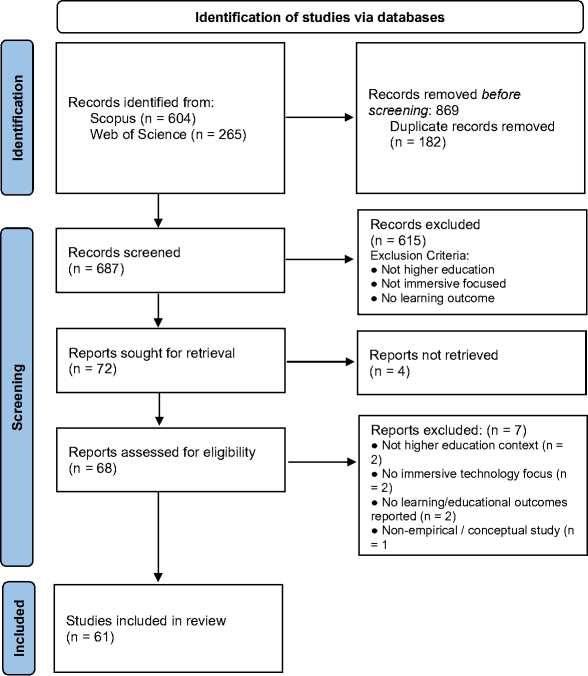
Figure 1. PRISMA flow diagram
Data Extraction and Coding Framework
An information extraction protocol was devised in a structured format to record descriptive and analytical information for each study. Data obtained comprised publication characteristics, disciplinary setting, immersive technology type, learning setting, and reported outcome focus and direction. Instead of the variables being perceived as discrete categories, they were coded in order to provide a cross-dimensional analysis where technology, context, and outcomes relationships would be pursued.
The coding structure was progressively improved during the extraction process, which is in line with best practices in systematic synthesis, in which categories are modified in response to the data ( Khatab et al., 2024 ). As an example, the outcome focus was initially considered broadly, but it was narrowed to studies that investigated skills and engagement, and/or both, in response to repeated patterns across the literature ( Lee et al., 2024 ).
Analytical Approach and Synthesis Strategy
Data synthesis proceeded in two complementary stages. First, a descriptive synthesis was conducted to identify dominant research characteristics, such as disciplinary concentration and the prevalence of technology. This step provided an empirical overview of how immersive learning research is currently structured. However, descriptive patterns alone were insufficient to address the study’s objectives. Accordingly, a second stage of thematic synthesis was undertaken to interpret how immersive technologies were conceptualized and evaluated across studies. This involved identifying recurring emphases, such as the privileging of skill acquisition over engagement, as well as notable absences, including limited exploration of mixed or neutral outcomes. As argued by Ke et al. (2025) , such interpretive synthesis is critical for moving beyond frequency counts toward theory-informed insight. Importantly, numerical values were used selectively to support key observations rather than to dominate the narrative. This approach aligns with calls for systematic reviews to prioritize meaningful interpretation over exhaustive quantification in heterogeneous fields ( Durak et al., 2026 ).
Quality Considerations and Trustworthiness
While formal risk-of-bias scoring was not applied due to methodological heterogeneity across studies, several steps were taken to enhance the review’s trustworthiness. These included transparent inclusion criteria, consistent coding procedures, and careful alignment between research questions, analysis, and reporting. Furthermore, the focus on peer-reviewed journal articles ensured a baseline level of methodological quality. The review does not claim to represent all immersive learning research exhaustively; rather, it offers a systematic and analytically robust snapshot of dominant trends and gaps. Such positioning is consistent with contemporary views that systematic reviews should be interpreted as theory-building and agenda-setting exercises, rather than definitive mappings of an entire field ( Benli and Kocaman, 2026 ).
To complement the thematic synthesis, we conducted a focused extraction and narrative-content analysis of reported outcomes from the 61 studies. Key findings on skill development, engagement, knowledge acquisition, confidence, and technology-specific effects were systematically compiled. These data were organized thematically to highlight dominant patterns, innovative practices, and contextual insights, enabling a richer understanding of the educational impacts of immersive technologies. This step ensured that the review captured both quantitative trends and qualitative nuances, bridging descriptive characteristics and the interpretive insights presented in the Findings section.
Methodological Positioning and Contribution
By integrating systematic procedures with interpretive synthesis, this methodology enables a nu-anced examination of immersive learning research that goes beyond surface-level trends. The approach is particularly suited to identifying imbalances in outcome focus, disciplinary silos, and technology dominance, which collectively shape how immersive learning is understood and applied. As such, methodological design directly supports the study’s aim of informing future theoretical development, empirical design, and practical implementation in immersive learning research.
This review synthesized 61 empirical studies examining the use of immersive technologies in higher education. Findings are organized around research characteristics, technology adoption, learning outcomes, discipline-specific patterns, and geographic distribution, emphasizing emerging patterns, gaps, and insights rather than exhaustive counts.
Research Characteristics and Dominant Patterns
Analysis of the research landscape reveals that education and health sciences dominate studies on immersive learning, collectively accounting for over 60% of the literature. Engineering/STEM contributes a substantial but smaller share, while social sciences, business, and sports sciences remain underrepresented, highlighting a clear disciplinary bias. This concentration suggests that immersive technologies are primarily applied where procedural, cognitive, or technical skill development is critical, leaving significant opportunities for creative, interpersonal, and social applications, as shown in the publication trend in Figure 2.
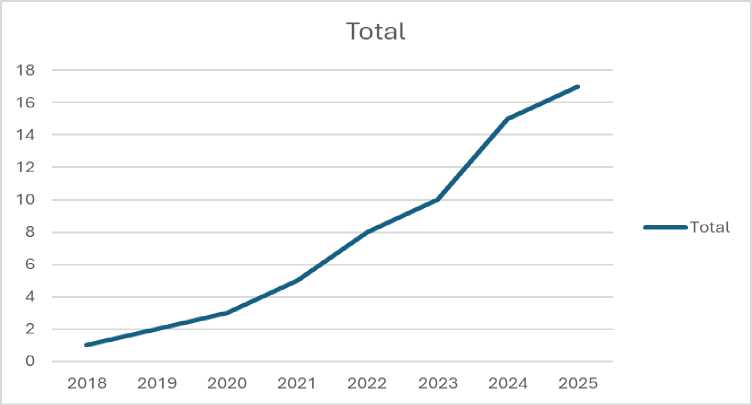
Figure 2. Publication Trend
The disciplinary breadth indicates that while most studies focus on a few core areas, there is a slow trend toward diversification. This pattern reflects both research priorities and technology suitability, as VR and XR are more readily integrated into education, health, and engineering curricula (See Table 1).
Table 1. Overall Research Characteristics of Immersive Learning Studies (N = 61)
|
Dimension |
Dominant Pattern |
Evidence (n, %) |
|
Academic Context |
Education and health sciences dominate; limited social uptake |
Education: 24 (39.3%); Medical / Health Sciences: 15 (24.6%); Engineering / STEM: 13 (21.3%); Social Sciences / Business: 4 (6.6%); Sports Sciences: 4 (6.6%) |
|
Technology Emphasis |
VR is dominant; XR represents a substantial secondary stream |
VR: 32 (52.5%); XR: 18 (29.5%); AR: 10 (16.4%); MR: 1 (1.6%) |
|
Disciplinary Breadth |
Narrow concentration with emerging diversification |
Core disciplines (Education, Health, Engineering): 52 (85.2%); Other fields (Social Sciences, Sports): 9 (14.8%) |
|
Outcome focus |
Integrated examination of skills and engagement outcomes |
Only skills (19.67%), only engagement (21.31%), both Skills and engagement (59.02%) |
|
Outcome direction |
Largely positive reported effects with minimal neutrality |
Largely positive reported effects with minimal neutrality |
Source: Author’s own construction
Table 1 indicates a strong disciplinary concentration of immersive learning research in education and health sciences, with limited representation from social sciences, business, and sports. VR dominates as the primary technology, while XR shows growing adoption and AR and MR remain underutilized. Most studies adopt an integrated focus on both skills and engagement, reflecting a holistic evaluation of learning outcomes. Overall, reported effects are largely positive, though the scarcity of neutral findings suggests the need for more critical and diversified investigations.
Technology Adoption Across Disciplines
VR is the dominant technology, appearing in more than half of the studies, particularly in health sciences and sports. Its prevalence reflects VR’s affordances for immersive, hands-on practice and realistic simulations. XR has emerged as a secondary stream, frequently applied in engineering and education for blended learning environments that combine cognitive, professional, and experiential skill development. AR, though less common, is strategically adopted where lightweight, context-sensitive interventions are needed. MR is almost absent, suggesting an untapped avenue for research.
These patterns show that technology choice is not random: VR is favored where high fidelity and presence are critical, XR is used for flexible, integrated learning, and AR supports practical, accessible interventions. This underscores the need to align technology with educational goals and learners’ needs.
Table 2. Discipline-wise Distribution of Technologies and Learning Outcomes
|
Discipline |
AR (n) |
VR (n) |
XR (n) |
Dominant Skill Focus |
Dominant Engagement Focus |
|
Education |
4 |
12 |
7 |
General, Cognitive |
Affective, Behavioral |
|
Engineering |
2 |
5 |
6 |
Cognitive, Professional |
Cognitive |
|
Health Sciences |
2 |
9 |
4 |
Cognitive, Psychomotor |
Affective |
|
Social Sciences |
1 |
2 |
1 |
Cognitive |
Affective |
|
Business |
1 |
0 |
0 |
Cognitive, Professional |
Affective |
|
Sports |
0 |
4 |
0 |
Psychomotor |
Behavioral |
Source: Author’s own construction
The integrated analysis in Table 2 shows that the adoption of immersive technologies and associated learning outcomes varies systematically across disciplines. VR is dominant in health sciences and sports, reflecting its suitability for simulation-based and psychomotor skill development. XR is more prevalent in engineering and education, supporting applied and professional competencies through blended learning approaches. Across disciplines, cognitive and general skills are most frequently targeted, while affective engagement remains the dominant engagement outcome. In contrast, social sciences and business fields remain underrepresented, with limited exploration of diverse skill sets such as communication and collaboration. These patterns suggest that technology adoption is closely aligned with disciplinary learning objectives rather than being randomly distributed.
Table 3. Immersive Technologies and Learning Outcomes: Integrated Synthesis
|
Outcome Domain |
Sub-Category |
VR |
AR |
XR |
Key Insight |
|
Skills |
General |
15 |
3 |
9 |
Core strength across all technologies |
|
Cognitive |
3 |
2 |
3 |
Strong in VR and XR |
|
|
Professional |
5 |
2 |
1 |
XR supports applied skills |
|
|
Psychomotor |
1 |
0 |
2 |
Dominated by VR |
|
|
Social/Communication |
1 |
1 |
1 |
Underexplored |
|
|
Engagement |
Affective |
4 |
4 |
4 |
Most dominant across all technologies |
|
Behavioral |
5 |
1 |
1 |
Limited evidence |
|
|
Cognitive |
3 |
0 |
1 |
Underreported |
|
|
Self-belief |
4 |
2 |
2 |
Moderate presence |
|
|
Presence |
3 |
0 |
1 |
Strong in VR |
Source: Author’s own construction
Table 3 provides an integrated synthesis of the associations between immersive technologies and different learning outcomes. VR shows strong alignment with general, cognitive, and psychomotor skills due to its high level of immersion and simulation capabilities. XR is more closely linked to professional and applied competencies, reflecting its role in blended and flexible learning environments. AR primarily contributes to cognitive and affective outcomes through context-sensitive, lightweight interventions. Across all technologies, affective engagement emerges as the most consistently reported outcome, highlighting the role of immersive environments in enhancing motivation, presence, and learner confidence. In contrast, behavioral and cognitive engagement remain underexplored, indicating a gap in understanding how immersive learning translates into deeper learning processes and active participation.
Geographic Distribution
Research is concentrated in Europe (34%) and East Asia (21%), with Southeast Asia and North America contributing moderately. Other regions, including Latin America, Africa, and Oceania, are underrepresented, pointing to a global imbalance in research activity. Regional adoption patterns also vary: VR dominates in Europe and East Asia, XR is increasingly used in North America and Europe, and AR appears more in Southeast Asia. These trends suggest that regional infrastructure, research priorities, and access to technology shape the adoption of immersive learning, offering insight into where future studies could expand geographically.
Table 4. Regional Patterns in Immersive Learning
|
Region |
No. of Papers) |
Percentage |
Key Countries |
|
Europe |
21 |
34.43% |
Spain (4), Netherlands (3), Denmark (3), UK (2), Slovakia (2) |
|
East Asia |
13 |
21.31% |
China (9), Taiwan (3), Japan (1) |
|
Southeast Asia |
9 |
14.75% |
Indonesia (3), Thailand (3), Malaysia (2) |
|
North America |
9 |
14.75% |
United States (6), Mexico (3) |
|
Middle East |
4 |
6.56% |
Saudi Arabia, Iran, Palestine, Turkey (1 each) |
|
Latin America |
3 |
4.92% |
Ecuador, Peru, Mexico (1 each) |
|
Africa |
2 |
3.28% |
Egypt (2) |
|
Oceania |
2 |
3.28% |
Australia (2) |
|
Total |
61 |
100% |
Source: Author’s own construction feedback
motivation
learning11
basic life support
embodied learning
■ordination
engineering, education
affordance network approach
arcs model
.'*■•-- VOSviewer
foreign lanjOage learning
head mounted display
Figure 3. Keyword Co-occurrence Network
Figure 3, generated in VOSviewer, a keyword co-occurrence network, visualizes the conceptual structure of immersive learning research. Virtual reality emerges as the dominant, most centrally connected node, underscoring its foundational role across educational contexts. Closely linked clusters around higher education, learning, motivation, and engagement suggest a strong emphasis on pedagogical outcomes. In contrast, adjacent nodes such as augmented reality, mixed reality, and STEM education reflect expanding technological diversification. The network highlights both core instructional applications and emerging interdisciplinary integrations, illustrating a maturing yet still evolving research landscape.
Discussion
The present systematic review highlights the growing adoption of immersive technologies in higher education, with VR, XR, and AR emerging as the primary tools for enhancing learning experiences. The concentration of research in education and health sciences underscores a clear disciplinary preference, suggesting that immersive technologies are most readily applied in domains requiring procedural, cognitive, or technical skill development. While these areas have effectively leveraged immersive tools, the relative underrepresentation of social sciences, business, and sports disciplines suggests untapped potential for immersive learning in domains that emphasize collaboration, communication, and higher-order thinking ( Kittel et al., 2024 ; Krouglov, 2024 ).
The bias towards designs based on quantitative analysis in the students included in the study indicates that the research questions are designed to address the measurable gains in skills. In contrast, few quantitative or mixed-method designs indicate a gap in the research to address how engagement and performance outcomes are facilitated and experienced by learners ( Fernandes et al., 2023 ). This knowledge can be critical because the motivational and affective components of the learning process may be as important as the acquisition of skills, especially in immersion settings where presence and self-efficacy can impact the learning process ( Thomann et al., 2024 ).
Technology-specific patterns reveal that VR dominates due to its capacity to deliver high-fidelity, immersive simulations, which are particularly effective in health sciences and sports training. XR, often deployed in blended learning settings, appears to facilitate professional skill development and affective engagement, offering flexibility that allows integration of cognitive and applied learning objectives. AR, although less prevalent, demonstrates meaningful contributions to cognitive and affective outcomes, particularly in educational and business contexts, highlighting its potential for context-sensitive, lightweight interventions. MR remains largely absent, representing an emerging frontier where future research could explore the simultaneous integration of cognitive, psychomotor, and affective dimensions, especially in complex or multi-step learning tasks ( Bödding et al., 2025 ).
The observed patterns in the adoption and outcomes of immersive technologies can be more meaningfully understood through established learning theories rather than only descriptive trends. From a constructivist perspective, immersive environments such as VR and XR allow learners to actively construct knowledge through interaction and contextualized experiences, which may explain their strong association with cognitive and procedural skill development. This aligns with experiential learning theory, in which learning is enhanced through concrete experience and reflective engagement, particularly in simulation-based environments commonly used in the health sciences and engineering. At the same time, the dominance of affective engagement outcomes can be interpreted through the lens of self-regulated learning, as immersive technologies appear to enhance motivation, presence, and confidence, which are critical precursors for autonomous learning processes. However, the limited evidence on behavioral and cognitive engagement suggests that these technologies are not yet consistently supporting deeper self-regulation strategies such as planning, monitoring, and reflection. In addition, cognitive load theory offers an important explanation for the uneven effectiveness across technologies. While high-immersion environments like VR can enhance learning by increasing realism, they may also impose extraneous cognitive load if not carefully designed, potentially limiting their effectiveness in complex or abstract learning tasks. In contrast, AR-based applications may reduce cognitive overload by embedding information within real-world contexts, thereby supporting more efficient knowledge processing. Taken together, these theoretical perspectives suggest that the effectiveness of immersive technologies depends not only on their level of immersion but also on how well they are aligned with learning processes, cognitive capacity, and learner self-regulation.
Additional understanding comes from discipline-based as well as geographic patterns. The correlation between VR and health sciences and sports has been associated with domain-specific affordances, and XR use in engineering and education means that it can be used to create integrated and hybrid learning experiences ( Samala et al., 2024 ). Eurocentric and East Asian geographic concentration also limits the generalizability of the results, as regions such as Latin America, Africa, and Oceania are underrepresented, casting doubt on the cultural, infrastructural, and pedagogical transferability ( Akinradewo et al., 2025 ).
Limitations and Future Directions
These research restrictions can be overcome in future studies by diversifying immersive learning research studies by discipline and location sub-areas, using a wider variety of technologies, and incorporating more comprehensive engagement systems. More focus on MR and AR would further research on blended and context-aware learning experiences, and longitudinal and mixed-methods designs would make the experiences and motivations of learners, along with interaction patterns, more comprehensive than immediate performance improvements. To enhance pedagogical integration, technology choices can be further aligned with the intended learning outcomes, including VR for procedural mastery, XR for applied and professional competencies, and AR for cognitive scaffolding and motivation. Taken together, these guidelines provide a way to move research on immersive learning beyond technology-based experimentation towards theoretically grounded, context-specific, and scalable educational interventions that can bring the full potential of immersive technologies in higher learning to life.
Acknowledgements
This study forms part of the research outputs of PJP PERSPEKTIF 2024 (Grant No. PJP/2024/ IPTK/PERINTIS/SA0050). The authors would like to acknowledge the support provided throughout the development of this research entitled Immersive Technologies and Learning in Higher Education: A Systematic Literature Review of Adoption, Engagement, and Skill Development.
Funding
This research did not receive any specific grant from funding agencies in the public, commercial, or not-for-profit sectors.
Conflict of interests
The authors declare no conflict of interest.
AI Declaration
The authors used generative AI tools, specifically ChatGPT and Grammarly, for language editing and formatting purposes only. The authors retain full responsibility for the accuracy, originality, and integrity of the manuscript.
Data availability statement
The original contributions presented in the study are included in the article/supplementary material; fur-ther inquiries can be directed to the corresponding author (s).
Institutional Review Board Statement
Not applicable.
Author Contributions
Conceptualization, W.A. and S.A.; methodology, W.A. and M.K.; data curation, W.A. and M.K.; formal analysis, W.A. and M.K.; visualization, W.A. and S.A.; writing original draft preparation, M.K. and W.A.; writing review and editing, N.B.A. and M.A.A.; supervision, W.A. and S.A. All authors have read and agreed to the published version of the manuscript.
