
Modeling the Impact of Perceived Security and Privacy on Student Adoption of Mobile Learning Applications Beyond Functionality
Journal: International Journal of Wireless and Microwave Technologies @ijwmt
Article in issue: 3 Vol.16, 2026.
Free access
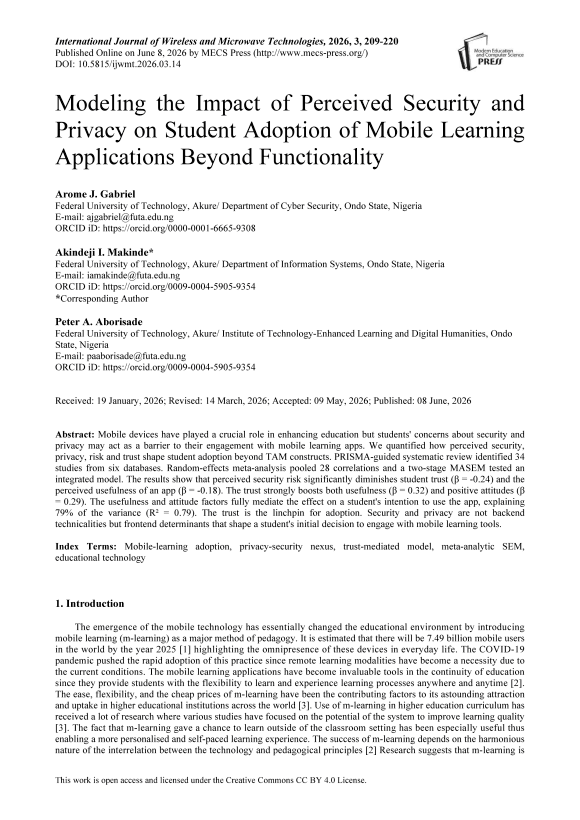
Mobile devices have played a crucial role in enhancing education but students' concerns about security and privacy may act as a barrier to their engagement with mobile learning apps. We quantified how perceived security, privacy, risk and trust shape student adoption beyond TAM constructs. PRISMA-guided systematic review identified 34 studies from six databases. Random-effects meta-analysis pooled 28 correlations and a two-stage MASEM tested an integrated model. The results show that perceived security risk significantly diminishes student trust (β = -0.24) and the perceived usefulness of an app (β = -0.18). The trust strongly boosts both usefulness (β = 0.32) and positive attitudes (β = 0.29). The usefulness and attitude factors fully mediate the effect on a student's intention to use the app, explaining 79% of the variance (R² = 0.79). The trust is the linchpin for adoption. Security and privacy are not backend technicalities but frontend determinants that shape a student's initial decision to engage with mobile learning tools.
Similar articles in the section Fundamentals of education. Theory, policy, etc.
Short address: https://sciup.org/15020460
IDS: 15020460 | DOI: 10.5815/ijwmt.2026.03.14
