
Participation of Kazakhstan Youth in Humanitarian Cooperation Projects Within the Framework of the EAEU
Section: Большие амбиции региональных лидеров
Article in issue: 2 т.31, 2026.
Free access
Introduction. The relevance of the topic is determined by the need to assess how youth initiatives are included in the humanitarian dimension of Eurasian integration and what place Kazakhstan occupies in these practices. The scientific novelty of this study lies in the development of a Kazakhstan-centric analytical framework for classifying these institutions based on their function, degree of institutionalization, format of participation, and verifiable outcomes. Methods and materials. The research is based on structural-functional analysis, comparative analysis, and case studies. The cases were selected according to four criteria: connection with the EAEU or the CIS-EAEU agenda, documented participation of Kazakhstan, availability of open sources, and humanitarian or youth orientation. The comparison was carried out by institutional status, target group, scale of Kazakhstani participation, continuity of the project, and presence of post-project support. The source base consists of regulatory documents from the EAEU and the CIS, materials from the Eurasian Economic Commission, reports from the organizers, and publicly available statistics. For the critical analysis of these sources, the views of researchers as reflected in the academic literature were also taken into account, including critical works on issues of Eurasian integration. Analysis. The article distinguishes institutional, forum, educational, media-cultural, and volunteer formats of cooperation. The participation of Kazakhstani youth is considered not a background element of the general EAEU agenda but three dimensions: representation, initiative, and infrastructure. Results. The study shows that Kazakhstan is regularly represented in key youth formats, but its participation is uneven and often quantitatively limited. The measurable effects of the initiatives are most reliably recorded at the level of contacts, project proposals, and institutional discussion, while claims about the formation of Eurasian identity or a stable community of leaders require additional sociological verification. The main problems are limited institutionalization, fragmented information support, barriers to academic mobility, and insufficient post-project support.
Short address: https://sciup.org/149151485
IDS: 149151485 | UDC: 94(574) | DOI: 10.15688/jvolsu4.2026.2.7
Участие казахстанской молодежи в проектах гуманитарного сотрудничества в рамках ЕАЭС
Введение. Актуальность темы определяется необходимостью оценить, каким образом молодежные инициативы включаются в гуманитарное измерение евразийской интеграции и какое место в этих практиках занимает Республика Казахстан. Научная новизна исследования состоит в разработке казахстаноцентричной аналитической рамки их классификации по функции, степени институционализации, формату участия и верифицируемым результатам. Методы и материалы. Исследование основано на структурно-функциональном, сравнительном и кейс-методе. Кейсы отбирались по четырем критериям: связь с повесткой ЕАЭС или сопряженными форматами СНГ – ЕАЭС, документированное участие Казахстана, наличие открытых источников и молодежно-гуманитарная направленность. Сопоставление осуществлялось по институциональному статусу, целевой группе, масштабу казахстанского участия, продолжительности проекта и наличию постпроектной поддержки. Источниковую базу составили нормативные документы ЕАЭС и СНГ, материалы Евразийской экономической комиссии, отчеты организаторов, открытая статистика. Для критического анализа источников также учитывалось мнение исследователей, отраженное в академической литературе, включая критические работы по проблемам евразийской интеграции. Анализ. В статье выделены институциональные, форумные, образовательные, медийно-культурные и волонтерские форматы сотрудничества. Участие казахстанской молодежи рассматривается не как фоновый элемент общей повестки ЕАЭС, а через три измерения: представительство, инициативность и инфраструктурный потенциал. Результаты. Показано, что Казахстан регулярно представлен в ключевых молодежных форматах, однако участие остается неравномерным и часто количественно ограниченным. Наиболее надежно фиксируемые эффекты инициатив проявляются на уровне контактов, проектных предложений и институционального обсуждения, тогда как выводы о формировании евразийской идентичности или устойчивого сообщества лидеров требуют дополнительной социологической проверки. Основными проблемами остаются ограниченная институционализация, фрагментарное информационное сопровождение, барьеры академической мобильности и недостаточная постпроектная поддержка.
Text of the scientific article Participation of Kazakhstan Youth in Humanitarian Cooperation Projects Within the Framework of the EAEU
DOI:
Цитирование. Куспанова А. Ж. Участие казахстанской молодежи в проектах гуманитарного сотрудничества в рамках ЕАЭС // Вестник Волгоградского государственного университета. Серия 4, История. Регионоведение. Международные отношения. – 2026. – Т. 31, № 2. – С. 75–86. – (На англ. яз.). – DOI:
Introduction. Youth cooperation in the humanities within the framework of the Eurasian Economic Union (EAEU) should be viewed as one of the channels for public and educational interaction that complements economic integration but does not replace its institutional and legal mechanisms. For Kazakhstan, this topic has practical significance: youth forums, academic mobility, project competitions, and media and cultural platforms create opportunities for crossborder contacts; however, their scale, sustainability, and actual effects require separate analytical examination.
In recent years, humanitarian cooperation among youth in the EAEU has become more prominent on the official agenda. The Union’s strategic documents emphasize the need to involve citizens, public organizations, and business associations of member states in determining the future directions of Eurasian integration [3; 4; 12]. In December 2020, the Eurasian Intergovernmental Council approved the Strategic Directions for the Development of Eurasian Economic Integration until 2025, which outlines the expansion of cooperation in the fields of education, healthcare, tourism, and sports [32]. For Kazakhstan, as one of the founding states of the EAEU, youth cooperation forms part of its policy on human capital development and international humanitarian engagement. At the same time, the mere existence of such initiatives does not in itself prove their integrative effect; therefore, this article distinguishes between participation, institutional outcomes, and the anticipated impact on the youth community.
With the establishment of the EEC Youth Council in 2019, the first sustainable mechanisms for advancing the youth agenda emerged at the supranational level. These were aligned with EAEU policy documents, primarily with the Strategic Directions for the Development of Eurasian Economic Integration until 2025 [19]. In this article, these mechanisms are analyzed not as self-evident proof of the effectiveness of humanitarian integration but as institutional conditions that can facilitate youth participation provided there is funding, transparent selection procedures, and post-project support.
The aim of this study is to identify the specific characteristics and limitations of Kazakhstani youth participation in youth humanitarian cooperation projects within the framework of the EAEU and related CIS-EAEU formats. The research question is formulated as follows: what exactly constitutes the Kazakhstani component of these initiatives, what is its scope, and what results can be considered verifiable through open sources? The objectives include: 1) to clarify the conceptual framework and criteria for classifying initiatives; 2) to characterize the institutional and regulatory foundations of youth cooperation in the EAEU; 3) to compare key initiatives involving Kazakhstani youth in terms of scale, functions, and results; 4) to identify problem areas and constraints affecting Kazakhstan’s participation.
The study covers the period from 2019 to 2025. The lower limit is determined by the establishment of the EEC Youth Council (2019) as the first permanent institutional mechanism for the youth agenda in the EAEU, while the upper limit is set by the documentation of current practices and results by the end of 2025, including the holding of the 3rd CIS and EAEU Youth Forum (Minsk, October 1–3, 2025) and the development of key educational, media, and project platforms in 2023–2024. The regulatory and programmatic context of the earlier period (the 2014 EAEU Treaty, the 2018 Declaration, and strategic documents through 2025) is considered as a preliminary background. To address terminological inconsistencies, the following working definitions are used. Humanitarian cooperation refers to educational, cultural, scientific, media, and volunteer practices aimed at developing intercommunity ties. Youth integration is interpreted as the inclusion of young citizens in such practices through forums, academic mobility, project competitions, and networking initiatives. Eurasian identity is not treated in this article as a proven outcome of participation but is understood as a potential subject for future sociological research. Public diplomacy refers to informal and semi-formal channels of interaction among youth, universities, NGOs, and expert platforms.
The Kazakhstan-centric analytical framework comprises three dimensions: representation (the proportion and regularity of Kazakhstani delegations’ participation), initiative
(the presence of proposals, projects, and organizational impetus from Kazakhstan), and infrastructural capacity (the role of Kazakhstani universities, technology hubs, and regional youth organizations in supporting cooperation). This framework allows us to avoid a mere retelling of the pan-Eurasian agenda and to highlight the specific features of the Kazakhstani case.
Methods and materials. The study employed a range of methods: structural-functional analysis, comparative analysis, and case studies. Structural-functional analysis was used to identify the functions of youth initiatives: institutional-communicative, educational, project-entrepreneurial, media, and volunteer. Comparative analysis was used to compare projects using a unified matrix of parameters: organizer and institutional status, target group, format of Kazakhstan’s participation, number or proportion of participants (where data is available), documented results, post-project support, and limitations. Case studies were applied to those initiatives for which open sources are available and Kazakhstan’s participation is documented.
The author uses the materials, which include regulatory documents of the Eurasian Economic Union (EAEU) and the Commonwealth of Independent States (CIS) that define the institutional and programmatic foundations of youth cooperation; informational and analytical materials from the Eurasian Economic Commission and the CIS Executive Committee; reports and communications from the organizers of youth forums, summits, and competitive projects; and open statistical data on educational mobility.
Academic studies on Eurasian integration, humanitarian cooperation, and issues in higher education help to represent all the critical points of view considering the integration process. The conceptual framework for research on Eurasian integration is provided by the monograph by E.Y. Vinokurov and A.M. Libman, which proposes an approach to Eurasian regionalism and identifies the factors influencing the sustainability of integration [2]. The post-Soviet legal architecture – from the CIS to the EAEU – is systematically described by Zh.M. Kembaev; his work allows for an account of the evolution of norms and institutions [12]. The study by
R. Dragneva and K. Volchuk is important for a critical analysis of the relationship between political agreements and formal rules in the EAEU [10].
The humanitarian dimension is explored in the works of G.I. Osadchaya: a monograph on the formation of the EAEU combines ideological foundations and institutional practice [25], while a later study focuses on human capital, demographics, and cooperation in education and culture [26]. M.V. Roslavtseva writes specifically about the value- and identity-based foundations of cooperation among young people, proposing operational indicators of social memory [33]. These works show that conclusions about identity require not a description of activities, but specific measurement procedures.
Youth policy within the EAEU framework is specifically addressed by A.V. Palamarchuk, who examines the role of Eurasian youth associations as a channel for public diplomacy [30], and by E.V. Kuznetsova, who considers forums, schools, and academic mobility as resources for humanitarian cooperation [13; 14]. For a critical assessment of the educational dimension, the works of T.V. Lebedeva, M.O. Govorchenko, G.I. Osadchaya, and T.N. Yudina are drawn upon, which identify barriers to the recognition of qualifications, inconsistencies in educational standards, limited funding, and low mobility [6; 16; 27].
Thus, the research materials are based on a combination of official documents, statistics, and academic literature. Official reports are used to document the facts regarding the conduct of events and the composition of participants, while scholarly works are used to interpret limitations, asymmetries, and conditions for effectiveness. This allows for maintaining analytical distance and prevents the study from merely reproducing the institutional rhetoric of the EAEU.
Analysis. The EEC Youth Council, established in 2019, is a fundamental institutional component of the EAEU’s youth agenda. Its role is not only to provide informational support for integration but also to facilitate communication among young professionals, national youth organizations, and supranational bodies. For the Kazakhstani case, the Council’s significance lies in the fact that representatives from Kazakhstan are included in a permanent mechanism for discussing youth initiatives; however, mere participation in the Council does not automatically translate into influence over the country’s youth community; such influence must be assessed based on the number of supported projects, the sustainability of communication, and the subsequent implementation of proposals.
The CIS and EAEU youth forums have become key practical platforms. The first forum took place on August 25–26, 2022, in Cholpon-Ata and brought together more than 250 participants from EAEU member states and Uzbekistan [29; 34]. For Kazakhstan, the forum is important as a platform for presenting proposals in the fields of education, youth entrepreneurship, tourism, volunteering, and the digital economy [7]. From an analytical perspective, its outcome should be assessed not through rhetoric of support but through the presence of subsequent institutional follow-up: the adoption of the Cholpon-Ata Action Plan, discussion of the mechanism for accepting youth initiatives, and the launch of specific educational projects [20].
The 2nd CIS and EAEU Youth Forum, held in June 2023 in Sochi, confirmed the regularity of this format. The Kazakh delegation participated in discussions on digital cooperation, startup initiatives, and academic and project mobility. At the same time, publicly available materials allow for the reliable documentation of, first and foremost, the fact of participation and the topics of proposals, whereas the degree of their subsequent implementation varies and requires separate monitoring. Therefore, the forum is viewed as a mechanism for placing initiatives on the agenda, rather than as a comprehensive tool for solving youth issues.
The 3rd CIS and EAEU Youth Forum took place in Minsk on October 1–3, 2025, and was organized into tracks related to the media sphere, education and science, youth initiatives, and innovative entrepreneurship [2]. Holding it following the meeting of the Eurasian Intergovernmental Council strengthened the link between the youth agenda and the intergovernmental level; however, the forum’s reach remained limited compared to the scale of youth groups in the EAEU states. Consequently, the forum’s significance lies primarily in the institutional signal it sends and the selection of project ideas, rather than in the mass engagement of youth.
One of the most significant areas of cooperation in the humanities is education and science. EAEU strategic documents provide for the use of network-based approaches to implementing educational programs and the harmonization of qualification requirements [5]. For Kazakhstan, this area has a dual nature: on the one hand, the country is actively engaged in educational ties with Russia and other states in the Eurasian region; on the other hand, these ties are marked by significant asymmetry and are not always formalized as actual EAEU programs. Therefore, academic mobility is viewed as an important context for Kazakhstan’s participation but is not equated with the outcomes of EAEU youth projects.
The 2023–2024 EAEU Global University Summit serves as a specialized educational platform bringing together students, young researchers, and representatives of universities, business, and integration institutions. In 2023, the summit addressed science, careers, student selfgovernance, and youth policy; in 2024, the increase in the number of applications indicated growing interest in the format [24]. However, the summit is not a representative indicator of overall academic mobility. It is more accurate to analyze it as a case of networked educational cooperation and as a mechanism for selecting motivated participants, rather than as a mass exchange program [28].
The data in the table reveal a marked imbalance in educational exchange between Kazakhstan and Russia. Even though some of the figures are rounded, it is clear that the flow of citizens from the Republic of Kazakhstan to Russian universities significantly exceeds the corresponding flow of citizens from the Russian Federation to Kazakhstani universities. This imbalance is significant for the research topic: Kazakhstan has a substantial youth contingent already integrated into the Russian educational sphere; however, this contingent does not automatically become participants in EAEU humanitarian projects. To transition from educational migration to integration-oriented participation, special programs, clear information channels, and post-project support are necessary.
Kazakhstan’s potential is linked not only to the scale of outbound educational mobility but also to its national infrastructure: universities, youth organizations, technology hubs, and regional initiatives. However, the impact of these tools specifically on intra-Union youth interaction requires documentary confirmation. Therefore, in this study, they are considered Kazakhstan’s infrastructural capabilities rather than a proven integration outcome.
Joint research and educational projects – ranging from schools for young scientists to student startup incubators – receive support at the EAEU level [7]. Their value lies in fostering professional networks and project skills, but their effectiveness must be assessed using measurable indicators: the number of participants, the proportion of Kazakhstani involvement, the continuation of projects after the event, the availability of grant or mentoring support, and the incorporation of results into educational programs [31].
Table 1. Trends in educational mobility between Kazakhstan and Russia for the period 2022–2025
|
Year / period |
The number of Kazakh citizens studying at universities in Russia |
The number of Russian citizens studying at universities in Kazakhstan |
Flow ratios (KZ to RU / RU to KZ) |
|
2022 |
≈ 67 000 |
1 247 |
≈ 53,7: 1 |
|
2023 |
≈ 79 000 |
1 298 |
≈ 60,9: 1 |
|
2024 |
≈ 83 000 |
≈ 2 100–2 200 |
≈ 37,7–39,5: 1 |
|
2025 |
≈ 85 000 |
2 426 |
≈ 35: 1 |
Notes. Compiled by the author based on materials from [11; 15]. Data on citizens of the Republic of Kazakhstan attending universities in the Russian Federation are presented as rounded estimates from open sources; data on citizens of the Russian Federation attending universities in the Republic of Kazakhstan are used as reported in available statistics. The ratio of student flows was calculated by the author as the ratio of the corresponding figures and is provided for reference purposes only.
Academic literature and publicly available materials point to persistent limitations on academic mobility within the EAEU: uneven recognition of disciplines and qualifications, differences in accreditation requirements, administrative barriers in arranging internships, and insufficient institutional support for exchanges. G.I. Osadchaya and T.N. Yudina note the fragmentation of practices and the inconsistency of educational standards [27]; T.V. Lebedeva links low mobility to differences in professional standards and legal regimes governing educational migration [17], while M.O. Govorchenko highlights limited funding and restricted studentfaculty mobility [6]. These factors directly limit the participation of Kazakhstani youth in EAEU projects [16].
Cultural, volunteer, and media initiatives expand the scope of youth cooperation beyond university mobility. The “100 Ideas for the CIS” project is relevant to this topic as a collaborative platform involving young people from EAEU member states, including Kazakhstan [1 8]. Kazakhstani projects presented in the competition finals demonstrate the presence of initiative potential; however, publicly available materials more often document competition recognition rather than subsequent sustainable implementation. Therefore, it is advisable to view such projects as a stage for testing ideas and establishing contacts, rather than as completed integration products.
The “CIS Youth Capital” project creates additional infrastructure for youth engagement within the Commonwealth. It is significant for this study to the extent that Kazakhstan has proposed to substantively strengthen this format by holding international youth forums, thereby creating a link between the agendas of the CIS and the EAEU. At the same time, quantitative data on the number of participants are used only when source transparency is available; in other cases, the analysis is limited to documenting the project’s institutional role and the participation of delegations.
A comparison of publicly available information on competitions, forums, and educational projects reveals common areas of concern. Following competition finals, sustained post-project support is not always guaranteed: acceleration programs, mentoring, pilot implementation, and co-funding are not available in all formats. Access to information also remains uneven: announcements and application procedures are scattered across various resources, and a unified digital platform featuring a calendar of opportunities and a “one-stop shop” approach to participation has not yet become a standard tool for all projects.
Media and educational projects have emerged specifically within the EAEU framework. In 2024, the Gorchakov Fund organized the international media school “EAEU-Media,” the in-person phase of which took place June 30 – July 4, 2024, at the “Mashuk” Knowledge Center in Pyatigorsk [9]. Participants included students from journalism and international relations departments, young bloggers, and student media staff aged 18–27, selected through a competitive process [22]. For Kazakhstan, this format could be useful as a channel for introducing young people to integration-related topics in a professional context; however, its effectiveness should be measured by subsequent media products, online connections, and continued professional collaboration, rather than by the mere fact that the school was held [1].
The “Eurasian Dialogue” forums are a scientific, educational, and expert discussion platform dedicated to exploring humanitarian cooperation, historical and cultural heritage, and integration processes [23]. Kazakhstani participants were represented at these events; however, in the absence of comparable lists and final reports, it is advisable to record the qualitative fact of participation rather than derive precise estimates of Kazakhstan’s share. The analytical significance of the format lies in supporting expert communication and discussing the humanitarian agenda, rather than in demonstrating a broad public impact.
The volunteer sector remains less institutionalized. At the CIS level, the Concept for the Development of Cooperation in Support of the Youth Volunteer Movement (2021–2030) has been adopted, and within the framework of EAEU youth forums, the idea of supporting volunteerism in an integration format has been discussed. For Kazakhstan, this area may hold promise thanks to the experience of youth organizations and regional initiatives; however, the creation of a Eurasian volunteer network should still be viewed as a recommendation rather than an already established mechanism.
A separate group consists of civil society youth initiatives that emerge with the support of grants and regional organizations. For example, the “Eurasian Express: Russia – Kazakhstan –
Tajikistan” project included a youth roundtable in Kostanay attended by students from Kazakhstan and the Chelyabinsk Region of the Russian Federation [21]. Such formats complement official events by fostering interpersonal and regional contacts, but their contribution to Eurasian integration should be assessed cautiously as the establishment of communication links rather than as an automatically measurable institutional outcome [8].
Below it is a summary table of the main initiatives involving Kazakhstani youth. The table is organized according to analytical parameters: type of initiative, period and location of implementation, form of Kazakhstan’s participation, nature of the outcome, and degree of verifiability of quantitative data.
Table 2. Key Youth Humanitarian Cooperation Projects Involving Kazakhstan within the EAEU
and Related Formats (2019–2024)
|
Project / Initiative |
Date, location |
Overview and Kazakhstan’s Participation |
Kazakhstan’s Participation and the Degree of Data Verifiability |
|
Youth Council of the Eurasian Economic Commission |
Founded in 2019, Moscow |
A permanent consultative and communication body for youth within the EAEU; the Council’s membership and activities include representatives from the Union’s member states, including Kazakhstan |
Representatives from Kazakhstan participate in the Council’s work on a permanent basis. Quantifying their contribution requires an analysis of the minutes, the composition of the working groups, and the list of supported initiatives |
|
“Made in the EAEU” Business Game |
September 2020, online/in-person |
A youth simulation program designed to promote an inclusive agenda and foster project-based thinking |
According to publicly available information, teams from Kazakhstan participated in the competition. The exact number of applications and teams that passed the selection process requires further documentary confirmation; therefore, this figure is provided for reference only |
|
The “Our Heroes” Project (Marking the 75th Annivers ary of Victory) |
2020, CIS countries / Eurasianregion |
A commemorative and patriotic initiative involving young people from various countries; Kazakhstani volunteers and students participated in joint commemorative events, online activities, and creative projects |
There is no officially comparable data on participants from all countries. Kazakhstan’s participation is recorded qualitatively, without any precise statistical conclusions |
|
CIS and EAEU Youth Forums (I and II) |
1st Forum – August 25–26, 2022, Cholpon-Ata; 2nd Forum – June 7–9, 2023, Sochi |
Forum platforms for discussing initiatives in the fields of education, entrepreneurship, tourism, digital cooperation, and community projects. The Kazakh delegation participated in both forums and presented proposals |
Cholpon-Ata 2022: approximately 20–25 delegates from Kazakhstan out of a total of over 250 (about 8–10%). Sochi 2023: approximately 20–30 delegates out of a total of about 150 (about 13–20%). Thedatashowstablebutlimitedrepresentation |
|
Eurasian Economic Union Global University Summit |
May 2023, Moscow; November 2024, Moscow |
An educational and expert discussion platform for universities, students, and young researchers from EAEU countries; in 2023, discussions focused on a networked master’s program and a university consortium |
2023: An estimated 25–40 participants from Kazakhstan out of a total on-site contingent of over 300 (8–13%). 2024: An estimated 30–50 participants out of 350–400 on-site participants (8–14%). This estimate reflects a percentage rather than exact statistics |
|
“EurasianDia logue” Forum |
2023 – Brest; 2024 – Minsk |
A forum for academic, educational, and expert discussion on humanitarian cooperation, integration processes, and the historical and cultural sphere |
Representatives from Kazakhstan participated in the forums. In the absence of comparable lists of participants, it is more appropriate to note their substantive participation rather than provide a strict quantitative assessment |
|
“EAEU- Media” MediaSchool |
June – July 2024, Pyatigorsk |
A two-phase educational project for young journalists, bloggers, and student media staff from EAEU countries. Kazakhstani participants were selected through a competitive process |
A few representatives from Kazakhstan participated in the in-person session, an estimated 3–4 people out of 25–30 in-person participants. The online participation by country requires further confirmation |
|
Youth Exchanges And Movements |
On an ongoing basis, including between Russia and Kazakhstan |
Student exchanges, camps, expeditions, festivals, grant programs, and educational initiatives that reflect the broader landscape of youth mobility |
In 2024, approximately 83,000 Kazakhstani citizens were enrolled in Russian universities, illustrating the scale of educational mobility. For short-term exchanges, only qualitative estimates are available, as there are no comprehensive aggregate statistics |
The data presented show that Kazakhstan’s participation in EAEU youth humanitarian initiatives and related Eurasian formats is consistent but, in a number of areas, limited in scope. The most reliably documented platforms are major institutional and forum-based initiatives – the EEC Youth Council, the CIS and EAEU youth forums, and the EAEU Global University Summit. These formats reveal that the share of Kazakhstani participants typically accounts for less than one-fifth of the total number and more often falls within the range of 8–14%, suggesting not a dominant but a stable representation. In cases where official comparable statistics are unavailable, it is more appropriate to use qualitative descriptions or a disclaimer regarding the approximate nature of the assessment to avoid excessive categorization.
It is important to note that participation in youth humanitarian initiatives involves not only representatives from Astana and Almaty but also young people from the regions of Kazakhstan. This broadens the social base of integration efforts, reduces the concentration of opportunities exclusively in the capital cities, and contributes to the formation of a broader network of horizontal ties among young professionals from different regions.
Fig. shows the approximate ratio of participants from Kazakhstan to those from other countries in projects for which at least comparable numerical data are available from open sources. These figures are used to illustrate the scale of representation and do not replace representative statistics on youth participation.
Source: Compiled by the author based on publicly available data from project organizers and the estimates provided in Table 2. Note: For projects with incomplete statistics, the median values of the published ranges were used; the figures are approximate.
Fig. 1 shows that the share of Kazakhstani participants in most of the formats examined remains limited. This allows us to refine the conclusion: Kazakhstan is present in key initiatives and, in some cases, puts forward proposals; however, this does not involve the mass engagement of youth, but rather targeted forms of participation focused on delegations, activists, students, and young professionals.
In terms of substance, Kazakhstan’s participation takes several forms: delegation representation at forums, the participation of students and young researchers in educational platforms, the presentation of project ideas, and the inclusion of individual representatives in media and expert formats. This structure encompasses different categories of youth but remains dependent on competitive selection, quotas, funding, and the availability of information for regional participants.
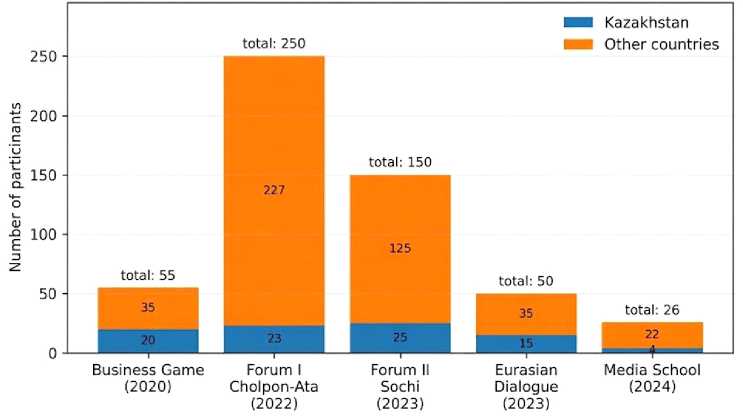
Fig. Estimated ratio of participants from Kazakhstan and other countries in key youth humanitarian cooperation projects within the EAEU (2019–2024)
Notes. Compiled by the author based on publicly available data from project organizers and the estimates provided in Table 2. For projects with incomplete statistics, the median values of the published ranges were used; the figures are approximate.
At the same time, the analysis reveals some bottlenecks. Kazakhstan’s representation at major forums and summits typically does not exceed onefifth of the total number of participants, and the share is even lower when it comes to media coverage. There is a gap between large-scale educational flows (tens of thousands of Kazakhstani students in Russian universities) and the relatively low levels of participation in EAEU offline activities. This gap is exacerbated by delegation quotas, limited funding, and weak postproject support.
The analysis identified key systemic problem areas: asymmetry in educational mobility, insufficient institutionalization of certain youth formats, limited transparency of statistics, a fragmented information ecosystem, and the absence of a sustainable mechanism for supporting initiatives after forums and competitions. These issues are particularly significant for Kazakhstan, as the country possesses considerable youth potential, yet its involvement in EAEU projects remains largely sporadic.
Operational constraints on mobility after 2022 deserve special attention: changes in transport routes, more complex calculations, rising transaction costs, and administrative procedures.
Based on an analysis of regulatory documents, academic literature, publicly available statistics, and case studies involving Kazakhstan, recommendations have been formulated to improve youth humanitarian cooperation within the EAEU.
First, a systematic program for academic and project mobility is needed, backed by sustainable funding: scholarships, microgrants, travel quotas, and transparent selection criteria. Such a program would link Kazakhstan’s large-scale educational mobility with specific EAEU integration projects.
Second, a unified digital platform for youth opportunities is needed under the auspices of relevant EAEU bodies: an events calendar, a “one-stop shop” for applications, localized materials, feedback, and open publication of final data. This is particularly important for young people in Kazakhstan’s regions, who have less access to information channels in the capital.
Third, post-project support for competition winners and finalists should be developed: mentoring, acceleration, pilot implementations, internships, and partnerships with universities, businesses, and technology hubs. Without such support, forums and competitions remain primarily event-based formats.
Fourth, procedural standards for academic mobility must be harmonized: recognition of disciplines and qualifications, internship regulations, academic calendars, and documentation requirements. Additionally, it is advisable to institutionalize volunteer programs and media support, including media literacy training and the bilingual presentation of materials.
Results. The analysis conducted showed that the humanitarian component of youth cooperation within the EAEU has gradually been institutionalized; however, it remains less developed than the economic and regulatory aspects of integration. The EEC Youth Council, CIS-EAEU forums, university summits, media schools, and project competitions form a set of interconnected but not yet fully synchronized tools.
The cooperation infrastructure encompasses the institutional level (EEC Youth Council), the event level (youth forums), and the educational level (summits, networking programs, and academic mobility), as well as media-cultural and volunteer formats. Its strength lies in the regularity of individual events and the opportunity for direct dialogue between young people and representatives of integration structures; its weakness lies in limited reach, incomplete statistical transparency, and insufficient linkage between events and subsequent project outcomes.
For Kazakhstan, participation in these projects has three distinctive features. First, it is consistently represented in key formats, but its scope is limited. Second, Kazakhstan acts not only as a participant but also as a source of specific proposals related to academic mobility, youth tourism, digital platforms, and project initiatives. Third, Kazakhstan’s national educational and technological infrastructure has the capacity to support Eurasian youth projects, though this potential is currently being realized only in a piecemeal fashion.
Verifiable results of the initiatives are primarily evident in the organizational and communication spheres: the holding of regular forums, the emergence of project proposals, support for specific grant initiatives, and the expansion of contacts between universities, youth organizations, and expert platforms.
Kazakh participants gain experience in international communication, project work, and expert discussions. However, the scope of this experience is limited by delegation and competition formats. Therefore, the main practical conclusion is the need to transition from one-off events to ongoing programs: internships, online courses, microgrants, acceleration, and tracking participants’ trajectories after the project concludes.
The direct participation of representatives from the executive branches of EAEU member states elevates the status of youth forums and allows proposals to be incorporated into the institutional agenda more quickly. At the same time, the mere existence of such dialogue does not in itself equate to program effectiveness. Effectiveness should be assessed based on which initiatives were selected for further development, which received funding, which were implemented, and which effects persisted after the event concluded.
The following challenges have been identified: differences in educational systems and procedures for recognizing qualifications, a lack of sustainable funding, bureaucratic barriers to internships and mobility, fragmented information support, limited delegation quotas, weak post- project support, and insufficient institutionalization of volunteer programs. These challenges indicate that youth cooperation within the EAEU is still in its formative stage and requires stricter coordination and measurement of results.
Thus, humanitarian projects involving youth can be viewed as a promising but not yet sufficiently institutionalized tool for Eurasian cooperation. They create the conditions for interpersonal contacts, professional networks, and joint initiatives; however, conclusions regarding the formation of a Eurasian identity, a sustainable community of leaders, or the high effectiveness of humanitarian diplomacy require representative surveys, interviews using transparent methodologies, content analysis of media products, and long-term monitoring of participants.
The Kazakhstani case shows that the potential for participation is not limited to Astana and Almaty: regional universities, youth organizations, and local initiatives are capable of expanding the social base of cooperation. However, to confirm the regional impact, it is necessary to collect comparable data on the geography of participants, types of organizations, duration of participation, and subsequent project outcomes.
