
Precision Agriculture through Multispectral Imaging and Machine Learning for Paddy Field Health Assessment
Journal: International Journal of Image, Graphics and Signal Processing @ijigsp
Article in issue: 3 vol.18, 2026.
Free access
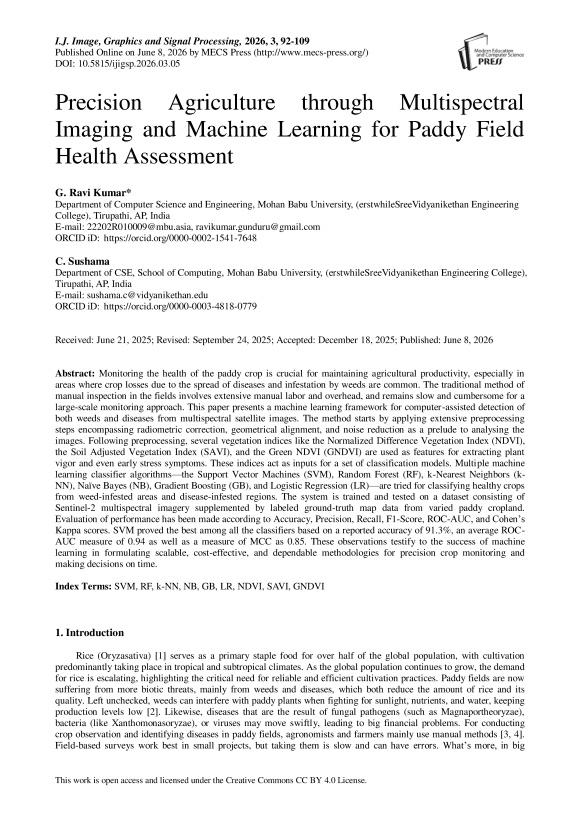
Monitoring the health of the paddy crop is crucial for maintaining agricultural productivity, especially in areas where crop losses due to the spread of diseases and infestation by weeds are common. The traditional method of manual inspection in the fields involves extensive manual labor and overhead, and remains slow and cumbersome for a large-scale monitoring approach. This paper presents a machine learning framework for computer-assisted detection of both weeds and diseases from multispectral satellite images. The method starts by applying extensive preprocessing steps encompassing radiometric correction, geometrical alignment, and noise reduction as a prelude to analysing the images. Following preprocessing, several vegetation indices like the Normalized Difference Vegetation Index (NDVI), the Soil Adjusted Vegetation Index (SAVI), and the Green NDVI (GNDVI) are used as features for extracting plant vigor and even early stress symptoms. These indices act as inputs for a set of classification models. Multiple machine learning classifier algorithms—the Support Vector Machines (SVM), Random Forest (RF), k-Nearest Neighbors (k-NN), Naïve Bayes (NB), Gradient Boosting (GB), and Logistic Regression (LR)—are tried for classifying healthy crops from weed-infested areas and disease-infested regions. The system is trained and tested on a dataset consisting of Sentinel-2 multispectral imagery supplemented by labeled ground-truth map data from varied paddy cropland. Evaluation of performance has been made according to Accuracy, Precision, Recall, F1-Score, ROC-AUC, and Cohen’s Kappa scores. SVM proved the best among all the classifiers based on a reported accuracy of 91.3%, an average ROC-AUC measure of 0.94 as well as a measure of MCC as 0.85. These observations testify to the success of machine learning in formulating scalable, cost-effective, and dependable methodologies for precision crop monitoring and making decisions on time.
Similar articles in the section Plant damage, injuries. Plant diseases. Pests, organisms injurious to plants. Plant protection
Short address: https://sciup.org/15020409
IDS: 15020409 | DOI: 10.5815/ijigsp.2026.03.05
