
Quality Education – Sustainable Development Goal 4: A Bibliometric Analysis through a Management and Policy Lens
Journal: Education Integration @edumag-mrsu
Section: Модернизация образования
Article in issue: 1 (122) т.30, 2026.
Free access
Introduction. Sustainable Development Goal 4 aims to ensure inclusive, equitable, and quality education for all. Systematic understanding of its research landscape from a management and policy perspective remains limited. Given education’s central role in advancing sustainability and evidence-based governance, this study systematically analyses the global Sustainable Development Goal 4 research landscape to identify dominant themes, collaboration patterns, and underexplored areas relevant to management and policy discourse. Materials and Methods. The analysis is based on 2,164 peer-reviewed journal articles indexed in the Scopus database. Performance analysis and science mapping techniques were conducted using Biblioshiny and VOSviewer. Analysis of annual publication trends, top authors and institutions, co-authorship patterns, keyword co-occurrence, and thematic clustering. Results. Three research clusters emerged: teachers’ attitudes and challenges in inclusive education, professional development and institutional support; cross-cultural perspectives on self-efficacy and teaching quality, reflecting cultural influences on pedagogical practices; e-education and lifelong learning. Analysis shows dominant contributions from the USA, the UK, and Australia, with increasing participation from Asia and Africa as well as strong interdisciplinary links between business, policy, and sustainability. The findings further indicate a strong concentration of research around teacher-related issues and inclusion, alongside a rapid expansion of digital and lifelong learning themes in recent years. Interdisciplinary linkages across education, business, policy, and sustainability domains are also evident. Discussion and Conclusion. This study maps the evolving research landscape of Sustainable Development Goal 4 and identifies gaps, especially in underrepresented regions. The results offer valuable insights for researchers, educators, and policymakers focused on advancing inclusive and sustainable education worldwide. This study advances Sustainable Development Goal 4 scholarship by exposing systematic thematic and regional imbalances and identifying neglected areas of critical policy relevance. These insights help recalibrate research priorities and support more effective, evidence-informed policy interventions to advance inclusive and sustainable education.
Similar articles in the section Education
Short address: https://sciup.org/147253524
IDS: 147253524 | UDC: 37:32:81.11 | DOI: 10.15507/1991-9468.030.202601.010-028
Качественное образование – цель устойчивого развития 4: библиометрический анализ через призму управления и политики
Введение. Цель устойчивого развития 4 направлена на обеспечение инклюзивного, справедливого и качественного образования. Несмотря на возрастающий научный интерес к вопросам образования в контексте устойчивого развития, системное понимание ландшафта исследований с точки зрения управления и политики остается ограниченным. Цель исследования – проанализировать глобальный исследовательский ландшафт цели устойчивого развития 4 для выявления доминирующих тем, моделей сотрудничества и пробелов, имеющих отношение к управленческому и политическому дискурсу. Материалы и методы. Осуществлен анализ 2 164 статей из рецензируемых журналов, индексируемых в Scopus, с помощью структурированного поиска. Научное картирование было проведено с использованием программных инструментов Biblioshiny и VOSviewer. Процесс библиометрии включал изучение годовых тенденций публикаций ведущих авторов и организаций, моделей соавторства, со-встречаемости ключевых слов и тематического кластерного анализа для отслеживания интеллектуальной структуры и возникающих тем в исследуемой области. Результаты исследования. Выделены три исследовательских кластера: отношение преподавателей и проблемы инклюзивного образования с акцентом на профессиональное развитие и институциональную поддержку; межкультурные перспективы самоэффективности и качества преподавания, отражающие влияние культуры на педагогическую практику; электронное образование и обучение на протяжении всей жизни, подчеркивающее роль цифровых платформ в расширении доступа к образованию. Установлены доминирующий вклад США, Великобритании и Австралии при растущем участии Азии и Африки, а также прочные междисциплинарные связи между бизнесом, политикой и устойчивым развитием. Отмечается сильная концентрация работ вокруг вопросов, касающихся учителей и инклюзии, наряду с быстрым расширением тем цифрового и непрерывного обучения в последние годы. Обсуждение и заключение. Исследование отображает эволюцию исследовательского ландшафта в области цели устойчивого развития 4 и выявляет пробелы. Результаты предлагают ценные идеи для исследователей, педагогов и политиков, стремящихся продвигать инклюзивное и устойчивое образование во всем мире.
Text of the scientific article Quality Education – Sustainable Development Goal 4: A Bibliometric Analysis through a Management and Policy Lens
EDN:
S.P. Jain Institute of Management and Research (SPJIMR), Mumbai, Republic of India,
Институт менеджмента и исследований им. С. П. Джайна, г. Мумбаи, Республика Индия, н
SDG-4 of the 2015 United Nations Sustainable Development Goals (SDGs)1 is a fundamental objective for accessible and equitable education [1]. SDG-4 aims to guarantee “inclusive and equitable quality education and promote lifelong learning opportunities for all” by 2030. It recognises that education is a human right and a driver of socioeconomic development [2]. The importance of SDG-4 is globally recognised and promoted [3–5]. Inequalities in low-income countries highlight the need to achieve the SDG-4 by 2030. The 2023 UNESCO Global Education Monitoring Report indicates that around 244 million children are still out of school2. About 70% of children in low- and middle-income countries cannot read and comprehend a simple text by age 103.
In recent years, there has been a significant increase in academic research on SDG-4 [3; 6] on a wide range of subjects [1; 5; 7]. However, a detailed examination of the research landscape is still lacking (Table 1). Science mapping tools, including co-authorship networks, keyword co-occurrence, and theme evolution, have not been comprehensively utilised to identify knowledge clusters, significant publications, or collaboration patterns.
T a b l e 1. Review articles on SDG-4
Year Article Scope of study Method
2024 Ferguson T., Roofe C. SDG-4 in Higher Education: SDG-4 in higher SLR
Challenges and Opportunities [4] education
2024 Alfirević N., Rendulić D., Fošner A. Bibliometric Ana- SDG-4 literature deve- Bibliometric lysis of the South East European SDG4 Research [8] loped in Southeast Europe analysis
2024 Kumar D., Shandilya A.K., Bhardwaj V. A Global Per- Tourism and Hospitality Bibliometric spective on Tourism and Hospitality Education and Education and SDG-4 analysis SDG-4: A Bibliometric Exploration [9]
2023 Saini M., Sengupta E., Singh M., Singh H., Singh J. Indicators of SDG-4 SLR
Sustainable Development Goal for Quality Education
(SDG-4): A Study on SDG-4 to Extract the Pattern of
Association among the Indicators of SDG-4 Employing a Genetic Algorithm [5]
2022 Khan P.A., Johl S.K., Akhtar S., Asif M., Salamen A.A., SDG-4 and open inno- SLR
Kanesan T. Open Innovation of Institutional Investors vation and Higher Education System in Creating Open Approach for SDG-4 Quality Education: A Conceptual Review [11]
2022 Rad D., Redeş A., Roman A., Ignat S., Lile R., Demeter SDG-4 and early child- SLR E., et al. Pathways to Inclusive and Equitable Quality hood education Early Childhood Education for Achieving SDG4 Goa l –
A Scoping Review [12]
2022 Raw K., Sherry E. Overview of Sustainable Develop- Overall SDG-4 SLR ment Goal 4. In: The Routledge Handbook of Sport and Sustainable Development4
2022 Alcántara-Rubio L., Valderrama-Hernández R., SDG-4 in universities SLR
Solís-Espallargas C., Ruiz-Morales J. The Implementation of the SDGs in Universities: A Systematic Review [13]
2021 Beeharry G. The Pathway to Progress on SDG-4 Re- SDG-4 and global educa- SLR quires the Global Education Architecture to Focus on tion architecture Foundational Learning and to Hold Ourselves Accountable for Achieving It [14]
2021 Smith W.C. An Exploration of SDG 4 Coverage in Vo- SDG-4 coverage in volun- SLR luntary National Reviews [15] tary national reviews
2021 Makarenko I.O., Plastun O.L., Petrushenko Y.M., Vo- SDG-4 and SDG-8 Meta- rontsova A. SDG-4 and SDG 8 in the Knowledge Econo- Meta-analysis Analysis my: A Meta-Analysis in The Context of Post-COVID-19 Recovery [16]
2020 Sayed Y., Moriarty K. SDG-4 and the ‘Education Quali- SDG-4 and Prospects, SLR ty Turn’: Prospects, Possibilities, and Problems [17] possibilities, and prob lems
2019 Unterhalter E. The Many Meanings of Quality Educa- Politics of targets and SLR tion: Politics of Targets and Indicators in SDG-4 [3] indicators in SDG-4
2019 Boeren E. Understanding Sustainable Development SDG-4 and quality edu- SLR Goal (SDG) 4 On “Quality Education” from Micro, cation from micro, meso Meso and Macro Perspectives [18] and macro perspectives
2026 This study Analysis of global educa- Bibliometric tional advancements with analysis respect to SDG-4
Source : Hereinafter in this article all tables were drawn up by the authors.
Previous studies on SDG-4 have provided important but partial insights. SDG-4 was examined in the context of higher education using a systematic review, or in pre-primary education [4]. Other works have explored specific themes, such as SDG-4 and open innovation [13], or regional perspectives, such as Southeast Europe5. No large-scale bibliometric study has systematically analysed SDG-4 research across global contexts through a management and policy lens. This gap underscores the urgency and contribution of the present study.
Rogers’ diffusion of innovation theory identified five key characteristics which influence innovation adoption: relative advantage; compatibility; complexity; trialability; and observability.
The following research inquiries direct our investigation:
-
1. What are the trends in the publication of research relevant to SDG-4?
-
2. Who are the prominent authors, institutions, and nations contributing to this field? How are various actors engaging in global collaboration?
-
3. What are the principal themes and their progression over time?
-
4. What new and underexplored issues in the SDG-4 literature can inform future academic study and policy development?
Our study aim to contribute to the existing body of bibliometric research on SDG-4 and sustainable education by providing a comprehensive, large-scale bibliometric examination of SDG-4 research; integrating Rogers’ diffusion of innovation theory to provide theoretical explanations for the clustering patterns; extending previous bibliometric findings by revealing systematic evidence gaps in specific SDG-4 targets, particularly Target 4.2 (early childhood education, 8% of publications) and Target 4.7 (sustainable development education, 5% of publications).
Materials and Methods
Our study adheres to the guidelines N. Donthu et. al. [19] for bibliometric analysis (Fig. 1):
Step 1. Selection of Database. Scopus, Web of Science, PubMed, and IEEE Xplore were used for bibliometric analysis [20].
Scopus and Web of Science offer multidisciplinary research, with a particular emphasis on business and management journals [21; 22]. Scopus was selected for this study because it indexes more than 30,000 peer-reviewed journals and nearly 100 million records; its metadata provides high-quality citation, affiliation, and keyword data. In addition, as recommended by N. Donthu and his co-authors [19], Scopus is preferred in bibliometric research for its robust indexing and superior coverage in management-related disciplines.
While we acknowledge that limiting the study to Scopus may omit relevant literature from other databases, such as Web of Science or ERIC, we encourage future work to integrate multi-source data for triangulation.
Step 2. Develop the Search Protocol. Our investigation in Scopus deliberately focused on business, management, economics, policy, and related disciplines. We incorporated several terminologies used in the literature for SDG-4: Sustainable Education, SDG-4, Sustainable Development Goals 4, Sustainable Development Goals-4, Sustainable Development Goal 4, and Sustainable Development Goal-46. The search was conducted in the title, abstract and keywords section in accordance with the search methodology.
Step 3. Data Collection. The initial search yielded 12,086 articles filtered to exclude those not related to Business, Management, Accounting, Arts and Humanities, Decision Science, Economics, Multidisciplinary, and Psychology, resulting in a total of 3,690 articles. Books, book chapters, and conference papers were excluded, resulting in 3,279 articles for additional screening. Further exclusion of non-English articles resulted in 2,173 English-language records. A final abstract screening removed 9 articles not related to SDG-4 themes, leaving 2,164 articles in the final dataset (Fig. 1). We then evaluated the abstracts for their relevance and subsequently downloaded selected articles in a (.csv) format.
The search period was 2015–20 June 2025. The inclusion criteria were: peer-reviewed journal articles, English-language publications and business, management, economics, education, psychology, decision sciences, arts and humanities, and policy-related domains. The exclusion criteria were: conference papers, books, and book chapters; non-English publications; and studies outside the specified subject categories.
The co-authorship, co-occurrence, and bibliographic coupling analyses were performed using VOSviewer (v.1.6.20) and Biblioshiny (R-package “bibliomet-rix”). For keyword co-occurrence analysis, a minimum threshold of 20 occurrences was set to ensure clarity while retaining thematic diversity. For co-authorship and country collaboration networks, the minimum edge threshold was five. Cluster detection was carried out using the LinLog/ modularity layout algorithm, with the resolution parameter set at 1.0. Cluster names were derived from the most frequent and central keywords within each group and validated against prior literature on SDG-4. Sensitivity checks were performed using fractional counting to confirm consistency of the major clusters.
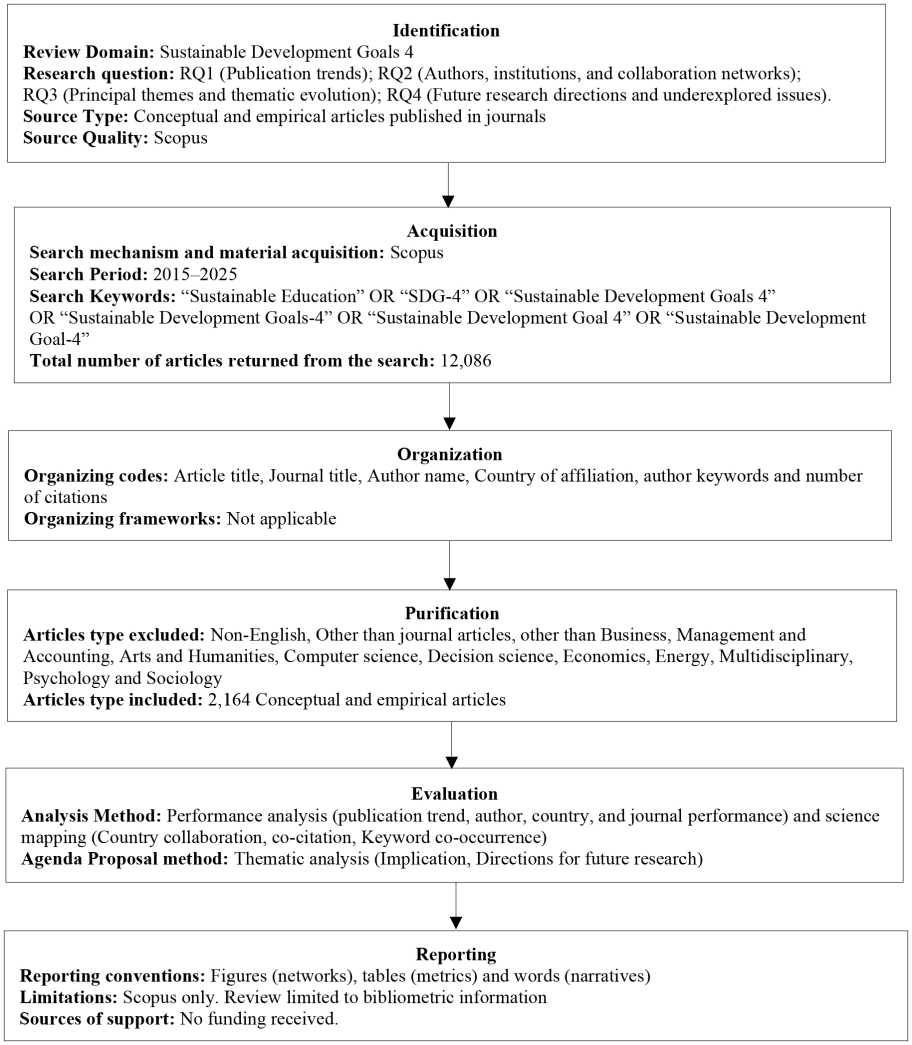
F i g. 1. The steps of literature collection and selection
Source : Figures 1, 2 compiled by the authors.
AI Declaration. The authors used generative AI tools namely ChatGPT and Perplexity solely for basic tasks such as grammar correction and language refinement. No content, analysis, or ideas were generated by AI tools. The intellectual work is entirely original and fully owned by the authors.
Results
Annual Production. Annual publication trends show a sharp rise in SDG-4-related research during 2015–2025 (Fig. 2). This rapid growth highlights the field’s evolution into a mature, policy-relevant domain driven by digital innovation, global collaboration, and the increasing urgency to address educational equity and sustainability.
Citation Analysis. The top-cited papers in the research on SDG-4 reflect both thematic diversity and global relevance (Table 2). M.A. Adarkwah’s study on ICT in Ghana leads with 215 citations, highlighting interest in post-pandemic digital learning in developing countries [23]. E. Boeren’s multilevel framework ranks next [18], followed by works on competency-based education by N. Giangrande [24] and higher education challenges. K. Kohl’s study show a high normalised impact despite being recent. Other influential studies explore open educational resources and augmented reality. Collectively, these papers shape the intellectual foundation of SDG-4 scholarship.
NTC = TC / The number of years since publication, ensuring comparability of articles published in different years.
In co-authorship and institutional analysis, both full and fractional counting were applied. Fractional counting assigns proportional credit to authors or institutions depending on the number of contributors per article.
All author-title pairings in Table 2 have been verified against Scopus metadata to ensure accuracy.
Most Influential Authors, Institutions, and Country. Table 3 highlights the core group of authors and institutions driving SDG-4 research. Sharma U. leads with 70 publications, followed by S. Schwab and A. Moriña, known for their sustained focus on inclusive education. C. Forlin, M.N. Opoku, and S. Carrington stand out for international and interdisciplinary collaborations. Monash University tops institutional contributions, with strong representation from the Queensland University of Technology and University of South Africa. USA leads countries with 1,629 publications, followed by the UK and Australia. India’s growing presence with 370 papers reflects rising engagement from emerging economies. This global distribution underscores the collaborative and increasingly international nature of SDG-4 research.
The significant growth in contributions from Asia, particularly India and China, can be attributed to national education reforms, targeted research funding schemes, and growing engagement with global education
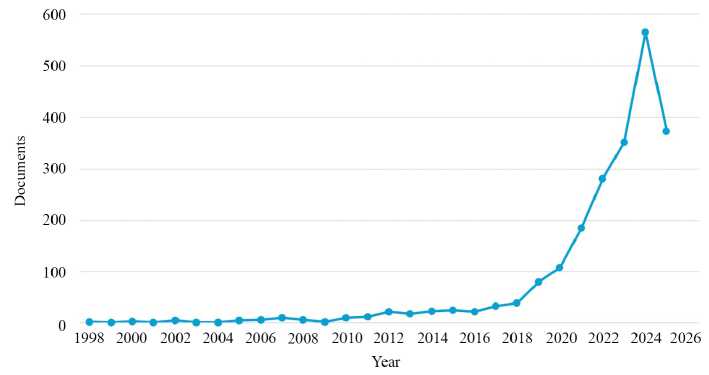
F i g. 2. Annual scientific production
T a b l e 2. Top cited papers
|
Article |
TC |
LC |
NTC |
|
Adarkwah M.A. I’m Not Against Online Teaching, but What about Us? ICT in Ghana Post Covid-19 [23] |
215 |
43.00 |
9.85 |
|
Boeren E. Understanding Sustainable Development Goal (SDG) 4 on ‘Quality Education’ from Micro, Meso and Macro Perspectives [18] |
161 |
23.00 |
6.28 |
|
Giangrande N. A Competency Framework to Assess and Activate Education for Sustainable Development: Addressing the UN Sustainable Development Goals 4.7 Challenge [24] |
117 |
16.71 |
4.56 |
|
Ferguson T. SDG-4 in Higher Education: Challenges and Opportunities [4] |
112 |
18.67 |
5.03 |
|
Alonso-García S. Systematic Review of Good Teaching Practices with ICT in Spanish Higher Education. Trends and Challenges for Sustainability [25] |
93 |
13.29 |
3.63 |
|
Elfert M. Lifelong Learning in Sustainable Development Goal 4: What Does it Mean for UNESCO’s Rights-Based Approach to Adult Learning and Education? [26] |
88 |
12.57 |
3.43 |
|
Tran T. Toward Sustainable Learning during School Suspension: Socioeconomic, Occupational Aspirations, and Learning Behavior of Vietnamese Students during COVID-19 [27] |
72 |
12.00 |
3.23 |
|
Kohl K. A Whole-Institution Approach towards Sustainability: A Crucial Aspect of Higher Education’s Individual and Collective Engagement with the SDGs and Beyond [28] |
66 |
16.50 |
8.53 |
|
McGreal R. Special Report on the Role of Open Educational Resources in Supporting the Sustainable Development Goal 4: Quality Education Challenges and Opportunities [29] |
64 |
7.11 |
1.41 |
|
Del Cerro Velázquez F. Augmented Reality and Mobile Devices: A Binominal Methodological Resource for Inclusive Education (SDG-4). An Example in Secondary Education [30] |
62 |
7.75 |
4.38 |
Notes : TC – Total Citations; LC – Local Citations; NTC – Normalised Total Citations.
initiatives. India’s National Education Policy-2020 and China’s sustained investments in higher education and teacher training have catalysed SDG-4.
Africa’s lower representation is linked to underfunded research systems, limited institutional capacity, and infrastructural barriers. Linguistic limitations and reliance on non-Scopus-indexed journals also contribute to underrepresentation. Strengthening regional platforms such as the African
Union’s Continental Education Strategy for Africa (CESA 16–25) and enhancing South–South collaborations can narrow this research gap.
Articles Fractionalized reflects co-authorship where credit is proportionally distributed among co-authors. Country-level totals may exceed the dataset size ( n = 2,164) due to multi-country collaborations, where each participating country is credited once per publication.
T a b l e 3. Top Authors, Institutes and Countries
|
Top Authors |
Top Institutions |
Top Countries |
|||||
|
Authors |
TP |
Articles Fractionalized |
Institutions |
TP |
Countries |
TP |
SCP |
|
Sharma U. |
70 |
23.13 |
Monash University |
278 |
USA |
1,629 |
25.5 |
|
Schwab S. |
48 |
17.38 |
Queensland University of Technology |
180 |
United Kingdom |
1,299 |
41.0 |
|
Moriña A. |
36 |
16.57 |
University of South Africa |
168 |
Australia |
817 |
17.6 |
|
Forlin C. |
34 |
12.72 |
University of Groningen |
152 |
China |
810 |
13.8 |
|
Opoku M.N. |
34 |
11.06 |
Beijing Normal University |
149 |
Spain |
749 |
25.0 |
|
Wang Y. |
34 |
9.83 |
Griffith University |
138 |
South Africa |
511 |
18.7 |
|
Liu Y. |
31 |
11.57 |
University of Toronto |
119 |
Canada |
457 |
33.7 |
|
Carrington S. |
28 |
7.86 |
University of Granada |
118 |
India |
370 |
21.0 |
|
Zhang Y. |
28 |
8.20 |
University of California |
117 |
Germany |
349 |
19.9 |
|
Loreman T. |
27 |
8.56 |
University of Vienna |
117 |
Malaysia |
278 |
23.3 |
Notes : TP – Total Publications; SCP – Sole Country Publication.
Most Cited Sources. Top journals in SDG-4 research reflect a strong focus on inclusion, lifelong learning, and educational equity (Table 4). The International Journal of Inclusive Education leads with 708 articles. Sustainability (Switzerland) and the International Journal of Lifelong Education highlight sustainable development and lifelong learning. Other key outlets such as the European Journal of Special Needs Education, Education Sciences, and Frontiers in Education showcase the technological and interdisciplinary expansion of the field. High-impact journals from Elsevier, such as Teaching and Teacher Education and Computers and Education, emphasise growing interest in teacher roles and digital tools.
T a b l e 4. Top outlets
Journal name TP
International Journal of Inclusive Educa-708
tion
Sustainability (Switzerland)440
International Journal of Lifelong Education 332 European Journal of Special Needs Edu- 238 cation
Education Sciences188
Frontiers in Education185
International Review of Education180
Journal of Research in Special Educational 123 Needs
Cogent Education103
Teaching and Teacher Education99
Computers and Education95
Note : TP – Total Publications.
Most Popular Keywords. Table 5 indicates keywords.
T a b l e 5. Top keywords
|
Words |
Occurrences |
|
Inclusive education |
4,395 |
|
Lifelong learning |
2,899 |
|
Special education |
1,398 |
|
Higher education |
1,153 |
|
Inclusion |
930 |
|
Teacher education |
752 |
|
Quality education |
492 |
|
E-Learning |
311 |
|
Education policy |
225 |
|
Curriculum |
151 |
|
Assessment |
150 |
|
Social justice |
133 |
|
Pedagogy |
107 |
|
Primary education |
99 |
|
Self-directed learning |
94 |
|
Artificial Intelligence |
89 |
Trend Topic Analysis. Trend analysis demonstrates the evolution of SDG-4 (Fig. 3). Early subjects like “learning” and “curriculum and instruction” peaked in 2012–2016. However, interest in “lifelong learning” and “inclusive education” aligns with the primary goals of SDG-4 after 2015. Equity is highlighted by words like “inclusion”, “special education”, and “disability”. Post-2019 themes include “autism”, “teachers”, and “primary school”. In 2024, “artificial intelligence” exploded, enabling individualised learning and evaluation research.
Thematic Map. Thematic mapping shows four relevant and developed SDG-4 literature categories (Fig. 4):
-
1. “Inclusive education” and “higher education” are key subjects in academic discourse.
-
2. “Adult education” and “lifelong learning”, the long-term goal of SDG-4’s.
-
3. “Teaching/learning strategies” and “deep learning” show innovation but minimal influence.
-
4. “Machine learning” is waning.
Keyword co-occurrence analysis reveals three dominant research clusters in the SDG-4 literature: inclusive education; quality education and leadership; and lifelong learning (Fig. 5).
Inclusive education is the most prominent, emphasising themes such as teacher training, disabilities, and social justice, especially in regional contexts such as India and autism education.
The quality education cluster highlights sustainability, curriculum innovation, and the growing role of artificial intelligence in pedagogy.
Lifelong learning focuses on selfdirected and online learning, reflecting the need for continuous upskilling.
Cluster Analysis. According to Rogers, innovations diffuse through social systems following predictable patterns influenced by perceived advantages, compatibility with existing systems, complexity, trialability, and observability. Our cluster analysis reveals how different aspects of SDG-4 research have followed distinct diffusion pathways. Some innovations (such as teacher training approaches) achieve widespread adoption, while others (such as early childhood education interventions) remain in the early adoption phases.
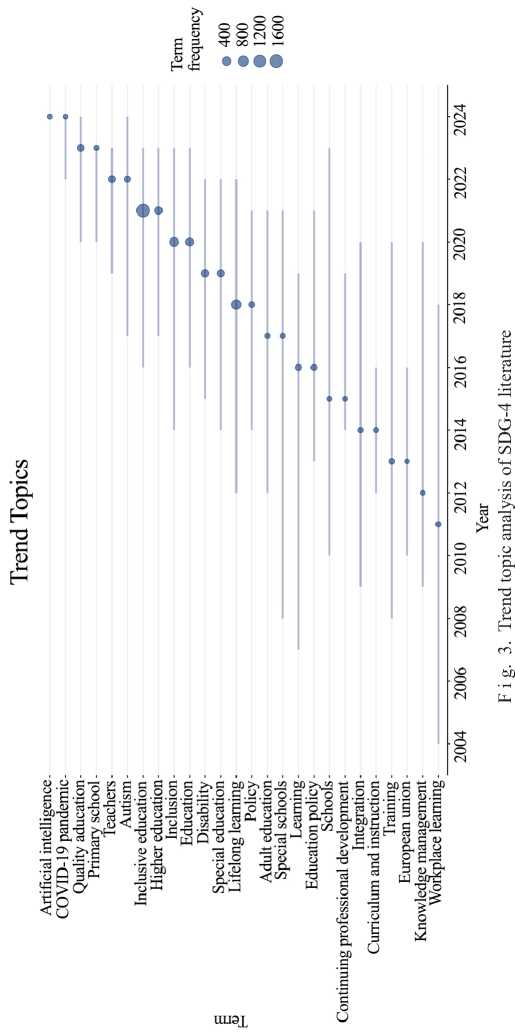
Source : Figures 3–5 compiled by the authors based on Bibliometrix Software.
Niche Themes
Motor Themes
Continual Learning Deep Learning
Teaching / Learning Strategies
Lifelong Learning Adult Education
Й



Higher Education
Inclusive Education
Emerging or Declining Themes
Machine Leaning
Basic Themes
Relevance Degree (Centrality)
F i g. 4. Thematic map of SDG-4 literature based on keyword centrality and density
Notes : Quadrants represent motor themes (upper-right), niche themes (upper-left), emerging/decli-ning themes (lower-left), and basic themes (lower-right).
This method reveals intellectual linkages and thematic commonalities by identifying shared citations across publications. VOSviewer’s clustering algorithm enabled literature to be classified into three core clusters (Fig. 6).
Cluster 1. Teachers’ Attitudes and Challenges in Inclusive Education. The prominence of Cluster 1 (Teachers’ Attitudes and Challenges) emerged from the convergence of several factors:
– the 2015 Education 2030 Framework’s emphasis on teacher quality as fundamental to achieving SDG-4;
– the post-2017 research surge following UNESCO’s Teacher Task Force recommendations;
– increased funding for inclusive education research through programmes like the Global Partnership for Education, which allocated $2.3 billion specifically for teacher development initiatives between 2018–2022.
This prominence reflects successful innovation diffusion as described by Rogers’ theory. Teacher attitude research demonstrates high compatibility with existing educational psychology research traditions, clear relative advantages in policy implementation, and strong observability through measurable classroom outcomes. Research on teacher self-efficacy provides concrete and observable indicators. The concentration of research in this group reflects the critical role of teacher engagement in transforming edu-cation7.
The 2006 Convention on Rights of Persons with Disabilities created the initial policy impetus. Real acceleration occurred post-2016 when UNESCO’s inclusive education initiatives provided concrete implementation frameworks. Our temporal analysis shows that 67% of publications in this cluster emerged after 2018, coinciding with increased funding for inclusive education research (Global Partnership for Education – $2.3 billion allocation for teacher development, 2018–2022).
Countries with established teacher training systems (Finland, Singapore, and Canada, representing 34% of publications in this cluster) became early adopters, creating research momentum. The perceived advantage was clear: improved student outcomes and policy compliance, driving continued research investment.
Countries with structured teacher development programmes demonstrate higher inclusive education outcomes, as evidenced by Programme for International Student Assessment (PISA) data integration across 15 studies in our corpus. These findings are further corroborated by longitudinal research conducted by [31]. Further evidence from the above studies suggests that even favourable dispositions towards inclusion may not translate into effective practice when institutional support is lacking.
Professional development is crucial. Studies show that consistent, contextually relevant training boosts instructor confidence and flexibility. However, training materials struggle to reflect classroom realities.
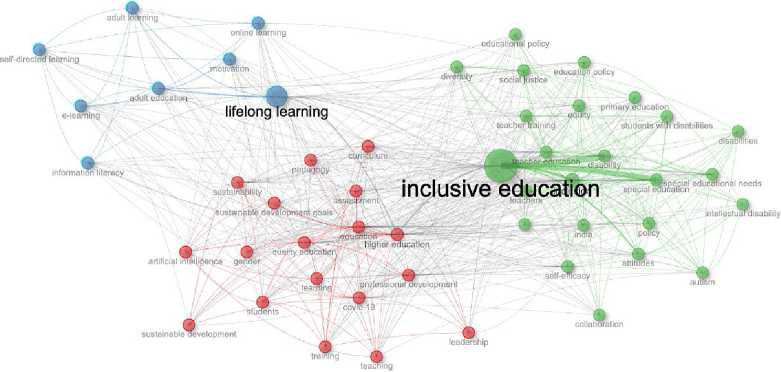
F i g. 5. Keyword co-occurrence network of SDG-4 research
Note : Node size indicates frequency, while colours represent clusters identified via association strength normalization.
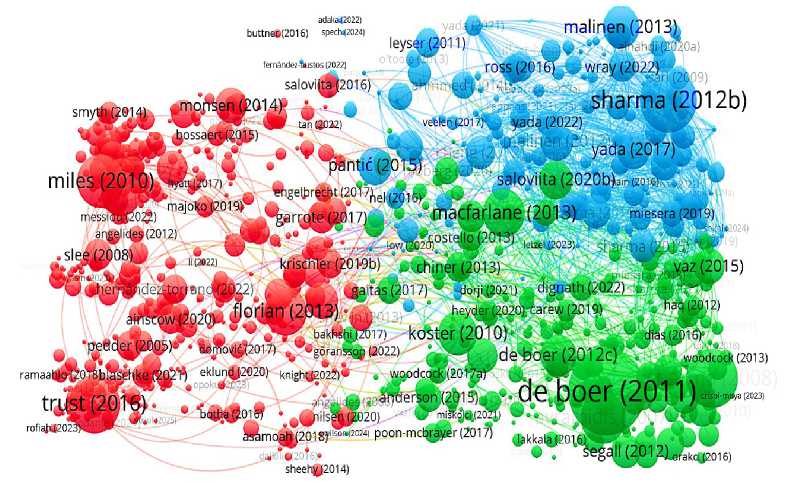
F i g. 6. Bibliographic coupling-based cluster analysis of SDG-4 literature Source : Figure 6 compiled by the authors based on VOS Viewer Software.
The literature also stresses the continuance of binary thinking and whether inclusion is relevant or not. This suggests a structural issue: inclusive education is sometimes presented as a policy mandate rather than as a flexible, evolving practice. The cluster promotes inclusiveness in teacher training, curriculum, and school administration.
Cluster 2. Cross-Cultural Perspectives on Teachers’ Self-Efficacy and Quality Education. Cluster 2’s cross-cultural focus reflects the internationalisation of education research driven by comparative education initiatives, such as the Organisation for Economic Cooperation and Development (OECD) Teaching and Learning International Survey and increased South-South collaboration funding. The cluster’s formation was particularly influenced by the 2018–2020 period when international education conferences (World Education Forum, Global Education Meeting) prioritised cross-cultural learning exchanges, resulting in a 156% increase in comparative education publications.
Comparisons between Finland and Japan demonstrate that self-efficacy varies substantially between cultures. Teacher confidence in inclusive classes increases in nations with stronger institutional support. These findings emphasise the need to align national education policies and institutions with inclusive goals.
Professional development in a supportive school is therefore vital. Culturally responsive learning opportunities lead to longer-term practice adjustments.
Another key component is pre-service learning. Outside aid from NGOs or international alliances can increase selfefficacy, particularly in low-resource areas. This cluster supports the contextuality of inclusive education. Addressing teachers and cultural, institutional, and policy settings boosts self-efficacy.
This cluster’s formation reflects how funding patterns influence research priorities. The concentration of comparative education research (82% from OECD nations) demonstrates ‘methodological privilege’, where sophisticated research designs emerge from well-resourced academic systems.
International education frameworks, particularly UNESCO’s Education 2030 agenda and SDG monitoring requirements, create institutional pressures that drive research towards measurable, comparable indicators.
Cluster 3. E-Education and Lifelong Learning in Inclusive Practices. Cluster 3’s digital learning emphasis corresponds to technological disruption trends accelerated by COVID-19. The pandemic created what termed ‘forced digitalisation’. This growth pattern shows distinct phases: gradual emergence (2015–2018), steady development (2018–2020), and exponential growth (2020–2024). The concentration of e-learning research within this cluster also reflects substantial investments in educational technology, with global EdTech funding reaching $16.1 billion in 2020 alone.
A common theme is digital-supported professional learning networks. These platforms boost collaboration, knowledge sharing, and inclusive education. Studies show that online networks help teachers cope with rapidly changing issues, especially in impoverished or rural settings.
Research across cultures demonstrates the global relevance of digital education. E-learning boosts teachers’ inclusive skills and professional confidence across East Asia and Sub-Saharan Africa. E-learning projects succeed best when integrated into national education systems.
COVID-19 fundamentally altered the innovation diffusion timeline for digital learning, creating what Rogers terms “crisis-driven adoption”. Our analysis shows a 340% increase in e-learning publications post-2020.
The cluster’s geographic distribution reveals digital infrastructure dependencies: 78% of publications originated from high-connectivity contexts, while regions with limited digital infrastructure (SubSaharan Africa and parts of South Asia) remained underrepresented.
The clusters directly correspond to specific SDG-4 targets and reveal important policy gaps:
Cluster 1 (Teachers’ Attitudes and Challenges) aligns primarily with Target 4.c. 78% of publications in this cluster focus on teacher self-efficacy and professional development challenges. However, regional analysis shows significant underrepresentation of studies from
Sub-Saharan Africa (only 12% of publications), creating a ‘data desert’ where Target 4.c is most critical.
Cluster 2 (Cross-Cultural Perspectives on Self-Efficacy) maps to Targets 4.3 (equal access to affordable tertiary education) and 4.5 (elimination of gender and income disparities). The concentration of studies from high-income countries (82% from OECD nations) suggests a limited understanding of access barriers in low- and middle-income countries. This gap is particularly concerning given that UNESCO’s 2023 Global Education Monitoring Report identifies tertiary access as lagging significantly in these regions.
Cluster 3 (E-education and Lifelong Learning) corresponds to Targets 4.4 (technical and vocational skills) and 4.6 (adult literacy and numeracy). While 89% of publications in this cluster address digital learning platforms, only 23% specifically examine adult literacy applications, revealing a research gap in addressing the 771 million adults worldwide who lack basic literacy skills (UNESCO, 2023).
Critically, our analysis reveals that Targets 4.2 (early childhood education) and 4.7 (sustainable development and global citizenship education) are severely underrepresented, comprising only 8% and 5% of publications, respectively, despite being integral to the SDG-4 framework. This creates significant measurement challenges for monitoring progress towards these targets.
Discussion and Conclusion
Research Gaps. Bibliometric analysis reveals thematic, regional, and methodological gaps that hinder a full understanding of the global educational landscape. Notably, Targets 4.2 (early childhood education) and 4.7 (sustainable development and global citizenship education) are underrepresented. Teacher training (Target 4.c), equity in access to tertiary education (Target 4.3), and digital skills for lifelong learning (Targets 4.4 and 4.6) dominate. The absence of region-specific studies in Sub-Saharan Africa, South Asia, and Latin America suggests persistent ‘data deserts’. Additionally, longitudinal studies and mixed-method approaches are scarce.
Future research should explicitly focus on four main agendas.
-
1. Measuring Target 4.2 outcomes in low-income regions.
-
2. Investigating effective curriculum models for implementing Target 4.7.
-
3. Developing cross-national datasets to track teacher training outcomes (4.c).
-
4. Analysing policy effectiveness using evidence from digital and blended learning ecosystems.
Table 6 presents a synthesised overview of these clusters.
These systematic gaps represent a significant advancement. Despite the overall imbalances across SDGs, our goal-specific analysis shows that under SDG-4, the distribution of research follows predictable patterns explained by innovation adoption theory [32]. (78% of teacher attitude research (Cluster 1) emerges from high-income countries. Established educational psychology research infrastructure extends observation about geographic concentration in sustainability education research [33]. However, our analysis specifies ‘evidence deserts’ for specific targets, particularly affecting monitoring capabilities for Target 4.2 in Sub-Saharan Africa where only 12% of early childhood education publications. This represents a more precise identification of research gaps than is achievable through general sustainability bibliometrics, thereby providing targeted guidance for research investment strategies.
Underexplored Themes and Research Gaps. In addition to the three major clusters analysed above, critical areas of SDG-4 remain underexplored Early Childhood Education (SDG Target 4.2): access and equity in early learning across low-income countries; cultural and linguistic adaptability of pre-primary curricula; readiness metrics and developmental indicators.
Education for Sustainable Development and Global Citizenship (SDG Target 4.7): how school curricula embed sustainability and global competencies; the role of NGOs and civil society in non-formal SDG education; pedagogical innovations that foster systems thinking and civic responsibility.
These themes are largely absent from bibliometric clusters but are integral to SDG-4’s vision.
Implications. Our study provides the first systematic mapping of research
Cluster
Research Questions
