
Rheological behavior of plasticized cement dispersed systems under
Journal: Nanotechnologies in Construction: A Scientific Internet-Journal @nanobuild-en
Section: Construction materials science
Article in issue: 2 Vol.18, 2026.
Free access
Introduction. Obtaining self-compacting structural lightweight concretes (LWSCC) is an urgent scientific and practical task in the development of multifunctional building materials, where the main problem is to maintain un-iformity with high fluidity. Russian studies and studies from other countries have been devoted to this problem. The main focus was on prescription factors that affect the rheological and technological proper-ties of LWSCC. The content of components with different densities is the main difficulty of this develop-ment. Oscillation is one of the methods for estimating changes in the rheology of cement-mineral systems over time. Early studies of LWSCC on hollow microspheres showed changes in rheological properties with changes in the concentration of plasticizer, W/C ratio and the dispersion of the mineral aggregate. The next stage of research on the rheology and uniformity of LWSCC by the oscillation method is to es-tablish the influence of each component in a separate group of cement–mineral systems included in LWSCC. Methods and Materials. The object of research is cement-mineral systems from different combinations of components in a con-stant ratio of their mass parts, which make up LWSCC on hollow microspheres with an average density of 1400 kg/m3. The subject of the study is the rheological properties of such systems during oscillation. Plasticized and non-plasticized systems were compared. The following parameters were used to analyze the structure of the studied systems: the thickness of the water shell, the volume of cement dough, the thickness of the cement dough, and the grain spreading coefficient. Results and Discussion. The kinetics of the shear stress variation during oscillation is described by varying intensity, showing the transformation of the cement system structure over time. There is a noticeable difference between the changes in the rheological properties of cement pastes with and without plasticizer. The importance of the addition of micro-silica in the stabilization of the concrete mixture is emphasized. Conclusion. The water thickness (hw) is a structural parameter that does not take into account the surface properties of dispersed phases and liquids in plasticized systems. The determination of the water consumption of LWSCC components and the role of plasticizer in this is a promising direction for the development of the topic.
Similar articles in the section Building materials. Building components
Short address: https://sciup.org/142247637
IDS: 142247637 | DOI: 10.15828/2075-8545-2026-18-2-167-179
Text of the scientific article Rheological behavior of plasticized cement dispersed systems under
Original article
Епихин С.Д., Иноземцев А.С. Реологическое поведение пластифицированных цементных дисперсных систем при вибрации. Нанотехнологии в строительстве. 2026;18(2):167–179. – EDN: ZWSKDH.
The development of multifunctional building materials is one of the recognized global trends in construction [1–4]. Such materials include high-strength lightweight concretes, which are developed by domestic and foreign engineers [5–7]. A popular scientific and practical task in the technology of structural and high-strength lightweight concretes is to expand the scope of application [8, 9], for example, for use in monolithic construction. Increasing the workability of high-strength lightweight concretes and
achieving their self-compaction [10] while maintaining uniformity is of interest in the study of such systems.
The main problem of self-compacting concretes (SCC) is the preservation of uniformity with high mobility of the mixture [11]. The main attention in the research of self-compacting concrete mixtures has been focused on prescription factors that affect the rheological and technological properties of the substrate [12–14]. The key to regulating the mobility and uniformity of concrete mixtures are changes in the amount of water and the quantity and quality of plasticizer [15, 16]. Also, the solid components
Table 1. Properties of the components of the studied pastes and concrete mixtures
|
№ |
Component |
True density, ρ, kg/m3 |
Specific surface area, Ss, m2/kg |
Particle diameter, df , mkm |
|
1 |
Portland cement |
3100 |
121.6 |
15.9 |
|
2 |
Micro-silica «Fremsilica MK-85 |
2250 |
171.2 |
15.6 |
|
3 |
Quartz flour |
2650 |
17.3 |
130.7 |
|
4 |
Fractional sand |
2650 |
3.3 |
694.6 |
|
5 |
Ceramic microspheres |
580 |
169.7 |
61.0 |
Nanotechnologies in construction
Нанотехнологии в строительстве
2026; 18 (2): 167–179
Nanob
CONSTRUCTION MATERIALS SCIENCE
of concrete mixtures are of great importance for regulating fluidity and uniformity. The work [17] presents studies of the impact of the use of waste from copper smelting and nanosilica in cast concretes. The results showed that the introduction of nanosilica in a fraction of up to 0.5% of the cement weight contributes to a gradual increase in the strength of fine-grained concrete to 6.7%, but at the same time reduces the plasticity of the mixture, which is observed even with an additive fraction of up to 0.2% of the cement weight. The authors suggested that the solution to this problem could be to increase the proportion of polycarboxylate plasticizer without increasing the W/C ratio.
The development of self-compacting lightweight concretes has great difficulties [18, 19]. The content of components of different densities (more than 1000 kg/m3 and less than 1000 kg/m3) the uniformity of the structure leads to the risk of stratification. Therefore, it is especially important for such systems to correctly select the composition of solid components [20]. One of the methods for assessing changes in the rheology of cement-mineral systems over time is the method of mixture oscillation. Scientists from the University of Glasgow School of Engineering together with scientists from the University of Manchester in their article [21] consider the latest advances in methods for measuring and characterizing dynamic and static rheology, compaction or liquefaction during shear, viscoelasticity and thixotropic structural build-up using rheometers as measuring instruments.
In early studies of lightweight concrete mixtures on hollow microspheres using the oscillation method [22], the authors evaluated changes in the rheological properties of LWSCC when changing parameters: plasticizer concentration, W/C ratio. It was found that the kinetics of viscosity changes during oscillation is described by different intensities, which indicates a transformation of the structure of the concrete mixture. The intensity of thixotropic liquefaction depends more on the concentration of the plasticizer than on the W/C ratio. The achievement of high stability and low fluidity of self-compacting lightweight concrete mixtures on hollow microspheres are in opposite ranges of W/C ratio variation and plasticizer concentration, which requires the search for a compro-
mise formulation solution based on achieving optimal structure.
The next stage in the development of research on the effect of prescription factors on rheological characteristics and uniformity is to determine the effect of each component in a particular group of cement-mineral systems, which are an integral part of self–compacting lightweight concrete mixtures.
METHODS AND MATERIALS
Cement-mineral systems were considered as an object of research. These systems consist of components that are part of high-strength lightweight concretes based on hollow microspheres: Portland cement CEM I 42.5 (C), ceramic microspheres ForeSphere (MS), microsilica MK-85 (SA), fractional sand fr. 0.16–0.63 mm (S f ), quartz flour (S p ) and water (W).
Cement-mineral systems consisted of different combinations of components with a constant ratio of their mass parts, relative to Portland cement, which was:
C : SA : S p : S f : MS : W =
= 1,00 : 0,p11 : 0,09 : 0,28 : 0,40 : 0,50.
The second series was distinguished by the presence of Melflux 2651F (Pl) hyperplasticizer in an amount of 1.4% by weight of Portland cement.
The rheological properties of cement-mineral pastes were studied using an MCR 101 rotary viscometer (Fig. 1) by measuring the shear stress during oscillation of a sensor (measuring system “ball” with a diameter of 8 mm) with a frequency of 15 Hz and a deflection angle of 0.42° for 600 s. The analysis of the obtained dependences was performed in accordance with the methodology described in [22], where the viscosity of the mixture was considered as a rheological parameter. According to this technique, the rheological curve is divided into 3 sections (Fig. 2), each of which is described by a trend line. The coefficients of the equation describing the sections characterize the behavior of the system under study under the influence of oscillation.
Nanotechnologies in construction
Нанотехнологии в строительстве
2026; 18 (2): 167–179
Nanob
CONSTRUCTION MATERIALS SCIENCE
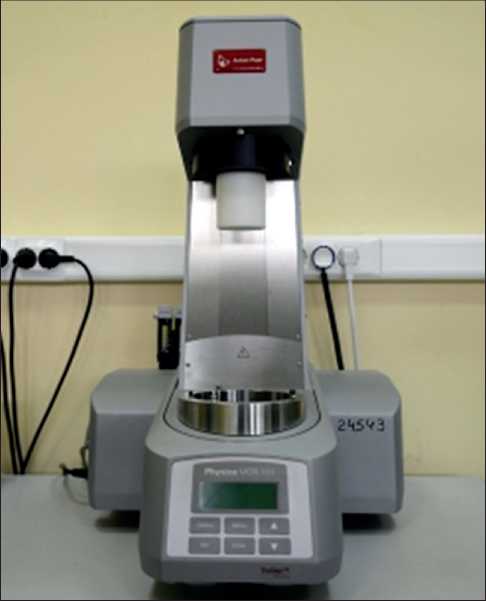
Fig. 1. MCR 101 rotational viscometer with a ball measuring system
of the water shell h w is calculated using the well-known formula:
V V
Sf $s,f ■ mf
where Vw is the volume of water, Sf is the total specific surface area of the particles, Ss.f is the specific surface area of the particle
The specific surface area can be expressed by a simplified formula (2), taking into account the average particle diameter or taking into account the contribution of particles of various sizes (3)
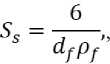
where df and pf are the diameter and density of particles of dry components, respectively, v is the proportion of i -s particles of a certain diameter.
The structure parameters for the studied mixtures were calculated
hcD_ _ ^CD/£f dy dy
where ν CD и h CD – are the volume and thickness of the cement paste layer, respectively.
RESULTS AND DISCUSSION
Various structural parameters were used to analyze the structure of the studied dispersed systems. The thickness
Establishing the role of each component of the concrete mixture to solve the problem of a parity combination
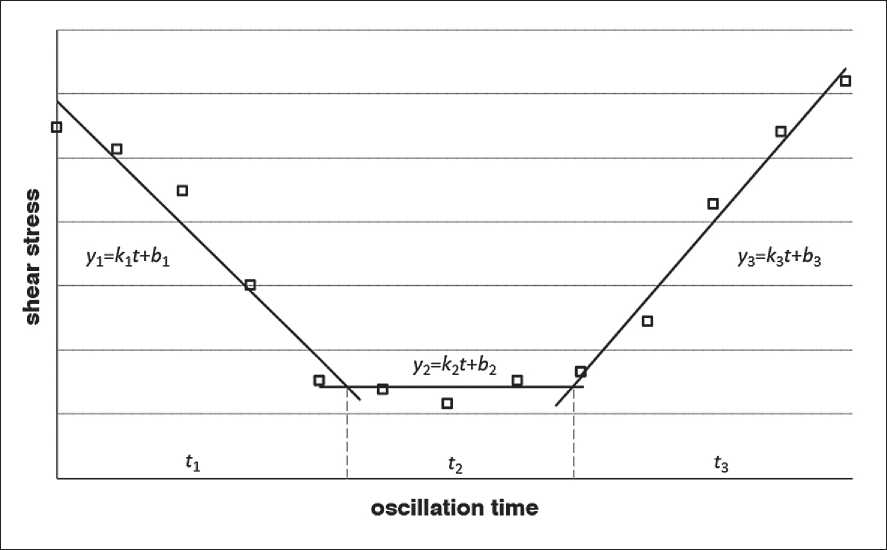
Fig. 2. General view of the rheological curve obtained during oscillation
Nanotechnologies in construction
Нанотехнологии в строительстве
2026; 18 (2): 167–179
Nanob
CONSTRUCTION MATERIALS SCIENCE
of high fluidity and the ability to maintain uniformity is of great importance for the development of self-compacting high-strength lightweight concretes. Earlier in [22], an approach was proposed that makes it possible to establish a change in the rheological properties of concrete mixtures under the influence of constant oscillatory action. The changing nature of the flow curve indicates changes in the structure of the system under study. The analysis is performed by dividing the kinetic dependence into sections that are described by different trend lines. The coefficients of these lines show the intensity of transformation of the structure of the studied dispersed systems.
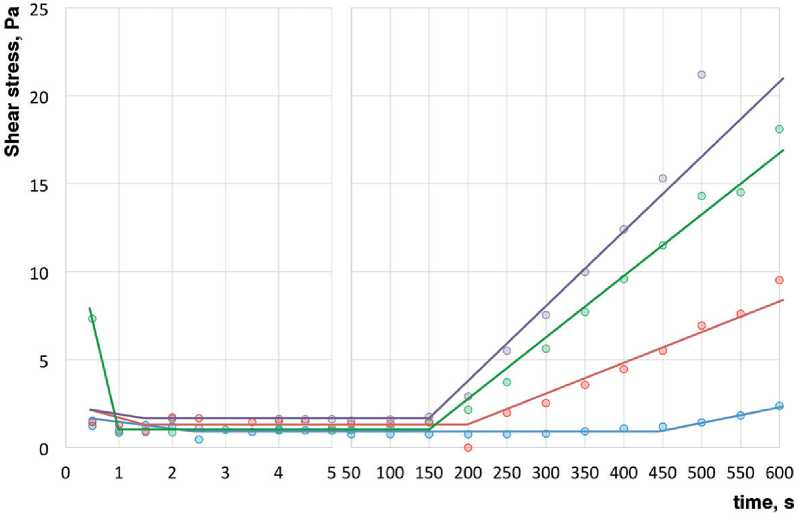
Fig. 3 shows the dependence of shear stress on time under constant vibration action for cement and cement- а
b
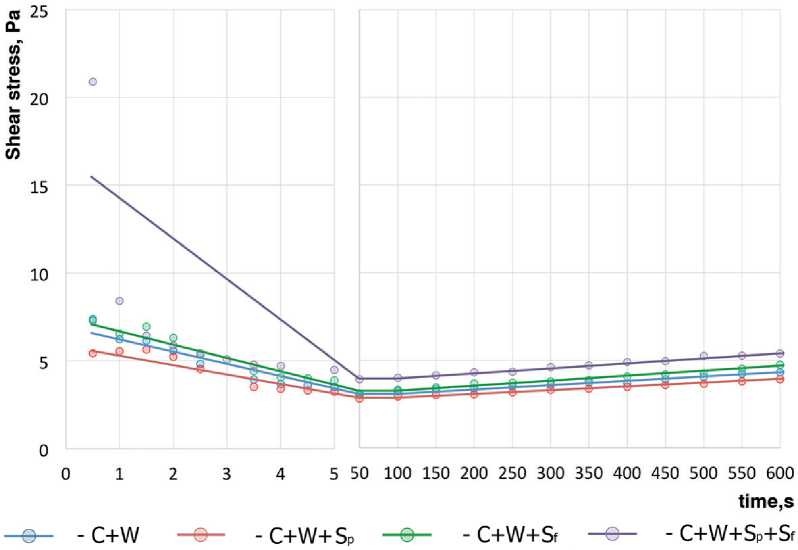
Fig. 3. Change in shear stress of cement-mineral pastes with plasticizer (a) and without plasticizer (b) during oscillation
Nanotechnologies in construction
Нанотехнологии в строительстве
2026; 18 (2): 167–179
Nanob
CONSTRUCTION MATERIALS SCIENCE
mineral pastes of various compositions with and without plasticizer.
In accordance with the methodology [22], three sections are highlighted on the presented graphs (Fig. 3), which describe straight lines. The coefficients of these lines are presented in Table 2. A clear difference between the kinetic dependences of shear stress for dispersed systems with and without plasticizer is shown in Fig. 3. Thus, pastes with plasticizer have a short (1.5...3.5 s) descending section 1, which is associated with thixotropic liquefaction. After that, the vibration effect does not lead to a change in the shear stress. This is section 2, which lasts for 150 to 450 seconds. After this section, the intensive increment of the shear stress to values exceeding the initial yield strength is fixed. This behavior may be caused by the transition of a dispersed system from a stable coagulation structure to an inhomogeneous one. Constant vibration exposure leads to a violation of uniformity, for example, the separation of the paste due to the convergence and formation of aggregates of dense particles, which tend to sedimentation under the influence of gravity. The addition of ground or fractionated sand to the cement paste reduces site 2.
Another dependence of the shear stress on the oscillation time is typical for the studied pastes without plasticizer. The shear stress has a significantly higher initial value, which is expressed by a longer section 1. The beginning of the ascending section 3 can be identified earlier than for the same pastes, but with a plasticizer. Section 2 is poorly identified, which is clearly observed when the parameters of the trend lines are analyzed. The results are presented in Table 2.
Table 2 shows, that within the experiment the duration of section 3 for pastes without plasticizer is 550 s, at which the shear stress increment occurs when close shear stress values are reached, as indicated by b2 = 2.81...4.19. In this case, the intensity of the increment, which is described by the coefficient k3, also has close values of 0.002...0.003. This behavior of the studied systems without plasticizer can be explained by the uneven distribution of water for wetting particles and the absence of a dispersing effect. A comparative analysis of the coefficients for each site shows the role of the plasticizer both in the dilution (b1 is 1.38...13.8 versus 6.39...26.4) and in the rate of uniformity disturbance (k3 is an order of magnitude higher) of the pastes.
An analysis of lines 1–4 in Table 2 shows that the rheology of plasticized pastes can be controlled using either dispersed components or combinations of them. It is shown that the introduction of quartz flour into the paste leads to a slight thickening, but reduces the duration of phase 2 from 450 to 250 seconds: it leads to an early violation of uniformity. The use of larger quartz particles in the paste leads to a greater intensification of the described effect. The high density of such pastes ( b 1 is 10 times greater) is explained by the high friction of quartz sand particles, and their size (fr. 0.16-0.63 mm), which exceeds the size of both flour and Portland cement, promotes faster stratification ( k 3 increases from 0.01 to 0.04). This effect can be balanced by a combination of S f and S p . In this case, the plasticized paste, which consists of Portland cement, water and quartz flour, forms a layer between the particles of fractionated sand, reducing their friction. However, an increase in the proportion of quartz components leads to an acceleration of delamination ( k 3 increases to 0.06), due to a decrease in the proportion of binder, which forms the coagulation structure of the system under study.
Thus, it is shown that the variation of the components of the dispersed medium makes it possible to control the rheological behavior of the paste. Reducing the proportion of binder by filling with quartz sand or a fine mineral additive reduces the ability of such systems to maintain uniformity. This is significantly noticeable on plasticized cement pastes.: the larger the particles of the dispersed phase, the more intense the stratification processes.
It is known that the use of fine mineral additives makes it possible to increase the uniformity of dispersed systems
Table 2. Parameters of the dependence of the shear stress of cement-mineral pastes on the oscillation time
|
№ |
The presence of plasticizer |
Marking the composition |
Sector 1 |
Sector 2 |
Sector 3 |
||||||
|
k 1 |
b 1 |
t 1 , с |
b 2 |
t 2 , с |
k 3 |
b 3 |
t 3 , с |
||||
|
1 |
Pl |
C+W |
– |
–0.25 |
1.38 |
3.5 |
0.87 |
447 |
0.01 |
–2.47 |
150 |
|
2 |
+ S p |
–0.51 |
1.74 |
1.5 |
1.48 |
248 |
0.02 |
–3.77 |
350 |
||
|
3 |
+ Sf |
–13.0 |
13.8 |
1.0 |
0.94 |
149 |
0.04 |
–5.16 |
450 |
||
|
4 |
+ Sp + Sf |
–0.67 |
1.81 |
1.5 |
1.52 |
248 |
0.06 |
–10.4 |
300 |
||
|
5 |
– |
– |
–0.85 |
7.29 |
5.0 |
3.39 |
45 |
0.002 |
2.97 |
550 |
|
|
6 |
+ S p |
–0.63 |
6.39 |
5.0 |
2.81 |
45 |
0.002 |
2.70 |
550 |
||
|
7 |
+ S f |
–0.84 |
7.73 |
5.0 |
3.01 |
45 |
0.003 |
3.04 |
550 |
||
|
8 |
+ Sp + Sf |
–14.5 |
26.4 |
1.5 |
4.19 |
45 |
0.003 |
3.73 |
550 |
||
Nanotechnologies in construction
Нанотехнологии в строительстве
2026; 18 (2): 167–179
Nanob
CONSTRUCTION MATERIALS SCIENCE
due to their high water retention capacity. The effect of micro-silica on the graph of the shear stress curve of cement-mineral pastes during oscillation is shown in Fig. 4.
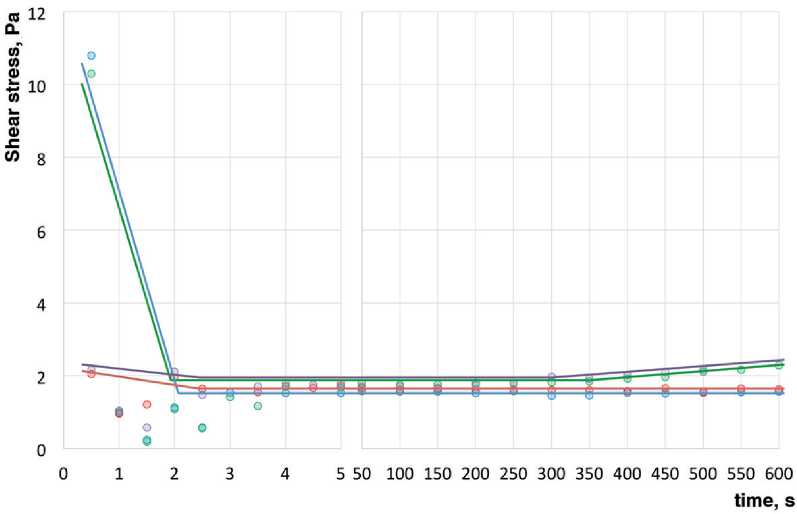
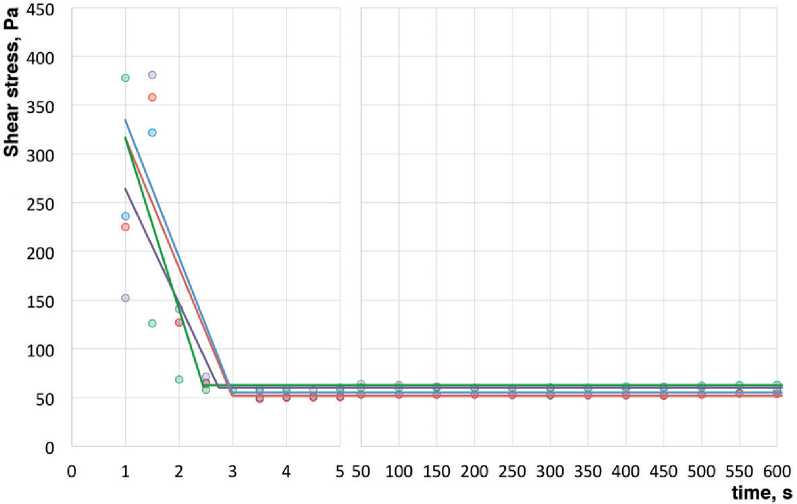
Fig. 4 shows that plasticized cement-mineral pastes with micro-silica have a low initial shear stress (less than 12 Pa), which are close to the values for pastes without plasticizer shown in Fig. 3 (less than 10 Pa), in contrast to non-plasticized pastes, where the values have changed by an order of magnitude (152...378 Pa versus 5.4...20.9 Pa). In Fig. 3b, the pastes C+B+SA+Sp and C+W+SA+Sp+Sf can be distinguished. Despite the possibility to identify individual sites, these cement-mineral systems are char- а
b
«- - C+W+SA -e- - C+W+SA+Sp -€»- - C+W+SA+Sf -e- - C+W+SA+S₽+Sr
Fig. 4. Change in shear stress of cement-mineral pastes with plasticizer (a) and without plasticizer (b) during oscillation
Nanotechnologies in construction
Нанотехнологии в строительстве
2026; 18 (2): 167–179
Nanob
CONSTRUCTION MATERIALS SCIENCE
acterized by a relatively low variability of shear stress throughout the entire period of oscillatory action: within 1.5...2.3 Pa. At the same time, the absence of ground sand (blue and green graph in Fig. 4a) in the composition increases the value of the initial shear stress. It is also noted that the systems with micro-silica and with fractionated sand (green and purple graph in Fig. 4a) differ in the presence of an ascending section on the rheological curve. This means that quartz sand acquires the role of a component that intensifies the violation of the uniformity of the paste structure. However, the intensity of this process is not significant for the studied systems.
The absence of plasticizer in the investigated microsilica pastes changes the features of their rheological behavior (Fig. 4b). Thus, all types of pastes are distinguished by the absence of site 3 within the duration of the study. At the same time, dilution as a result of the oscillatory effect proceeds in similar time ranges (Table 3).
It is noted that the thickening of pastes due to the introduction of micro-silica affects the intensity of liquefaction, which occurs faster (after 2.5 seconds versus 5 seconds). However, such a mixture has a higher b2 coefficient, which increased by an order of magnitude from 2.81...4.19 to 50.9...59.0.
Thus, it can be concluded about the role of the components in the studied pastes to control their properties. In plasticized cement-mineral pastes, varying the content of quartz flour makes it possible to reduce the flow rate while maintaining uniformity. Varying the content of a large fraction of quartz sand can be used to control the thixotropic dilution of cement mixtures, but the increased tendency to delamination must be taken into account. Micro-silica makes it possible to stabilize the structure of cement-mineral pastes, including plasticizer systems.
Obviously, in the studied dispersed systems based on Portland cement or quartz sand, the change in structure under the influence of vibration will be slower. This is due to the fact that the density of the dispersed phase, which is a fractionated quartz aggregate and a dispersion medium
(cement-mineral paste) have similar values. The introduction of a hollow filler, such as hollow microspheres, will lead to a decrease in the stability of the system, the tendency to stratification of which will occur earlier. However, it is impossible to ensure the high fluidity that selfcompacting concrete mixtures on a hollow filler should have without using a plasticizer.
Fig. 5 shows that the introduction of hollow microspheres into plasticized and non-plasticized cementmineral systems with micro-silica contributes to the appearance of site 3. The only system without this site is C+W+SA+MS+S p +S f . It is noted that the stability period is longer for plasticizer systems, where the exception is C+W+SA+MS+S f, because in this system the period of preservation of uniformity is the same with the same composition of the mixture without plasticizer. This once again proves the previous thesis about the role of sand as a component that intensifies the violation of the uniformity of the paste. In systems without plasticizer, the introduction of quartz filler of different dispersion and volume (S p and S f ) contributes to a change in the onset of stratification over time: it leads to a later stratification. In plasticized mixtures, a change in the dispersion of the filler does not change the mark of the beginning of stratification: section 3 for compositions C+W+SA+MS, C+W+SA+MS+S f , C+W+SA+MS+S p , starts at t = 350. The combined introduction of fillers of different dispersion (S p +S f ) will lead to a later start of the stratification process. So, for C+W+SA+MS+S p +S f the set oscillation time (t = 600 seconds) is not sufficient to accurately determine the beginning of the stratification period of the mixture.
The introduction of hollow microspheres significantly changes the rheology of the investigated cement pastes with silica: both with and without plasticizer. Almost all studied systems with microspheres have a section 3 (Fig. 5b) within the duration of the study. Dilution due to oscillation occurs in similar time ranges for plasticized systems, except for the composition with S p +S f , and dif-
Table 3. Parameters of the dependence of the shear stress of cement-mineral pastes on the oscillation time
|
№ |
The presence of plasticizer |
Marking the composition |
Sector 1 |
Sector 2 |
Sector 3 |
||||||
|
k 1 |
b 1 |
t 1 , с |
b 2 |
t 2 , с |
k 3 |
b 3 |
t 3 , с |
||||
|
1 |
Pl |
C+W+SA |
– |
–19.6 |
20.6 |
2.0 |
1.54 |
598 |
– |
||
|
2 |
+ S p |
–2.17 |
3.14 |
2.0 |
1.65 |
598 |
– |
||||
|
3 |
+ Sf |
–18.5 |
19.6 |
2.0 |
1.71 |
346 |
0.002 |
1.12 |
200 |
||
|
4 |
+ Sp + Sf |
–2.30 |
3.32 |
2.0 |
1.74 |
297 |
0.001 |
1.56 |
300 |
||
|
5 |
– |
– |
–141.4 |
435 |
2.5 |
51.3 |
597 |
– |
|||
|
6 |
+ S p |
–142.7 |
443 |
2.5 |
50.9 |
597 |
– |
||||
|
7 |
+ S f |
–203.6 |
514 |
2.5 |
59.0 |
597 |
– |
||||
|
8 |
+ Sp + Sf |
–96.4 |
354 |
2.5 |
59.0 |
597 |
– |
||||
Nanotechnologies in construction
Нанотехнологии в строительстве
2026; 18 (2): 167–179
Nanob
CONSTRUCTION MATERIALS SCIENCE
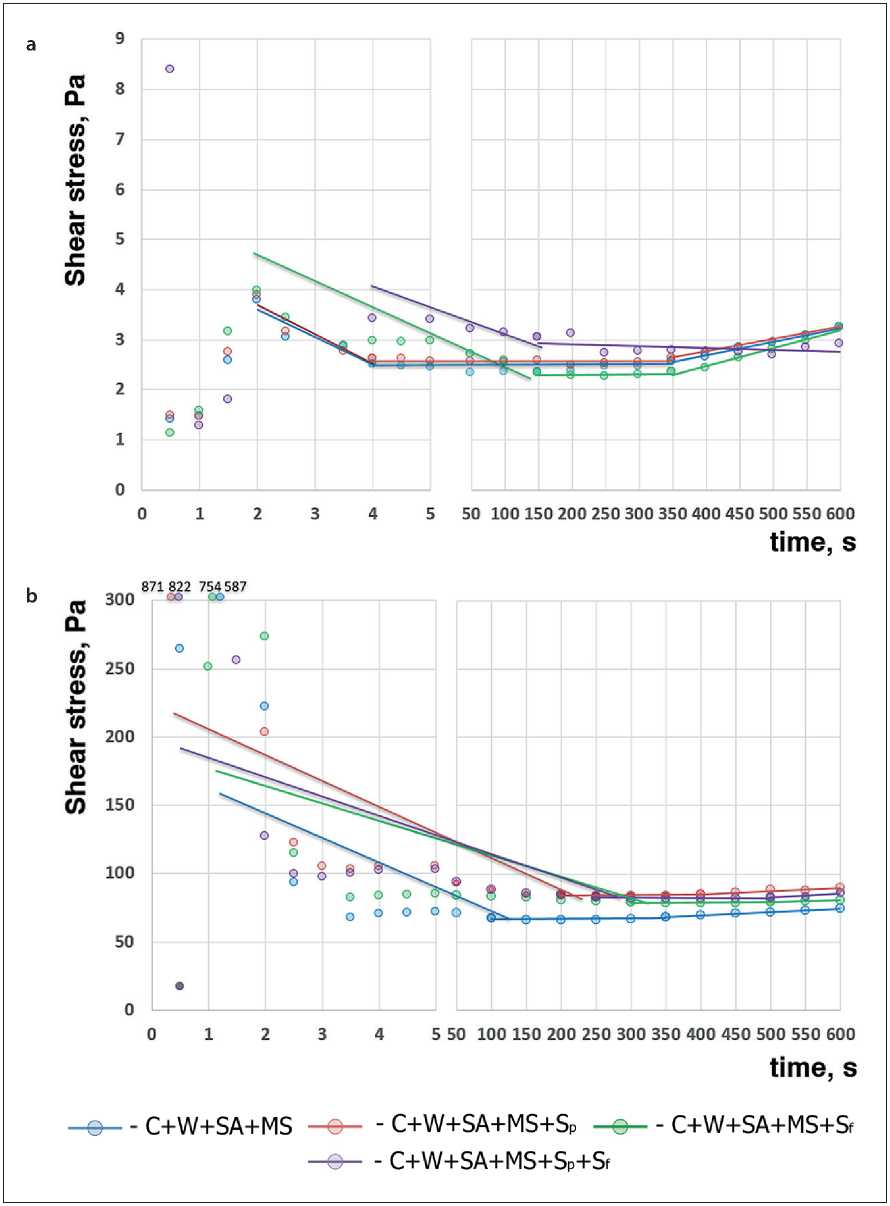
Fig. 5. Change in shear stress of cement-mineral pastes with plasticizer (a) and without plasticizer (b) during oscillation
ferent ranges for systems without plasticizer, where a decrease in site 3 occurs due to an increase in the size of the quartz aggregate (Table 4).
A feature of the rheological behavior of mixtures on hollow microspheres is the presence of a short interval in the initial period of time, when an increase in shear stress
Nanotechnologies in construction
Нанотехнологии в строительстве
CONSTRUCTION MATERIALS SCIENCE
2026; 18 (2): 167–179
Nanob
Table 4. Parameters of the dependence of the shear stress of cement-mineral pastes on the oscillation time
Thus, it has been established that multicomponent dispersed systems have complex rheological behavior. The introduction of a light, finely dispersed phase stabilizes the system and prevents stratification for a certain period of time.
It is obvious that the rheological behavior of dispersed systems is associated with the formation of a certain structure. The properties of such a structure depend on the parameters that are achieved by varying prescription factors. Such structural parameters for cement-mineral pastes and concrete mixtures include the volume of cement paste, the thickness of the water layer, the particle size of the dispersed phase, the grain spreading coefficient or the distance between the particles of the dispersed phase, etc. [5]. Table 5 shows some structural parameters of the studied mixtures.
Varying the formulation of cement-mineral paste or concrete mixture leads to the formation of a structure that can be described by various parameters. This is clearly demonstrated in Table 5. The determination of the dependence of the rheological properties of a dispersed system on its structural parameters will make it possible to determine the prescription factors that allow them to be controlled. Table 6 shows the results of the correlation analysis of rheological parameters for some of the studied dispersed systems.
Table 5. Structural parameters of cement-mineral pastes
|
№ |
Dispersed |
Σ S , ·103 m2 |
h w , mkm |
ν CD |
S f , ·103 m2 |
h CD |
h CD / d f |
|
|
Environment |
Phases |
|||||||
|
1 |
C+W |
S p |
72.5 |
8.03 |
0.96 |
0.9 |
1010 |
7.72 |
|
2 |
S f |
72.1 |
7.46 |
0.89 |
0.5 |
1653 |
2.38 |
|
|
3 |
SA |
83.1 |
6.88 |
0.94 |
11.5 |
81.8 |
5.25 |
|
|
4 |
MS |
111.2 |
2.98 |
0.55 |
39.7 |
13.7 |
0.23 |
|
|
5 |
S p + S f |
73.0 |
7.10 |
0.85 |
1.48 |
575 |
1.39 |
|
|
6 |
Sp + SA |
84.0 |
6.54 |
0.91 |
12.5 |
72.6 |
0.99 |
|
|
7 |
Sp + MS |
112.2 |
2.88 |
0.53 |
40.6 |
13.1 |
0.14 |
|
|
8 |
SA + Sf |
83.6 |
6.10 |
0.84 |
12.0 |
69.7 |
0.20 |
|
|
9 |
SA + MS |
122.7 |
2.61 |
0.53 |
51.2 |
10.3 |
0.27 |
|
Table 6. Correlation coefficient between structural and rheological parameters
|
Parameters |
With plasticizer |
Without plasticizer |
||||||
|
h w |
ν CD |
h CD |
h cd / d f |
H w |
ν CD |
h CD |
h cd / d f |
|
|
k 1 |
–0.35 |
–0.40 |
–0.11 |
–0.17 |
–0.33 |
–0.50 |
0.42 |
0.09 |
|
b 1 |
0.17 |
0.23 |
0.03 |
0.09 |
0.18 |
0.37 |
–0.54 |
–0.15 |
|
b 2 |
–0.91 |
–0.88 |
–0.72 |
–0.56 |
–0.28 |
–0.09 |
–0.68 |
–0.35 |
Nanotechnologies in construction
Нанотехнологии в строительстве
2026; 18 (2): 167–179
Nanob
CONSTRUCTION MATERIALS SCIENCE
It has been established that the rheological parameters ( k 1 , b 1 , b 2 ) of systems with and without plasticizer have a good correlation with some structural parameters. Table 6 shows that in non-plasticized systems, the volume of cement paste ( v CD ) is a sensitive structural parameter to the intensity of liquefaction in the initial time period ( k 1 ), and the thickness of cement paste ( h CD ) to the initial shear stress ( b 1 ). This may be due to the noticeable transformations that the system undergoes at the initial stage of the oscillation effect. That is, without a plasticizer, the mixtures are thick and dilute more intensively under the influence of vibration. The greatest correlation coefficients (| r |) with rheological parameters with both b 1 and b 2 are observed in the thickness of the h CD cement paste layer. For dispersed plasticizer systems, a high correlation coefficient (modulo) is characteristic of each structural parameter and rheological parameter b 2 . The most sensitive (| r | > 0.80) structural parameter to the magnitude of the shear stress b 2 , which the mixture tends to under the influence of vibration, is the thickness of the water layer h w and the volume of the cement paste v CD .
Thus, it is shown that the common structural parameters used to describe dispersed systems have limited applicability. For thick mixtures, the selected structural parameter can be used to estimate the intensity of liquefaction, and for fluid mixtures, to estimate the maximum amount of liquefaction. However, it is worth noting that none of these structural parameters, calculated using known prescription formulas, takes into account the con- tribution of the plasticizer. That is, both the distribution of water (hw) and the volume of cement paste (vCD), which depends on it, for a system with and without plasticizer are identical to the structural parameters. Therefore, plasticized dispersed systems such as self-compacting concrete mixtures require parameters that take into account the role of the plasticizer.
CONCLUSION
The research results have shown that plasticized multicomponent dispersed systems have complex rheological behavior, which indicates the peculiarities of the formation of the structure of the concrete mixture with plasticizer. It is shown that filling cement systems with larger components reduces the ability of such systems to maintain uniformity. A large proportion of fine components, such as quartz flour or silica, increase the uniformity of both plasticized and non-plasticized cement-mineral systems. It is shown that hollow microspheres significantly change the rheology of cement systems, which is characterized by an increased tendency to delamination. Correlation analysis has shown the incorrectness of using traditional structural parameters of dispersed systems to describe their properties, especially with plasticizer. Standard applied structure parameters such as the thickness of the water layer or the thickness of the cement paste layer ignore the properties of the dispersed phases and the liquid in the system. This creates the need to search for such criteria.
