
Scenario-Based Security and Reliability Evaluation of Connected Autonomous Vehicles Using a Hybrid CRITID–Fuzzy BWM–VIKOR Swarm Approach
Journal: International Journal of Information Engineering and Electronic Business @ijieeb
Article in issue: 3 vol.18, 2026.
Free access
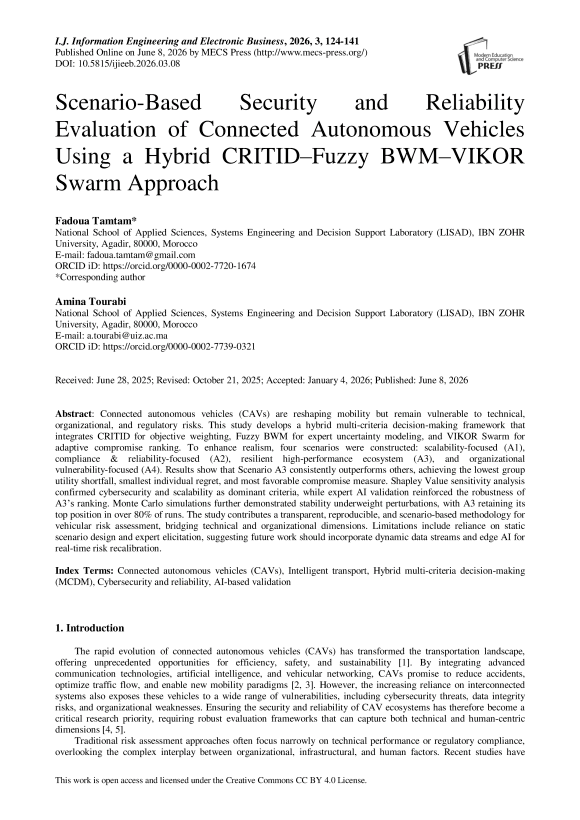
Connected autonomous vehicles (CAVs) are reshaping mobility but remain vulnerable to technical, organizational, and regulatory risks. This study develops a hybrid multi criteria decision-making framework that integrates CRITID for objective weighting, Fuzzy BWM for expert uncertainty modeling, and VIKOR Swarm for adaptive compromise ranking. To enhance realism, four scenarios were constructed: scalability focused (A1), compliance & reliability focused (A2), resilient high performance ecosystem (A3), and organizational vulnerability focused (A4). Results show that Scenario A3 consistently outperforms others, achieving the lowest group utility shortfall, smallest individual regret, and most favorable compromise measure. Shapley Value sensitivity analysis confirmed cybersecurity and scalability as dominant criteria, while expert AI validation reinforced the robustness of A3’s ranking. Monte Carlo simulations further demonstrated stability underweight perturbations, with A3 retaining its top position in over 80% of runs. The study contributes a transparent, reproducible, and scenario based methodology for vehicular risk assessment, bridging technical and organizational dimensions. Limitations include reliance on static scenario design and expert elicitation, suggesting future work should incorporate dynamic data streams and edge AI for real time risk recalibration.
Similar articles in the section Transport vehicle engineering
Short address: https://sciup.org/15020384
IDS: 15020384 | DOI: 10.5815/ijieeb.2026.03.08
