
Socio-demographic Factors and Their Influence on the Development of Entrepreneurial Potential of Students
Journal: International Journal of Cognitive Research in Science, Engineering and Education @ijcrsee
Section: Original research
Article in issue: 3 vol.13, 2025.
Free access
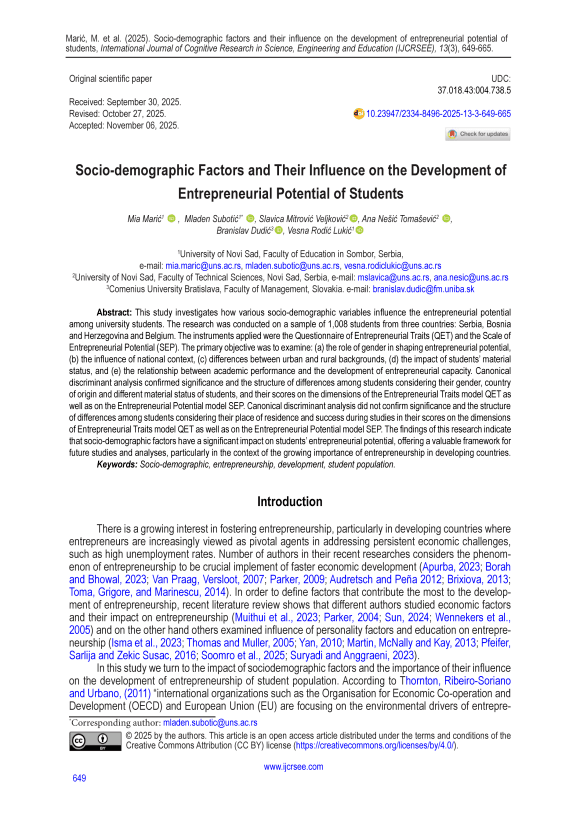
This study investigates how various socio-demographic variables influence the entrepreneurial potential among university students. The research was conducted on a sample of 1,008 students from three countries: Serbia, Bosnia and Herzegovina and Belgium. The instruments applied were the Questionnaire of Entrepreneurial Traits (QET) and the Scale of Entrepreneurial Potential (SEP). The primary objective was to examine: (a) the role of gender in shaping entrepreneurial potential, (b) the influence of national context, (c) differences between urban and rural backgrounds, (d) the impact of students’ material status, and (e) the relationship between academic performance and the development of entrepreneurial capacity. Canonical discriminant analysis confirmed significance and the structure of differences among students considering their gender, country of origin and different material status of students, and their scores on the dimensions of the Entrepreneurial Traits model QET as well as on the Entrepreneurial Potential model SEP. Canonical discriminant analysis did not confirm significance and the structure of differences among students considering their place of residence and success during studies in their scores on the dimensions of Entrepreneurial Traits model QET as well as on the Entrepreneurial Potential model SEP. The findings of this research indicate that socio-demographic factors have a significant impact on students’ entrepreneurial potential, offering a valuable framework for future studies and analyses, particularly in the context of the growing importance of entrepreneurship in developing countries.
Similar articles in the section Fundamentals of education. Theory, policy, etc.
Short address: https://sciup.org/170211406
IDS: 170211406 | UDC: 37.018.43:004.738.5 | DOI: 10.23947/2334-8496-2025-13-3-649-665
Text of the scientific article Socio-demographic Factors and Their Influence on the Development of Entrepreneurial Potential of Students
There is a growing interest in fostering entrepreneurship, particularly in developing countries where entrepreneurs are increasingly viewed as pivotal agents in addressing persistent economic challenges, such as high unemployment rates. Number of authors in their recent researches considers the phenomenon of entrepreneurship to be crucial implement of faster economic development ( Apurba, 2023 ; Borah and Bhowal, 2023 ; Van Praag, Versloot, 2007 ; Parker, 2009 ; Audretsch and Peña 2012 ; Brixiova, 2013 ; Toma, Grigore, and Marinescu, 2014 ). In order to define factors that contribute the most to the development of entrepreneurship, recent literature review shows that different authors studied economic factors and their impact on entrepreneurship ( Muithui et al., 2023 ; Parker, 2004 ; Sun, 2024 ; Wennekers et al., 2005 ) and on the other hand others examined influence of personality factors and education on entrepreneurship ( Isma et al., 2023 ; Thomas and Muller, 2005 ; Yan, 2010 ; Martin, McNally and Kay, 2013 ; Pfeifer, Sarlija and Zekic Susac, 2016 ; Soomro et al., 2025 ; Suryadi and Anggraeni, 2023 ).

© 2025 by the authors. This article is an open access article distributed under the terms and conditions of the Creative Commons Attribution (CC BY) license .
neurship, especially the social and cultural factors that influence the individual career choice to be an entrepreneur and to create a new business ( European Commission, 2004, 2006 ; OECD, 1998, 2000 )” (p.106). Furthermore they conclude that social cultural factors and their influence on entrepreneurship remains under researched. Turker and Selcuk in their study of factors that affect student entrepreneurial potential conclude that society that is supportive towards entrepreneurship and fosters entrepreneurial activity of its younger population will as a result have a higher level of confidence among young entrepreneurs which leads to development of entrepreneurial activity. Gurol and Atsan, (2006) conclude that in order to define entrepreneurial characteristics of a society we need to closely examine different factors. Urbano and Alva rez (2013) researched the influence of institutions on entrepreneurial activity and their sample consisted of 36,525 individuals from 30 countries according to ( GEM and IMD data for 2008 ). In their overall assessment they stated that: “while the regulative and normative environments encourage people to become entrepreneurs, a strong cultural-cognitive environment is needed to create a new firm” (p. 713). Global Entrepreneurship Monitor studies contextual factors like socio-cultural and demographical influence the process of forming our personality and influence our perception and the way we act ( GEM, 2010 ).
In our study we will investigate different sociodemographic factors focusing on gender, country of origin, influence of rural and urban area of residence, material status of students, and influence of success during studies and try to assess how they influence entrepreneurial potential of students.
Hofsted et, al. (2004) in their research concludes that factors influencing the development of entrepreneurship in a society are multidimensional and complex. Nicolae, M., Ion, I. and Nicolae, E. (2016) , in their study state: “that entrepreneurship phenomenon is currently understood as a reflection of the local competitive advantages and disadvantages of the external environment” (p 394). In our research we will focus on student population and examine sociodemographic factors and their influence on this part of population. According to Shinnar, Giacomin and Janssen, (2012) who used Krueger, Reilly, and Carsrud (2000) statement: “Students fac[e] an immediate career choice [and]...starting a business may be a realistic option” (p. 425).
This study employed two conceptual frameworks: the Entrepreneurial Traits Model (QET) and the Entrepreneurial Potential Model (SEP). The QET model encompasses six dimensions—unconventionality and creativity, achievement orientation and challenge acceptance, entrepreneurial self-efficacy, assertiveness and communication skills, positive attitudes toward entrepreneurship, as well as interest and knowledge related to entrepreneurial activity. The SEP model evaluates entrepreneurial potential through dimensions such as intellectual capacity, self-confidence, motivation, social interaction, physical constitution, emotional stability, extroversion, and organizational competence. The SEP instrument quantifies respondents’ scores across these dimensions, with higher scores indicating a greater degree of entrepreneurial potential.
Liberty, Tunde and Tinuola (2016) conclude in their study that sociodemographic factors influence development of entrepreneurial activity. In this research we will assess the influence of following sociodemographic factors: (a) the role of gender in shaping entrepreneurial potential, (b) the influence of national context, (c) differences between urban and rural backgrounds, (d) the impact of students’ material status, and (e) the relationship between academic performance and the development of entrepreneurial capacity.
Influence of gender on the development of entrepreneurial potential
Research conducted on the student population revealed that male students exhibit a higher readiness to initiate their own businesses and pursue entrepreneurial careers. This research also shows that even though women enjoy family support, they feel less self-confident to start their own business (Bela et al., 2021; Dabic et al., 2012; Martín-Gutiérrez et al., 2025). Despite encountering socio-economic challenges—such as limited resource access, market inequality, and persistent gender-based stereo-types—women exhibit resilience through strategies like professional networking, skill development, and continuous learning (Đurđević, 2025). Gupta and Bhawe (2007) researched proactive personality as a characteristic that is significantly associated to entrepreneurship. They assessed that this is especially evident in an environment that is not supportive towards potential entrepreneurs, this lack of support is characteristic for the environment of developing countries such as Serbia and Bosnia we are researching. They concluded in their research that more proactive woman had significantly more developed entrepreneurial potential, and that this fact held them back from becoming entrepreneurs because of the common stereotype that entrepreneurship is connected to male population and that proactivity is commonly associated as a masculine trait. Envick and Lim (2011) according to Bartos et al. (2015) examine in their study of gender and entrepreneurial orientation in the sample of 4 countries: US, Korea, Malaysia and Fiji that male entrepreneurs are more prone to risk propensity behaviour, they display more aggressive behaviour when competing on the market than females do, they also discovered that males lead in regard to female population of US and Korea in regard to independent decision making, and males are also found to be more confident in decision making process across the sample. Differences in level of entrepreneurial development between genders can be explained by gender discrimination women face (Fischer et al., 1993). Since 1999, Global Entrepreneurship Monitor (GEM) provides data on the fact that women develop less entrepreneurial potential and stay behind men in entrepreneurship activity. Research results from Bulgaria show that women have less expressed entrepreneurial potential than men (Yordanova and Tarrazon, 2010), this survey is very interesting to our own study because of the similarity in the mentality in the region of Balkans. Bartos et al. (2015) conclude in their study that male entrepreneurs in Czech Republic are more aggressive than female entrepreneurs and more innovative. Shinnar, Giacomin and Janssen, (2012) in their research which is similar to our own used a sample of 761 university students from three different nations: Belgium, China and United States, their study pointed to the existence of significant influence of gender and culture for development of entrepreneurship in a society. Also, this research found that gender negatively influences the development of entrepreneurship through the society’s lack of support for female entrepreneurship. Research conducted on student population in India shows that student gender is a factor that strongly influences the development of entrepreneurship (Sonia Katherin Mathew and Dr. Johney Johnson, 2014). Demographic factor like gender among others is strongly connected to self-employment and influences entrepreneurial potential of individuals (Wilson, Kickul and Marlinon, 2007).
Influence of rural and urban area of residence on entrepreneurial potential
Hyunjeong, (2011) in his research found that most of the literature collects data in urban settings and gives exzamples of Panel Study of Entrepreneurial Dynamics (PSED) and the Global Entrepreneurship Monitor (GEM). He concludes in his study that main difference between rural and urban entrepreneurship is in resources, rural areas lack in education and financial resources but show rich entrepreneurial potential. Different research point to the fact that the rate of entrepreneurial development is significantly lower in rural than in urban areas ( Eurobarometer, 2007 ).
According to the research of Capelleras, Contín-Pilart, Martin-Sanchez and Larraza-Kintana, (2013) that used data from the Spanish GEM project, they found: “that individuals in rural areas who perceive new opportunities are more likely to become nascent entrepreneurs rather than those who live in urban ones” (p. 97). Urban environments are assumed to foster greater entrepreneurial intentions in students due to increased exposure to economic activities compared to rural environments ( Al Harrasi and Ali, 2025 ). Rural and urban areas of residence significantly influence entrepreneurial potential among women entrepreneurs in Pakistan, with differences in home ownership, household size, and financial position ( Muhammad and Ximei, 2022 ). Faggio and Silva (2014) in their research of self-employment and entrepreneurship in rural and urban markets argue that self-employment in rural and urban areas is not the part of the same phenomenon of entrepreneurship. They find that urban areas provide self-employment of working people based on innovative behaviour, risk taking propensity which form entrepreneurship, while rural workers more often engage in self-employment because they lack other job opportunities. According to Duricova (2014) Baumgartner et al., (2013) state that: “entrepreneurship has become a key topic in rural development” (p. 197). Duricova (2014) , in her study on entrepreneurship across rural and urban regions within the EU, argues that individuals residing in underdeveloped rural areas are more inclined to engage in entrepreneurial activities compared to those living in more developed urban settings.
However, empirical findings on the influence of residential context remain inconsistent. While some studies suggest that urban environments exert a stronger impact on the development of entrepreneurial potential, others indicate that rural areas contribute equally to fostering entrepreneurial capabilities.
Influence of material status of students
Material status has a complex but generally positive influence on students’ entrepreneurial potential, with financial resources serving as a key enabler of entrepreneurial intentions. The evidence suggests multiple dimensions of material status impact entrepreneurship. Li (Li et al., 2022) found materialism positively predicts entrepreneurial intention through a serial mediation involving achievement motivation, while another author (Rajković et al., 2021) specifically noted that financial opportunities to start a new business was the most influential variable on entrepreneurial intentions. According to Lee and Persson, (2012) there are number of research that provide evidence of significant connection among personal wealth and propensity to start entrepreneurial activity (Alger and Weibull, 2010). Friedline and West, (2015) in their research examined the impact of wealth on young adults and their entrepreneurial activity. They concluded that young adults with lower material status encounter difficulties in acquiring financial resources needed to start their own business.
Hosseini (2016) states in his research that: “financial resources within the family stimulates entry into entrepreneurship” (p. 31). He even found that wealthier is the family background larger is the entrepreneurial venture individuals form. Research in the field of entrepreneurship show that entrepreneurial background in the family poses a source of different assets for the new entrepreneurs in the family, such as financial resources, suppliers, connections in the market, connection with the suppliers and knowledge of needed technologies ( Dunn and Holtz-Eakin, 2000 ). According to Mustapha and Selvaraju, (2015) family also stimulates students by creating a supportive environment which provides them with resources and knowledge that help them start their entrepreneurial activity after they finish their studies ( Bagheri and Pihie, 2010 ).
OECD and European Commision (2014) consider that young people are more prone to entrepreneurial activity, but statistics shows that their rate of becoming entrepreneurs is lower than one of the adults. They state that: “this is the result of barriers related to lack of awareness, orientation of education and training, lack of experience, fewer financial resources, limited networks, and market barriers”. OECD and European Commision (2014) also imply that EU entrepreneurship programs can overcome these obstacles. One of the programs is The Youth Employment Initiative (YEI) Activities supported include: “encourage schools and employment services to promote and provide continued guidance on entrepreneurship and self-employment for young people”. This can be very important and helpful for the young people coming from families with lower material status. Motivation and support they lack at home they can overcome by formal programs and entrepreneurship education. According to Jiménez, Palmero-Cámara, González-Santos, González-Bernal, Jiménez-Eguizábal, (2015) in their research they concluded that education influences the increases of entrepreneurial activity, and it is connected to the level of the higher self-confidence, lower perceived risk and enhanced human capital.
Influence of success during studies on the development of entrepreneurial potential of students
The influence of academic success factors such as education, motivation, practical experience, and social support positively impacts students’ readiness to become entrepreneurs, as they have great potential to start businesses with innovative ideas, relevant skills, and necessary resources (Marpaung et al., 2023). Anderson, Samimi, and Boh (2010) in their book asses that academic success and formal education can be a “security ceiling” that is hard to escape and embrace other possibilities outside the given framework of a false feeling of security. Ward (2004) in his research states: “More than ever we need to prepare young people to build a life of purpose and opportunity in which they are aware of and can draw on their various talents and abilities. Enterprise Education offers a framework for this kind of learning” (p. 105). Sharma and Madan, (2014) found in their research that students with high scores on intelligence tests had low propensity towards entrepreneurship but attendance of entrepreneurship courses resulted in higher propensity towards entrepreneurship. Chad Moutray (2009) examined the Department of Education data in the USA and found that students with better academic achievement had slightly less chances of being self-employed and becoming entrepreneurs. Research conducted on student population in India shows that student age is a factor that strongly influences the development of entrepreneurship (Sonia Katherin Mathew and Dr. Johney Johnson, 2014). Peterman and Kennedy (2003) conclude that different educational programs can significantly influence development of entrepreneurship. Several studies (Gyang et al., 2023; Machado et al., 2022; Mumtaz et al., 2024) provide comprehensive evidence that entrepreneurial education significantly enhances students’ entrepreneurial potential across different educational contexts and geographic regions. Gyang et al. (2023) specifically identified self-efficacy as a critical mediating factor, showing that education builds students’ confidence in their entrepreneurial abilities, while Machado et al. (2022) added academic engagement as another important mechanism, demonstrating that entrepreneurial education creates more engaged learners with higher entrepreneurial potential. Mumtaz et al. (2024) confirmed that students develop positive attitudes, subjective norms, and behavioral control - all key components of entrepreneurial intention. The same author identified a critical gap between students’ entrepreneurial potential and current curriculum offerings, suggesting that while the impact is positive, educational systems need improvement to fully capitalize on students’ entrepreneurial capacity. Levesque and Minniti (2006) in their research revealed that age is significantly connected to entrepreneurial potential and activity. Students that are older have more experience and attend more entrepreneurial courses and consequently have more developed entrepreneurial potential, so attendance of entrepreneurial programs and courses shows more impact on development of entrepreneurial potential than student academic success. Above literature survey implies that academic success does not provide a pattern that detects significant relation between academic success and development of entrepreneurship potential of students.
Materials and Methods
Research methodology
The primary aim of this study is to examine the influence of various socio-demographic factors on the entrepreneurial potential of university students. The research utilized two key instruments: the Questionnaire on Entrepreneurial Traits (QET) and the Scale of Entrepreneurial Potential (SEP). Five groups of socio-demographic factors were analysed: (a) the role of gender in shaping entrepreneurial potential, (b) the influence of national context, (c) differences between urban and rural backgrounds, (d) the impact of students’ material status, and (e) the relationship between academic performance and the development of entrepreneurial capacity.
In this paper we hypothesize that students with different demographic background differ from each other in terms of expression of certain dimensions of entrepreneurial potential models QET and SEP.
Data collection and descriptive statistics
The research sample comprised university students from three countries—Serbia and Bosnia and Herzegovina, as EU candidate countries, and Belgium, an EU Member State. Participants were recruited from three universities and eleven faculties, resulting in a total of 1,008 respondents, including 589 male and 419 female students. The study adhered to ethical research standards, including institutional approval from participating universities. Questionnaires were administered during regular class sessions, ensuring respondent anonymity and the exclusive use of data for scientific purposes. Participants reported clear understanding of the instructions, and no issues were encountered during the data collection process.
Instruments
This study employed two primary instruments: the Scale of Entrepreneurial Potential (SEP) and the Questionnaire of Entrepreneurial Traits (QET). The SEP scale assesses entrepreneurial potential across eight sub-scales: intellectual abilities, self-confidence, motivation, social relations, physical constitution, emotional stability, extroversion, and organizational skills.
Each SEP sub-scale captures a distinct dimension of entrepreneurial potential. The intellectual abilities sub-scale evaluates resourcefulness in various situations, the capacity for independent problemsolving and decision-making, as well as a proactive attitude toward learning and personal development. The self-confidence sub-scale measures boldness in expressing personal views and assertiveness in social and professional contexts.
The physical constitution sub-scale reflects aspects of physical fitness, energy, and endurance, which are considered relevant to sustained entrepreneurial engagement. The organizational skills sub-scale assesses individuals’ preference for managerial roles and their ability to effectively plan, structure, and execute tasks.
The extroversion sub-scale—referred to as openness in earlier conceptualizations—includes traits such as risk-taking propensity, openness to new experiences, and creativity. The motivation sub-scale encompasses competitive spirit, grit, initiative, goal orientation, ambition, perseverance, dedication, and work ethic.
The emotional stability sub-scale evaluates an individual’s self-regulation, resilience under stress, emotional balance, and general optimism. Finally, the social relations sub-scale measures leadership potential, communicative competence, social influence, teamwork orientation, adaptability, conflict resolu- tion skills, and the ability to make a positive impression in social settings
The SEP inventory consists of 34 items designed to assess respondents’ scores across the eight sub-scales representing different dimensions of entrepreneurial potential. The total entrepreneurial potential score is calculated by summing the scores across all sub-scales, with higher total scores indicating stronger entrepreneurial potential. This instrument was developed specifically for the purposes of this study, based on theoretical frameworks and prior research on entrepreneurial characteristics.
Responses were recorded using a 5-point Likert-type scale, ranging from “strongly agree” to “strongly disagree.” Confirmatory factor analysis supported the factorial validity of the inventory, and the instrument demonstrated acceptable reliability, with Cronbach’s alpha coefficients ranging from 0.751 to 0.756 across individual sub-scales.
The Questionnaire of Entrepreneurial Traits (QET), developed by Gracanin and Coso (2013), is designed to assess entrepreneurial self-efficacy and attitudes toward entrepreneurship. The inventory comprises 58 items and evaluates six sub-scales: entrepreneurial unconventionality and creativity, focus on achievement and acceptance of challenges, entrepreneurial self-efficacy, assertiveness and communication, positive attitudes toward entrepreneurship, and interest in entrepreneurship and knowledge. The total QET score is obtained by summing scores across all sub-scales, with higher values indicating a greater level of entrepreneurial potential.
The QET inventory evaluates six interrelated sub-scales that collectively capture key dimensions of entrepreneurial traits. The first sub-scale, unconventionality and creativity, reflects an individual’s tendency to approach problem-solving in original and non-traditional ways, often involving a willingness to take risks. It also measures self-perceived creativity and confidence in utilizing these traits. The second sub-scale, focus on achievement and acceptance of challenges, pertains to one’s motivation to tackle complex tasks and engage in activities with uncertain outcomes, demonstrating a readiness to embrace challenges as part of the entrepreneurial process. The third sub-scale, entrepreneurial self-efficacy, is the most extensive and central within the inventory. It assesses confidence in personal entrepreneurial capabilities, persistence in goal pursuit, general entrepreneurial orientation, and leadership potential. The fourth sub-scale, assertiveness and communication, captures interpersonal skills vital to entrepreneurship, particularly the ability to express ideas clearly and interact effectively with others. The fifth sub-scale, positive attitudes toward entrepreneurship, evaluates favorable perceptions of entrepreneurs and entrepreneurship, along with an individual’s openness to becoming an entrepreneur. Lastly, the sixth sub-scale, interest in entrepreneurship and knowledge, focuses on self-assessed understanding of entrepreneurial concepts and the extent of recent learning in this domain.
All responses were collected using a 5-point Likert-type scale, ranging from “strongly agree” to “strongly disagree.” Confirmatory factor analysis supported the factorial validity of the instrument, confirming its underlying structure. In the present study, the QET demonstrated satisfactory reliability, with Cronbach’s alpha coefficients ranging from 0.732 to 0.805 across the sub-scales.
Data analysis
The data were processed using the statistical software packages Statistica and SPSS. Descriptive statistics were employed to examine the basic characteristics of the sample and the distribution of variables. To assess the existence and strength of relationships between the observed variables, canonical discriminant analysis was conducted. This method enabled the identification of socio-demographic factors that most significantly differentiate levels of entrepreneurial potential among student respondents.
Results
The significance and structure of gender differences in scores on the dimensions of the QET questionnaire were determined using canonical discriminant analysis.
|
Table 1. Indicators of the significance of discriminant functions in separating groups |
|||||||
|
Function |
Λ |
% of variance explained |
Rc (canonical correlation) |
ΛW partial Wilks’ Lambda |
χ2 (chi-square statistic) |
df (chi-square statistic) |
P (p-value) |
|
1 |
.038 |
100.0 |
.190 |
.964 |
37.058 |
6 |
.000 |
Male students have higher scores on the dimensions Positive Attitudes toward Entrepreneurs and Interest in Entrepreneurship, Entrepreneurial Self-Efficacy and Assertiveness and Communication, and lower scores on Knowledge (ΛW=.964, χ2 (df=6)= 37.058, p<0.01). The ability of these two functions to classify respondents was 57.6 %.
Table 2. Structural matrix and discriminant function values at group centroids
|
Function – Indicator |
Coefficient |
|
Entrepreneurial self-efficacy |
.642* |
|
Assertiveness and communication |
.576* |
|
Knowledge |
-.488* |
|
Positive attitudes toward entrepreneurs and interest in entrepreneurship |
.331* |
|
Unconventionality and creativity |
.251 |
|
Achievement orientation and acceptance of challenges |
.183 |
|
Function at group centroids |
|
|
Male |
.163 |
Female
-.230
Legend:* indicates a statistically significant structural coefficient
Canonical discriminant analysis was used to determine the significance and structure of gender differences between male and female students in scores on the dimensions of the SEP questionnaire.
Table 3. Indicators of the significance of discriminant functions in separating groups
|
Function |
% of Λ variance Rc ΛW χ² df p explained |
|
1 |
0.032 100.0 0.177 0.969 31.927 8 0.000 |
Male students have higher scores on Motivation (ΛW=.969, χ2 (df=8)= 31.927, p<0.01). The classification accuracy of this function was 56.7%.
Table 4. Structural matrix and discriminant function values at group centroids
|
Function – Indicator |
Coefficient |
|
Motivation |
–0.513* |
|
Openness |
–0.215 |
|
Self-confidence |
0.161 |
|
Constitution |
0.149 |
|
Intellectual abilities |
–0.097 |
|
Social relationships |
–0.073 |
|
Emotionality |
0.042 |
|
Organizational abilities |
0.011 |
|
Function at group centroids |
|
|
Male Female |
-.152 .213 |
|
Legend:* indicates a statistically significant structural coefficient |
|
Canonical discriminant analysis was used to determine the differences and the structure of differences between students from different countries in scores on the dimensions of the QET questionnaire.
Table 5. Indicators of the significance of discriminant functions in separating groups
|
Function |
Λ |
% of variance explained |
Rc |
ΛW |
χ² |
df |
p |
|
1 |
0.066 |
65.8 |
0.249 |
0.907 |
97.756 |
12 |
0.000 |
|
2 |
0.034 |
34.2 |
0.182 |
0.967 |
33.747 |
5 |
0.000 |
The results indicate that students from Belgium, when compared to their peers from Bosnia and Herzegovina, scored significantly higher on the QET sub-scales Positive Attitudes toward Entrepreneurs and Interest in Entrepreneurship, Unconventionality and Creativity, Entrepreneurial Self-Efficacy, and Assertiveness and Communication, while exhibiting lower scores on the Knowledge. These differences were statistically significant (ΛW = 0.907, χ²(df = 12) = 97.756, p < 0.01).
Furthermore, in comparison to students from Serbia, Belgian students demonstrated significantly higher scores on the sub-scales Entrepreneurial Self-Efficacy, Assertiveness and Communication, Achievement Orientation and Acceptance of Challenges, and Knowledge (ΛW = 0.967, χ²(df = 5) = 33.747, p < 0.01).
The overall classification accuracy of the two discriminant functions was 45.5%, with the lowest classification precision observed among students from Serbia, indicating greater overlap in their entrepreneurial trait profiles relative to the other groups.
Table 6. Structural matrix and discriminant function values at group centroids
Dimension Function 1 Function 2
|
Positive Attitudes toward Entrepreneurs and Interest |
0.620* |
0.244 |
|
Unconventionality and Creativity |
0.505* |
–0.106 |
|
Entrepreneurial Self-Efficacy |
0.503* |
0.709* |
|
Assertiveness and Communication |
0.416* |
0.701* |
|
Achievement Orientation and Acceptance of Challenges |
0.242 |
0.603* |
|
Knowledge |
–0.469* |
0.565* |
|
Function at group centroids |
||
|
Serbia |
0.077 |
0.053 |
|
Bosnia and Herzegovina |
–0.767 |
–0.069 |
|
Belgium |
0.227 |
–0.819 |
Legend: *statistically significant structural coefficient
Canonical discriminant analysis was used to determine the differences and the structure of differences between students from different countries in scores on the dimensions of the SEP questionnaire.
Table 7. Indicators of the significance of discriminant functions in separating groups
|
Function |
Λ |
% of variance explained |
Rc |
ΛW |
χ² |
df |
p |
|
1 |
0.043 |
77.9 |
0.204 |
0.947 |
54.617 |
16 |
0.000 |
|
2 |
0.012 |
22.1 |
0.110 |
0.988 |
12.198 |
7 |
0.094 |
Students from Bosnia and Herzegovina, in comparison to their peers from Belgium, demonstrated significantly higher scores across all dimensions of the SEP model (ΛW = 0.947, χ²(df = 16) = 54.617, p < 0.01). The most discriminating dimensions contributing to this difference were Organizational Abilities, Social Relationships, Self-Confidence, Constitution, and Motivation.
The second discriminant function did not significantly distinguish the groups of students from differ- ent countries. The classification accuracy of these two functions was 36.5%, with the poorest classification results observed among students from Serbia.
Table 8. Structural matrix and discriminant function values at group centroids
|
Dimension |
Function 1 |
|
Organizational Abilities |
0.818* |
|
Social Relationships |
0.793* |
|
Self-Confidence |
0.694* |
|
Constitution |
0.664* |
|
Motivation |
0.584* |
|
Openness |
0.524* |
|
Emotionality |
0.362* |
|
Intellectual Abilities |
0.392* |
|
Function at group centroids |
|
|
Serbia |
0.005 |
|
Bosnia and Herzegovina |
0.342 |
|
Belgium |
–0.822 |
Legend: *statistically significant structural coefficient
Canonical discriminant analysis did not find a statistically significant difference between students from different places of residence in scores on the dimensions of the QET questionnaire (ΛW = 0.996, χ²(df = 6) = 3.556, p > 0.05).
Table 9. Indicators of the significance of discriminant functions in separating groups
|
Function |
Λ |
% of variance explained |
Rc |
ΛW |
χ² |
df |
p |
|
1 |
0.004 |
100.0 |
0.059 |
0.996 |
3.556 |
6 |
0.736 |
Canonical discriminant analysis did not find a statistically significant difference between students from different places of residence in scores on the dimensions of the SEP questionnaire (ΛW = 0.997, χ²(df = 8) = 3.068, p > 0.05).
Table 10. Indicators of the significance of discriminant functions in separating groups
Function Λ % of variance explained Rc ΛW χ² df p
1 0.003 100.0 0.055 0.997 3.068 8 0.930
Canonical discriminant analysis was used to determine the differences and the structure of differences between students with different material status on the dimensions of the QET questionnaire.
Table 11. Indicators of the significance of discriminant functions in separating groups
Function Λ % of variance explained Rc ΛW χ² df p
|
1 |
0.075 |
88.5 |
0.265 |
0.921 |
82.581 |
12 |
0.000 |
|
2 |
0.010 |
11.5 |
0.099 |
0.990 |
9.792 |
5 |
0.081 |
Students with below-average material status scored significantly higher on the Knowledge (ΛW = 0.921, χ²(df = 12) = 82.581, p < 0.01) compared to those with average material status. The second discriminant function did not significantly distinguish the groups of students with different material status. The classification accuracy of these two functions was 45.9%, and students from all categories were classified with roughly equal success.
Table 12. Structural matrix and discriminant function values at group centroids
|
Dimension |
Function 1 |
|
Knowledge |
0.898* |
|
Unconventionality and Creativity |
–0.128 |
|
Assertiveness and Communication |
–0.143 |
|
Achievement Orientation and Acceptance of Challenges |
–0.127 |
|
Positive Attitudes toward Entrepreneurs and Interest |
–0.056 |
|
Entrepreneurial Self-Efficacy |
–0.229 |
|
Function at group centroids |
|
|
Below-average |
.440 |
|
Average |
–0.182 |
|
Above-average |
0.191 |
Legend: *statistically significant structural coefficient
Canonical discriminant analysis was used to determine the differences and the structure of differences between students with different material status on the dimensions of the SEP questionnaire.
Table 13. Indicators of the significance of discriminant functions in separating groups
|
Function |
Λ |
% of variance explained |
Rc |
ΛW |
χ² |
df |
p |
|
1 |
0.033 |
79.0 |
0.179 |
0.959 |
41.553 |
16 |
0.000 |
|
2 |
0.009 |
21.0 |
0.094 |
0.991 |
8.828 |
7 |
0.265 |
Students with above-average material status, compared to those with average status, have higher scores on Social Relationships, Organizational Abilities, Self-Confidence, and Openness (ΛW = 0.959, χ²(df = 16) = 41.553, p < 0.01). The second discriminant function did not significantly distinguish the groups of students with different material status. The classification accuracy of these two functions was 42.5%, with the poorest classification observed among students with below-average material status.
Table 14. Structural matrix and discriminant function values at group centroids
|
Dimension |
Function 1 |
|
Social Relationships |
0.684* |
|
Organizational Abilities |
0.587* |
|
Self-Confidence |
0.356* |
|
Openness |
0.298M |
|
Motivation |
0.288 |
|
Intellectual Abilities |
0.253 |
|
Constitution |
0.126 |
|
Emotionality |
–0.262 |
|
Function at group centroids |
|
|
Below-average |
0.220 |
|
Average |
–0.119 |
|
Above-average |
0.439 |
Legend: *statistically significant structural coefficient
M - marginally significant coefficient
A multiple regression analysis was conducted to determine whether the dimensions of the applied models predict student success. This analysis was conducted only on the 208 students who responded to this question.
It was not established that the dimensions of the QET model predict academic success (adjusted R² = –0.01, F(6, 201) = 0.674, p > 0.05).
It was not established that the dimensions of the SEP model predict academic success (adjusted R² = 0.03, F(8, 199) = 1.769, p > 0.05).
Table 15 . Significance of the multiple regression model
|
Model |
R |
R² |
Adjusted R² |
df reg |
df res |
F |
p |
|
QET |
0.140 |
0.020 |
–0.010 |
6 |
201 |
0.674 |
0.670 |
|
SEP |
0.258 |
0.066 |
0.029 |
8 |
199 |
1.769 |
0.085 |
Discussion
The entrepreneurial potential of young people represents a category of dynamic and complex nature, and as such is subject to the action of various internal and external factors, some of which are hereditary, static and unchanging in nature, while others are subject to minor or major variations and changes ( GEM, 2010 ; Liberty, Tunde and Tinuola, 2016 ; Martin, McNally and Kay, 2013 ; Parker, 2004 ; Pfeifer, Sarlija and Zekic Susac, 2016 ; Thomas and Muller, 2013 ; Yan, 2010 ). The main goal of this paper was to examine the effect of five groups of socio-demographic factors on the development of dimensions of entrepreneurial potential among the student population: gender, country and place of residence, material status and success in studies. Entrepreneurial characteristics are theoretically defined and operationally measured with the help of two models of entrepreneurial potential - QET and SEP. The central research assumption posited that students would differ in the expression of specific entrepreneurial characteristics, as measured by the QET and SEP models, depending on the influence of various socio-demographic factors. The study showed that the expressiveness of the students’ entrepreneurial potential is related to three categories of socio-demographic factors - gender, country, and financial status of the respondents.
Regarding the relationship between gender and the expression of entrepreneurial potential, the findings confirmed the existence of gender-based differences across several dimensions of the QET and SEP models. Specifically, within the QET model, male students exhibited significantly higher scores on the sub-scales positive attitudes toward entrepreneurs and interest in entrepreneurship, entrepreneurial self-efficacy, and assertiveness and communication, while scoring lower on the interest in entrepreneurship and knowledge sub-scale compared to female students. Also, the results showed that male students have a more pronounced dimension of Motivation, within the SEP model. This finding is expected and speaks of a more pronounced entrepreneurial potential in the male population, in the domain of most entrepreneurial traits ( Bartos et al., 2015 ; Bela et al., 2021 ; Dabic et al., 2012 ; Fischer et al., 1993 ; Gupta and Bhawe, 2007 ; Martín-Gutiérrez et al., 2025 ; Mathew and Johnson, 2014 ; Shinnar, Giacomin and Janssen, 2012 ; Wilson, Kickul and Marlinon, 2007 ; Yordanova and Tarrazon, 2010 ).
When considering the characteristics of the development of certain traits through evolution, the characteristics of the current socio-cultural environment and the specifics of occupations that have traditionally been considered predominantly male, and this certainly includes entrepreneurship, the obtained findings have their deep evolutionary and social roots ( Dabic et al., 2012 ; Gupta and Bhawe, 2007 ; Mathew and Johnson, 2014 ). Namely, throughout the evolutionary period, the qualities of proactivity, independence, fighting spirit, and willingness to openly and directly advocate for one’s own goals, and even to take certain risks and deviate from the expected norms and rules, when the situation so dictates, were encouraged in men ( Bartos et al., 2015 ; Wilson, Kickul and Marlinon, 2007 ).Traditionally, the socialization and education of women have emphasized traits such as modesty, adherence to social norms, and behavioral conformity, often reinforcing passivity and a dependence on expected roles—primarily within the family sphere—while placing less emphasis on career independence or entrepreneurial aspirations. This orientation has frequently directed women toward traditionally female-dominated occupations ( Fischer et al., 1993 ; Shinnar, Giacomin, and Janssen, 2012 ; Yordanova and Tarrazon, 2010 ). In light of these historical and cultural patterns, it is not surprising that male students tend to show greater interest in entrepreneurship, express more positive attitudes toward entrepreneurial careers, demonstrate higher confidence in goal achievement, display stronger assertiveness and communication skills, and exhibit greater overall motivation for entrepreneurial engagement.
The finding that female students exhibit higher levels on the interest in entrepreneurship and knowl- edge sub-scale is encouraging, as it indicates the presence of a critical cognitive predisposition for engaging in entrepreneurial activity. However, the results also suggest that they may lack, to some extent, the necessary motivation, self-confidence, and active interest to translate this knowledge into entrepreneurial behavior. These insights should be carefully considered when designing and implementing programs aimed at fostering female entrepreneurship. Such initiatives should begin by cultivating motivation and entrepreneurial interest among young women, with the goal of empowering them to independently pursue and succeed in entrepreneurial careers (Karnavat et al., 2024; Wilson, Kickul and Marlinon, 2007; Yor-danova and Tarrazon, 2010).
The results also confirmed significant cross-national differences in the expression of entrepreneurial potential dimensions, as measured by both the QET and SEP models, among students from the countries included in the study.Thus, compared to students from BiH, students from Belgium have more developed dimensions Positive attitudes about entrepreneurs and interest in entrepreneurship, Unconventionality and creativity, Entrepreneurial self-efficacy and Assertiveness and communicativeness, and less expressed Knowledge, within the QET model. At the same time, compared to students from Serbia, students from Belgium have more pronounced dimensions Entrepreneurial self-efficacy, Assertiveness and communicativeness, Orientation to achievement and acceptance of challenges and Knowledge. This finding is expected and speaks in favor of the fact that young people from the EU have a more developed majority of characteristics that make them predisposed to engage in entrepreneurship. On one hand, these differences may reflect specific socio-cultural contexts in which young people are socialized, particularly in Western European countries. In these settings, educational systems and societal norms tend to emphasize achievement orientation, independence, self-reliance, a proactive approach to problemsolving, as well as the cultivation of uniqueness and creativity from an early age ( Bartos et al., 2015 ; Gupta and Bhawe, 2007 ; Pfeifer, Sarlija and Zekic Susac, 2016 ; Urban and Alvarez, 2013 ; Yordanova and Tarrazon, 2010 ), while on the other hand, different more specific educational contents and methods, starting from preschool institutions up to higher education institutions, as well as direct programs intended to encourage and develop entrepreneurship ( GEM, 2010 ; European Commission, 2004, 2006, 2014 ; Martin, McNally and Kay, 2013 ; OECD, 1998, 2000, 2014 ; Thomas and Muller, 2005 ; Yan, 2010 ), in children and young people during their entire growing up, develop entrepreneurial qualities and foster an entrepreneurial spirit.
The findings show that compared to students from Belgium, students from Bosnia and Herzegovina have more developed all dimensions of the SEP model, where they are best distinguished by the development of the dimensions of Organizational Ability, Social Relations, Self-Confidence, Constitution and Motivation. Although somewhat unexpected, this finding is nonetheless encouraging, as it demonstrates that young people from developing, non-EU countries possess several core attributes of entrepreneurial potential—such as organizational skills, social relations, self-confidence, and motivation—despite facing different socio-economic conditions. These results underscore the importance of further strengthening and guiding these existing capacities through targeted educational initiatives and concrete entrepreneurship support programs. Given that the entrepreneurial potential of youth is a key driver of social transformation and broader socio-economic development, especially in transitional contexts, investing in the entrepreneurial empowerment of young individuals from outside the EU is both a strategic and necessary endeavor ( Audretsch and Peña 2012 ; Baporikar, 2020 ; Brixiova, 2013 ; Čeko and Rađenović-Kozić, 2023 ; Kudysheva, 2020 ; Parker, 2009 ; Sarlija and Susac, 2010 ; Sulejman, 2020 ; Toma, and Marinescu, 2013 ; Yordanova and Tarrazon, 2010 ).
The results did not show the existence of significant differences between students from urban and rural areas in the expressiveness of the entrepreneurial potential dimensions of the QET and SEP models. The results of previous studies in this domain are not completely unambiguous (Capelleras et al., 2013; Duricova 2014; Faggio and Silva, 2014; Al Harrasi and Ali, 2025; Hyunjeong, 2011; Muhammad and Ximei, 2022) and this finding points to the fact that young people in urban and rural areas have equally developed entrepreneurial abilities, skills, knowledge, motivation, and interests needed to engage in entrepreneurship. To a certain extent, this finding gives a positive picture, when it comes to the urban and rural population and its readiness to engage in entrepreneurial occupations, which speaks of positive tendencies and opportunities for growth and development, both in urban and rural areas (Capelleras et al., 2013; Duricova 2014). On the other hand, if certain incentive programs are planned for the development of entrepreneurship and the entrepreneurial potential of the population, it is necessary to organize and implement them, with equal intensity, both in urban and rural areas, whereby the specificities and needs characteristic of the given environment can be included in concrete incentives and activities (Faggio and Silva, 2014; Hyunjeong, 2011).
When it comes to the effect of financial status on the development of entrepreneurial potential among young people, differences between students of different financial status were confirmed in terms of the expressiveness of the dimensions of the QET and SEP models. The analysis revealed that students with below-average financial status scored higher on the interest in entrepreneurship and knowledge subscale of the QET model compared to those with average financial status. In contrast, students with aboveaverage financial status demonstrated significantly higher scores on the SEP sub-scales social relations, organizational skills, self-confidence, and extroversion, relative to students with average financial status. These findings suggest that different dimensions of entrepreneurial potential may be deferentially influenced by students’ material conditions.This result indicates that young people who are in a better financial condition have more developed key qualities for engaging in entrepreneurship, such as organizational skills, self-confidence, and openness to change, skills in social contacts. It is possible that the material condition alone directly provides them with certain security, self-confidence and openness to various opportunities ( Alger and Weibull, 2010 ; Friedline and West, 2015 ; Hosseini, 2016 ; Lee and Persson, 2012 ), while there is also the possibility that the good material condition of such young people is a consequence of growing up in a stimulating environment, where the entrepreneurial spirit and entrepreneurship are nurtured, which further represents an additional factor that contributes to their development of entrepreneurial potential ( Bagheri and Pihie, 2010 ; Dunn and Holtz-Eakin, 2000 ; Li et al., 2022 ; Mustapha and Selvaraju, 2015; Rajković et al., 2021 ). Young people who are of lower material status only have a more developed dimension of knowledge, which is very encouraging and can have positive effects, if in the educational sense they are directed in a timely manner towards the development of other entrepreneurial capacities and skills, and especially motivated through various stimulating programs for engaging in entrepreneurship ( Jiménez et al., 2015 ; OECD and European Commission, 2014 ).
An interesting finding of the study is that students’ academic success does not exhibit a direct correlation with the dimensions of entrepreneurial potential as measured by the QET and SEP models. This suggests that the core characteristics underlying entrepreneurial potential may operate independently of traditional academic performance, reflecting distinct cognitive, motivational, and behavioral traits not necessarily captured by academic achievement alone. and speaks of the fact that they are more related to practical abilities, skills and action, and less to the general success in the academic community, theoretical knowledge and skills needed to achieve success in learning, in a narrower sense, but without the application of knowledge ( Anderson, Samimi and 2010 ; Machado et al., 2022 ; Moutray, 2009 ; Mumtaz et al., 202 4; Sharma and Madan, 2014 ). The absence of a direct link between academic success and entrepreneurial potential—along with the recognition that academic achievement alone does not guarantee success in entrepreneurship—highlights the need to broaden educational content and methodologies. Specifically, curricula should be expanded to actively foster the development of entrepreneurial potential among young people. This includes promoting students’ readiness to engage in entrepreneurship through practical, experience-based learning formats such as hands-on teaching practice, independent project work, and guided mentorship. Crucially, these activities should take place in environments that closely simulate real-world conditions and future workplace settings, thereby enhancing the relevance and applicability of entrepreneurial education ( Levesque and Minniti, 2006 ; Mathew and Johnson, 2014; Peterman and Kennedy, 2003 ; Sharma and Madan, 2014 ; Ward, 2004 ).
Conclusions
The results of this research confirmed that various socio-demographic factors influence the expression of the entrepreneurial potential of young people. Thus, it was confirmed that young male respondents, students from the EU, as well as respondents with a better financial status have better developed most entrepreneurial traits, while young people from urban and rural areas, as well as students of different academic success, do not differ from each other in terms of the development of dimensions of entrepreneurial potential.
Analyzing the social and economic background of the countries from which the respondents in- volved in this research come from, we can already detect major differences in the social structure and class system that could provide interesting insight for future research. Respondents from Bosnia and Herzegovina and Serbia come from, a decades long socialist system that now days evolved in market economy having a very harsh trasitional period. While respondents from Belgium as an EU country come from a decedes long capitalist system, that nurtured entrepreneurship as its core value. This alone points to major differences of the respondents perspective of researched phenomenon. Future research comparing post socialist societies and the differences in the development of entrepreneurship in regard to developed countries could be potentially very interesting.
The results obtained in this study hold considerable significance for both theoretical and practical domains. Theoretically, they enhance the conceptual understanding of entrepreneurial potential, offering insights into its multidimensional structure and the socio-demographic factors that shape the development of specific dimensions. Practically, the findings open important avenues for the more effective planning and implementation of educational interventions and entrepreneurship support programs. These programs should be strategically designed to promote female entrepreneurship, support entrepreneurial initiatives in transitional economies at various stages of EU accession, and empower socially vulnerable populations—particularly individuals from lower socio-economic backgrounds. Furthermore, the results highlight the need for a thorough revision and innovation of school and university curricula, with the aim of systematically fostering entrepreneurial potential among children and youth through the development of relevant cognitive, emotional, social, and behavioral traits. Possible limitations of the study simultaneously open questions for future research, in which it would be expedient to include primary and secondary school students, to expand the number of countries included in the sample, especially those from the EU, as well as to examine potential interactions between various socio-demographic factors, with the aim of creating a more comprehensive model of the action of various factors of entrepreneurial potential in children and young people.
Funding
This research did not receive any specific grant from funding agencies in the public, commercial, or not-for-profit sectors.
Conflict of interests
The authors declare no conflict of interest.
Data availbility statement
The original contributions presented in the study are included in the article/supplementary material, further inquiries can be directed to the corresponding author/s.
Institutional Review Board Statement
Not applicable.
Author Contributions
Conceptualization, M.S. and M.M.; Methodology, M.M., M.S., V. R.L. and S.M.; Formal analysis, V. R.L. and S.M..; Visualization, V. R.L.; Validation, S.M. and M.S.; Resources, M.S.; Supervision, M.S. and B.D.; Writing—original draft, M.M., S.M. and M.S.; Writing—review & editing, M.M., V.R.L., S.M., M.S., A.N.T. and B.D.; Investigation, A.N.T. and B.D.; Data curation, A.N.T.; Project administration, B.D.
