
Study of microbiological processes in the production of traditional Kazakh dairy product “sary irimshik”
Journal: Bulletin of Almaty Technological University @vestnik-atu
Section: Технология пищевой и перерабатывающей промышленности
Article in issue: 2 (152), 2026.
Free access
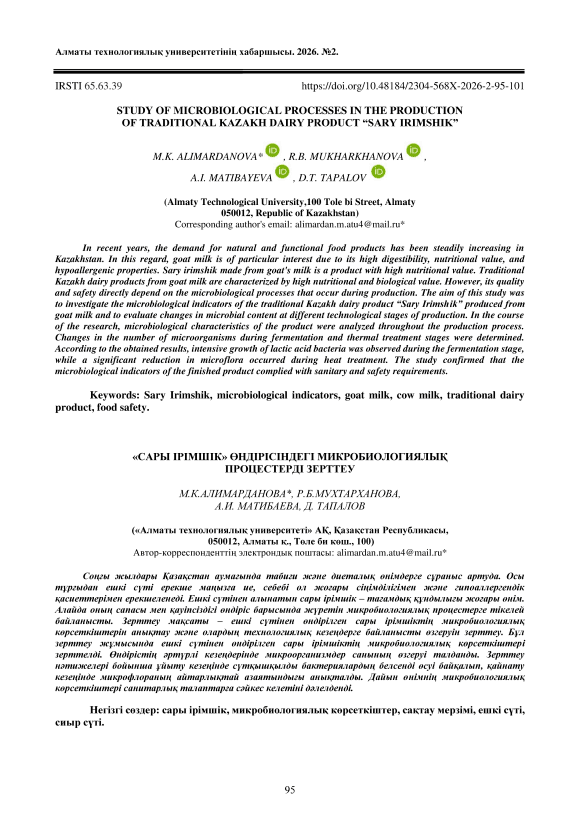
In recent years, the demand for natural and functional food products has been steadily increasing in Kazakhstan. In this regard, goat milk is of particular interest due to its high digestibility, nutritional value, and hypoallergenic properties. Sary irimshik made from goat's milk is a product with high nutritional value. Traditional Kazakh dairy products from goat milk are characterized by high nutritional and biological value. However, its quality and safety directly depend on the microbiological processes that occur during production. The aim of this study was to investigate the microbiological indicators of the traditional Kazakh dairy product “Sary Irimshik” produced from goat milk and to evaluate changes in microbial content at different technological stages of production. In the course of the research, microbiological characteristics of the product were analyzed throughout the production process. Changes in the number of microorganisms during fermentation and thermal treatment stages were determined. According to the obtained results, intensive growth of lactic acid bacteria was observed during the fermentation stage, while a significant reduction in microflora occurred during heat treatment. The study confirmed that the microbiological indicators of the finished product complied with sanitary and safety requirements.
Similar articles in the section Communication and transport industries. Accountancy. Business management. Public relations
Short address: https://sciup.org/140315566
IDS: 140315566 | UDC: 65.63.39 | DOI: 10.48184/2304-568X-2026-2-95-101
Исследование микробиологических процессов при производстве «сары иримшик»
В последние годы на территории Казахстана возрастает спрос на натуральные и диетические продукты. В этом отношении особое значение имеет козье молоко, которое отличается высокой усвояемостью и гипоаллергенными свойствами. Сары иримшик, произведённый из козьего молока, является продуктом с высокой пищевой ценностью. Однако его качество и безопасность напрямую зависят от микробиологических процессов, происходящих в ходе производства. Цель исследования – определить микробиологические показатели сары иримшик, произведённого из козьего молока, а также изучить их изменения в зависимости от технологических этапов. В данной исследовательской работе были изучены микробиологические показатели сары иримшик, произведённого из козьего молока. Проанализированы изменения количества микроорганизмов на различных этапах производства. По результатам исследования установлено, что на этапе сквашивания наблюдается активный рост молочнокислых бактерий, а на этапе варки значительно снижается количество микрофлоры. Доказано, что микробиологические показатели готового продукта соответствуют санитарным требованиям.
«Сары ірімшік» өндірісіндегі микробиологиялық процестерді зерттеу
Соңғы жылдары Қазақстан аумағында табиғи және диеталық өнімдерге сұраныс артуда. Осы тұрғыдан ешкі сүті ерекше маңызға ие, себебі ол жоғары сіңімділігімен және гипоаллергендік қасиеттерімен ерекшеленеді. Ешкі сүтінен алынатын сары ірімшік – тағамдық құндылығы жоғары өнім. Алайда оның сапасы мен қауіпсіздігі өндіріс барысында жүретін микробиологиялық процестерге тікелей байланысты. Зерттеу мақсаты – ешкі сүтінен өндірілген сары ірімшіктің микробиологиялық көрсеткіштерін анықтау және олардың технологиялық кезеңдерге байланысты өзгеруін зерттеу. Бұл зерттеу жұмысында ешкі сүтінен өндірілген сары ірімшіктің микробиологиялық көрсеткіштері зерттелді. Өндірістің әртүрлі кезеңдерінде микроорганизмдер санының өзгеруі талданды. Зерттеу нәтижелері бойынша ұйыту кезеңінде сүтқышқылды бактериялардың белсенді өсуі байқалып, қайнату кезеңінде микрофлораның айтарлықтай азаятындығы анықталды. Дайын өнімнің микробиологиялық көрсеткіштері санитарлық талаптарға сәйкес келетіні дәлелденді.
Text of the scientific article Study of microbiological processes in the production of traditional Kazakh dairy product “sary irimshik”
Currently, there is growing interest in traditional food products in Kazakhstan. In particular, national dairy products are becoming increasingly popular due to the population’s increasing demand for healthy and balanced nutrition. One of these traditional products is “Sary Irimshik,” a traditional Kazakh dairy product distinguished by its high nutritional value and extended shelf life.
Scientific studies devoted to the composition and properties of dairy products have demonstrated that they contain biologically valuable components essential for human health. Milk proteins contain a complete set of essential amino acids, while minerals contribute to bone formation and metabolic processes. During the production of dairy products, the major nutritional components of milk become concentrated, thereby increasing the nutritional and energy value of the finished product. Studies on the biochemical properties of milk and dairy products have confirmed the high digestibility of milk proteins (casein), fats, and minerals by the human body [1]. In addition, thermal treatment during dairy product processing leads to structural changes in proteins, improving the texture and sensory properties of the product.
Adnan Y. Tamime [2], who investigated the structure and texture of dairy products, reported that the reduction in moisture content and increase in dry matter concentration during high-temperature processing contribute to extending product shelf life. These characteristics are also typical technological features of traditional Kazakh dairy products such as “Sary Irimshik.”
Furthermore, studies conducted by Paul L.H. McSweeney and other researchers on the microbiological safety and quality of traditional dairy products emphasize the important role of fermentation and thermal processing in reducing pathogenic microorganisms and ensuring product safety [3].
Kazakhstani researchers have also made a significant contribution to the study of traditional dairy products. In particular, Kuanyshev [4] described the technological features and nutritional value of traditional Kazakh dairy products and highlighted their importance in the national food system.
In addition, state programs implemented by the Ministry of Agriculture of the Republic of Kazakhstan aimed at developing the agroindustrial sector contribute to expanding the production, processing, and export potential of national food products [5].
Recent studies have focused on the probiotic properties of traditional dairy products. Seppo Salminen [6] demonstrated that fermented dairy products can positively influence intestinal microflora and contribute to improved digestive health. In this regard, traditional Kazakh dairy products such as “Sary Irimshik” may be considered functional foods with potential health benefits.
The adaptation of traditional food products to industrial production conditions has also been widely discussed in scientific literature. Alan H. Varnam and J.P. Sutherland [7] emphasized that standardization of technological processes, quality control, and compliance with food safety requirements are among the key factors ensuring efficient and sustainable production.
In the production of traditional Kazakh dairy products, goat milk is often used alongside cow milk as a valuable raw material. Due to its unique composition and physicochemical properties, goat milk is considered an effective alternative to cow milk in certain applications. Goat milk is regarded as a high-quality raw material for producing nutritionally valuable dairy products. In particular, products based on goat milk are recommended for pregnant and lactating women, premature infants, preschool and school-age children, and people with special dietary needs [8,9,10].
According to the Kazakh Academy of Nutrition, goat milk is characterized by high nutritional and biological value. It contains significant amounts of proteins, fats, vitamins, and essential trace elements. Similar to cow milk, goat milk belongs to the casein group; however, it contains lower levels of allergenic proteins that are commonly associated with allergic reactions [11].
Thus, the analysis of international and domestic scientific studies indicates that traditional Kazakh dairy products such as “Sary Irimshik” possess high nutritional and biological value and represent technologically promising products with strong potential for industrial production and functional nutrition applications.
Research Materials and Methods
The objects of this study were traditional Kazakh dairy products “Sary Irimshik” produced from goat and cow milk. Experimental studies were carried out in the laboratory of the Food Safety Research Institute of Almaty Technological University. Optimal technological conditions for the production of the product were determined during the study.
The following standard analytical methods were used:
GOST 3624-92 - Milk and dairy products. Methods for determination of acidity;
GOST 9225-84 - Milk and dairy products. Methods for microbiological analysis;
GOST 33951-2016 - Milk and dairy products. Method for determination of lactic acid microorganisms;
GOST 5867-90 - Milk and dairy products. Methods for determination of fat content.
Results and Discussion
One of the main technological features of traditional Kazakh dairy product “Sary Irimshik” is the prolonged thermal treatment applied during production. During this process, the moisture content of the product decreases, while the concentration of dry matter increases. As a result, the product acquires a denser texture, characteristic golden-yellow color, and specific sensory properties. In addition, exposure to high temperatures significantly reduces the number of microorganisms, thereby ensuring microbiological safety and extending shelf life.
Scientific studies have demonstrated that fermented dairy products positively affect the digestive system by supporting the balance of intestinal microflora and improving immune system function. Therefore, traditional dairy products such as “Sary Irimshik” can be considered functional foods with beneficial nutritional properties.
The industrial production of traditional dairy products remains one of the important areas of modern food technology. In this regard, standardization of technological processes, stabilization of quality indicators, and compliance with food safety requirements play a significant role. The industrial production of traditional products requires the effective integration of traditional manufacturing methods with modern technological equipment and quality control systems.
In recent years, the demand for natural and dietary food products has increased significantly in Kazakhstan. Goat milk has attracted particular attention due to its high digestibility, nutritional value, and hypoallergenic characteristics. Dairy products produced from goat milk are considered promising products for functional and healthy nutrition.
Traditional Kazakh dairy products produced from goat milk are characterized by high nutritional value; however, their quality and safety largely depend on the microbiological processes occurring during production.
Based on these considerations, the production technology of traditional Kazakh dairy product “Sary Irimshik” from goat milk was carried out according to the following technological scheme:
Raw material acceptance, quality check
Pasteurization of milk at a temperature of 720C
Cooling milk to a temperature of 32-340C
Adding calcium chloride
Addition of starter culture and rennet enzyme
Mixing the curd for 30–40 minutes
Heating the curd in whey at 95–98°C for 4–5 hours with sugar addition
Sary Irimshik molding
Drying 50-55 0C (4 hours)
Figure 1. Production technology of “ Sary Irimshik ”.
Ensuring product safety and quality in dairy production is essential for the development of the food industry and directly affects several important aspects, particularly consumer health protection. The production of traditional dairy products is closely associated with the use of animal raw materials, which may be exposed to microbiological contamination risks [12].
As noted by international researchers, microbiological contamination in dairy production remains a significant issue, since microbiologically safe milk is one of the key factors in obtaining high-quality and safe dairy products. Spoilage microorganisms can affect milk components through enzymatic activity, leading to undesirable changes in the taste, odor, texture, and overall quality of the product. Furthermore, contaminants may enter the product during processing and storage stages, resulting in product defects and potential health risks for consumers [13].
Therefore, ensuring strict quality control and food safety is essential for preventing the spread of foodborne diseases and maintaining product quality. In the production of traditional dairy products, particular attention is paid to technological processes aimed at preventing contamination by pathogenic microorganisms. The application of modern technologies and systematic microbiological testing of finished products makes it possible to minimize potential health risks for consumers [14–16].
In addition, strict sanitary and hygienic control at all stages of production ensures the preservation of product quality and microbiological safety.
In the present study, the levels of microorganisms were investigated at each technological stage of “Sary Irimshik” production as well as in the finished product. The results of the microbiological analysis are presented in Table 1.
Table 1. Changes in the number of microorganisms in goat milk
|
Production processes |
Total microbial count ( CFU/g ) |
Acidity (°T) |
|
Raw milk |
8.5 × 10⁵ |
18 |
|
During fermentation |
4.2× 10⁷ |
70 |
|
During the boiling process |
1.8 × 10³ |
75 |
|
In the finished product |
1.2 × 10² |
80 |
The results presented in Table 1 demonstrated that the initial microflora of goat milk was relatively low, which can be explained by its natural bactericidal properties. During the fermentation stage, active growth of lactic acid bacteria such as Lactobacillus , Lactococcus , and Streptococcus thermophilus was observed, ensuring the proper course of lactic acid fermentation.
The increase in acidity during fermentation contributed to the formation of the characteristic structure and sensory properties of the product while simultaneously inhibiting the growth of pathogenic microorganisms. During the thermal treatment stage, most microorganisms were destroyed due to exposure to high temperatures, thereby ensuring the microbiological safety of the finished product.
The low total microbial count and the absence of pathogenic bacteria in the finished product indicate that the product complies with sanitary and microbiological safety requirements.
Table 2. Changes in the number of microorganisms in cow's milk
|
Production processes |
Total microbial count ( CFU/g ) |
Acidity (°T) |
|
Raw milk |
1.2 × 10⁶ |
16 |
|
During fermentation |
5.8× 10⁷ |
65 |
|
During the boiling process |
2.1 × 10³ |
70 |
|
In the finished product |
1.5 × 10² |
75 |
According to the data presented in Table 2, the number of microorganisms increased significantly during the fermentation stage (5.8×10⁷ CFU/g), while a substantial reduction in microbial count was observed during the thermal treatment stage (2.1×10³ CFU/g). In the finished product, microbiological indicators stabilized at 1.5×10² CFU/g.
The study demonstrated that the primary microflora of milk mainly consists of lactic acid bacteria such as Lactobacillus, Lactococcus, and Streptococcus thermophilus. During fermentation, these microorganisms actively multiply and promote lactic acid fermentation processes. As a result, the acidity of the medium increases, thereby inhibiting the growth and development of pathogenic microorganisms.
The thermal treatment stage is particularly important from a microbiological perspective, since high temperatures effectively destroy potentially hazardous microorganisms, including Escherichia coli and Salmonella , thus ensuring the microbiological safety of the finished product.
During the study, physicochemical and microbiological indicators of traditional Kazakh dairy product “Sary Irimshik” produced from goat and cow milk were determined. The obtained results are presented in Tables 3 and 4.
Table 3. Physicochemical and microbiological Indicators of “Sary Irimshik” produced from goat Milk
|
Name of indicators, unit of measurement |
Standard value |
Results obtained |
Test method |
|
1 |
2 |
3 |
4 |
|
Physico-chemical indicators: |
|||
|
-pН |
5.61 |
Potentiometric method |
|
|
-Titratable acidity, ot |
80 |
GOST 3624-92 |
|
|
Microbiological indicator: |
|||
|
-KMAFAnM, CFU/g |
100 |
16 |
GOST 9225-84 |
|
-BGKP (coli forms), in 1.0 g of product |
Not detected |
Not detected |
GOST 9225-84 |
|
-lactic acid microorganisms, CFU/g |
6 x 10⁶ |
GOST 33951-2016 |
Table 4. Physicochemical and microbiological Indicators of “Sary Irimshik” produced from cow Milk
|
Name of indicators, unit of measurement |
Standard value |
Results obtained |
Test method |
|
1 |
2 |
3 |
4 |
|
Physico-chemical indicators: |
|||
|
-pН |
5.44 |
Potentiometric method |
|
|
-Titratable acidity, OT |
38 |
GOST 3624-92 |
|
|
Microbiological indicator: |
|||
|
-KMAFAnM, CFU/g |
100 |
13 |
GOST 9225-84 |
|
-BGKP (coli forms), in 1.0 g of product |
Not detected |
Not detected |
GOST 9225-84 |
|
-lactic acid microorganisms, CFU/g |
2 x 10⁶ |
GOST 33951-2016 |
Conclusion
The results of the study demonstrated that the traditional Kazakh dairy product “Sary Irimshik” possesses high nutritional value and significant potential for industrial production. Under modern production conditions, this traditional product can be developed into a competitive national food brand of Kazakhstan through the application of modern food technologies and quality control systems.
In addition, the use of goat milk alongside cow milk in the production of “Sary Irimshik” increases the possibility of obtaining a product with high nutritional and microbiological quality. According to the obtained results, goat milk can be considered a highly suitable raw material for the production of traditional dairy products from a microbiological perspective.
The number of lactic acid microorganisms in products produced from goat and cow milk was 6×10⁶ CFU/g and 2×10⁶ CFU/g, respectively, indicating more intensive microbiological fermentation processes in goat milk. At the same time, no BGKP (coliform bacteria) were detected in either sample, confirming the microbiological safety of the traditional Kazakh dairy product “Sary Irimshik”.
The obtained results indicate that traditional Kazakh dairy products such as “Sary Irimshik” have strong potential for further industrial application, development of functional food products, and promotion within the modern food industry.
Gratitude, conflict of interest (financing)
This research was carried out within the framework of the scientific project IRN №BR24993234 “Innovative Technologies for the Production of National Products: Intensification and Digitalization of Meat and Dairy Production.” There is no conflict of interest.
