
Subtitles’ functions in cross-cultural communication through short videos: case studies of Chinese cultural short videos
Journal: Theory and Practice of Modern Science @modern-j
Section: Основной раздел
Article in issue: 4 (130), 2026.
Free access
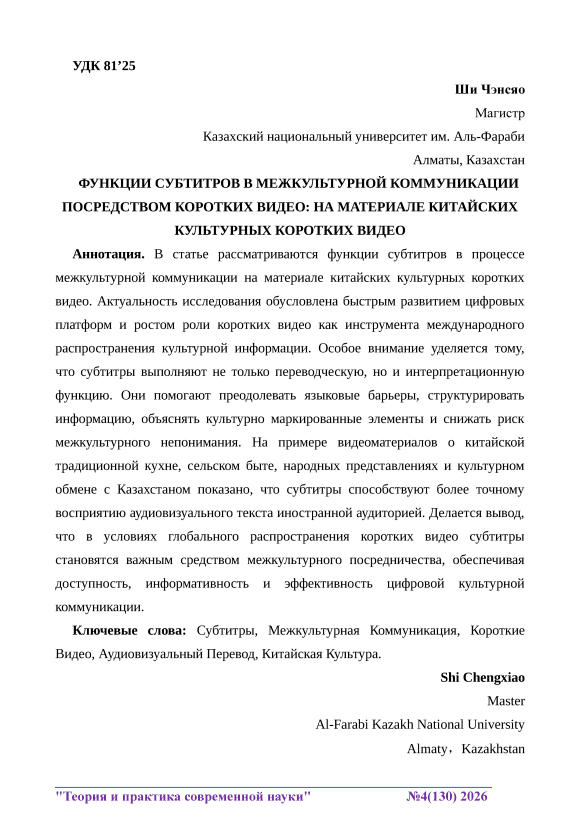
This article examines the functions of subtitles in intercultural communication based on Chinese cultural short videos. The relevance of the study is determined by the rapid development of digital platforms and the growing role of short videos as a tool for the international dissemination of cultural information. Special attention is paid to the fact that subtitles perform not only a translation function but also an interpretive function. They help overcome language barriers, structure information, explain culturally marked elements and reduce the risk of intercultural misunderstanding. Using video materials about Chinese traditional cuisine, rural life, folk performances and cultural exchange with Kazakhstan as examples, the article shows that subtitles contribute to a more accurate perception of audiovisual texts by foreign audiences. The article concludes that, in the context of the global spread of short videos, subtitles are becoming an important means of intercultural mediation, ensuring the accessibility, informativeness and effectiveness of digital cultural communication.
Short address: https://sciup.org/140316015
IDS: 140316015 | UDC: 81’25
Функции субтитров в межкультурной коммуникации посредством коротких видео: на материале китайских культурных коротких видео
В статье рассматриваются функции субтитров в процессе межкультурной коммуникации на материале китайских культурных коротких видео. Актуальность исследования обусловлена быстрым развитием цифровых платформ и ростом роли коротких видео как инструмента международного распространения культурной информации. Особое внимание уделяется тому, что субтитры выполняют не только переводческую, но и интерпретационную функцию. Они помогают преодолевать языковые барьеры, структурировать информацию, объяснять культурно маркированные элементы и снижать риск межкультурного непонимания. На примере видеоматериалов о китайской традиционной кухне, сельском быте, народных представлениях и культурном обмене с Казахстаном показано, что субтитры способствуют более точному восприятию аудиовизуального текста иностранной аудиторией. Делается вывод, что в условиях глобального распространения коротких видео субтитры становятся важным средством межкультурного посредничества, обеспечивая доступность, информативность и эффективность цифровой культурной коммуникации.
Text of the scientific article Subtitles’ functions in cross-cultural communication through short videos: case studies of Chinese cultural short videos
In the context of digital globalization, short-video platforms have become an increasingly important medium for the international circulation of cultural content. Unlike traditional forms of cultural communication, short videos combine visual narration, oral explanation, music, performance and platform-based interaction within a highly compressed format. This makes them especially effective for presenting cultural practices such as traditional food, handicrafts, folk performances and everyday rural life to audiences from different linguistic and cultural backgrounds. At the same time, the rapid growth of short-video communication has created new challenges for intercultural understanding, since visual images alone do not always provide sufficient information for foreign viewers to interpret culturally specific meanings correctly.
The relevance of this study is determined by the growing role of subtitles as a communicative and interpretive mechanism in digital audiovisual texts. In Chinese cultural short videos, subtitles are not limited to the technical translation of spoken language. They also explain culturally marked concepts, organise key information guide viewers’ attention and reduce the possibility of misunderstanding. This is particularly important in the case of Chinese cultural content distributed on global platforms, where audiences may lack the linguistic competence and cultural background necessary for understanding the symbolic meaning of certain practices.
The aim of this article is to analyse the main functions of subtitles in cross-cultural communication through short videos, using Chinese cultural short videos as case studies. To achieve this aim, the article examines several interrelated functions of subtitles: reducing language barriers, improving the efficiency of information delivery, interpreting cultural symbols, supporting two-way cultural exchange and adapting audiovisual content to contemporary mobile viewing practices. The empirical examples discussed in the article include Chinese rural-life videos, cooking videos, dragon dance performances and short videos introducing Kazakh folk culture to Chinese and international audiences.
The scientific significance of the study lies in its attempt to consider subtitles not merely as an auxiliary element of audiovisual translation, but as an active tool of intercultural mediation. The article argues that subtitles contribute to the transformation of short videos from entertainment-oriented media products into effective instruments of international cultural communication.
Reducing Language Barriers
Language difference remains one of the most significant obstacles in global cultural communication, especially in the context of short-video platforms where messages must be delivered within a limited time. Many Chinese cultural short videos use Mandarin Chinese as the primary spoken language. For international viewers who do not understand Chinese, visual images alone are often insufficient for grasping the detailed meaning, cultural background, and symbolic value of the content. In this regard, subtitles perform not only a linguistic function but also a mediating cultural function. They translate spoken discourse, clarify key concepts and help viewers interpret culturally specific practices more accurately.
A representative example can be found in the videos of the Chinese creator Li Ziqi, whose works on traditional rural life have attracted a broad international audience. In her video showing the process of making traditional soy sauce, the audience observes the preparation, fermentation, and storage of soybeans over several months. Without subtitles, foreign viewers may understand the general visual process but fail to recognize its cultural significance in Chinese family cooking and food traditions. Chinese-English subtitles provide concise explanations of each production stage and connect the visual narrative with its broader cultural meaning. As Díaz Cintas and Remael note, subtitling is not a simple mechanical transfer of words from one language into another; rather, it is a form of audiovisual translation that must consider linguistic, technical, and cultural constraints simultaneously [1].
Therefore, subtitles in Chinese cultural short videos function as an essential tool for overcoming language barriers and supporting intercultural understanding. They allow viewers to follow the narrative, identify culturally marked information, and develop a more accurate perception of Chinese traditions. In this sense, subtitles contribute to the transformation of short videos from simple entertainment products into effective instruments of international cultural communication.
Improving Information Delivery and Cultural Interpretation
Subtitles play an important role in improving the efficiency of information transmission in short-video communication. Unlike traditional documentary films or television programmes, short videos usually last only a few minutes or even less. Therefore, creators have to present complex practical procedures, cultural background and visual details within a highly compressed time frame. In this situation, subtitles function as a concise textual layer that guides viewers’ attention and helps them identify the most important information while watching the images. From the perspective of audiovisual communication, subtitles do not merely duplicate spoken language; rather, they organise information, reduce cognitive uncertainty and support the simultaneous processing of verbal and visual signs.
The cooking videos of the Chinese chef Wang Gang provide a representative example. His videos usually demonstrate the preparation of classical Chinese dishes including the selection of ingredients, control of heat, cutting techniques and seasoning procedures. English subtitles often list key ingredients, quantities and important cooking steps. For international viewers who are unfamiliar with Chinese cuisine, such subtitles make the cooking process more accessible and easier to reproduce. At the same time, brief subtitle explanations may introduce the cultural background of particular dishes, such as their regional origin or their role in family meals. This confirms the view that subtitle processing can be cognitively effective because viewers are able to understand audiovisual content without necessarily losing attention to the visual scene. Perego, Del Missier, Porta and Mosconi demonstrate that subtitles can support comprehension while allowing viewers to process both textual and visual information effectively [2].
In addition to information compression, subtitles also perform a cultural interpretive function. Images alone do not always have universal meanings. A cultural symbol may be interpreted differently depending on the viewer’s linguistic, historical and religious background. For example, videos of Chinese dragon dance performances are widely circulated on global platforms. In Chinese culture, the dragon symbolises good fortune, strength and collective prosperity. However, in some Western cultural traditions, dragons are often associated with danger, destruction or evil. If no explanatory subtitles are provided, foreign viewers may misread the symbolic meaning of the performance. Short subtitle comments can therefore reduce cultural misunderstanding and guide the audience toward a more accurate interpretation. Ramière argues that audiovisual translation involves the transfer of culture-specific references and requires attention to the intercultural dimension of meaning [3].
Thus, subtitles in Chinese cultural short videos serve two interconnected purposes: they accelerate information reception and mediate cultural interpretation. Through these functions, subtitles transform short videos from simple visual entertainment into effective tools of cross-cultural communication.
Supporting Two-Way Cultural Exchange
Subtitles, Two-Way Cultural Exchange and Mobile Viewing Practices
Cross-cultural communication through subtitles should not be understood only as the outward dissemination of Chinese culture to foreign audiences. In the contemporary short-video environment, subtitles also support a reverse and reciprocal flow of cultural information, enabling foreign cultures to be introduced to Chinese viewers. This two-way mechanism is particularly important in the context of digital platforms, where cultural communication is no longer controlled only by official institutions or traditional media. Instead, individual creators can participate in intercultural dialogue by combining visual narration, multilingual subtitles and platform-based audience interaction.
A relevant example can be observed in short videos produced by Chinese speaking creators living in Kazakhstan. Some of these creators record local traditions, folk music and everyday cultural practices, presenting them to audiences in China and other countries. In videos devoted to Kazakh folk songs, subtitles in Chinese English and Russian often explain the meaning of the lyrics, the historical background of the song and the symbolic role of national costumes. For Chinese viewers, such subtitles provide the necessary interpretive framework for understanding a culture that may be geographically close but linguistically and historically unfamiliar. At the same time, Russian and English subtitles expand the potential audience and allow local or international viewers to participate in the circulation of these cultural materials. In this sense, subtitles create a multilingual communicative space in which different audiences can access the same audiovisual text from their own linguistic positions.
Subtitles also improve the viewing experience in everyday mobile-media contexts. Short videos are frequently watched in public places such as buses, offices classrooms or waiting rooms, where users often turn off the sound. Under these conditions, subtitles become essential for maintaining comprehension and narrative continuity. Research on audience reception in audiovisual translation shows that viewer comments often reveal practical demands for subtitles, including comprehension, integral viewing, cultural learning and language acquisition. Wu’s corpus-driven study of YouTube comments, for example, demonstrates that audiences actively respond to the presence or absence of subtitles and that subtitle availability can shape viewing behaviour and reception patterns [4] .
Therefore, subtitles in short videos perform more than a supplementary linguistic role. They facilitate two-way cultural exchange, increase accessibility in multilingual communication and adapt audiovisual content to contemporary mobile viewing habits. As short-video platforms continue to expand globally, subtitles will remain a crucial instrument for international cultural interaction.
Conclusion
The analysis shows that subtitles perform several interconnected functions in the cross-cultural communication of short videos. First, they reduce linguistic barriers by making Chinese-language audiovisual content accessible to international audiences. In cultural short videos, subtitles help viewers understand spoken information, follow the narrative structure and identify culturally significant details that may not be fully conveyed through images alone. Secondly, subtitles improve the efficiency of information transmission. Since short videos are usually limited in duration, subtitles allow creators to present key concepts, procedural details and cultural explanations in a concise and visually accessible form. This function is particularly important in cooking, handicraft and folk-performance videos, where viewers need to understand both the practical process and its cultural meaning.
At the same time, subtitles serve as an instrument of cultural interpretation and intercultural mediation. They help prevent possible misunderstandings caused by different symbolic associations in different cultures and guide viewers toward a more accurate understanding of Chinese traditions. Moreover, subtitles support two-way cultural exchange by enabling both the dissemination of Chinese culture abroad and the introduction of foreign cultures to Chinese audiences. In mobile-media contexts, subtitles also increase accessibility when users watch videos without sound. Therefore, subtitles should be regarded not as a secondary technical element, but as an essential component of short-video communication. They integrate translation explanation and audience adaptation, thereby transforming short videos into effective tools for intercultural dialogue and international cultural communication.
