
Taxonomic composition and use of species of the genus Rhubarb (Rheum L.) in the territory of the Nakhchivan Autonomous Republic
Journal: Bulletin of Science and Practice @bulletennauki
Section: Естественные науки
Article in issue: 11 т.11, 2025.
Free access
The presented article provides information on the taxonomic spectrum and uses of species belonging to the genus Rheum ( Rheum L.) of the family Polygonaceae Juss., nom. cons., distributed in the flora of the Nakhchivan Autonomous Republic. The conducted studies revealed that 2 species of this genus are found in the flora of the Nakhchivan Autonomous Republic. The flora of the Nakhchivan Autonomous Republic is quite rich in accordance with its geographical location, relief and climate. Since the region covers both mountainous and steppe and semi-desert areas, various types of vegetation have formed here. The Nakhchivan Autonomous Republic is one of the regions with the richest flora in Azerbaijan. The rare and endemic plants here are of particular importance not only for the country, but also for the world flora. Scientists note that the rhubarb plant has astringent and hemostatic properties. It is used in kidney, gynecological, lymphangitis and furunculosis diseases. It has a strong calming, anti-inflammatory, antiseptic, choleretic and strengthening effect. It increases metabolism in the body.
Similar articles in the section General botany
Short address: https://sciup.org/14135419
IDS: 14135419 | UDC: 581: | DOI: 10.33619/2414-2948/120/06
Таксономический состав и использование видов рода ревень (Rheum L.) на территории Нахчыванской автономной республики
Представленна информация о таксономическом спектре и использовании видов, принадлежащих к роду Ревень ( Rheum L.) семейства Гречишные (Polygonaceae Juss.), распространенному во флоре Нахчыванской Автономной Республики. Проведенные исследования выявили, что во флоре Нахчыванской Автономной Республики встречаются 2 вида этого рода. Флора Нахчыванской Автономной Республики довольно богата в соответствии с ее географическим положением, рельефом и климатом. Поскольку регион охватывает как горные, так и степные и полупустынные районы, здесь сформировались различные типы растительности. Нахчыванская Автономная Республика является одним из регионов с самой богатой флорой в Азербайджане. Редкие и эндемичные растения здесь имеют особое значение не только для страны, но и для мировой флоры. Ученые отмечают, что растение ревень обладает вяжущими и кровоостанавливающими свойствами. Его применяют при заболеваниях почек, гинекологических, лимфангитах и фурункулезе. Оказывает сильное успокаивающее, противовоспалительное, антисептическое, желчегонное и общеукрепляющее действие. Усиливает обмен веществ в организме.
Text of the scientific article Taxonomic composition and use of species of the genus Rhubarb (Rheum L.) in the territory of the Nakhchivan Autonomous Republic
Бюллетень науки и практики / Bulletin of Science and Practice Т. 11. №11 2025
UDC 581: 582
The research was conducted in the Shahbuz and Ordubad districts of the Nakhchivan Autonomous Republic in 2022-2024. Collection of herbarium material and stationary observations began in 2022. To study the plant Rheum ribes L., which is widespread in the flora, regular routes were laid in different directions (at an altitude of 800-1100 m above sea level). The definition and clarification of the names of species belonging to the genus Rheum ribes L. were given on the basis of A. Asarov's book "Flora World of Azerbaijan" [14] and other works. The latest taxonomic changes were clarified using World Flora Online .
In the Nakhchivan Autonomous Republic, the genus Rheum is one of the important plant species, part of the region's rich flora. Two species of the genus are found in Azerbaijan and in the flora of the Nakhchivan Autonomous Republic. The taxonomic composition, ecological groups, range, altitudinal zonation, and flowering and fruiting phases of the species within the genus are listed in the table below. Rheum turkestanicum Janisch. and Rheum ribes L.— xerophyte, altitude zone — mid-mountainous and subalpine. Areal class Rheum turkestanicum Janisch — Turkey, flowering and fruiting phase — V-VI. Areal class Rheum ribes L. — Iran, flowering and fruiting phase — VI-VII. An analysis of the ecological groups of species within the genus revealed that the xerophyte ecological group is widespread in the study area and is represented by two species. This represents 100% of the total flora. Based on literature sources and our own fieldwork, it was established that the species of the genus belong to different ranges, which allows us to determine the migration routes of species into this area. Based on zonal and regional principles, the species within the genus are grouped into two ranges. As the table shows, each of the Iranian and Turkish ranges is represented by one species. Rheum L. is a plant with large, simple, rosette-shaped leaves arranged around the stem and a paniculate inflorescence. The flowers are bisexual or partially male. The petals of the inflorescence are six-lobed, hardening after anthesis. There are usually nine (5-10) stamens, three stigmas, and a capitate pharynx. The fruits are triangular, winged nuts. Two species of this genus are found in Azerbaijan and the Nakhchivan Autonomous Republic. The scientific name of the plant, commonly known as "ushgun" or "gabalag," is black rhubarb ( Rheum ribes L.). This plant grows wild in sandy and rocky areas of the mid-mountain and subalpine zones of the Ordubad, Julfa, and Shahbuz districts of the Nakhchivan Autonomous Republic. Scientists note that the plant has astringent and hemostatic properties. It is used for kidney diseases, gynecological conditions, lymphangitis, and furunculosis. It has a strong sedative, anti-inflammatory, antiseptic, choleretic, and restorative effect. It enhances metabolism. Because the root contains anthraquinone and tannoglucosides, it is used to prepare tinctures and decoctions for the treatment of a number of intestinal, bladder, and kidney ailments. Extracts obtained from the plant are also used in the treatment of lung cancer and play an important role in medicine (Figure 1, 2).
Turkestan rhubarb ( Rheum turkestanicum Janisch.) is rich in biologically active substances. It contains anthraquinones, flavonoids, taines, steroids, amino acids, and essential oils. The plant is used as a digestive, diuretic, anti-inflammatory, and antimicrobial agent. The Nakhchivan Autonomous Republic, the subject of this study, is a region favorable for xerophytic plants due to its climatic and geographical conditions. The xerophytic ecological group of plants includes droughtresistant plants adapted to a dry climate. They use water efficiently through a number of adaptations. The role of xerophytes in ecosystems is crucial, as they protect the soil, provide food and shelter for animals, and maintain ecological stability. Due to their ecological and economic importance, xerophytes bring significant benefits to both nature and humans [13, 22, 33, 34].
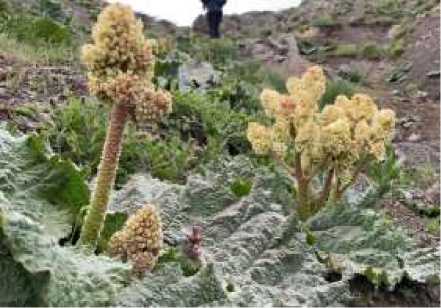
Figure 1. Rheum ribes
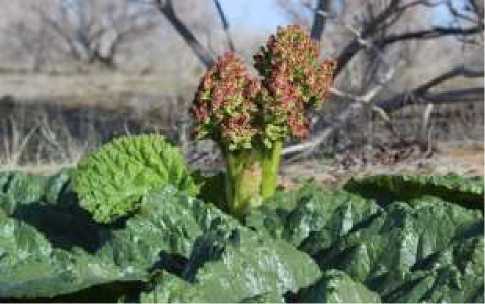
Figure 2. Rheum turkestanicum
Regardless of the research area, herbaceous plants in all regions are closely related to the species of a number of seasons and form various groups [9, 11, 12, 15, 25-27].
The xerophytic herbaceous plants of Nakhchivan are a branch related to the cultivation of low-water and drought-resistant plants, taking into account the arid climate and soil conditions of the region. Xerophytic plants grow in the semi-desert and steppe zones of Nakhchivan in accordance with the local flora and can be used in both agriculture and animal husbandry. Xerophytic herbaceous plants have great potential for local agriculture and farming by ensuring the efficient use of soil and water resources [1, 2, 8, 10, 20-24, 28, 29].
Along with herbaceous plants, forest and shrub plants that form various complex ecosystems are also widespread. These ecosystems play a key role in maintaining ecological balance and provide significant support to local flora and fauna. Thus, the dominant species in the formed phytocenoses are plants belonging to many families, such as Fabaceae, Malvaceae, Rosaceae, etc. [3-7, 14, 16-19, 30-32].
The xerophytic vegetation of the Nakhchivan Autonomous Republic, the study area, creates an ecosystem that ensures sustainable life in the region's dry climate. These plants contribute to ecosystem stability. Xerophytic plants play an important role in protecting the natural environment during droughts and ensuring sustainable agricultural development. Nakhchivan's xerophytic ecosystem is an important resource, forming the basis for both natural life and economic development. Therefore, the above-mentioned species of the genus Rheum L. do not fully reflect its uses. In our future research, we believe it is advisable to comprehensively study all the characteristics of this genus.
Conclusion
-
1. The conducted research revealed that two species of the genus Rheum L. are found in the flora of the Nakhchivan Autonomous Republic. Both species within the genus have ornamental, medicinal, and ecological significance.
-
2. An analysis of the ecological groups of the species within the genus revealed that both species are xerophytes. According to an analysis of geographic range classes, one species is found in Turkey and one species in Iran; both are monotypic.
