
The boundaries of population welfare in the Arctic regions and municipalities of the European part of the Russian Arctic
Journal: Economic and Social Changes: Facts, Trends, Forecast @volnc-esc-en
Section: Social and economic development
Article in issue: 2 т.19, 2026.
Free access
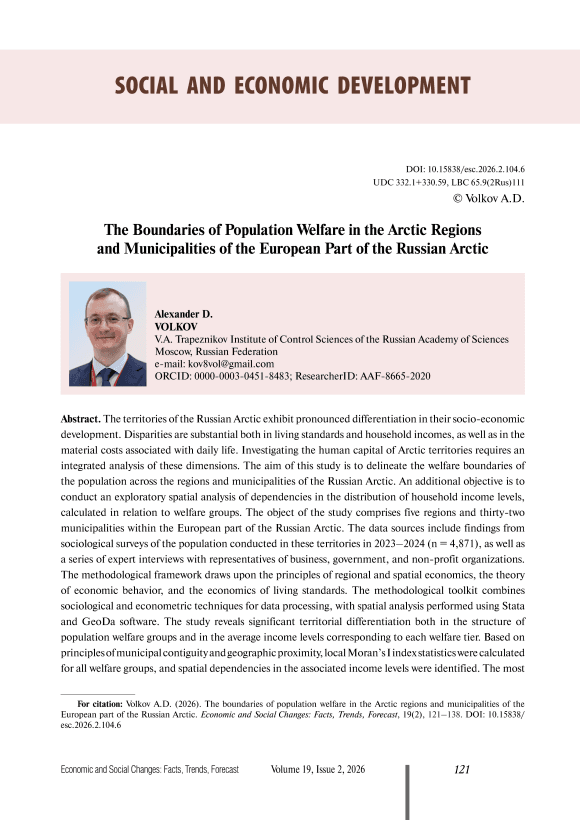
The territories of the Russian Arctic exhibit pronounced differentiation in their socio-economic development. Disparities are substantial both in living standards and household incomes, as well as in the material costs associated with daily life. Investigating the human capital of Arctic territories requires an integrated analysis of these dimensions. The aim of this study is to delineate the welfare boundaries of the population across the regions and municipalities of the Russian Arctic. An additional objective is to conduct an exploratory spatial analysis of dependencies in the distribution of household income levels, calculated in relation to welfare groups. The object of the study comprises five regions and thirty-two municipalities within the European part of the Russian Arctic. The data sources include findings from sociological surveys of the population conducted in these territories in 2023–2024 (n = 4,871), as well as a series of expert interviews with representatives of business, government, and non-profit organizations. The methodological framework draws upon the principles of regional and spatial economics, the theory of economic behavior, and the economics of living standards. The methodological toolkit combines sociological and econometric techniques for data processing, with spatial analysis performed using Stata and GeoDa software. The study reveals significant territorial differentiation both in the structure of population welfare groups and in the average income levels corresponding to each welfare tier. Based on principles of municipal contiguity and geographic proximity, local Moran's I index statistics were calculated for all welfare groups, and spatial dependencies in the associated income levels were identified. The most pronounced dependencies are observed within the middle-welfare group. A low income threshold for achieving this welfare level is characteristic of the White Sea coastal territories of the Republic of Karelia, whereas a high threshold is found in the Murmansk Urban Okrug and the municipal okrugs of Kolsky, Monchegorsk, and Olenegorsk. A juxtaposition of low and high income levels is recorded in Zapolyarny District of the Nenets Autonomous Area and the Urban Okrug of Naryan-Mar, as well as in the Inta Municipal Okrug and its surrounding areas.
Similar articles in the section Regional economics. Territorial economics
Short address: https://sciup.org/147253865
IDS: 147253865 | UDC: 332.1+330.59 | DOI: 10.15838/esc.2026.2.104.6
