
The potential of using «green» concrete and waste glass in the manufacture of light-transmitting decorative products
Journal: Nanotechnologies in Construction: A Scientific Internet-Journal @nanobuild-en
Section: Efficient use of recycled resources
Article in issue: 3 Vol.18, 2026.
Free access
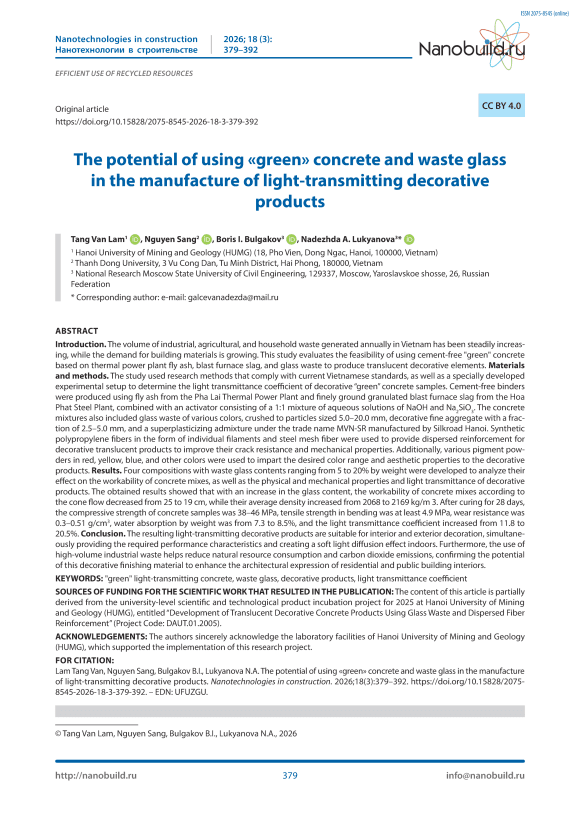
Introduction. The volume of industrial, agricultural, and household waste generated annually in Vietnam has been steadily increasing, while the demand for building materials is growing. This study evaluates the feasibility of using cement-free "green" concrete based on thermal power plant fly ash, blast furnace slag, and glass waste to produce translucent decorative elements. Materials and methods. The study used research methods that comply with current Vietnamese standards, as well as a specially developed experimental setup to determine the light transmittance coefficient of decorative “green” concrete samples. Cement-free binders were produced using fly ash from the Pha Lai Thermal Power Plant and finely ground granulated blast furnace slag from the Hoa Phat Steel Plant, combined with an activator consisting of a 1:1 mixture of aqueous solutions of NaOH and Na2SiO3. The concrete mixtures also included glass waste of various colors, crushed to particles sized 5.0–20.0 mm, decorative fine aggregate with a fraction of 2.5–5.0 mm, and a superplasticizing admixture under the trade name MVN-SR manufactured by Silkroad Hanoi. Synthetic polypropylene fibers in the form of individual filaments and steel mesh fiber were used to provide dispersed reinforcement for decorative translucent products to improve their crack resistance and mechanical properties. Additionally, various pigment powders in red, yellow, blue, and other colors were used to impart the desired color range and aesthetic properties to the decorative products. Results. Four compositions with waste glass contents ranging from 5 to 20% by weight were developed to analyze their effect on the workability of concrete mixes, as well as the physical and mechanical properties and light transmittance of decorative products. The obtained results showed that with an increase in the glass content, the workability of concrete mixes according to the cone flow decreased from 25 to 19 cm, while their average density increased from 2068 to 2169 kg/m 3. After curing for 28 days, the compressive strength of concrete samples was 38–46 MPa, tensile strength in bending was at least 4.9 MPa, wear resistance was 0.3–0.51 g/cm3, water absorption by weight was from 7.3 to 8.5%, and the light transmittance coefficient increased from 11.8 to 20.5%. Conclusion. The resulting light-transmitting decorative products are suitable for interior and exterior decoration, simultaneously providing the required performance characteristics and creating a soft light diffusion effect indoors. Furthermore, the use of high-volume industrial waste helps reduce natural resource consumption and carbon dioxide emissions, confirming the potential of this decorative finishing material to enhance the architectural expression of residential and public building interiors.
Similar articles in the section Building materials. Building components
Short address: https://sciup.org/142248071
IDS: 142248071 | DOI: 10.15828/2075-8545-2026-18-3-379-392
