
Transmission of Technical Information in Traditional Societies
Section: Древний мир и археология
Article in issue: 5 т.30, 2025.
Free access
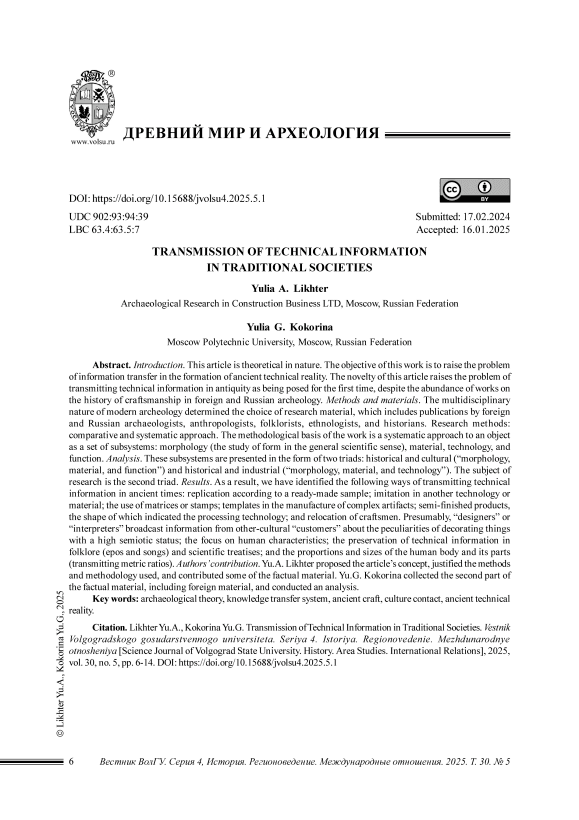
Introduction. This article is theoretical in nature. The objective of this work is to raise the problem of information transfer in the formation of ancient technical reality. The novelty of this article raises the problem of transmitting technical information in antiquity as being posed for the first time, despite the abundance of works on the history of craftsmanship in foreign and Russian archeology. Methods and materials. The multidisciplinary nature of modern archeology determined the choice of research material, which includes publications by foreign and Russian archaeologists, anthropologists, folklorists, ethnologists, and historians. Research methods: comparative and systematic approach. The methodological basis of the work is a systematic approach to an object as a set of subsystems: morphology (the study of form in the general scientific sense), material, technology, and function. Analysis. These subsystems are presented in the form of two triads: historical and cultural (“morphology, material, and function”) and historical and industrial (“morphology, material, and technology”). The subject of research is the second triad. Results. As a result, we have identified the following ways of transmitting technical information in ancient times: replication according to a ready-made sample; imitation in another technology or material; the use of matrices or stamps; templates in the manufacture of complex artifacts; semi-finished products, the shape of which indicated the processing technology; and relocation of craftsmen. Presumably, “designers” or “interpreters” broadcast information from other-cultural “customers” about the peculiarities of decorating things with a high semiotic status; the focus on human characteristics; the preservation of technical information in folklore (epos and songs) and scientific treatises; and the proportions and sizes of the human body and its parts (transmitting metric ratios). Authors’ contribution. Yu.A. Likhter proposed the article’s concept, justified the methods and methodology used, and contributed some of the factual material. Yu.G. Kokorina collected the second part of the factual material, including foreign material, and conducted an analysis.
Similar articles in the section Archaeology
Short address: https://sciup.org/149149825
IDS: 149149825 | UDC: 902:93:94:39 | DOI: 10.15688/jvolsu4.2025.5.1
Передача технической информации в традиционных обществах
Введение. Данная статья носит теоретический характер. Целью работы является постанов ка проблемы о путях передачи информации о формировании древней технической реальности, под которой понимается материальная составляющая искусственной среды обитания, создаваемой человеком в прошлом. В условиях современного информационного общества выявление путей передачи технической ин формации в древности как одного из важнейших факторов развития человечества представляется актуальным. Новизна данной статьи состоит в том, что, несмотря на обилие работ по истории ремесла в зарубежной и российской археологии, проблема реконструкции путей трансляции технической информации в древности ставится впервые. Методы и материалы. Мультидисциплинарный характер современной археологии определил выбор материала для исследования, которым являются публикации зарубежных и российских археологов, антропологов, фольклористов, этнологов, историков. Методы исследования: компаративный, системный подход, дескриптивный, классификационный, моделирование. Методологической основой работы является системный подход к вещи, рассматриваемой как совокупность подсистем: морфология (в общенаучном смысле как учение о форме), материал, технология и функция. Анализ. Эти подсистемы представлены в виде двух триад: историко-культурной («морфология, материал и функция») и историко-производственной («морфология, материал и технология»). Предметом исследования в данной работе является вторая триада. Композиция работы построена в зависимости от составляющих второй триады по хронологическому принципу. Результаты. В результате нами выделены следующие пути передачи информации о технической реальности в древности: повторение по готовому образцу; имитация в другой технологии или материале; использование матриц или штампов; шаблонов; схем и образцов при изготовлении сложных артефактов; полуфабрикатов, форма которых указывала на технологию обработки; переселение мастеров. Предположительно – использование «дизайнеров» или «переводчиков» для трансляции информации от инокультурных «заказчиков» об особенностях выполнения декора вещей с высоким семиотическим статусом; ориентация на особенности человека, пропорции и размеры человеческого тела и его частей (при передаче метрических соотношений). Сохранение технических сведений в фольклоре (эпос, песни) и ученых трактатах. Вклад авторов. Ю.А. Лихтер предложила концепцию статьи и часть фактического материала, обосновала методику и методологию. Ю.Г. Кокорина собрала вторую часть фактического материала, в том числе иностранного, провела анализ.
