
Влияние антифрикционных присадок на генерацию тепла в контактах качения с проскальзыванием
Рубрика: Контроль и испытания
Статья в выпуске: 3 т.17, 2017 года.
Бесплатный доступ
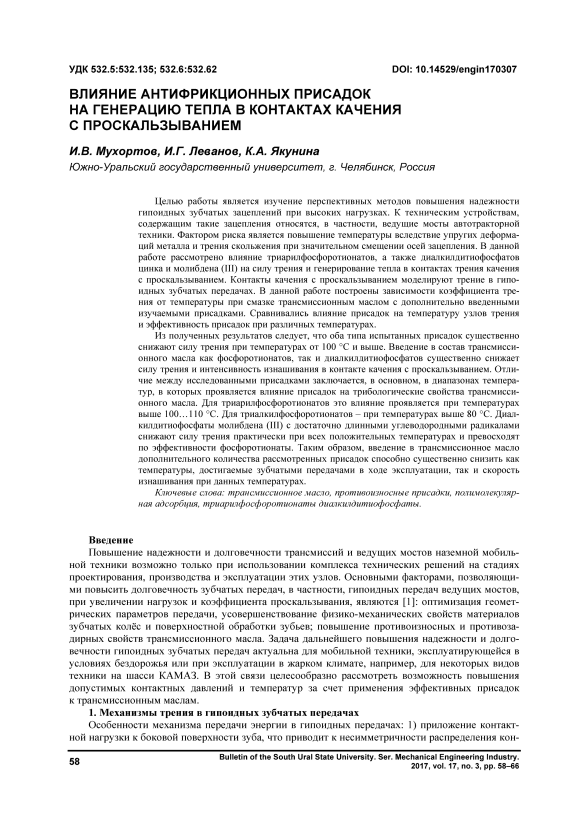
Целью работы является изучение перспективных методов повышения надежности гипоидных зубчатых зацеплений при высоких нагрузках. К техническим устройствам, содержащим такие зацепления относятся, в частности, ведущие мосты автотракторной техники. Фактором риска является повышение температуры вследствие упругих деформаций металла и трения скольжения при значительном смещении осей зацепления. В данной работе рассмотрено влияние триарилфосфоротионатов, а также диалкилдитиофосфатов цинка и молибдена (III) на силу трения и генерирование тепла в контактах трения качения с проскальзыванием. Контакты качения с проскальзыванием моделируют трение в гипоидных зубчатых передачах. В данной работе построены зависимости коэффициента трения от температуры при смазке трансмиссионным маслом с дополнительно введенными изучаемыми присадками. Сравнивались влияние присадок на температуру узлов трения и эффективность присадок при различных температурах. Из полученных результатов следует, что оба типа испытанных присадок существенно снижают силу трения при температурах от 100 °С и выше. Введение в состав трансмиссионного масла как фосфоротионатов, так и диалкилдитиофосфатов существенно снижает силу трения и интенсивность изнашивания в контакте качения с проскальзыванием. Отличие между исследованными присадками заключается, в основном, в диапазонах температур, в которых проявляется влияние присадок на трибологические свойства трансмиссионного масла. Для триарилфосфоротионатов это влияние проявляется при температурах выше 100…110 °С. Для триалкилфосфоротионатов - при температурах выше 80 °С. Диалкилдитиофосфаты молибдена (III) с достаточно длинными углеводородными радикалами снижают силу трения практически при всех положительных температурах и превосходят по эффективности фосфоротионаты. Таким образом, введение в трансмиссионное масло дополнительного количества рассмотренных присадок способно существенно снизить как температуры, достигаемые зубчатыми передачами в ходе эксплуатации, так и скорость изнашивания при данных температурах.
Похожие статьи в разделе Гидромеханика. Механика жидкостей и газа
Короткий адрес: https://sciup.org/147151759
IDS: 147151759 | УДК: 532.5:532.135; | DOI: 10.14529/engin170307
Influence antifrictional additives on heat generation in rolling contact with slippage
The aim of the study is the investigation of advanced ways to increase the reliability of hypoid gear-tooth systems at high loads. The technological equipment containing such systems include, in particular, drive axles of automotive engines. The risk factor is the rise of temperature because of the metal elastic deformations and sliding friction at significant offset of the instant axes. The present paper studies the influence of triaryl phosphorothionates, as well as zinc and molybdenum (III) dialkyldithiophosphates upon friction force and heat generation at the surface contacts under combined rolling and sliding friction. Rolling and sliding contacts model the friction in hypoid gearing. The dependencies of friction coefficient from the temperature are graphed for lubricating by transmission gear oil with the studied additives introduced into the system. The influence of additives upon the temperature of friction units has been compared together with the efficiency of additives at various temperatures. As follows from the obtained results, both types of the studied additives significantly decrease the friction force at temperatures from 100 °С and more. Addition of phosphorothionates and dialkyl dithiophosphates into the transmission oil composition significantly decreases the friction force and wear intensity at the rolling and sliding contact. Dissimilarity between the studied additives is observed mostly in the temperature ranges, in which the influence of the additives upon tribological properties of transmission oil is evident. For triaryl phosphorothionates this influence is observed at temperatures greater than 100…110 °С. For trialkyl phosphorothionates it exists at temperatures greater than 80 °С. Molybdenum (III) dialkyl thiophosphates with long hydrocarbon radicals lower the friction force practically at all positive temperatures; they exceed phosphorothionates in efficiency. Thus, introduction of additional quantity of the studied additives into transmission oil can substantially decrease both the temperatures reached by the gearing in operation and the wear rate at given temperatures.
Список литературы Влияние антифрикционных присадок на генерацию тепла в контактах качения с проскальзыванием
- Оболенцев, Р.Д. Химия сераорганических соединений, содержащихся в нефтях и нефтепродуктах/Р.Д. Оболенцев. -Уфа, 1963. -Т. 5. -264 с.
- Присадки к маслам: труды второго всесоюзного научно-технического совещания/под ред. С.Э. Крейна. -М.: Химия, 1968. -348 с.
- Братков, А.А. Теоретические основы химмотологии/А.А. Братков. -М.: Химия, 1985. -321 с.
- Бондарь, В.В. Технология органических веществ. 1966: сб. ст./гл. ред. В.В. Бондарь. -М.: ВИНИТИ, 1968. -195 с.
- Виппер, А.Б. Зарубежные масла и присадки/А.Б. Виппер. -М.: Химия, 1981. -189 с.
- Spikes, H. The History and Mechanisms of ZDDP/H. Spikes//Tribology Letters. -2004. -Vol. 17 (3). -P. 469-489.
- Связь структуры и трибологических характеристик диалкилдитиофосфатов цинка/И.В. Мухортов, К.А. Почкайло, А.А. Дойкин, И.Г. Леванов//Вестник ЮУрГУ. Серия «Машиностроение». -2016. -Т. 16, № 4. -С. 67-74 DOI: 10.14529/engin160408
- The Influence of Poly-molecular Adsorption on the Rheological Behaviour of Lubricating Oil in a Thin Layer/M. Fuller, Z. Yin, M. Kasrai et al.//Tribology International. -1997. -Vol. 30 (4). -P. 305-315.
- Solution Decomposition of Zinc Dialkyl Dithiophosphate and Its Effect on Antiwear and Thermal Film Formation Studied by X-ray Absorption Spectroscopy/M. Fuller, M. Kasrai, G.M. Bancroft et al.//Tribology International. -1998. -Vol. 31 (10). -P. 627-644.
- The Chemistry of Antiwear Films Generated by the Combination of ZDDP and MoDTC Examined by X-ray Absorption Spectroscopy/M. Kasrai, J.N. Cutler, K. Gore et al.//Tribology Transactions. -1998. -Vol. 41 (1). -P. 67-77.
- Additive-Additive Interaction: an XPS Study of the Effect of ZDDP on the AW/EP Characteristics of Molybdenum Based Additives/R. Unnikrishnan, M.C. Jain, A.K. Harinarayan, A.K. Mehta//Wear. -2002. -Vol. 252 (3). -P. 240-249.
- Taylor, L.J. Friction-Enhancing Properties of ZDDP Antiwear Additive: Part I: Friction and Morphology of ZDDP Reaction Films/L.J. Taylor, H.A. Spikes//Tribology Transactions. -2003. -Vol. 46 (3). -P. 303-309.
- So, H. The Theory of AntiWear for ZDDP at Elevated Temperature in Boundary Lubrication Condition/H. So, Y. Lin//Wear. -1994. -Vol. 177 (2). -P. 105-115.
- Spedding, H. The Antiwear Mechanism of Zddp's. Part I/H. Spedding, R. Watkins//Tribology International. -1982. -Vol. 15 (1). -P. 9-12.
- Investigation of the Interactions Between a Novel, Organic Anti-Wear Additive, ZDDP and Overbased Calcium Sulphonate/A. Greenall, A. Neville, A. Morina, M. Sutton//Tribology International. -2012. -Vol. 46 (1). -P. 52-61.
- Calcium Sulphonate and its Interactions With ZDDP on Both Aluminium-Silicon and Model Silicon Surfaces/M. Burkinshaw, A. Neville, A. Morina, M. Sutton//Tribology International. -2012. -Vol. 46 (1). -P. 41-51.
- Wu, H. The Tribological Properties and Action Mechanism of Non-Active Organic Molybdate Ester and Its Combination with ZDDP/H. Wu, Y-G. Wang, T.-H. Ren//Tribology International. -2012. -Vol. 49. -P. 90-95.
- Model Formation of ZDDP Tribofilm From a Mixture of Zinc Metaphosphate and Goethite/S. Berkani, F. Dassenoy, C. Minfray et al.//Tribology International. -2014. -Vol. 79. -P. 197-203.
