
Analysis of the national education portal in the context of using content for developing a responsible attitude towards health
Journal: Sport Mediji i Biznis @journal-smb
Article in issue: 2 vol.12, 2026.
Free access
Introduction: Digital educational platforms have become an essential component of contemporary educational systems, providing teachers with accessible resources for promoting students’ health literacy and healthy lifestyles. However, evidence regarding the actual utilization of these resources remains limited, particularly in national educational platforms. Aim: The aim of this study was to evaluate the utilization of digital educational resources available within the Responsible Attitude towards Health section of the Serbian National Education Portal by analysing user engagement indicators, including page views, active users, engagement time, and interaction events during the period from July 2023 to April 2026. Methods: A retrospective descriptive study was conducted using anonymized web analytics collected from the National Education Portal (https://zuov.gov.rs). Indicators included page views, active users, average engagement time, and recorded user events. Results: During the observation period, the page generated 7,246 views from 4,443 active users and recorded 73,491 interaction events. The average engagement time reached 1 minute and 56 seconds. Distinct increases in user activity coincided with the publication of new educational resources, indicating continuous demand for updated materials. Conclusions: The findings demonstrate sustained utilization of digital health education resources among educational professionals and emphasize the importance of continuously updating evidence-based teaching materials. These findings may support future strategies for strengthening digital health education within national educational systems.
Short address: https://sciup.org/170213396
IDS: 170213396 | UDC: 37.091.3:613(497.11); 37.091.3:613]:004.738.1(497.11) | DOI: 10.58984/smb2602119v
Text of the scientific article Analysis of the national education portal in the context of using content for developing a responsible attitude towards health
Health literacy has become one of the central priorities of contemporary educational systems because healthy behavioural patterns established during childhood and adolescence substantially influence lifelong physical and mental well-being (Lee, 2009; Bröder & Carvalho, 2019). In recent years, digital educational platforms have emerged as an essential component of modern education by providing teachers with immediate access to evidence-based teaching materials, interactive resources, and professional support for implementing health education (Lupton, 2021; Dagenais et al., 2022). Despite substantial investments in developing national digital educational infrastructures, relatively little is known about the actual utilization of these resources and their practical value for educational professionals. In Serbia, the National Education Portal serves as the official repository of educational materials designed to support teachers in developing cross-curricular competences, including Responsible Attitude towards Health. However, no previous study has systematically evaluated user engagement with these digital resources or examined whether continuous content updates influence their utilization. This knowledge gap provided the primary motivation for conducting the present study, with the intention of generating evidence that could support the further development of digital educational resources and strengthen health promotion within the national education system.
International legislation is based primarily on the UN Sustainable Development Goals – Goal 4 (United Nations, 2015): ensuring inclusive and quality education by 2030, as well as on the Council of Europe Education Strategy (2024–2030) and UNESCO documents. General crosscurricular competences in the education system represent a set of integrated knowledge, skills, and attitudes necessary for the personal development, social inclusion, and employability of every individual. They are not linked exclusively to a single subject but are developed across all teaching areas.
The educational role of education institutions is presented as a priority in the Strategy for the Development of Education in the Republic of Serbia until 2030. Within General Objective 1, the Strategy defines work on increasing the quality of teaching and learning, as well as the equity and accessibility of pre-university education, which will contribute to the enhanced educational function of education institutions (Azer, 2005). The planned activities include the development of training programmes and working materials for the implementation of preventive and intervention activities in a range of areas: protection against violence and discrimination, preservation of mental health, development of gender and all other forms of equality, improvement of reproductive health, as well as the prevention of risky forms of behaviour among children and young people (Aldana et al., 2005; Bynner, 2005). In addition, the Strategy for the Development of Education in the Republic of Serbia until 2030 identifies school sport as one of its strategic priorities; therefore, with the aim of developing healthy lifestyles and a responsible attitude towards health, special attention is devoted to its improvement.
The study Violence in Schools and Student Well-Being in Serbia (Councile of Europe, 2025), conducted in 2024 and published in 2025, with a sample of 5200 respondents, produced a range of findings as well as recommendations for the education system and schools. Within the framework of education policies, the recommendations refer to the need for schools to improve extracurricular activities by involving teachers and strengthening a positive school culture through the implementation of preventive and intervention measures; to work on strengthening students’ well-being; to develop students’ competences to recognise violence; to introduce the “Peer Shield” approach, which involves student bystanders in interventions in cases of violence and requires appropriate training and support for students who help their peers; to strengthen the application of positive disciplinary methods by encouraging responsibility, cooperation, and self-control among students; and to develop socio-emotional skills and ensure their inclusion in teaching.
The Law on the Foundations of the Education System, in the General Principles of Education, Article 7 (ZOSOV, n.d.), prescribes “the development and practice of healthy lifestyles, awareness of the importance of one’s own health and safety, and the need to nurture and develop physical abilities.” Thus, the aim of health education in the teaching and learning process is presented as the acquisition of knowledge that leads to the development of skills, followed by the formation of attitudes, which in turn leads to the formation or change of behaviours that either contribute to better health or undermine it.
In accordance with the standards for general cross-curricular competences prescribed by the Institute for Education Quality and Evaluation and approved by the Ministry of Education, 11 key cross-curricular competences have been defined:
-
• Competence for lifelong learning: the student’s ability to plan, organise, and monitor their own learning process, while recognising their own needs and opportunities for progress.
-
• Communication: the effective expression and interpretation of thoughts, feelings, and facts in oral and written form, with respect for the rules of communication and the use of digital tools.
-
• Working with data and information: the skill of finding, selecting, analysing, and critically evaluating information from different sources.
-
• Problem solving: the ability to identify obstacles, make decisions, and apply different strategies to find solutions in real-life situations.
-
• Digital competence: the safe and critical use of information and communication technologies (ICT) for work, leisure, and communication.
-
• Cooperation: readiness for teamwork, respect for different opinions, and contribution to a common goal while observing the rules of social interaction.
-
• Responsible participation in a democratic society: knowledge of rights and responsibilities, and the development of civic awareness, empathy, and competences for democratic culture.
-
• Health competence (Responsible Attitude towards Health): developing awareness of the importance of physical and mental health, safety, and healthy lifestyles.
-
• Aesthetic competence: recognising and valuing cultural values, artistic expression, and creativity.
-
• Entrepreneurship and entrepreneurial orientation: the ability to turn ideas into action, and to plan and manage projects in order to achieve goals.
-
• Responsible attitude towards the environment: developing environmental awareness and readiness to act in accordance with the principles of sustainable development.
Education legislation requires these competences to be developed through all forms of teaching and extracurricular activities. Teachers are trained to use an interdisciplinary approach and innovative methods to connect the content of different subjects so that students acquire functional and lasting knowledge.
The Competence Responsible Attitude towards Health
-
1. Physical health and personal hygiene: adopting habits of regular hygiene; understanding the importance of proper nutrition and regular sleep; recognising the importance of physical activity for proper development.
-
2. Mental and emotional health: recognising and controlling one’s own emotions; developing self-esteem and a positive self-image; developing the ability to cope with stress and seek help when necessary.
-
3. Safety and risk prevention: recognising and avoiding risky behaviours, including psychoactive substances, alcohol, and tobacco; safe behaviour in traffic and in the digital environment.
-
4. Awareness of the prevention of communicable and non-communicable diseases.
-
5. Reproductive health: understanding biological changes during growing up; developing a responsible attitude towards sexuality and health protection.
Responsible Attitude towards Health is a cross-curricular competence included in the learning outcomes of subjects such as Biology or Physical and Health Education; however, related content is present in all subjects across all three education cycles. Examples of implementation include:
-
• Biology/The World Around Us: learning about organs, nutrition, and prevention.
-
• Physical and Health Education: developing motor skills and exercise habits.
-
• Civic Education/Class Teacher Period: working on empathy, mental health, and violence prevention.
-
• Art/Music Education: using art for relaxation and emotional expression.
The aim is for students, by the end of formal education, to actively choose a healthy lifestyle and take responsibility for their actions.
This cross-curricular competence contributes to a more dynamic and engaged combination of subject-specific knowledge, skills, and attitudes, making them relevant to various real-life contexts that require their functional application. Within the education system, health education is explicitly implemented through teaching and learning programmes, namely through the compulsory subject Physical and Health Education in primary education and in grammar schools since 2017, through the compulsory subject Sport and Health in sports grammar schools, through the elective programme Health and Sport in grammar schools since 2018, as well as through other subjects and numerous free and extracurricular activities.
Developing responsibility for health, both one’s own and that of society as a whole, is the task of health education, or education for health, as part of general education (Bruun Jensen, 2000). Health education, including the area of reproductive health, is also organised through other extracurricular activities. In addition to Physical and Health Education classes, the subjects that include health-related content in the first cycle of primary education are The World Around Us and Nature and Society. Through learning outcomes, teaching topics, and content, a proper and responsible attitude towards health, prevention, protection against disease, personal hygiene, and basic health protection measures is developed (Ejemot-Nwadiaro et al., 2021).
Support for education staff in their work with students is provided by the Catalogue of Continuous Professional Development Programmes for Teachers, Preschool Teachers, and Professional Associates for the 2025/2026, 2026/2027, and 2027/2028 School Years (Institute for the Improvement of Education, 2024), which contains 31 training programmes in the field of health education, as well as 25 programmes in the field of physical education.
In addition, with the aim of strengthening education staff for the development of the crosscurricular competence Responsible Attitude towards Health among students, the Ministry of Education, in cooperation with the United Nations Population Fund (UNFPA), within the programme for empowering education staff to develop a responsible attitude towards health and to preserve students’ health and safety (2021), created materials in the Responsible Attitude towards Health section of the National Education Portal of the Institute for the Improvement of Education. These materials were developed in order to make educational resources available to teachers for the creation or adaptation of content through which this competence can be achieved. Workshop scenarios for working with students were prepared, as well as presentations for working with students and parents. The resources section also
Vuković, S., & Savić, I. (2026). Analysis of the national education portal in the context of using content for developing a responsible attitude towards health, Sport media and business , 12(2), 108-119 contains a handbook that was part of the online training conducted with all professional associates working in schools in July 2022.
In 2025 and 2026, the content on the page was updated. A Guide for Achieving a Responsible Attitude towards Health (Institute for the Improvement of Education, 2026) was developed, covering the following areas:
-
• healthy lifestyles
-
• physical activity
-
• healthy nutrition
-
• prevention of communicable diseases
-
• reproductive health
-
• emotional literacy
-
• social skills and relationships
-
• risky behaviour among young people and the use of psychoactive substances
-
• community mental health and prevention
-
• coping strategies, etc.
In addition to explaining these areas, the Guid e3 also contains a Practicum with teachers’ lesson preparations for the implementation of workshops, as well as workshop content for students. Practical application of skills: contemporary health education focuses on the development of skills, such as decision-making and resisting peer pressure, rather than solely on facts. In its second part, this Guide offers teachers tools for organising workshops and interactive exercises that help children apply these skills in real life.
The website also contains presentations that teachers can use in their work with students across different cycles and levels of education. The programmes can be implemented by teachers and professional associates within individual school subjects, in cooperation with local healthcare institutions, or as part of numerous projects carried out in cooperation with other ministries, civil society, and international organisations.
Therefore, the aim of this study was to evaluate the utilization of digital educational resources available within the "Responsible Attitude towards Health" section of the Serbian National Education Portal by analysing user engagement indicators, including page views, active users, average engagement time, and interaction events recorded between July 2023 and April 2026. It was hypothesised that continuous updating of educational content would be associated with sustained user engagement and increased utilization of the available digital resources,
Vuković, S., & Savić, I. (2026). Analysis of the national education portal in the context of using content for developing a responsible attitude towards health, Sport media and business , 12(2), 108-119 thereby demonstrating their practical value in supporting teachers and promoting health education within the Serbian educational system.
Methods
Study design
This study employed a retrospective descriptive observational design based on learning analytics and website usage data collected from the National Education Portal of the Institute for the Improvement of Education of the Republic of Serbia . Rather than involving human participants directly, the study analysed anonymised digital interaction data generated through users' visits to the portal section entitled "Responsible Attitude towards Health". The study was designed to evaluate the utilisation of digital educational resources intended to support teachers in implementing health education within the Serbian educational system.
Data source
Data were extracted from the integrated web analytics platform used by the National Education Portal (Google Analytics 4). The analysed dataset covered the period from July 2023 to April 2026 and included only aggregated, anonymised indicators. No personally identifiable information was collected or processed during the study.
Observed variables
The following web analytics indicators were analysed:
-
• total page views;
-
• number of active users;
-
• average engagement time per active user;
-
• number of interaction events (e.g., downloads, clicks, scrolling, video interactions);
-
• temporal trends in user activity.
These indicators were selected because they represent internationally accepted measures of user engagement and digital resource utilisation in learning analytics research.
Data analysis
Descriptive statistics were used to summarise website activity throughout the observation period. Continuous variables are presented as absolute values and averages. Temporal trends were examined graphically in order to identify changes in user engagement over time and to determine whether increases in portal activity coincided with the publication of new educational resources. The interpretation of user engagement followed the principles of learning analytics, whereby higher levels of page activity, repeated visits, longer engagement times, and increased interaction events are considered indicators of greater educational resource utilisation.
Vuković, S., & Savić, I. (2026). Analysis of the national education portal in the context of using content for developing a responsible attitude towards health, Sport media and business , 12(2), 108-119 Ethical considerations
Because this study analysed only aggregated and fully anonymised website analytics, without collecting personal or sensitive information from users, formal ethical approval and informed consent were not required according to national regulations governing non-interventional observational studies.
Results with Discussion
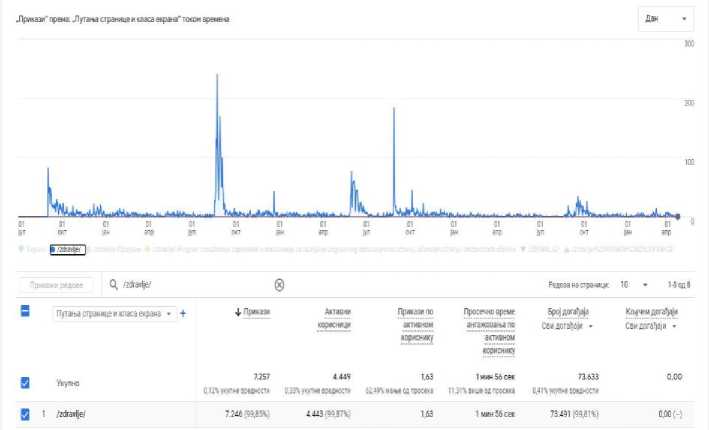
Figure 1. Analytical Data.
Based on the aggregated website analytics, the "Responsible Attitude towards Health" page demonstrated consistent and sustained user engagement throughout the observation period from July 2023 to April 2026, with several distinct peaks in activity corresponding to specific time intervals. During this period, the page generated 7,246 page views, representing 99.85% of all recorded views within the analysed portal segment. In addition, 4,443 active (unique) users accessed the page, accounting for 99.87% of all active users recorded within the same segment. These findings indicate that the page constituted one of the most frequently accessed educational resources within the analysed section of the National Education Portal.
The average number of page views per active user was 1.63, suggesting that while most users accessed the resource once, a considerable proportion returned for repeated visits, reflecting continued interest in the available educational materials. Furthermore, the average engagement time reached 1 minute and 56 seconds, exceeding the portal average by 11.31%. This level of engagement suggests that users spent sufficient time exploring or downloading the available educational resources rather than leaving the page immediately after accessing
Vuković, S., & Savić, I. (2026). Analysis of the national education portal in the context of using content for developing a responsible attitude towards health, Sport media and business , 12(2), 108-119 it. Consequently, engagement time may be considered an indirect indicator of the practical relevance and usability of the published materials for educational professionals.
A total of 73,491 interaction events were recorded during the study period. According to Google Analytics terminology, events represent meaningful user interactions with webpage content, including downloading educational materials, clicking interactive elements, scrolling through the page, viewing multimedia resources, and other user-initiated actions. Thus, 4,443 unique users generated 73,491 interaction events across 7,246 page views, representing 99.81% of all recorded events within the analysed portal segment. The exceptionally high number of interaction events relative to page views indicates that users actively interacted with the available content rather than passively browsing the webpage, further supporting the educational value of the portal resources.
The graphical analysis of temporal trends revealed relatively stable user activity throughout most of the observation period, interrupted by several pronounced increases in page visits. These peaks consistently coincided with the publication of newly developed educational materials and resource updates, suggesting that continuous content renewal represents a major driver of user engagement. The relatively high number of active users indicates sustained interest among educational professionals in digital health education resources. More importantly, the repeated peaks in portal activity observed throughout the study period occurred immediately after the publication of new educational materials, indicating that teachers actively seek newly developed evidence-based resources to support classroom practice and the implementation of the cross-curricular competence Responsible Attitude towards Health . Similar patterns have been reported in previous studies evaluating educational portals and digital learning environments, where regular content renewal significantly improved user retention, repeated access, and long-term engagement. Consequently, the present findings reinforce the importance of maintaining dynamic, continuously updated digital repositories that respond to teachers' evolving professional needs and support the sustainable implementation of health education within the school system.
|
Indicator |
Value |
|
Period |
July 2023 – April 2026 |
|
Page title |
Responsible Attitude towards Health |
|
Page views / number of users |
7.246 |
|
Active users |
4.443 |
|
Average number of views per active user |
1.63 |
|
Average engagement time per active user |
1 minute and 56 seconds |
|
Number of events – total number of actions on the page |
73.491 |
Table 1. User Data.
The relatively high number of active users indicates sustained interest among educational professionals in digital health education resources. More importantly, the repeated peaks in portal activity observed throughout the study period occurred immediately after the publication of new educational materials, suggesting that regular content updates represent one of the primary drivers of user engagement. This finding indicates that teachers actively seek newly developed evidence-based resources to support classroom practice and the implementation of the cross-curricular competence Responsible Attitude towards Health. Similar patterns have been reported in previous studies evaluating educational portals and digital learning environments, where continuous content renewal significantly improved user retention, repeated access, and long-term engagement (Couper et al., 2010; Lupton, 2021; Dagenais et al., 2022). Consequently, the present findings reinforce the importance of maintaining dynamic, regularly updated digital repositories that respond to the evolving professional needs of teachers and support sustainable implementation of health education within the school system.
Conclusion
This study achieved its objective by evaluating the utilization of digital educational resources available within the Responsible Attitude towards Health section of the Serbian National Education Portal. The analysis demonstrated sustained user engagement throughout the observation period, with marked increases in activity following the publication of new educational materials. These findings indicate that continuously updated, evidence-based digital resources constitute an important form of professional support for teachers responsible for developing students' health competence. Beyond confirming the practical value of the National Education Portal, the study highlights the strategic importance of investing in digital educational infrastructures that facilitate health promotion within schools. Future research should complement web analytics with qualitative investigations of teachers' experiences and evaluate the impact of these digital resources on students' health knowledge, attitudes, and behaviours.
