
Automata-Theoretic Framework for Modeling and Optimizing Library Resource Allocation
Journal: International Journal of Modern Education and Computer Science @ijmecs
Article in issue: 3 vol.18, 2026.
Free access
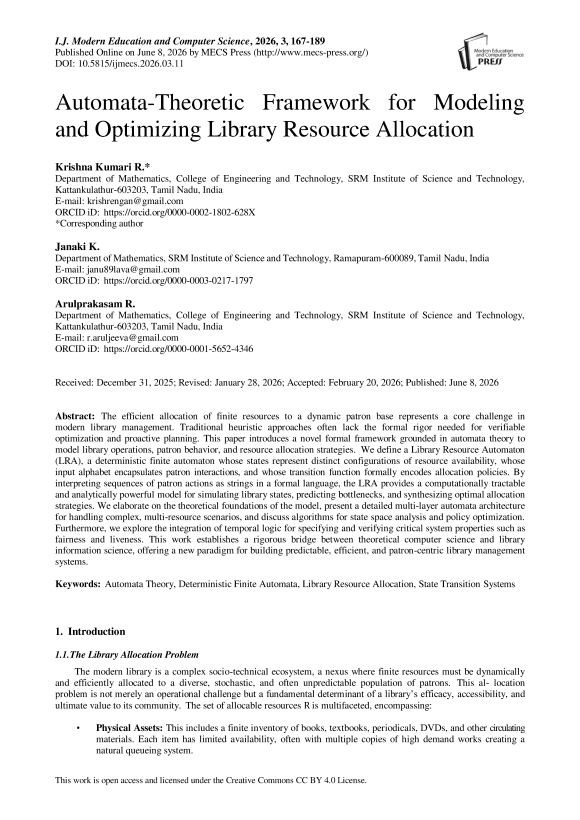
The efficient allocation of finite resources to a dynamic patron base represents a core challenge in modern library management. Traditional heuristic approaches often lack the formal rigor needed for verifiable optimization and proactive planning. This paper introduces a novel formal framework grounded in automata theory to model library operations, patron behavior, and resource allocation strategies. We define a Library Resource Automaton (LRA), a deterministic finite automaton whose states represent distinct configurations of resource availability, whose input alphabet encapsulates patron interactions, and whose transition function formally encodes allocation policies. By interpreting sequences of patron actions as strings in a formal language, the LRA provides a computationally tractable and analytically powerful model for simulating library states, predicting bottlenecks, and synthesizing optimal allocation strategies. We elaborate on the theoretical foundations of the model, present a detailed multi-layer automata architecture for handling complex, multi-resource scenarios, and discuss algorithms for state space analysis and policy optimization. Furthermore, we explore the integration of temporal logic for specifying and verifying critical system properties such as fairness and liveness. This work establishes a rigorous bridge between theoretical computer science and library information science, offering a new paradigm for building predictable, efficient, and patron-centric library management systems.
Similar articles in the section Librarianship
Short address: https://sciup.org/15020363
IDS: 15020363 | DOI: 10.5815/ijmecs.2026.03.11
