
Coins of the Turkic Khaganates from Taraz settlement (southern Kazakhstan)

Journal: Materials on Archaeology and History of the Ancient and Medieval Black Sea Region @maiask
Article in issue: 21, 2025.
Free access
The aim of this article is to introduce into scholarly discourse an extensive collection of Turkic coins unearthed during archaeological excavations at the Taraz settlement and to analyze their numismatic significance. The study employs instrumental measurement methods (weight, diameter) and classifies the coins based on legends in Sogdian script, tamghas, and additional symbols. The authors classify 444 coin specimens dated to the 8th - 9th centuries and identify distinctive features reflecting the political, ethnic, and economic structures of the Turgesh and Karluk Khaganates. The findings confirm Taraz’s role as a key center of coinage and prompt a reevaluation of local economic autonomy during the era of the Turkic khaganates.
Similar articles in the section Plastic arts
Short address: https://sciup.org/14135357
IDS: 14135357 | DOI: 10.53737/2713-2021.2025.72.81.005
Монеты тюркских каганатов из городища Тараз (Южный Казахстан)
Целью статьи является введение в научный оборот крупной коллекции тюркских монет, обнаруженных при археологических раскопках городища Тараз, и анализ их нумизматического значения. В работе использованы методы инструментального измерения (вес, диаметр) и классификации по легендам на согдийском письме, тамгам и дополнительным знакам. Авторы классифицируют 444 экземпляра монет, датируемых VIII-IX вв., и выявляют характерные признаки, отражающие политическую, этническую и экономическую структуру Тюргешского и Карлукского каганатов. Результаты подтверждают роль Тараза как ключевого центра денежной эмиссии и позволяют переосмыслить локальную экономическую автономию в эпоху тюркских каганатов.
Text of the scientific article Coins of the Turkic Khaganates from Taraz settlement (southern Kazakhstan)
Coins constitute one of the most important sources for reconstructing the political, economic, and cultural history of any people. The first locally minted coins in Taraz — one of the largest medieval cities in Central Asia — began to be produced during the period of the Turgesh Khaganate. Under the influence of Chinese dynastic coinage, an autonomous numismatic tradition developed in the region, incorporating Turkic, Chinese, and Sogdian elements.
Archaeological investigations at Taraz have been conducted intermittently since 1927 (Baipakov et al. 2011: 47). Among all the coins discovered in Taraz, Turkic coins are the most thoroughly studied; in the present work, we limit our discussion to those studies that identify and describe specific coin types found at Taraz.
The first major contribution to the study of Turkic coins was made by A.N. Bernshtam. Based on coins collected during the 1938 excavations at Taraz and from chance finds, A.N. Bernshtam identified six types of bronze coins. According to A.N. Bernshtam, these coins were found in stratigraphic layers dated to the 8th—9th centuries and continued to appear as late as layers dated to the 11th—12th centuries. He identified the cities of Suyab and Taraz as centers of coin production and dated one of the coin types to the mid-8th century (Bernshtam 1940: 110) (Fig. 1).
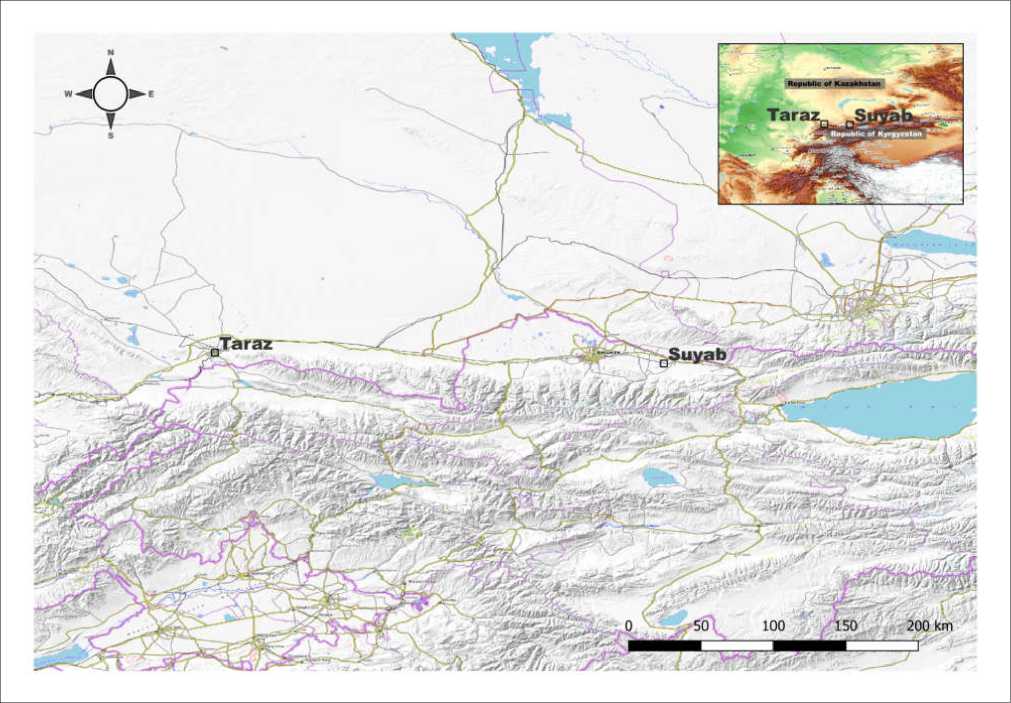
Fig. 1. Map indicating the locations of Taraz and Suyab. Created by A. Shayakhmetov.
In her study, O.I. Smirnova identified four types of coins discovered in Taraz (from excavations conducted by A.N. Bernshtam in 1936 and T.N. Senigova in 1962) as well as at other medieval settlements in Semirechye. According to Smirnova, the absence of large-scale imported issues (Bukharan, Ferghanan, or Sogdian coins) indicates the self-contained nature of the regional monetary system and its independence from the broader Sogdian trade network (Smirnova 1981: 165).
МАИАСП № 21. 2025
Coins of the Turkic Khaganates from Taraz settlement (Southern Kazakhstan)
The most comprehensive typology was proposed by A.M. Kamyshev, who systematically catalogued coins found across Kazakhstan and Kyrgyzstan (Kamyshev 2002). Kamyshev’s research encompasses not only coin typology but also attribution, chronology, and statistical data (Kamyshev 2024; 2023). According to his published statistics (Kamyshev 2023: 325), the largest number of Turkic coins has been uncovered at settlement sites in the Chu and Talas valleys. It is precisely the coins from Taraz that form the core of the analysis presented in this article.
D.A. Voyakin, S.Sh. Akylbek, and R.N. Buranbayev reported the discovery of 50 coins (Voyakin et al. 2014: 185). In their study summarizing the 2013 excavations at the Taraz settlement, the authors distinguished three coin types: 10 specimens of the Vakhshutava coin; 4 specimens of the Inal-Tegin type; and 4 specimens of the “Turgesh Denga” (Voyakin et al. 2014: 185). Meanwhile, in the study by M.E. Eleuov, G.B. Babayarov, and A.V. Kubatin titled “Pre-Islamic Coins of Taraz,” the authors analyzed approximately 100 coins dated from the 7th—8th to the 18th—19th centuries and identified three main groups comprising several distinct coin types (Eleuov et al. 2014: 15).
The aforementioned works represent the principal publications on Taraz addressing coin chronology and typology. They enable the chronological and attributive classification of Turkic coins and partially reconstruct the historical processes that unfolded during the Turgesh and Karluk Khaganates. However, these studies were based on relatively small collections, often lacking a clear archaeological context, which limited the potential for statistical analysis and precise identification of minting centers.
Between 2014 and 2017, large-scale archaeological excavations were carried out at the Taraz settlement under the direction of Zh. Smailov. Excavations across an extensive area within stratigraphic layers dating from the 10th to the 13th centuries revealed significant portions of the urban layout, along with unique finds including ceramic and metal vessels, as well as artifacts made of metal, bone, glass, and coins (Smailov et al. 2023: 32). These excavations yielded a substantial numismatic assemblage, a portion of which — specifically coins from the Turgesh and Karluk Khaganates — forms the basis of the present publication. In this study, we refer to these as “Turkic coins” (Fig. 2).
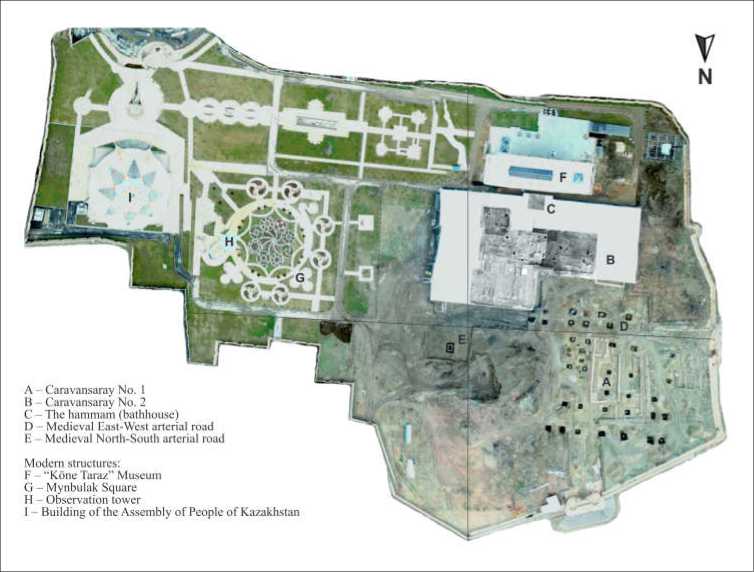
Fig. 2. Excavation plan of the Taraz settlement. Coins were found across the entire investigated area (From the archive of Zh. Smailov).
МАИАСП № 21. 2025
The aim of this article is to introduce into scholarly discourse a large collection of Turkic coins unearthed at the Taraz settlement. The total number of coins’ amounts to 533 specimens, of which 444 are sufficiently well-preserved to allow for typological classification.
This collection is significantly larger — both in terms of the number of coin types and the total quantity of specimens — than those assembled in previous studies and archaeological investigations conducted at Taraz in earlier years.
Methods and Materials
Methods
For quantitative and metrological analysis, all coins underwent instrumental measurements of weight and diameter. Metrological parameters were recorded with high precision: weight was measured using digital scale with an accuracy of ±0.01 g, and diameter was measured with a digital caliper. These parameters enable an assessment of casting standardization, identification of possible variants within a single type, and comparison of the finds with known emissions.
For each identified type, minimum, maximum, and average values of weight and diameter were calculated. The data were compiled into a summary table, facilitating quantitative and statistical analysis.
Similarly, for each typological variant, minimum, maximum, and average values of weight and diameter were determined. The resulting dataset was consolidated into a comprehensive table, allowing for statistical processing and comparative analysis — including refinement of chronology and localization of minting centers.
Typological classification of the Turkic coins from Taraz was carried out through comparative analysis with previously published coin types for which established typologies and chronologies exist.
Classification was based on the following criteria: legends inscribed in Sogdian script; the presence and specific form of Turkic tamghas; and additional symbols or marks. This approach enabled not only the differentiation of coins into distinct types but also their association with specific political entities or historical periods.
Typology and Metrology of the Coins
Coins of the Turgesh and Karluk Khaganates were found throughout the entire excavated area of Taraz within cultural layers dated to the 10th—13th centuries. Notably, no hoard consisting exclusively of such coins has been recorded; all finds are individual (single) specimens.
Based on typological identification, twelve distinct coin types were distinguished (Fig. 3). The results have been systematized in Table 1, which presents consolidated metrological data for each coin type, including average, minimum, and maximum values (Table 1).
МАИАСП № 21. 2025
Coins of the Turkic Khaganates from Taraz settlement (Southern Kazakhstan)
Coins typology from the Taraz settlement
Type No. 1. Coin of the Turgesh Khagan.
Obverse: Sogdian legend βγy twrkyš γ’γ’n pny.
Reverse: Turgesh tamga.
First half of the 8th century.
AE, 24.61 mm, 4.54 g. (Fig. 3: 1) (Kamyshev 2024: Tab. X, Coin. No. 3).
Type No. 2.
Coin of the Turgesh Khagan.
Obverse: Sogdian legend βγy twrkyš γ’γ’n pny.
Reverse: Turgesh tamga, Karluk tamga to the left.
Mid-8th century.
AE, 24.05 mm, 5.95 g. (Fig. 3: 2) (Kamyshev 2024: Tab. X, Coin. No. 4).
Type No. 3.
Coin of the Turgesh Khagan.
Obverse: Sogdian legend βγy twrkyš х’γ’n pny.
Reverse: Turgesh and Karluk tamgas, Sogdian inscription prn (glory).
Mid-8th century.
AE, 24.6 mm, 5.42 g. (Fig. 3: 3) (Kamyshev 2024a: Tab. X, Coin. No. 5).
Type No. 4.
Coin of the Turgesh Khagan.
Obverse: Sogdian legend βγy twrkyš γ’γ’n pny.
Reverse: Turgesh tamga, to the left the Karluk tamga, below the inscription m’x (moon).
Mid-8th century.
AE, 26.94 mm, 10.91 g. (Fig. 3: 4) (Kamyshev 2024: Tab. X, Coin. No. 6).
Type No. 5.
Coin of Vakhshtuva, Karluk Khaganate.
Obverse: Sogdian legend xwt’ w’wšwt’wy pny.
Reverse: Tamgas of the Turgesh and Karluks, and the Chinese character yuan.
Mid-8th century.
AE, 22.04 mm, 2.61 g. (Fig. 3: 5) (Kamyshev 2024: Tab. X, Coin. No 7).
Type No. 6.
Coin of Arslan—Kul Irkin, Karluk Khaganate.
Obverse: Circular Sogdian legend 'rsl'n kwyl 'yrkyn.
Reverse: Tamgas of the Turgesh and Karluks.
Mid-8th century.
AE, 24 mm, 5.14 g. (Fig. 3: 6) (Kamyshev 2024: Tab. X, Coin. No. 10).
Type No. 7.
Coin of Arslan Irkin, Karluk Khaganate. Obverse: Sogdian legend ’rsl’n ’yrk’yn xwβw pny.
Reverse: Tamgas of the Turgesh and Karluks, Sogdian inscription prn (glory).
The second half of the 8th century.
AE, 25.92 mm, 4.73 g. (Figure 3: 7) (Kamyshev 2024a: Tab. X, Coin. No. 8).
МАИАСП № 21. 2025
Type No. 8.
Coin of Arslan Irkin, Karluk Khaganate.
Obverse: Sogdian legend ’rsl’n ’yrk’yn xwβw pny.
Reverse: Tamgas of the Turgesh and Karluks, Sogdian inscription prn (glory).
Mid-8th century.
AE, 18.22 mm, 1.86 g. (Fig. 3: 8) (Kamyshev 2024: Tab. X, Coin. No. 16).
Type No. 9.
Coin of Arslan Irkin. Karluk Khaganate. Obverse: Sogdian legend ’rsl’n ’yrk’yn xwβw pny.
Reverse: Tamgas of the Turgesh and Karluks, Sogdian inscription prn (glory).
Second half of the 8th century.
AE, 18.36 mm, 1.76 g. (Fig. 3: 9) (Kamyshev 2024: Tab, X, Coin. No. 17).
Type No. 10.
Coin of Vakhshtuva, Karluk Khaganate.
Obverse: Sogdian legend xwt’ w’wšwt’wy pny.
Reverse: Tamgas of the Turgesh and Karluks, inscription prn (glory).
Second half of the 8th century.
AE, 18.83 mm, 1.76 g. (Fig. 3: 10) (Kamyshev 2024: Tab. X, Coin. No. 18).
Type No. 11.
Coin of Wanantmakh.
Turgesh Khaganate.
Obverse: Sogdian legend βγy twrkyš γ’γ’n pny.
Reverse: Legend wn’ntm’x xwβw — “ruler Wanantmakh” and tamga.
Early 9th century.
AE, 16.62 mm, 0.75 g. (Fig. 3: 11) (Kamyshev 2024: Tab. X, Coin. No. 19).
Type No. 12.
Coin of Wanantmakh, Turgesh Khaganate.
Obverse: Sogdian legend βγy twrkyš γ’γ’n pny.
Reverse: Legend wn’ntm’x xwβw — “ruler Wanantmakh” and tamga.
Early 9th century.
AE, 19.88 mm, 1.85 g. (Fig. 3: 12) (Kamyshev 2024: Tab. X, Coin. No. 20).
МАИАСП № 21. 2025
Coins of the Turkic Khaganates from Taraz settlement
(Southern Kazakhstan)
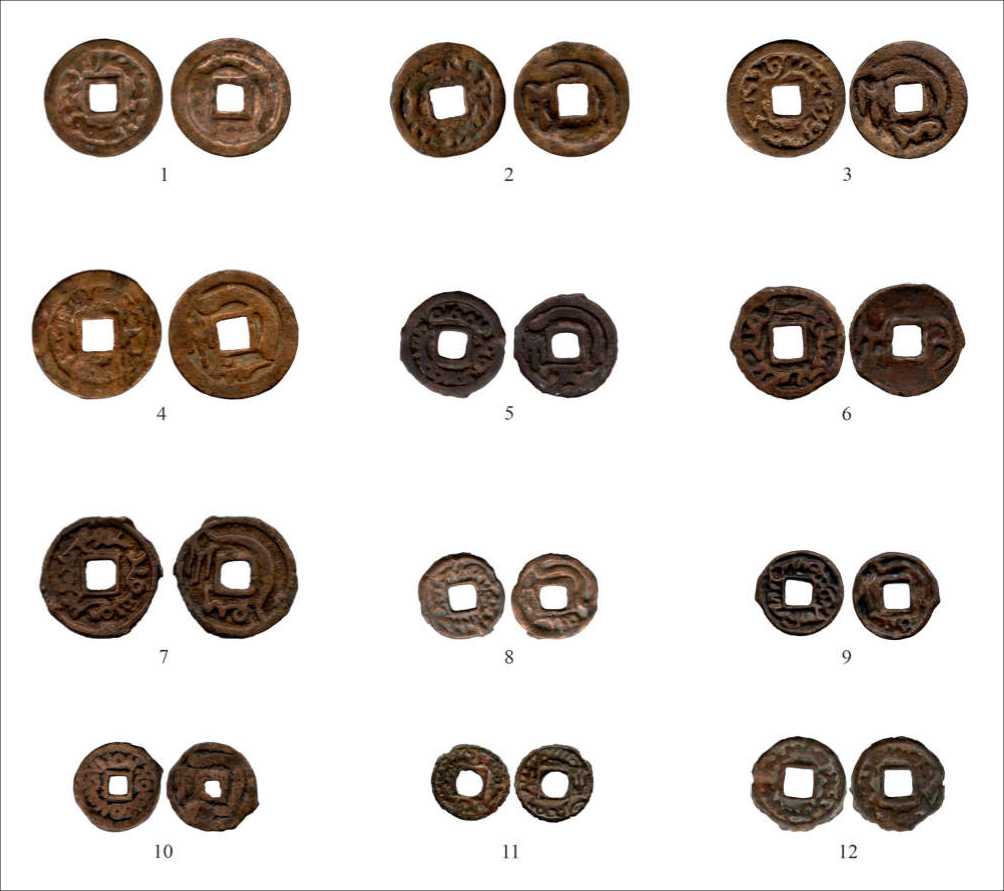
Fig. 3. Coins of the Taraz settlement of the 8th—9th centuries: 1 — Type No. 1; 2 — Type No. 2; 3 — Type No. 3; 4 — Type No. 4; 5 — Type No. 5; 6 — Type No. 6; 7 — Type No. 7; 8 — Type No. 8; 9 — Type No. 9; 10 — Type No. 10; 11 — Type No. 11; 12 — Type No. 12.
МАИАСП № 21. 2025
Table 1. Summary of Metric Data by Coin Types
|
Total quantity |
Average weight, grams |
Average diameter, mm |
Maximum weight, grams |
Maximum diameter, mm |
Minimum weight, grams |
Minimum diameter, mm |
|
|
Type No. 1. |
112 |
3.4 3 |
22.4 |
6.33 |
25.0 1 |
1 |
17.2 6 |
|
Type No. 2. |
35 |
4.7 |
23.4 |
6.28 |
24.8 1 |
2.07 |
20.6 4 |
|
Type No. 3. |
70 |
4.3 |
23.2 |
6.95 |
25.6 5 |
0.95 |
15.9 3 |
|
Type No. 4. |
21 |
10. 8 |
27 |
12.3 5 |
27.6 5 |
7.9 |
25.9 7 |
|
Type No. 5. |
112 |
2.9 |
22.3 |
4.68 |
25.1 6 |
1.08 |
17.2 4 |
|
Type No. 6. |
1 |
5.1 6 |
24.1 9 |
||||
|
Type No. 7. |
30 |
2.9 |
21.5 |
6.04 |
26.1 3 |
0.85 |
16.6 |
|
Type No. 8. |
5 |
2.4 3 |
18.4 |
2.88 |
18.9 |
1.86 |
17.2 |
|
Type No. 9. |
6 |
1.8 |
18.1 |
2.54 |
20.1 3 |
1.09 |
16.7 2 |
|
Type No. 10. |
45 |
1.9 |
18.6 |
4.79 |
22.7 3 |
1 |
16.1 2 |
|
Type No. 11. |
4 |
1.4 |
18.4 |
1.85 |
19.8 8 |
0.75 |
16.6 2 |
|
Type No. 12. |
2 |
1.9 6 |
18.6 |
2.47 |
19.0 5 |
1.45 |
18.1 4 |
Discussion
The analysis carried out on the identified coin types allows dividing them into three groups according to quantity: a large quantity (100 or more specimens), a medium quantity (from 20 to 70 specimens), and a small quantity (up to 10 specimens). This division by quantity enables us to trace the prevalence of a particular coin type within the territory of Taraz.
The first group by quantity includes the most numerous coins: Type No. 1, “Coin of the Turgesh Khagan” (112 specimens), and Type No. 5, “Coin of the Karluk Khagan” (112 specimens). Type No. 1 is one of the most numerous coin types; however, apart from the Sogdian legend on the obverse and the Turgesh tamgha on the reverse, it lacks any other elements.
Regarding Type No. 1, “Coin of the Turgesh Khagan,” V.N. Nastich distinguished three main groups (Nastich 1989: 118): large coins (diameter 23 mm and above) — 62 specimens; medium coins (diameter 18—22 mm) — 49 specimens; small coins (diameter 17 mm and below) — 1 specimen. Thus, the largest group consists of large coins, followed by medium coins, and a single small coin.
Type No. 1 coins are the most widespread. They have been discovered in the Chu Valley: Suyab — 189 specimens, Navekat — 484 specimens, Kuz-Ordu — 23 specimens, Nuzket — 67 specimens. In the cities of the Talas Valley: Shelji — 6 specimens, Atlakh — 5 specimens, Bek-tobe — 4 specimens (Kamyshev 2023: 325). Single specimens have been found at the Sauran settlement (Smagulov 2010: 285) and at the Altyn-tobe settlement (Smagulov 2010: 222), as well as at Sayram, Juantobe, and Karaspan (Baytanaev et al. 2020).
On Type No. 5 coins, the obverse bears a Sogdian legend specifying the ruler’s name: “Denga Vakhshtuva,” while the reverse features not only the Turgesh tamgha but also the Karluk tamgha, along with the Chinese character “yuan”. Type No. 5, “Coin of Vakhshtuva, Karluk Khaganate,” also allows
МАИАСП № 21. 2025
Coins of the Turkic Khaganates from Taraz settlement (Southern Kazakhstan)
for the identification of three main groups: large (diameter 23—25 mm) — 30 specimens; medium (diameter 20—22 mm) — 80 specimens; small (diameter 17—19 mm) — 2 specimens.
Type No. 5 coins occur in large numbers in Taraz. In Navekat — 11 specimens, in Suyab — 2 specimens, in Bek-tobe — 6 specimens (Kamyshev 2023: 325). Single specimens have been found at the Altyn-tobe, Bozaryk, and Amangeldy settlements (Baitanayev et al. 2020). Considering that Type No. 1 belongs to the Turgesh Khagan and Type No. 5 to the Karluk Khagan, it may be assumed that these coin types were the principal ones in the Chu—Talas Valley region.
It should also be noted that different attributions exist for Type No .5. The authors M.E. Eleuov, G.B. Babayarov, and A.V. Kubatin propose the following reading of this coin: on the obverse, xwt’w prn xwt’wy pny — “Coin of the Lord Farn-Khutava”. On the reverse: The Turgesh tamgha, the Old Turkic runic sign r² (er, meaning “warrior/hero, brave”), and at the bottom the Chinese character “yuan” (coin). Late 7th — early 8th centuries (Eleuov et al. 2014: 45).
Y. Yoshida considers coins of the type wn'ntm'x, on one side of the specimen under consideration is the tamgha characteristic of Turkic coins. The inscription on the opposite side reads xwt'w wxšwt'wy pny, which translates as “copper coin of Lord Vakhshtuva.” “Vakhshtuva” is a common Sogdian word. Possibly, the coin of Vakhshtuva reflects Sogdian origin, while its minting took place under Turkic authority (Yoshida 2018: 158).
Furthermore, the high frequency of Types No. 1 and No. 5 indicates their wide circulation or prolonged use in monetary circulation.
The second group includes coins represented by Types No. 2—4, 7, and 10. Within this group, Types No. 2 (4.7 g) — coins with a Sogdian legend on the obverse and Turgesh and Karluk tamghas on the reverse — and Type No. 3 (4.3 g) — coins with a Sogdian legend on the obverse and Turgesh and Karluk tamghas along with the inscription “glory” at the bottom of the reverse — have relatively high weights. The average diameter in the second group does not show significant variation, except for Type No. 10 (18.6 mm) — “Coin of Vakhshtuva.” Type No. 2 has been found in Taraz in a quantity of 35 specimens and is extremely rare at other settlements: two specimens were discovered in Suyab, and one specimen each in Navekat and Shelji.
Type No. 3 was found in a quantity of 70 specimens. The discovery of such a large number of coins of this type also allows for the identification of three main groups: large (diameter 23— 25 mm) — 51 specimens; medium (diameter 18—22 mm) — 16 specimens; small (diameter 15— 17 mm) — 3 specimens. Thus, the largest group consists of large coins, followed by medium coins, and then small coins.
Type No. 3 coins in the Chu Valley have been found in Navekat (four specimens), Kuz-Ordu (two specimens), and Nuzket (one specimen); in the Talas Valley — in Atlakh and Bek-tobe (two specimens each) (Kamyshev 2023: 325). Single finds have also been recorded at the Altyn-tobe settlement (Smagulov 2010: 222), as well as in Shymkent and Karaspan (Baitanayev et al. 2020). Additional specimens have been documented in studies conducted over various years by the Margulan Institute of Archaeology: Kuyryk-tobe — two specimens, Kostobe — one specimen, Taraz — one specimen, Otyrar — one specimen, Aktobe — one specimen, Altyn-tobe — one specimen, Kuyryk-tobe — one specimen (Musakaeva, Voyakin 2025).
A distinctive type within this group is Type No. 4, with a Sogdian legend on the obverse and on the reverse: The Turgesh tamgha, the Karluk tamgha, and at the bottom the inscription “moon”. This type has an anomalously high average weight (10.8 g) and large average size (27 mm) compared to all other types. In the 9th—10th centuries, monetary circulation in Mawarannahr was based on three types of coins: musayyabi, muhammadi, and ghitrifi. These coins were used in trade, and after the monetary reform, taxes were calculated in these coins (Davidovich 1989: 88). Taking this historical context into account, it may be assumed that the distinctive features of Type No. 4 could indicate either its belonging to a limited series of denominations associated with fiscal purposes or the presence of a distinctive mark identifying it as a means of tax payment. Type No. 4 is represented only by single finds: one specimen each in Navekat and Bek-tobe (Kamyshev 2023: 325).
МАИАСП № 21. 2025
Type No. 7 coins were discovered in Taraz in a quantity of 30 specimens, while in Navekat, Shelji, and Bek-tobe they occur as single specimens (Kamyshev 2023: 325).
Type No. 10 coins have been recorded in Suyab (one specimen), Navekat (two specimens), Atlakh (one specimen), and Bek-tobe (two specimens) (Kamyshev 2023: 325).
The third group includes coins found in small quantities, namely Types No. 6, 8, 9, 11, and 12. Single finds may indicate that these coins were not minted in Taraz but arrived here through communication networks.
It should also be noted that in this publication, coin Types No. 6—9, attributed to the coins of Arslan Irkin and Arslan Küli Irkin, are dated to the mid-8th century and the second half of the 8th century. Of particular significance are the coins of Arslan Küli Irkin, which P.B. Lurje dates to the second half of the 10th century, indicating the continuation of coin production within local dynasties — so-called Arslanids (Lurje 2022: 55). These coins, based on their orthographic features, suggest a later date, and it is possible that coin minting did not cease with the end of the khaganate but transformed into a regional practice.
Type No. 6 coins have been found in Navekat (one specimen) and Nuzket (22 specimens) (Kamyshev 2023: 325).
Type No. 7 coins have been recorded at three locations: one specimen each in Navekat, Shelji, and Bek-tobe (Kamyshev 2023: 325).
Type No. 8 coins were not found in the presented sample.
Type No. 9 coins were found predominantly in Navekat (12 specimens), as well as one specimen each in Kuz-Ordu and Shelji, and two specimens in Bek-tobe (Kamyshev 2023: 325).
Despite the quantitative predominance of finds from the Chu Valley, the material from Taraz nonetheless demonstrates considerable typological diversity. In particular, the distribution of coin Types No. 2—5, 7, 8, and 10 occurs predominantly or exclusively in Taraz, which may indicate the existence here of an independent minting center.
Thus, the collection of Turkic coins from the archaeological excavations at Taraz allows us to assume that, within the unified numismatic tradition of the Chu—Talas Valley, individual cities could function as local monetary centers, where their own denominations and coin types predominated, likely reflecting the specificity of local monetary circulation.
Conclusion
The collection of 444 Turkic coins discovered during the archaeological excavations of the Taraz settlement in 2014—2017 represents a large-scale and typologically diverse find, the most extensive ever published for Taraz and the Talas Valley.
The most significant result of the study is the hypothesis regarding the existence of an independent minting center in Taraz during the period of the Turgesh and Karluk Khaganates. The high concentration of coin Types No. 2—5, 7, and 10 — extremely rare in other centers of the Chu-Talas Valley — testifies to the localized nature of emission. Particularly noteworthy are Type No. 4 coins with anomalously high weight (average — 10.8 g) and diameter (27 mm), which may indicate either a special denomination (for example, fiscal or symbolic).
The chronological discrepancy between the dating of the coins (8th — early 9th centuries) and the stratigraphic context of their discovery (10th—13th centuries) suggests that Turkic coins continued to circulate in monetary circulation centuries after the collapse of the khaganates, likely as small change or symbolic currency during the period of the Karakhanid state.
The quantitative and typological superiority of the Taraz coin assemblage over other cities of the Talas Valley allows us to speak of Taraz’s role as a center of independent coin emission. Furthermore, the predominance of certain types in Taraz and other types in different cities of the Chu—Talas Valley makes it possible to assume parallel development of monetary systems in Turkic cities, each using its own coinage.
Thus, this study not only introduces into scholarly discourse a unique body of material but also reinterprets the role of Taraz within the numismatic system of the Talas Valley, confirming its status as
МАИАСП № 21. 2025
Coins of the Turkic Khaganates from Taraz settlement (Southern Kazakhstan)
one of the key centers of coin emission during the era of the Turgesh and Karluk Khaganates. The results of the research provide new insights into the mechanisms of economic and political adaptation of Turkic societies in the context of cultural interaction and the transformation of state structures.
