
Development and research of textile materials with UV protection
Journal: Bulletin of Almaty Technological University @vestnik-atu
Section: Технология текстиля и одежды, дизайн
Article in issue: 4 (150), 2025.
Free access
The article presents data on the development of technology for imparting UV-protective properties to cotton fabrics at the stages of final finishing. Increase of functionality of textile materials is provided at the expense of introduction of highly effective methods of processing with use of textile auxiliary substances possessing UV-absorbing properties, and also application of new chemical and physical methods of intensification of proceeding processes. Technological solutions for processing cotton fabrics aimed at achieving the required level of physical and mechanical characteristics and resistance to UV radiation have been developed. The optimal parameters of preparation of working solutions were selected: concentrations of UV stabilizers, ratio of components, temperature and duration of treatment. The qualitative characteristics of the treated fabric, including the uniformity of the protective layer application and UV-protection efficiency, as well as physical and mechanical parameters were investigated. Both periodic and continuous treatment methods are proposed, providing stable fixation of functional substances on the surface of textile fibers. Implementation of the developed technology will improve the quality of finished textile materials due to simultaneous improvement of hygienic and protective properties, reduction of energy consumption and processing time. The results of the research can be used in the creation of modern technological processes for the production of textiles from natural, chemical fibers and their mixtures with specified functional characteristics, including for products of special, medical and everyday use.
Similar articles in the section Home economics. Domestic science. Housekeeping
Short address: https://sciup.org/140313237
IDS: 140313237 | UDC: 64.29.23 | DOI: 10.48184/2304-568X-2025-4-228-233
Разработка и исследование текстильных материалов с защитой от ультрафиолета
В статье представлены данные о разработке технологии придания хлопчатобумажным текстильным материалам УФ-защитных свойств на этапах заключительной отделки. Повышение функциональности текстильных материалов обеспечено за счёт внедрения высокоэффективных методов обработки с использованием текстильных вспомогательных веществ, обладающих УФ-абсорбирующими свойствами, а также применения новых химических и физических методов интенсификации протекающих процессов. Разработаны технологические решения по обработке хлопчатобумажных тканей, направленные на достижение требуемого уровня физико-механических характеристик и устойчивости к УФ-излучению. Подобраны оптимальные параметры приготовления рабочих растворов: концентрации УФ-стабилизаторов, соотношение компонентов, температура и продолжительность обработки. Исследованы качественные характеристики обработанной ткани, включая равномерность нанесения защитного слоя и эффективность УФ-защиты, а также физико-механических показателей. Предложены как периодические, так и непрерывные методы обработки, обеспечивающие стабильное закрепление функциональных веществ на поверхности текстильных волокон. Внедрение разработанной технологии позволит повысить качество текстильных материалов за счёт одновременного улучшения гигиенических и защитных свойств, сокращения энергозатрат и времени обработки. Результаты исследования могут быть использованы при создании современных технологических процессов производства текстиля из натуральных, химических волокон и их смесей с заданными функциональными характеристиками, в том числе для изделий специального, медицинского и повседневного назначения.
Ультракүлгін сәулелерден қорғайтын текстиль материалдарын жасау және зерттеу
Мақалада мақта маталарына соңғы әрлеу кезеңдерінде ультракүлгін қорғаныс қасиеттерін беру технологиясының дамуы туралы мәліметтер келтірілген. Текстиль материалдарының функционалдығын арттыру ультракүлгін сіңіргіш қасиеттері бар текстиль көмекші заттарын пайдалана отырып, өңдеудің жоғары тиімді әдістерін енгізу, сондай-ақ жүріп жатқан процестерді интенсификациялауда жаңа химиялық және физикалық әдістерін қолдану. Физикалық-механикалық сипаттамалардың қажетті деңгейіне және ультракүлгін сәулеленуге төзімділікке қол жеткізуге бағытталған мақта маталарын өңдеу бойынша технологиялық шешімдер жасалды. Жұмыс ерітінділерін дайындаудың оңтайлы параметрлері таңдалды: ультракүлгін тұрақтандырғыштардың концентрациясы, компоненттердің қатынасы, температура және өңдеу ұзақтығы. Өңделген матаның сапалық сипаттамалары, соның ішінде түзңлген қорғаныс қабатының біркелкілігі және ультракүлгін сәулелерден қорғаудың тиімділігі, сондай-ақ физика-механикалық көрсеткіштер зерттелді. Текстиль талшықтарының бетіне функционалды заттардың тұрақты бекітілуін қамтамасыз ететін периодты және үздіксіз өңдеу әдістері ұсынылды. Жасалған технологияны енгізу гигиеналық және қорғаныш қасиеттерін жақсарту, энергия шығыны мен өңдеу уақытын қысқарту есебінен дайын текстиль материалдарының сапасын арттыруға мүмкіндік береді. Зерттеу нәтижелері арнайы, медициналық және күнделікті мақсаттағы бұйымдар үшін берілген функционалдық сипаттамалары бар табиғи, химиялық талшықтардан және олардың қоспаларынан текстиль өндірісінің заманауи технологиялық процестерін жасау кезінде пайдаланылуы мүмкін.
Text of the scientific article Development and research of textile materials with UV protection
IRSTI 64.29.23
One of the topical directions in the field of textile industry is the development and introduction of functional finishes that provide additional protection of the consumer from unfavorable external factors. In particular, special attention is paid to the creation of textile materials with protection from ultraviolet (UV) radiation, which can cause destruction of fiber structure and also have a negative impact on human health [1,2].
With the increasing intensity of solar radiation, as well as the expansion of textile applications in medicine, workwear, sports and summer clothing, there is a growing need to develop effective technological solutions aimed at giving textile materials UV-barrier properties. Modern approaches to solving this problem involve the use of UV-absorbing textile auxiliary substances, nanostructured materials, as well as the development of methods of stable fixation of functional components on the fiber structure of fabrics [3-5].
To ensure ultraviolet protection of textile materials, special light stabilizers - UV absorbers -are widely used in production. These substances absorb harmful ultraviolet radiation and prevent its penetration through the fabric, thereby reducing the photodestructive effect on the material and protecting human skin. Depending on the chemical nature and mechanism of action, UV absorbents are usually classified into three main groups:
Organic absorbents have high UV absorption efficiency in certain ranges but can be sensitive to temperature and light: benzotriazoles, benzophenones, oxalilanilides, cinnamate derivatives, salicylates.
Inorganic UV absorbers (nanoparticles) have high thermal and photochemical stability, work as shielding agents: titanium dioxide effectively absorbs UV radiation, is safe, can give tissues a self-cleaning effect (photocatalysis); used in the form of nanoparticles [6,7]. Zinc oxide has good UV-blocking properties, antibacterial effect, often used in children's and medical clothing [8,9,10]. Alumina and silicate carriers with UV active components are used as a base for the application of absorbents.
Combined systems (hybrid coatings). Nanocomposites based on TiO₂ or ZnO with organic stabilizers increase the efficiency and durability of the protective effect [11,12].
Sol-gel coatings with UV-absorbing agents form a thin film on fabrics, lock in well, and improve wash resistance.
The choice of textile material for imparting UV-protective properties depends on several factors: fiber type, its absorption capacity, compatibility with UV absorbents, treatment resistance, and the purpose of the final product. Cotton textile material is an optimal choice due to its high safety and comfort for the consumer, which makes it promising for research and implementation in the production of functional textile products with improved resistance to UV radiation [13,14].
Various treatment methods are used to impart UV-protective properties to textile materials. The most common is impregnation of fabrics with solutions with UV absorbents, which ensures uniform application of the protective layer. Coating of fabrics with protective compositions with nanoparticles of titanium and zinc oxides, which effectively reflect and absorb UV radiation, is also widely used. Microencapsulation of UV-active substances allows to increase the resistance of the finish to washing and mechanical effects. Additionally, thermofixation and plasma treatment are used to improve adhesion and durability of the UV protective layer [15,16].
Despite the presence of a significant amount of research in this field, the task of increasing the efficiency of UV finishing while maintaining the performance characteristics of fabric, reducing energy consumption and ensuring technological reproducibility remains relevant. In this regard, scientifically substantiated developments are required, including selection of the composition of technological solutions, optimization of treatment modes and evaluation of complex characteristics of finished materials.
The present work is aimed at development and research of technology of UV finishing of cotton fabrics, providing stable formation of UV-protective properties while preserving physical, mechanical and hygienic indicators of textile materials [17].
Materials and research methods
The developed composition is an aqueous solution containing zinc oxide (ZnO) in the form of a dispersion, a stabilizing or complexing agent, as well as an acid acting as an acidic pH regulator and an additional binder. Cotton textile material is pre-cleaned from contaminants and application by washing or treatment in a solution of surfactants, after which it is dried to a stable moisture state. Zinc oxide (ZnO) is dispersed in distilled water with the subsequent addition of stabilizer and acid. The solution is thoroughly mixed until a homogeneous suspension is obtained. Concentrations of components are selected depending on the required level of UV protection. The fabric is treated by immersion in the prepared composition with subsequent squeezing to the residual moisture capacity of 70-80 %. Samples are dried at a temperature of 100-110 °C, then subjected to heat treatment at 140-160 °C for 1-3 minutes to fix the coating and improve adhesion of components to fibers.
Results and discussion
The research conducted with the use of spectrophotometer, quantitative indicators of UV protection efficiency of treated textile samples were obtained. According to the results of the study of UV radiation intensity, it was found that untreated cotton textile material transmits UV energy with an intensity of 61,2 µW/cm². Treatment of the fabric with the developed composition allowed to reduce the transmitted radiation to 28,4 µW/cm². With increasing concentration of the protective coating, a further decrease in the level of transmitted UV radiation was observed, indicating an increase in UV protection efficiency. The measurements demonstrated a significant increase in the reflection and absorption coefficients of UV radiation compared to the original, untreated fabrics. These results indicate the high efficiency of the developed composition in providing protection of textile materials from UV exposure.
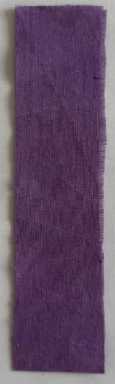
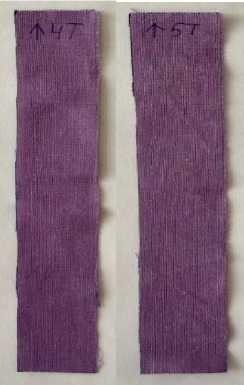
The physical and mechanical properties of textile samples were tested in order to confirm the compliance of the material with the established safety standards and quality indicators. In particular, the stiffness indicators of treated and untreated fabrics were analyzed. The measurement results showed that the stiffness of the untreated sample was 49,3 µN·m, whereas the stiffness of the treated specimen 52,4 µN·m, figure 1. A slight increase in this indicator is due to the formation of a thin surface film associated with the application of UV-protective composition. At the same time, the deviation remains within acceptable values and does not significantly affect the flexibility and comfort of the textile material during operation.
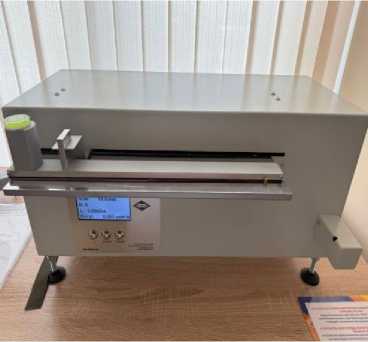
Figure 1. Results of stiffness tests on textile materials: comparison of untreated materials (а) and processed samples (b)
Textile materials were subjected to pilling tests in order to assess their resistance to lint formation during use. According to the test results, it was found that both untreated and treated samples of cotton fabrics demonstrated the maximum – five-point level of resistance to pilling, Figure 2. This index indicates the absence of visually pronounced surface flaking.
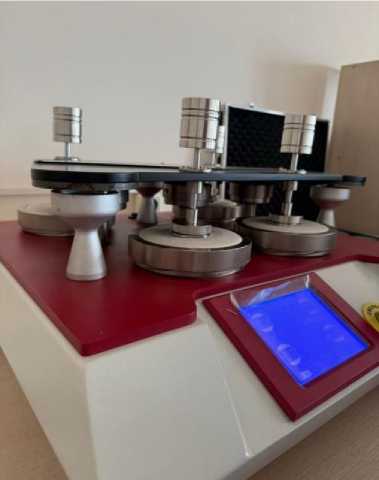
Figure 2. Results of pilling tests on textile materials: comparison of untreated (а) and processed samples (b).
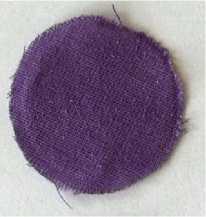
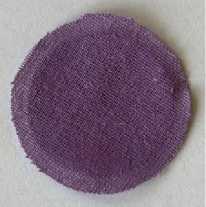
Preservation of high indicators after treatment indicates the absence of negative influence of UV-protective composition on the surface of fibers, as well as an increase in the strength characteristics of the material, which contributes to the extension of the service life of products and preservation of their appearance during operation.
Conclusion
In the course of the conducted research the high efficiency of the developed UV-protective composition based on zinc oxide for the treatment of cotton textile materials was established. The treatment allowed to significantly reduce the level of ultraviolet radiation transmittance. The efficiency of UV protection increased with increasing concentration of the applied composition.
Physical and mechanical tests showed that the coating application does not adversely affect the stiffness of the fabric, remaining within the normal range. In addition, according to the results of pilling tests, the treated samples retained the maximum level of resistance to lint formation, which confirms the preservation of the appearance and wear resistance of the fabric after modification.
Thus, the proposed processing technology provides a comprehensive improvement of the operational characteristics of cotton materials, increasing their protective properties and durability without deterioration of tactile and visual qualities. The obtained results confirm the prospects of the developed composition implementation in modern technologies of textile modification.
Gratitude, conflict of interest (funding)
The work was carried out at the Almaty Technological University. The authors declare that there is no conflict of interest.
