
Enforcement in family relations – the handing over and taking away of a child, with emphasis on the role of the guardianship authority
Journal: Pravo - teorija i praksa @pravni-fakultet
Section: Articles
Article in issue: 3 vol.42, 2025.
Free access
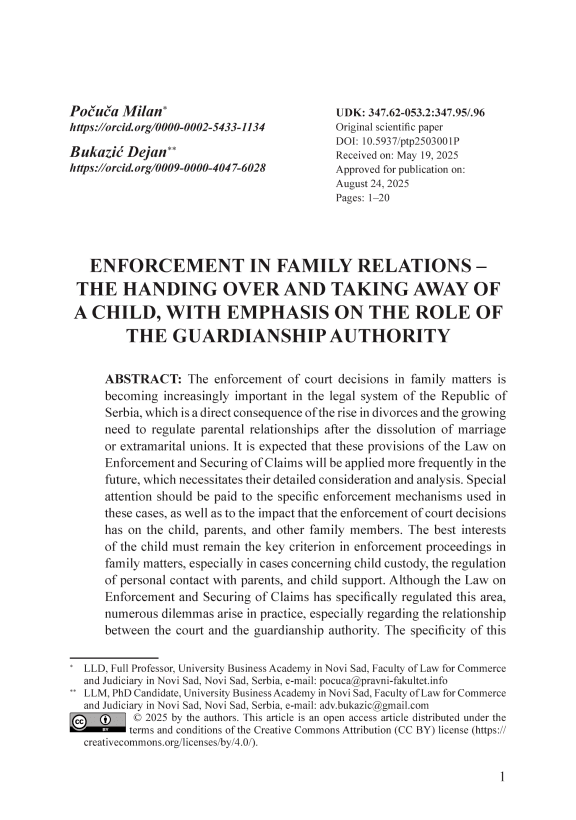
The enforcement of court decisions in family matters is becoming increasingly important in the legal system of the Republic of Serbia, which is a direct consequence of the rise in divorces and the growing need to regulate parental relationships after the dissolution of marriage or extramarital unions. It is expected that these provisions of the Law on Enforcement and Securing of Claims will be applied more frequently in the future, which necessitates their detailed consideration and analysis. Special attention should be paid to the specific enforcement mechanisms used in these cases, as well as to the impact that the enforcement of court decisions has on the child, parents, and other family members. The best interests of the child must remain the key criterion in enforcement proceedings in family matters, especially in cases concerning child custody, the regulation of personal contact with parents, and child support. Although the Law on Enforcement and Securing of Claims has specifically regulated this area, numerous dilemmas arise in practice, especially regarding the relationship between the court and the guardianship authority. The specificity of this procedure lies in the fact that, in certain situations, the court becomes an auxiliary body to the guardianship authority, even though its traditional role is the opposite — to make decisions that administrative bodies implement. This legal solution raises certain practical concerns and requires further consideration. This paper aims to analyze the legal framework for enforcement in family relations through the provisions of Articles 368–381 of the Law on Enforcement and Securing of Claims, with a critical review of the challenges in their application. Through the analysis of judicial practice and a comparison with potential alternative enforcement models, the paper highlights possible directions for improving the system to ensure greater legal certainty, protection of the child’s rights, and efficiency of the enforcement procedure.
Similar articles in the section Family law. Law of inheritance. Heirs. Successors
Short address: https://sciup.org/170211018
IDS: 170211018 | UDC: 347.62-053.2:347.95/.96 | DOI: 10.5937/ptp2503001P
Izvršenje u porodičnim odnosima – predaja i oduzimanje deteta, sa osvrtom na ulogu organa starateljstva
Izvršenje sudskih odluka u porodičnim odnosima postaje sve značajnije u pravnom sistemu Republike Srbije, što je direktna posledica porasta broja razvoda i povećane potrebe za regulisanjem roditeljskih odnosa nakon prestanka bračne ili vanbračne zajednice. Očekuje se da će u budućnosti ove odredbe Zakona o izvršenju i obezbeđenju biti sve češće primenjivane, što nameće potrebu za njihovim detaljnim razmatranjem i analizom. Posebnu pažnju treba posvetiti specifičnim izvršnim mehanizmima koji se koriste u ovim slučajevima, ali i uticaju koji izvršenje sudskih odluka ima na dete, roditelje i druge članove porodice. Najbolji interes deteta mora biti ključni kriterijum prilikom izvršenja u porodičnim odnosima, što se posebno odnosi na postupke koji se tiču poveravanja deteta, određivanja načina održavanja ličnih odnosa sa roditeljima i izdržavanja. Iako je Zakon o izvršenju i obezbeđenju posebno regulisao ovu materiju, u praksi se javljaju brojne dileme, naročito u vezi sa odnosom suda i organa starateljstva. Specifičnost ovog postupka ogleda se u činjenici da sud u određenim situacijama postaje pomoćni organ organu starateljstva, iako je njegova uloga tradicionalno suprotna – da donosi odluke koje organi uprave sprovode. Ovo pravno rešenje u praksi izaziva određene nedoumice i zahteva dalje razmatranje. Ovaj rad ima za cilj da analizira pravni okvir izvršenja u porodičnim odnosima kroz odredbe članova 368–381 Zakona o izvršenju i obezbeđenju, uz kritički osvrt na izazove u njihovoj primeni. Kroz analizu sudske prakse i poređenje sa potencijalnim alternativnim modelima izvršenja, ukazaće se na moguće pravce unapređenja sistema, kako bi se osigurala veća pravna sigurnost, zaštita prava deteta i efikasnost samog postupka.
