
Exploring entrepreneurial intentions among vocational students: the moderating role of perceived behavioural control

Journal: Education Integration @edumag-mrsu
Section: Международный опыт интеграции образования
Article in issue: 2 (123) т.30, 2026.
Free access
Introduction. Entrepreneurial intentions play an important role for vocational school graduates in training new entrepreneurs. Many surveys of entrepreneurial intentions are often associated with the Theory of Planned Behaviour but they are limited to testing perceived behavioural control as a moderator. Therefore, this study aims to examine the antecedents of entrepreneurial intentions in the Theory of Planned Behaviour model and investigate the moderator role of perceived behavioural control in this model. Materials and Methods. A total of 266 vocational school students participated in this study by completing questionnaires based on the Theory of Planned Behaviour and entrepreneurial intention constructs. The data were analysed using Structural Equation Modelling to examine the relationships among variables and to test the proposed research model and hypotheses. The Structural Equation Modelling allows to analyse complex cause and effect relationships simultaneously. Results. The entrepreneurial intentions of vocational school students are influenced by behavioral attitudes, social norms, and perceived control over their actions. Students’ perceptions of an entrepreneurial career play a crucial role in shaping their entrepreneurial aspirations. Developing positive attitudes, providing social support, and strengthening behavioral control should be encouraged through educational activities in schools. An additional finding shows that perceived behavioural control significantly moderates the positive effects of attitude and social norms on entrepreneurial intentions. These findings highlight the importance of integrating psychological and social dimensions in vocational entrepreneurship education by reinforcing students’ attitudes, supportive environments, and behavioural control, while also extending the Theory of Planned Behaviour in vocational contexts. Conclusion. These results provide practical guidance for teachers and curriculum developers to design learning experiences that enhance students’ self-efficacy, experiential engagement, and entrepreneurial confidence, thereby fostering stronger and more sustainable entrepreneurial intentions among vocational learners.
Short address: https://sciup.org/147254466
IDS: 147254466 | UDC: 371.21:33-057.875 | DOI: 10.15507/1991-9468.26302.258-273
Изучение предпринимательских устремлений среди учащихся профессиональных учебных заведений: посредническая роль воспринимаемого поведенческого контроля
Введение. Предпринимательские устремления играют важную роль для выпускников профессиональных училищ в формировании новых бизнес-проектов. Работы по данной теме часто опираются на теорию запланированного поведения, но ограничиваются проверкой воспринимаемого контроля поведения в качестве модератора. Цель исследования – изучить факторы, предшествующие предпринимательским устремлениям в модели теории запланированного поведения; проанализировать модераторскую роль воспринимаемого контроля поведения в этой модели. Материалы и методы. В исследовании приняли участие 266 учащихся профессиональных училищ. Данные получены путем заполнения анкет и проанализированы с использованием моделирования структурных уравнений с целью изучения взаимосвязей между переменными и проверки предложенной исследовательской модели и гипотез. Представленная модель позволяет одновременно анализировать сложные причинно-следственные связи. Результаты исследования. На предпринимательские намерения студентов профессиональных училищ влияют поведенческие установки, социальные нормы и воспринимаемый контроль над действиями. Решающую роль в формировании предпринимательской устремленности играет представление студентов о предпринимательской карьере. Развитие позитивного отношения, обеспечение социальной поддержки и усиление контроля поведения необходимо стимулировать через образовательные мероприятия в школах. Воспринимаемый поведенческий контроль значительно смягчает положительное влияние отношения к поведению и социальных норм на предпринимательские устремления. Подчеркивается важность интеграции психологических и социальных аспектов в профессиональное предпринимательское образование путем укрепления отношения студентов, создания благоприятной среды и контроля поведения, а также расширения теории запланированного поведения в условиях профессиональной подготовки. Заключение. Материалы статьи предоставляют практические рекомендации для преподавателей и разработчиков учебных программ по созданию учебных мероприятий, повышающих самоэффективность студентов, их вовлеченность в практический опыт и уверенность в предпринимательстве, способствуя тем самым формированию более сильных и устойчивых предпринимательских устремлений среди учащихся профессиональных учебных заведений.
Text of the scientific article Exploring entrepreneurial intentions among vocational students: the moderating role of perceived behavioural control
ISSN 1991-9468 (Print),
EDN:
In recent years, studies on entrepreneurship have been in the spotlight of many Scholars [1–3]. Entrepreneurship is considered a creative and innovative process which is an important indicator of a country’s economic growth and development because it creates more job opportunities [4]. Increasingly, the economic growth strategies of many countries have focused on developing innovation through the creation of new businesses [5]. Currently, in many countries, entrepreneurship is seen as an important factor for economic expansion [6; 7]. In fact, many countries have developed entrepreneurship programs for young people, to combat youth unemployment caused by various factors including slow economic growth, by increasing job opportunities for the young generation.
Technology is an essential factor in the development of new entrepreneurs. For example, start-up programs are now in the spotlight to create new businesses. The term “start-up” refers to establishing an innovative process or system that produces and sells products or services in a business context. This entrepreneurship program is suitable to be developed in vocational education, because vocational education is focussed on the basic skills necessary to carry out business processes [8-10]. Many studies emphasize the critical role of entrepreneurship programs in vocational education [10–12].
The development of entrepreneurship programs in vocational education, particularly at vocational high school level, is regarded as a potential strategy to address the high unemployment rates among vocational high school graduates. In Indonesia, vocational school graduates constitute the largest share of the unemployed among population with education attainment1. Strengthening various entrepreneurship programs is expected to encourage vocational school graduates to create new jobs through vocational skills acquired at school. Previous studies revealed that entrepreneurial intentions play an important role in creating new entrepreneurs [1; 13; 14]. In Indonesia, vocational high school education is designed to prepare students for work and entrepreneurship. Thus, it is very important to understand how the entrepreneurial intentions of vocational school students are formed.
Many surveys have discussed entrepreneurial intentions of vocational school students [11; 12; 15]. However, studies discussing the entrepreneurial intentions of vocational school students using the theory of planned behaviour (TPB) approach are still limited, especially models that involve the moderating role of perceived behavioural control. The use of TPB has been recognized as the most appropriate theory to explain how intentions are formed, especially related to entrepreneurial intentions [14; 16]. TPB is one of the most popular ideas that researchers use to predict what people will do2. This theory emphasizes that a person’s plans to carry out certain behaviours can be predicted by “attitude toward the behaviour”, “subjective norms”, and “perceived behavioural control”.
Although interest in examining perceived behavioural control within TPB research has increased, prior studies have conceptualized perceived behavioural control as a direct predictor or mediating variable rather than as a moderator shaping the strength of other TPB antecedents [18; 20; 21]. Existing moderation studies in entrepreneurship – for instance, examined the interaction between passion and intention or between educational support and intention [18; 20; 21], – have been conducted largely in higher education contexts but examined rarely whether PBC simultaneously moderates multiple TPB pathways. Moreover, there is still no empirical evidence demonstrating whether perceived behavioural control alters the effects of attitude toward behaviour and social norms within vocational education settings, where learning is highly practice-oriented and employment expectations differ substantially from those of university students [8–10]. This absence of contextualized moderation evidence indicates the need to refine how TPB is applied by positioning perceived behavioural control not only as a predictor but also as a moderator which affects intention formation in vocational education contexts.
The role of perceived behavioural control as a moderator variable has not been widely discussed in previous studies. This study aims to examine the impact of PBC towards the relationship between the independent and dependent variables on TPB. Furthermore, this study is designed to investigate the antecedents of entrepreneurial intentions. It examines the moderating role of perceived behavioural control in the relationships between attitude toward the behaviour, social norms, and the entrepreneurial intentions among vocational school students.
Thus, the hypothesis of this study is defined as follows (Fig. 1):
Н1. Attitude toward the behaviour has a significantly positive influence on the entrepreneurial intentions of vocational school students
Н2. Social norms have a significant positive effect on the entrepreneurial intentions of vocational school students
Н3. Perceived behavioural control has a significantly positive effect on the entrepreneurial intentions of vocational school students
Н4. Perceived behavioural control significantly moderates the effect of attitude toward the behaviour on the entrepreneurial intentions of vocational school students
Н5. Perceived behavioural control significantly moderates the effect of social norms on the entrepreneurial intentions of vocational school students.
Literature Review
Entrepreneurial Intention of Vocational School Students. Previous studies have highlighted intention as a strong predictor factor for predicting certain behaviours [22]. In the context of this study, intention has an important position that influences individual behaviour to become entrepreneurs. Entrepreneurial intention is the first step in the entrepreneurial process and is seen as the basis for actions such as planning and implementing new business ideas that originate from a conscious state of mind [23]. V. Souitaris et al. stated that entrepreneurial intention is a state of mind that makes a person focus and take steps toward entrepreneurship [24]. Entrepreneurial intention is the first step in the business process, it is seen as one of the indicators of what people will do in the end. Entrepreneurial intention may refer to intentions to start a new business or to acquire and expand an existing business. However, this study focuses on the intention to start a new business [25].
The determination of a person to act in a certain way is called as intention4. Intentions capture the factors influencing behaviour. Intentions show how strongly individuals are motivated to do certain behaviour and how they plan to do it. Entrepreneurial intention is the desire to start a business or work for yourself. The dream of becoming an entrepreneur also includes having personal interests that can lead to starting a business. Entrepreneurial intention is one of the most essential factors in how a business starts, grows, and changes over time [26]. The desire to start a business is crucial in becoming an entrepreneur [27].
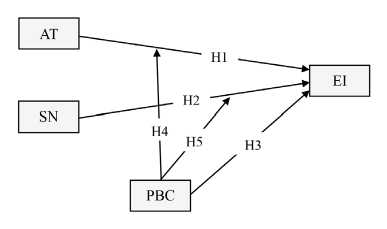
F i g. 1. Hypothetical Model
Notes : Hereinafter in figures: AT – attitude toward the behaviour; SN – social norms; PBC – perceived behavioural control; EI – entrepreneurial intentions.
Source : Figures 1 and 5 a, b compiled by the authors.
Without an entrepreneurial intention, new entrepreneurs will not emerge.
Entrepreneurial intention is widely recognised as a precursor to entrepreneurial behaviour. However, previous studies have stated that the strength and development of entrepreneurial intention may differ across contexts, learner characteristics, and environmental influences. For instance, studies in higher education populations often report relatively strong entrepreneurial intention driven by personal aspiration and career autonomy [26], yet research involving vocational students shows more varied patterns, with intention sometimes constrained by limited confidence, resource access, or perceived risk [8–10]. Considering the fact, entrepreneurial intention is not merely a universal cognitive state but rather shaped through interaction between individual motivation and contextual realities. In the vocational education context - where students possess practical competencies yet face uncertain labour-market absorption – the formation of entrepreneurial intention becomes particularly nuanced. Thus, synthesizing existing evidence underscores the need to examine not only whether vocational students exhibit entrepreneurial intention, but also how psychological and contextual determinants contribute to its formation within specific educational and cultural environments.
Theory Planned of Behaviour (TPB). The theory of the planned behaviour model by I. Ajzen is the most commonly used model to study entrepreneurial intentions. According to TPB5, planned behaviour is intentional and thus predictable by attitudes and perceived behavioural control. TPB is a cognitive model which suggest that people’s actions can predict outcomes because they have reasons, plans, and control over them6. I. Ajzen said that attitude towards behaviour, social norms, and perceived behavioural control affects intentions and behaviour. In TPB, attitude towards behaviour refers to a function of individuals’ behavioural beliefs and their evaluation of their behaviour, ranging from positive to negative. Attitudes toward behaviour reflect individuals’ evaluations of their behaviour which are processed by their beliefs about its expected impact [28]. A person will have a favourable opinion of a particular behaviour if they believe it will produce more or less favourable results.
Social norms refer to pressure from other people who are referred, such as family, friends, cousins, co-workers, and others, to perform or not perform certain behaviours. Social norms capture individuals’ perceptions of social pressure from significant others (family, friends, teachers) regarding a certain behaviour. It is the belief that people important to someone want them to do or not do something [29]. Social norms also refer to individuals’ intentions or views about how many people in particular community care that they should or should not engage in certain behaviour [30].
To conclude, perceived behavioural control means how strongly someone thinks to do something7. Perceived behavioural control deals with individuals’ skill, resources, and other essential things to perform certain activity. This study suggests that, the more someone can control how they act to become an entrepreneur, the better they can act as an entrepreneur [29]. Many real-world studies on TPB related to entrepreneurial intentions have shown that TPB can measure individuals’ intention and action when starting a new business [1; 4; 31].
TPB has been widely applied to explain entrepreneurial intention. However, research findings have shown that the relative influence of its three components is not always consistent across populations, cultural settings, and educational pathways. For example, some studies identify attitude toward behaviour as the strongest predictor of entrepreneurial intention, particularly in contexts where entrepreneurship is seen as desirable or prestigious [1; 4; 31]. In contrast, research conducted in collectivist societies or among younger learners suggests that social norms may exert a stronger influence due to familial expectations and peer approval [16; 19; 20]. Meanwhile, perceived behavioural control has been shown to play a dual role, functioning both as a direct predictor of intention and as a boundary condition shaping how individuals translate attitudes and social cues into action8 [18; 19; 21]. These variations indicate that TPB relationships may be dependent on contextual dynamics rather than universal or fixed. Therefore, examining how TPB components operate within vocational education – where students navigate practical skill development, employment uncertainty, and emerging entrepreneurial identity – offers an opportunity to deepen theoretical understanding and assess whether the model behaves differently in this specific learning environment.
The Moderating Role of Perceived Behavioural Control. Perceived behavioural control is a person’s perception of how difficult or simple it is to engage in entrepreneurial activities [32]. During the early stages of company formation, individuals must face adverse and challenging situations; an individual with a high PBC finds it easier to manage such situations, resulting in a higher entrepreneurial intention [33]. The individual’s belief in feeling capable of carrying out activities as an entrepreneur drives the strength of their intention to start a new business. Previous studies have placed perceived behavioural control as a control variable that can strengthen individual intentions [18; 20; 21]. In the context of this study, we suspect that increasing student behaviour control will lead to an increased positive influence on the relationship between student attitudes and entrepreneurial intentions. On the other hand, it is also possible to increase behavioural control to strengthen vocational school students’ social relations, norms, and entrepreneurial intentions.
While prior studies have acknowledged the importance of perceived behavioural control in shaping entrepreneurial intention, they differ in how this construct functions within the TPB framework. Some evidence conceptualizes perceived behavioural control primarily as a direct antecedent of intention, reflecting beliefs about capability and perceived feasibility [1–3], whereas other studies indicate that PBC may operate as a boundary condition that amplifies or reduces the effect of attitudinal or social predictors depending on individuals’ confidence and contextual experiences [18; 20; 21]. These mixed findings suggest that the role of perceived behavioural control may not be static but conditional, varying across developmental stages, educational settings, and cultural environments. In vocational education, the moderating influence of perceived behavioural control may be especially relevant, as students with higher confidence may be more likely to translate positive attitudes or supportive social expectations into stronger entrepreneurial intentions. Thus, investigating perceived behavioural control as a moderator within this context is essential to clarify whether it merely predicts intention or actively shapes how intention is formed among vocational learners.
Based on the literature review and prior studies, it can be concluded that vocational school students’ entrepreneurial intentions are shaped by their attitudes toward behaviour and social norms, while perceived behavioural control is expected to strengthen these relationships. However, whether perceived behavioural control amplifies or weakens the link between the independent variables and entrepreneurial intention within the TPB framework remains unclear, forming the core research gap of this study. Accordingly, this study aims to examine the antecedents of entrepreneurial intentions and to analyse the moderating role of perceived behavioural control in influencing the relationship between attitude toward behaviour, social norms, and the entrepreneurial intentions of vocational school students.
Materials and Methods
Participants. The data collection for this study used an online survey involving students from five civil engineering public vocational high schools in Solo, Indonesia. A total of 266 students from five public vocational high schools in Solo, Indonesia, participated in this study. All respondents were informed of the purpose of the study and expressed their willingness (consent) to cooperate. Data were collected online between February and April 2025, with classroom teachers facilitating the survey distribution. The sample consisted of 26.7% male and 73.3% female, representing first-, second-, and third-year student cohorts. A detailed demographic breakdown is presented in Table 1.
|
T a b l e |
1. Background of participants |
||
|
Attribute |
Categories |
n |
% |
|
School |
A |
41 |
15.4 |
|
B |
61 |
23.0 |
|
|
C |
57 |
21.4 |
|
|
D |
49 |
18.4 |
|
|
E |
58 |
21.8 |
|
|
Gender |
Male |
71 |
26.7 |
|
Female |
195 |
73.3 |
|
|
Degree |
1st grade |
87 |
32.7 |
|
2nd grade |
88 |
33.1 |
|
|
3th grade |
91 |
34.2 |
|
Notes : A – Bhinneka Karya Vocational High School of Surakarta; B – State Vocational High School 5 of Surakarta; C - State Vocational High School 2 of Surakarta; D – State Vocational High School 2 of Sukoharjo; E – State Vocational High School 5 of Sukoharjo. Source : Hereinafter in this article all tables were drawn up by the authors.
Measures and Procedures. A previous questionnaire measured vocational school students’ attitudes toward behaviour, social norms, perceived behavioural control, and entrepreneurial intentions [19]. A total of 14 items in this questionnaire consist of five attitudes toward the behaviour items (for example, being an entrepreneur implies more advantages than disadvantages to me), three social norms items (for example, your close family), six perceived behavioural control items (for example, to start a firm and keep it working would be easy for me), and six points of entrepreneurial intention (for example, I am ready to do anything to be an entrepreneur). The measurement scale for attitude toward the behaviour and perceived behavioural control, and entrepreneurial intentions uses five Likert scales to indicate how much they agree, ranging from strongly disagree (1) to strongly agree (5). Meanwhile, the measurement scale for social norms uses a five Likert scale to show how close they are to their social environment, ranging from very distant (1) to very close (5).
Analysis. In this study, structural equation modelling (SEM) was used to test the hypotheses of the study. In applying SEM analysis, the researcher used Amos 18 software. SEM analysis on Amos 18 evaluated two aspects; measurement model and structural model. The measurement model for this study was tested using confirmatory factor analysis (CFA) with a significance value above 0.059. Moreover, the hypothesis of the study was examined using path analysis in the SEM model. The hypothesis was considered accepted if the significance value is below 0.0510. Prior to testing, we tested the fit model using the following criteria: Cmin/df = ≤ 5, the Goodness of Fit Index (GFI) GFI = ≥ 0.90, Comparative Fit Index (CFI) = CFI ≥ 0.90, Root Mean Square Error of Approximation (RMSEA) = = RMSEA ≤ 0.08. For moderation analysis, all continuous variables were mean-centred to reduce multicollinearity before computing the product term between perceived behavioural control and the independent variables11. The dataset was checked for missing responses, and as none exceeded the 5% threshold, full information maximum likelihood (FIML) estimation was applied. To assess potential common method bias, Harman’s single-factor test was conducted; the first factor accounted for less than 50% of the total variance, indicating that common method bias was not a threat to the validity of the results.
Results
Questionnaire Validity. In examining the validity of the questionnaire items, the researcher applied confirmatory factor analysis (CFA). The item validity results based on the factor loading criteria are shown in Figure 2. The results of the model analysis evaluation in Figure 2 show the acquisition of a fit model (Cmin/df = 2.834, GFI = 0.836, CFI = 0.921, and RMSEA = 0.073). The acquisition of factor loading values for each item of attitude toward the behaviour variable, social norms, perceived behavioural control, and entrepreneurial intentions of vocational students is shown in Table 2.
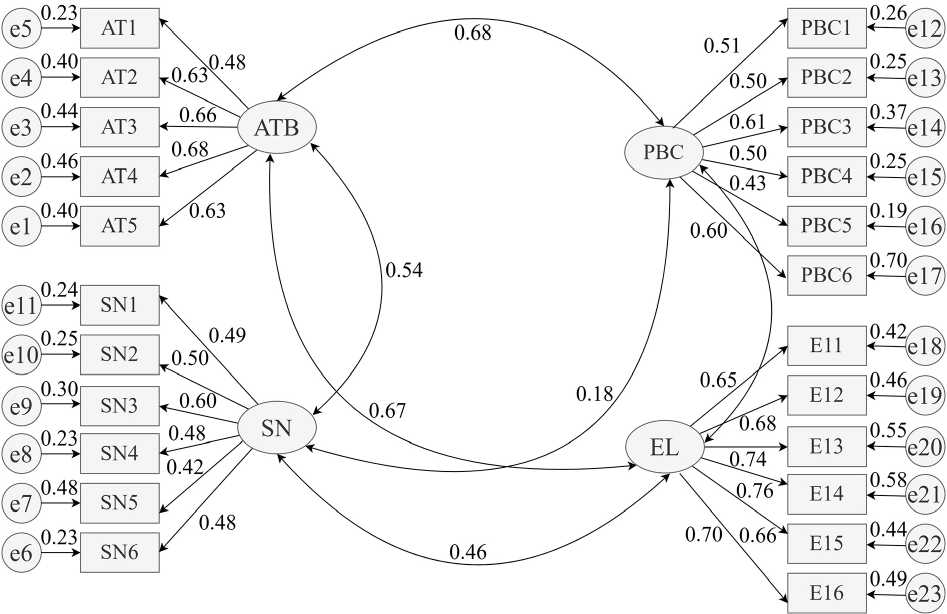
F i g. 2. Measurement model for each variable
Source : Hereinafter in this article all figures compiled by the authors in Amos software.
|
T a b l e 2. Factor loading measurement model |
|||||
|
Variable |
Items |
Estimate |
S.E. |
C.R. |
P |
|
Attitude toward the behaviour |
AT1 |
0.479 |
– |
– |
|
|
AT2 |
0.633 |
0.133 |
6.584 |
*** |
|
|
AT3 |
0.661 |
0.112 |
6.543 |
*** |
|
|
AT4 |
0.680 |
0.177 |
6.761 |
*** |
|
|
AT5 |
0.630 |
0.189 |
6.533 |
*** |
|
|
Social norms |
SN1 |
0.487 |
– |
– |
– |
|
SN2 |
0.500 |
0.151 |
5.433 |
*** |
|
|
SN3 |
0.601 |
0.194 |
5.337 |
*** |
|
|
SN4 |
0.479 |
0.178 |
5.035 |
*** |
|
|
SN5 |
0.420 |
0.145 |
4.539 |
*** |
|
|
SN6 |
0.478 |
0.180 |
5.088 |
*** |
|
|
Perceived behavioural control |
PBC1 |
0.508 |
– |
– |
– |
|
PBC2 |
0.499 |
0.123 |
5.693 |
*** |
|
|
PBC3 |
0.608 |
0.175 |
6.114 |
*** |
|
|
PBC4 |
0.496 |
0.193 |
5.520 |
*** |
|
|
PBC5 |
0.433 |
0.150 |
5.218 |
*** |
|
|
PBC6 |
0.604 |
0.150 |
6.545 |
*** |
|
|
Entrepreneurial intention |
EI1 |
0.647 |
– |
– |
– |
|
EI2 |
0.682 |
0.111 |
9.470 |
*** |
|
|
EI3 |
0.738 |
0.090 |
10.035 |
*** |
|
|
EI4 |
0.762 |
0.091 |
10.076 |
*** |
|
|
EI5 |
0.661 |
0.118 |
9.096 |
*** |
|
|
EI6 |
0.700 |
0.098 |
9.533 |
*** |
|
Notes : Hereinafter in tables: AT1–AT5 – items of attitude toward the behaviour; SN1–SN6 – items of social norms; PBC1–PBC6 – items of perceived behavioural control; EI1–EI6 – items of entrepreneurial intentions12; S.E.- Standard Error; C.R.- Critical Ratio; *** - p-value < 0.05.
In Table 2 it is concluded that all items have fulfilled the significance and mean that each item of the questionnaire in this study was declared valid.
Hypothesis Test. The first step is to test the hypothesis by running the SEM model to test the direct effect of the independent variables on the dependent variable. The direct influence test in this study included the influence of attitude toward the behaviour, social norms, and perceived behavioural control on the entrepreneurial intentions of vocational students. The model fit test obtained the fit model criteria as shown in Figure 3 (Cmin/ df = 3.528, GFI = 0.901, CFI = 0.929, and RMSEA = 0.063).
Table 3 shows the results of the hypothesis testing for each path. Testing the first hypothesis regarding the influence of attitudes towards behaviour on entrepreneurial intentions of vocational school students showed a p-value < 0.05. These findings led to the conclusion that attitude toward the behaviour has a significantly positive effect on the entrepreneurial intentions of vocational school students (the first hypothesis is accepted). Furthermore, this study also revealed that social norms proved to have a significantly positive effect on the entrepreneurial intention of vocational school students (second hypothesis accepted). Another finding of this study is that perceived behavioural control is proven to directly influence the entrepreneurial intentions of vocational school students. This is proven by obtaining a p-value below 0.05, which serve as evidence concluding that the third hypothesis is accepted.
T a b l e 3. Path analysis for each variable
|
Path Analysis |
Estimate |
S.E. |
C.R. |
P |
|
AT – EI |
0.486 |
0.072 |
10.042 |
*** |
|
SN – EI |
0.174 |
0.126 |
3.684 |
*** |
|
PBC – EI |
0.158 |
0.048 |
3.504 |
*** |
Furthermore, the researchers examined the moderating role of perceived behavioural control in the effect of attitude toward the behaviour and social norms on the entrepreneurial intentions of vocational school students, to test the fourth and fifth hypothesis. At the first stage, the results of perceived behavioural control as a moderator of the relationship between attitude toward the behaviour and entrepreneurial intentions among vocational school students are presented in Figure 4a. Figure 4a shows that the interaction of the variable attitude toward the behaviour and perceived behavioural control has been proven to significantly moderate the effect of the attitude toward the behaviour on the entrepreneurial intentions of vocational school students (estimate = 0.15, S.E. = 0.44, C.R. = 3.320, p-value = ***). Thus, the fourth hypothesis is accepted.
In addition, the moderation test is used to determine the significance of the interaction of social norms and perceived behavioural control on the entrepreneurial intentions of vocational school students. Figure 4b shows a moderation test model for perceived behavioural control of the social norms on the entrepreneurial intentions impact on vocational school students. The results show that perceived behavioural control significantly moderates the effect of social norms on entrepreneurial intentions of vocational school students (estimate = 0.14, S.E. = 0.48, C.R. = 3.470, p-value = *** ), which means that the fifth hypothesis is accepted.
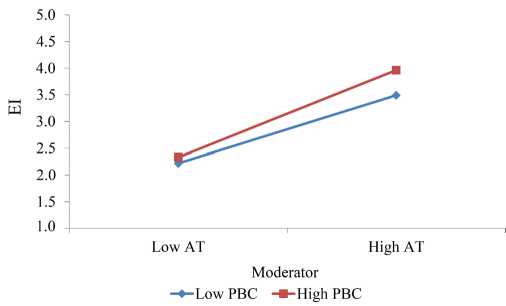
Furthermore, the visualization of the moderating role of perceived behavioural control on the effect of attitude toward the behaviour on the entrepreneurial intentions of vocational school students is plotted in two-way interaction effects (Fig. 5a). Figure 5a shows that the effect of attitude toward the behaviour on the entrepreneurial intention of vocational students is more significant in students with high perceived behavioural control than in those with low perceived behavioural control.
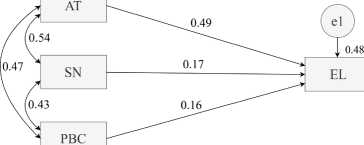
F i g. 3. Structural Equation Modelling (SEM) analysis
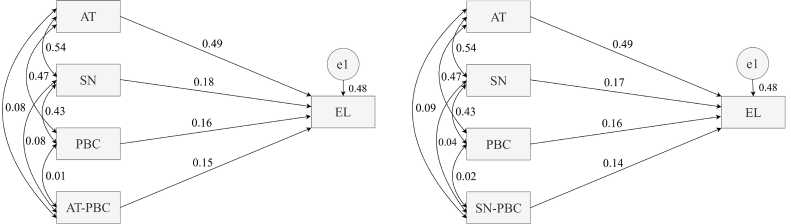
a)
b)
F i g. 4. Analysis of the role of moderation:
a) moderation of perceived behavioural control on the effect of attitude toward entrepreneurial intentions;
b) moderation of perceived behavioural control on the effects of social norms on entrepreneurial intentions.
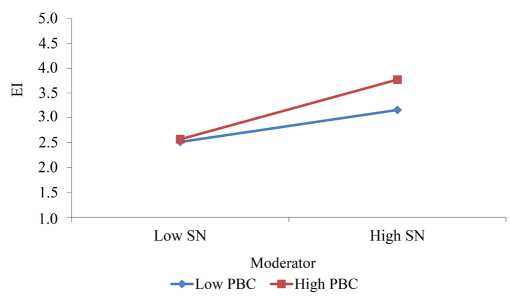
In addition, the role of moderation in the form of plots of two-way interaction effects is also shown in Figure 5b. Figure 5b shows the moderating role of perceived behavioural control on the effects of social norms on vocational students’ entrepreneurial intentions. Figure 4a shows that the influence of social norms on the entrepreneurial intention of vocational students is more significant in students with high perceived behavioural control than in those with low perceived behavioural control. Moreover, the moderating role of perceived behavioural control in this study has proven significant.
The results of the hypothesis testing indicate that all hypotheses in this study are accepted, meaning that each relationship between the proposed variables is proven to be significant and in the expected direction. This finding indicates that the independent variables, including attitude toward, social norms, and perceived behavioural control, have a significant influence on vocational students’ entrepreneurial intentions, both directly and through the tested moderating role.
Discussion
The significant moderating role of perceived behavioural control suggests that students with higher levels of self‐confidence and perceived capability are more likely to convert favourable attitudes and social norms into stronger entrepreneurial intentions. This finding aligns with the view that intention formation is not solely based on cognitive evaluation or social influence, but also depends on whether individuals perceive themselves as capable of converting motivation into action13 [18; 20; 21]. When perceived behavioural control is high, positive attitudes toward entrepreneurship become more meaningful, because the students are not only valuing entrepreneurship, but also believing that they can execute entrepreneurial activities. Similarly, social encouragement appears to influence intention more strongly among students who feel competent, as external support may function as validation of their perceived readiness. This reveals that perceived behavioural control moderates’ motivation to intention, as an answer to why intention may vary even among students who hold similar values or receive similar support.
Entrepreneurial intention plays a vital role in creating new entrepreneurs. Previous studies have shown that having the intention to become an entrepreneur during school is an essential first step, but keeping that intention alive after graduation (entrepreneurial goal intention) is just as important. Many studies have highlighted the importance of studying entrepreneurial intentions. This study investigated the antecedents of entrepreneurial intentions and the moderating role of perceived behavioural control on the effect of attitude toward the behaviour and social norms on vocational students’ entrepreneurial intentions.
The results of this study expand the TPB theory, elaborated perceived behavioural control as a boundary condition of both the influence of attitude toward the behaviour and social norms on vocational students’ entrepreneurial intentions. The TPB model states that a person’s intention is influenced by three TPB antecedent factors: attitude toward the behaviour, social norms, and perceived behavioural control. This study implemented TPB model to test the three TPB antecedent factors on vocational students’ entrepreneurial intentions. The first finding, attitude toward the behaviour, was proven to give a significant influence on vocational students’ entrepreneurial intentions. The effect on this relationship is positive, meaning that the more positive the attitude of students regarding the entrepreneurial profession, the stronger the intention to become entrepreneurs, and this finding is relevant to previous studies [1; 34; 35]. The attitude aspect plays an essential role in shaping students’ entrepreneurial intentions. Students’ attitudes toward becoming entrepreneurs depend on expectations regarding the outcomes of these behaviours.
For example, students with a positive attitude toward entrepreneurial behaviour will generate a positive motivational intention to become an entrepreneur.
Further findings show that social norms influence vocational students’ entrepreneurial intentions, sharing consistent results with the previous studies [1; 16; 36]. On the other hand, the findings of this study show a different result from the study conducted by T.K. Dao et al. [37]. The proximity of students with family, friends, and colleagues is more beneficial for students to start a new business. If students have positive support from the surrounding environment, their intention to become entrepreneurs will increase. Support and encouragement from people close to us, such as family members and friends, will improve EI. Family and friends can influence an entrepreneur’s business decisions. The support and closeness of student relationships with family, friends,
a)
b)
F i g. 5. Plots of two-way interaction effects:
а) moderation of perceived behavioural control on the relationship between attitude towards and entrepreneurial intention;
b) moderation of perceived behavioural control on the relationship between social norms and entrepreneurial intention
and colleagues will be able to determine student business decisions to become entrepreneurs. Social support or social capital will be essential for students to start a business [8].
In addition, perceived behavioural control has been tested significantly influential for vocational students’ entrepreneurship intentions. The higher the students’ belief in their ability to start a new business, the higher their intention to start a new business. This finding reinforces previous studies [1; 34; 38]. Beliefs about the ability, convenience, feasibility, mastery, and chances of success in starting a new business are psychological aspects to control individual decisions to start entrepreneurial activities. This means that when students believe they can control variables beyond their control, they will quickly develop entrepreneurial intentions. In other words, students’ intentions will increase if students have a high capacity to control their behaviour to become an entrepreneur.
This study also revealed that perceived behavioural control moderates the effect of attitude toward the behaviour and social norms on vocational students’ entrepreneurial intentions. The implementation of perceived behavioural control as a boundary condition variable in the TPB model refers to previous studies [20; 39]. Students’ self-confidence regarding their ability to start a business will increase the influence of attitudes and social aspects on the formation of vocational students’ entrepreneurial intentions. In the context of this study, learning process in schools should be able to facilitate the promotion of strengthening attitudes, social aspects, and students’ beliefs or self-efficacy to build students’ entrepreneurial intentions. The hope is that vocational high school graduates will be able to fill job opportunities provided by industry and create new job opportunities through new businesses on students’ areas of expertise.
Taken together, the findings of this study make several important contributions. At the theoretical level, the study refines the application of the Theory of Planned Behaviour by empirically demonstrating that perceived behavioural control operates not only as a direct antecedent of entrepreneurial intention, but also as a moderating role that conditions the strength of the relationships between attitude toward the behaviour, social norms, and entrepreneurial intention. While previous studies have acknowledged the central role of perceived behavioural control within TPB, the moderating effect identified in this study provides new insight into how confidence and perceived capability shape intention, particularly in settings where entrepreneurship is not the default post‐school pathway [18; 20; 21]. At the empirical level, this research extends TPB-based entrepreneurial intention studies into the vocational education context in Indonesia, a group that remains understudied despite its strategic relevance to national workforce development and persistent unemployment challenges among vocational graduates14. Finally, at the practical level, the findings underscore that entrepreneurship education in vocational schools will be more effective when instructional practices explicitly strengthen students’ self-belief, supportive social environments, and favourable attitudes toward entrepreneurship, rather than focusing solely on technical and business skills.
Conclusion
This study shows that attitudes and social norms influence students’ entrepreneurial intentions, with perceived behavioural control strengthening this relationship. In the context of vocational high schools, these findings are important because they can be used by schools and teachers to design more practical entrepreneurship learning and increase student confidence through direct experience. Furthermore, the government and industry can leverage these findings to develop programs and partnerships that encourage the production of vocational high school graduates who are ready to become entrepreneurs.
Attitudes toward behaviour, social norms, and perceived behavioural control strongly influence vocational high school students’ entrepreneurial intentions. The most considerable influence of the antecedent factor of entrepreneurial intention is students’ attitudes regarding entrepreneurial careers. Strengthening attitudes, social support, and behaviour control need to be promoted through the learning process in school. Another study finding revealed that perceived behavioural control significantly moderates the effect of attitude toward the behaviour on entrepreneurial intentions. In addition, the moderating role of perceived behavioural control is also significant in the relationship between social norms and vocational students’ entrepreneurial intentions.
The results of this study provide important implications for teachers to instil attitudes, social support, and behaviour control in school entrepreneurship learning activities. Developing entrepreneurship learning to increase students’ entrepreneurial intentions strongly supports the Indonesian government’s program. Reducing the number of unemployed can be solved by creating more job opportunities through new businesses created by vocational high school graduates.
Beyond confirming that the Theory of Planned Behaviour explains entrepreneurial intention among vocational students, the findings of this study offer broader implications for policy and educational practice. The moderating role of perceived behavioural control suggests that entrepreneurship education should not only focus on business knowledge but also purposefully strengthen students’ confidence, self-efficacy, and perceived behavioural control of entrepreneurship. Learning strategies such as mentoring, experiential projects, simulations, and exposure to entrepreneurial role models may be essential in shaping intention. At the policy level, the results emphasise the importance of structured school – industry collaboration and clearer entrepreneurial pathways within vocational curricula to position entrepreneurship as a viable career option rather than a fallback choice. Future research could examine how entrepreneurial intention evolves over time and explore additional psychological or contextual moderators. Expanding investigations to other vocational domains or regions would help build a more comprehensive understanding of intention formation and transition to entrepreneurial action.
