Investigation of the effect of plant antioxidants on the color characteristics of cooked sausage using low-value by-products
Journal: Bulletin of Almaty Technological University @vestnik-atu
Section: Технология пищевой и перерабатывающей промышленности
Article in issue: 4 (150), 2025.
Free access
The study focuses on controlling the color formation and color stability of cooked sausages by deliberately varying two functional ingredients: collagen hydrolysate from low-value by-products and cranberry powder. The aim was to quantitatively describe the dose-response effects of these factors on the integral color stability and to propose a technologically feasible optimal range. The methodology included the preparation of five experimental samples (control; 10% hydrolysate; and 10% hydrolysate with 1, 2, and 3% cranberry), instrumental color evaluation in the CIE Lab* system before and after 60 minutes of exposure and calculation of the percentage of stability based on normalized changes in L*, a*, b*. Based on these experimental points, a full-square regression model RSM was evaluated, after which theoretical values were calculated on a regular grid of factors (hydrolysate 0–15%, cranberry powder 0–3%) for surface visualization and optimization. The experimental data showed that the best color stability indicator was demonstrated by the sample with 10% hydrolysate and 3% cranberry powder – 90,24%. Approximation by the RSM (R²=0,995; R²_adj=0,991) revealed a dominant positive linear contribution of cranberry powder, a stable negative linear contribution of hydrolysate, and negative quadraticity for cranberries (saturation of the effect); the interaction of factors is statistically insignificant. Practical significance – recommendation to minimize the proportion of hydrolysate to about 5-10% and dose cranberries at 2-3% to achieve a stability plateau with low sensitivity to dosing errors.
Similar articles in the section Communication and transport industries. Accountancy. Business management. Public relations
Short address: https://sciup.org/140313226
IDS: 140313226 | UDC: 65.59.31 | DOI: 10.48184/2304-568X-2025-4-130-138
Исследование влияния растительного антиоксиданта на цветовые характеристики вареной колбасы с использованием малоценных субпродуктов
Исследование посвящено управлению цветообразованием и устойчивостью цвета варёных колбас путём варьирования количества двух функциональных ингредиентов: коллагенового гидролизата из малоценных субпродуктов и порошка клюквы. Целью было количественно описать дозо-ответные эффекты указанных факторов на интегральную устойчивость цвета и предложить технологически реализуемую область оптимума. Методология включала изготовление 5 опытных образцов (контроль, колбаса с 10% гидролизата, колбасы с 10% гидролизата и с 1, 2, 3% порошка клюквы), инструментальную оценку цвета в системе CIE Lab* до и после 60-минутной экспозиции лампой накаливания и расчёт процента устойчивости по нормированным изменениям L*, a*, b*. По этим экспериментальным точкам была оценена полно-квадратичная регрессионная модель RSM, после чего на её основе вычисляли теоретические значения на регулярной решётке факторов (гидролизат 0–15%, клюква 0–3%) для визуализации поверхности отклика и оптимизации. Экспериментальные данные показали, что наилучший показатель стабильности цвета показал образец с 10% гидролизата и 3% порошка клюквы – 90,24%. Аппроксимация поверхностью отклика (R²=0,995; R²_adj=0,991) выявила доминирующий положительный линейный вклад порошка клюквы, устойчиво отрицательный линейный вклад гидролизата и отрицательную квадратичность для клюквы (насыщение эффекта); взаимодействие факторов статистически несущественно. Практическая значимость исследования — рекомендация минимизировать долю гидролизата около 5-10% и дозировать клюкву на уровне 2-3% для достижения плато устойчивости цвета при низкой чувствительности к погрешностям дозирования.
Төмен құнды субөнімдер қолданылған пісірілген шұжықтың түстік көрсеткіштеріне өсімдік текті антиоксиданттың әсерін зерттеу
Зерттеу пісірілген шұжықтардың түс түзілуі мен түс тұрақтылығын екі функционалдық қоспаны (аз құнды субөнімдерден алынған коллаген гидролизатын және мүкжидек ұнтағын) вариациялау арқылы басқаруға бағытталды. Зерттеу мақсаты – интегралдық түстік тұрақтылыққа осы факторлардың мөлшер–жауап әсерін сандық сипаттау және технологиялық тұрғыдан оңтайлы аралықты ұсыну. Зерттеу барысында 5 тәжірибелік үлгі дайындалып (бақылау; 10% гидролизат; және 10% гидролизат + 1, 2, 3% мүкжидек ұнтағы), үлгілер CIE Lab* жүйесінде түс аспаптық бағаланды (экспозицияға дейін және қыздыру шамымен 60 минуттан кейін) және L*, a*, b* нормаланған өзгерістері бойынша түс тұрақтылық пайызы есептелді. Осы эксперименттік нүктелерге сүйене отырып, жауап беті әдісі (RSM) бойынша толық квадратикалық регрессиялық модель бағаланды және модельдік визуализация мен оңтайландыру үшін факторлардың торында (гидролизат 0–15%, мүкжидек 0–3%) теориялық мәндер есептелді. Эксперименттік мәндер бойынша ең жоғары түс тұрақтылығы 10% гидролизат + 3% мүкжидек ұнтағында тіркелді — 90,24%. RSM аппроксимациясы (R² = 0,995; R²_adj = 0,991) мүкжидек ұнтағының басым оң линиялық әсерін, гидролизаттың тұрақты теріс линиялық әсерін және мүкжидек бойынша теріс квадратикалық мүшені (әсердің қанығуы) көрсетті; факторлардың өзара әсері статистикалық тұрғыдан мәнді емес. Практикалық маңызы – түстік тұрақтылық платосына аз дозалау қателіктеріне сезімталдық төмен болғанда қол жеткізу үшін гидролизат үлесін шамамен 5–10%, мүкжидек ұнтағын 2–3% деңгейінде ұсыну.
Text of the scientific article Investigation of the effect of plant antioxidants on the color characteristics of cooked sausage using low-value by-products
IRSTI 65.59.31
Across modern meat chains, edible byproducts are still underexploited at a large scale. It was quantified that food loss and waste in the meat sector is heavily skewed towards the end of the chain: approximately 64% at the consumption stage and approximately 20% at manufacturing, with smaller shares at distribution and primary production; the results show that this pattern amplifies sanitation loads and nutrient leakage if offal streams are not valorized (multi-source synthesis). The results also show that valorizing slaughter by-products (hides, bones, feet/hooves, viscera) reduces wastewater COD/BOD and odour burdens relative to disposal and is aligned with circular bioeconomy routes [1, 2]. High-quality compositional work, analyzed using validated laboratory methods, examined beef offal: every item met at least one “good” (≥ 10% DV) or “excellent” (≥ 20% DV) nutrient claim on the separable lean fraction; the results show that offal delivers complete protein alongside dense packages of heme iron, Zn, Se, folate, choline, and B-complex (especially B12), often exceeding skeletal muscle for key micronutrients. A recent study further documents batch-to-batch variability across raw and cooked offal (liver, heart, kidney, spleen, tongue, blood, oesophagus) yet confirms consistently high nutritive value when measured with standardized protocols [3].
Hydrolysed collagen is a peptide mixture with a low molecular weight of approximately 3– 6 kDa, far below native collagen (approximately 285–300 kDa); the results show that this size shift underpins higher bioavailability and distinct techno-functional behaviour in foods (gelling/emulsifying support and documented antioxidant/antimicrobial activities), provided the dose and pH are tuned to the specific matrix. Recent reviews describe routine sourcing of hydrolysed collagen from underused by-products and successful incorporation into beverages, gels, and meat emulsions without texture penalties when inclusion levels are optimized; clinical-nutrition syntheses place the mean molecular weight of “specific collagen peptides” around approximately 5 kDa and meta-analyses report significant improvements (p<0,00001)) in skin hydration and elasticity versus placebo, supporting physiological uptake claims relevant to functional foods [4, 5].
Kazakh researchers have materially advanced the valorisation of collagen-rich byproducts into food-grade hydrolysates and their incorporation into meat systems, including cooked sausages [6-9]. Recent work devised and optimised a process for producing protein hydrolysates from collagen-containing raw materials—explicitly including beef legs with fetlock—and demonstrated, via a Box–Behnken design, a statistically significant second-order model for enzymatic hydrolysis; the optimised regime (thermal step 70,4 °C, fermentation 50 °C, 2 h) yielded amino nitrogen – 2,00 mg/g and, when dosed into boiled sausage (0–15 %), increased water-holding capacity by – 9,3 % with concurrent gains in antioxidant activity (DPPH up to approximately 29,9 %, FRAP – 33,5 mg GAE/g), while noting sensory limits at the highest inclusion level [10].
Consumer acceptance of cooked emulsions (bologna-type) tracks CIE L*a*b* governed by nitrosylhemochrome stability; results show that light/oxygen exposure typically decrease a* (loss of redness) and increase b* (yellowness) during storage/display. Reviews on curing agents and alternatives underline that nitrite (or nitrate with culture) stabilizes pigment but may form N-nitroso compounds, so mitigation relies on reductants/antioxidants and process control; at the same time, studies demonstrate that adjusting additive systems and peptide-rich ingredients can slow a* decline and limit TBARS rise in sausage models, although responses are matrix-specific and require dose-response verification under the intended thermal/light regime [11, 12].
Cranberry ( Vaccinium spp.) provides phenolic acids, proanthocyanidins, and flavonols with radical-scavenging and metal-chelating capacity; across meat systems, results show that fruit-derived phenolics reduce TBARS by approximately 20-50% at realistic addition levels and attenuate a* decline, with the magnitude depending on pH, salt, fat, and light. In fermented venison sausage, adding freeze-dried cranberry significantly depressed TBARS versus control during ripening/storage (p ≤ 0,05) and preserved heme-iron at day 90 (approximately 21,5 mg/kg), indicating slower oxidative colour drift. Independent work reports that 5 g/kg cranberry powder improved colour and reshaped microbiota (dominance of beneficial LAB/staphylococci during fermentation), providing a plausible mechanistic link to redness retention [13-15].
Accordingly, the present study quantifies how graded cranberry powder modulates L*, a*, b* trajectories and colour stability (ΔE) in cooked sausages formulated with protein hydrolysates under controlled light exposure,
Materials and methods
Cooked sausage products produsced with low-value animal by-products were prepared at the Educational and scientific center of meat processing of Almaty Technological University. As the control, was adopted the formulation and manufacturing process of the Centre’s “ATU-skaya” cooked sausage. The “ATU-skaya” cooked sausage, in turn, had been developed on the basis of the “Otdelnaya” cooked sausage in accordance with GOST 31785-2012.
For the experiments, the primary raw materials for the cooked sausages—beef, poultry meat, and bovine visceral fat—were procured from local suppliers at the “Green Bazaar” (Almaty). Each lot of raw materials was accompanied by a veterinary certificate confirming wholesomeness and compliance with sanitary requirements. In addition, common cranberry and bovine fetlock joints were purchased as sources of functional ingredients.
Bovine fetlock joints were used to obtain a collagen protein hydrolysate. The raw material was thoroughly cleaned and washed, then cut into pieces of approximately 80–100g. Defatting was performed at 60–65°C for 45–50 min, after which the semifinished material was cooled to 45°C.
Enzymatic hydrolysis was carried out at 45°C for 24 h using the BLT-7 enzyme complex (1%). Enzymes were inactivated by holding the hydrolysate at 95±2°C for 30 min. The resulting protein hydrolysate was dried (inlet air 135– 140°C; outlet air 85–90°C) and subsequently used in the meat systems.
Cranberry was employed as a source of natural antioxidants. The berries were first dried in dedicated drying equipment (FD1104, Redmond, Russia ) under parameters optimised to preserve polyphenols and vitamin C (t = 40–45°C, τ = 12–16 h). The dried berries were then milled to a homogeneous powder using a knife mill (Grindomix GM 200, Retsch, Germany) and incorporated into the cooked-sausage formulations.
The manufacturing process for the cooked sausages began with deboning and trimming of the meat raw materials. Prepared meat and raw beef fat were coarsely minced (particle diameter 6mm) on a grinder (CE 660F, la Minerva, Italy).
Salting was performed with holding at t = 2 ± 2°C for 8–12 h. The raw mix was then transferred to a bowl cutter (K30Neo, Talsa, Spain). During cutting (t = 12°C, τ = 5 min), spices, ice, and functional additives (collagen hydrolysate from low-value by-products and cranberry powder) were added to the batter. The finished batter was stuffed into casings under pressure (P = 0,8×10⁵ Pa). The loaves were rested (τ = 2 h, t = 0–4°C). Thermal processing was conducted in a universal smoke-cooking chamber (UK-3\1M100, Tekhtron+, Russia) and comprised roasting (t = 80–100°C, τ = 65–140 min) followed by cooking (t = 76–85°C, τ = 50–150 min). Thereafter, the products were cooled to a product temperature of t = 0–15°C in a chilling room set to t = 8°C for τ = 50–150 min.
The formulation of cooked (boiled) sausage products developed using low-value by-products is presented in Table 1.
Table 1. Formulations of experimental cooked sausages using low-value by-products
|
Ingredients |
Sample 1 (Control) |
Sample 2 |
Sample 3 |
Sample 4 |
Sample 5 |
|
Raw materials, kg per 100 kg |
|||||
|
Poultry meat (chicken fillet) |
45 |
40 |
40 |
40 |
40 |
|
Beef, trimmed |
45 |
40 |
39 |
38 |
37 |
|
Bovine visceral raw fat |
10 |
10 |
10 |
10 |
10 |
|
Protein hydrolysate from low-value by-products |
– |
10 |
10 |
10 |
10 |
|
Cranberry powder |
– |
– |
1 |
2 |
3 |
|
Spices, g per 100 kg |
|||||
|
Salt |
2000 |
2000 |
2000 |
2000 |
2000 |
|
Sugar |
100 |
100 |
100 |
100 |
100 |
|
Sodium nitrite |
5 |
5 |
5 |
5 |
5 |
|
Black pepper |
50 |
50 |
50 |
50 |
50 |
|
Nutmeg |
25 |
25 |
25 |
25 |
25 |
Colour characteristics of the cooked sausages were determined using a spectrophotometer (CM-2300d, Konica Minolta, Japan). Prior to measurements, the instrument underwent standard preparation and two-point calibration (zero adjustment and the certified white calibration tile from the kit) strictly following the manufacturer’s manual. For each formulation, two disc-shaped slices (“plugs”) were cut from different parts of the loaf; for each slice, three consecutive readings were taken and then averaged. Colour was evaluated in the CIE Lab* system in Cartesian coordinates: L*— lightness; a*—red/green component (values > 0 correspond to a red hue); b*—yellow/blue component (values > 0 correspond to a yellow hue). In addition, colour stability after light exposure was calculated.
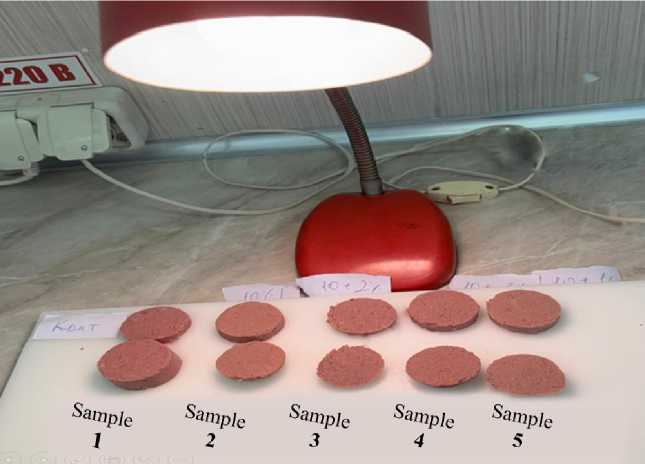
Figure 1. Samples of experimental cooked sausages during light exposure
The samples were exposed under an incandescent lamp for 60 minutes, after which the coordinates were re-measured. Colour stability (%) was computed according to:
Y = (i-(|^^+(|^^)+(|^^))xiooi%) (1), к к 3xL1 к 3xa1 / к 3xb1 JJ , where L₁, a₁, b₁ are the values before exposure and L₂, a₂, b₂ are the values after exposure.
Results and discussion
All colour data were aggregated across replicates and analysed descriptively to enable a comparative assessment of the formulations. Preexposure L*, a*, b* means (±SD) are reported in Table 2, whereas post-exposure coordinates and the computed colour-stability (%) are provided in Table 3.
Table 2. Lab* system сolour coordinates of experimental cooked sausages
|
Sample name |
L*—lightness |
a*—red/green component |
b*—yellow/blue component |
|
Sample 1 (Control) |
42,65±1,47 |
16,75±0,84 |
16,23±0,72 |
|
Sample 2 |
48,39±0,97 |
14,16±0,31 |
16,43±0,82 |
|
Sample 3 |
47,68±0,84 |
11,82±0,34 |
16,42±1,03 |
|
Sample 4 |
47,39±0,78 |
12,66±0,62 |
17,05±0,77 |
|
Sample 5 |
44,18±0,92 |
13,32±0,36 |
17,57±0,07 |
As can be seen from Table 2, the addition of hydrolysate (Sample 2) lightened the product: L* increased from 42,65±1,47 to 48,39±0,97, with a simultaneous decrease in redness a* from 16,75±0,84 to 14,16±0,31 and a slight increase in yellowness b* from 16,23±0,72 to 16,43±0,82. With further addition of cranberries, a nonlinear reaction is observed: at 1% (Sample 3), a* reaches a minimum of 11,82±0,34, after which it partially recovers at 2–3% (12,66±0,62 and 13,32±0,36, respectively), remaining below the control level. The yellowness b* increases monotonically from 16,42±1,03 to 17,57±0,07, indicating a shift in tone towards a more warm color. The lightness L* decreases with an increase in cranberry relative to Sample 2, i.e., cranberry partially compensates for excessive lightening, but even at 3% L*, it remains higher than the control. The noted differences in a* and L* exceed the typical measurement spread (St.d. of about 0,2–1,5), which indicates technologically significant shifts. At the same time, for b*, the effect of cranberries manifests itself as a steady increase with dose. Taken together, the results show that the hydrolysate itself makes the minced meat lighter and less “red,” while the addition of cranberries reduces redness and increases yellowness in a dose-dependent manner, with a tendency toward saturation, while simultaneously pulling L* toward the control level
Table 3. Post-exposure Lab* system сolour coordinates and calculated colour stability
|
Sample name |
L*—lightness |
a*—red/green component |
b*—yellow/blue component |
Сolour stability ΔE , % |
|
Sample 1 (Control) |
42,38±0,53 |
14,18±0,88 |
19,71±0,15 |
87,65 |
|
Sample 2 |
47,75±0,58 |
10,98±0,42 |
20,22±0,28 |
84,67 |
|
Sample 3 |
46,91±0,56 |
9,36±0,42 |
18,66±0,87 |
88,28 |
|
Sample 4 |
45,05±0,71 |
10,79±0,64 |
18,78±0,71 |
89,63 |
|
Sample 5 |
42,88±0,48 |
11,66±0,25 |
20,05±1,52 |
90,24 |
The data after light exposure demonstrate consistent shifts in color coordinates and dosedependent stability dynamics. All samples showed a decrease in a* (red fading) and an increase in b* (yellowing), while L* changed moderately. The lowest color stability was observed in the sample with hydrolysate only (Sample 2 – 84,67%), accompanied by the greatest loss of redness (a*– 10,98±0.42) and one of the highest b* values (20,22±0,28). The addition of cranberries against a background of 10% hydrolysate consistently improved stability with a maximum in Sample 5 — 90,24%. At the same time, in the cranberry variants, the decrease in a* becomes less pronounced (to 11,66±0,25 at 3%), and the
Y = 87,6515 - 0,2849 X1 + 4,0799 X2
The model describes the data with virtually no bias: R² = 0,9949; R²_adj = 0,9913;
Residual variance MSₑ = 0,0536, which corresponds to RMSE = 0,232 p.p. of color increase in b* is limited (18,66–20,05), which indicates partial inhibition of pigment photodegradation. The control (Sample 1) is characterized by average stability (87,65%) and a pattern typical for exposure: a moderate decrease in a* (14,18±0,88) with an increase in b* (19,71±0,15). In summary, the results confirm that the hydrolysate itself reduces light stability, while cranberry increases the color stability of sausages in a dose-dependent manner.
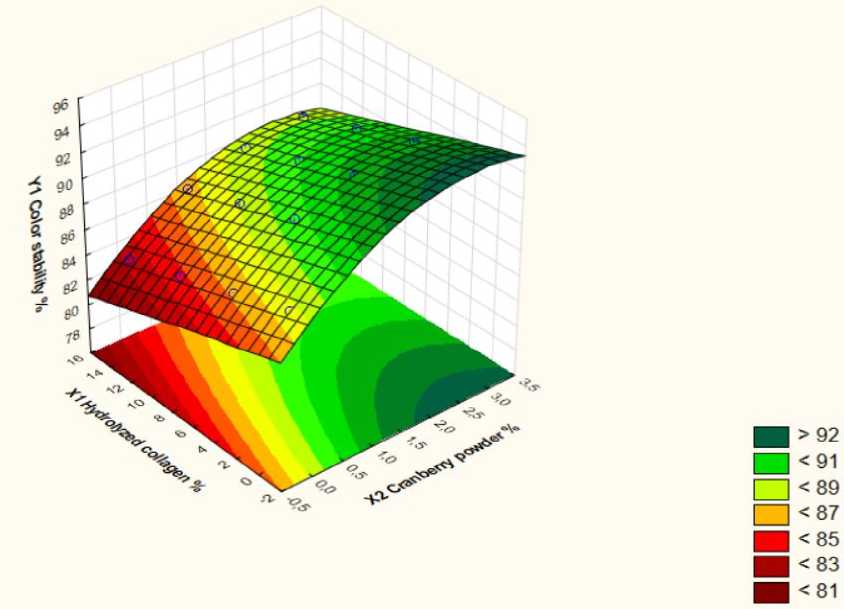
Based on experimental data, a second-order quadratic model was constructed for the response Y = Color stability, % according to the factors: X₁ = hydrolyzed collagen, % and X₂ = cranberry powder, %:
0,0006X12 - 0,0007X1X2 - 0,756 X22.
stability. This is less than the intergroup shifts observed when factors change (usually 1–4 p.p.), i.e., the differences are technologically significant and well separated from noise.
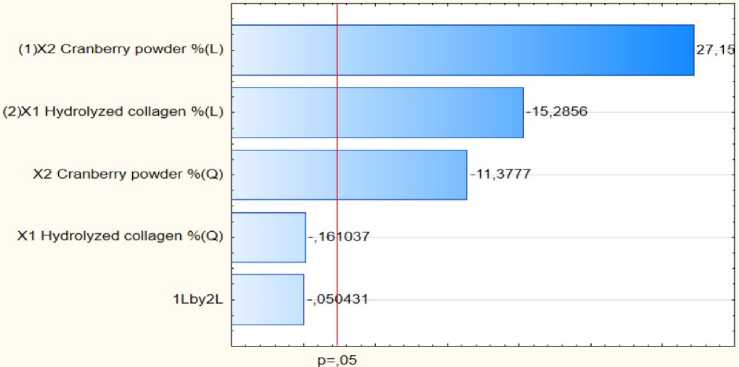
Figure 2. Pareto Chart of standardised effects of factors on Colour stability
According to the Pareto chart, it can be seen that the strongest contribution is made by the linear effect of cranberry X₂(L) with a positive sign (+27,15; p<0,05). This is followed by the linear effect of hydrolysate X₁(L) with a negative sign (-15,29; p<0,05). The quadratic effect X₂(Q) (-11,38; p<0,05) is also significant, indicating saturation of the cranberry effect with increasing dose. The quadratic term X₁(Q) and the interaction X₁×X₂ are statistically insignificant (|t| Figure 3. 3D Surface Plot of Color stability (Y) against hydrolyzed collagen (X1) and cranberry powder (X2) The 3D surface and contour maps show a monotonic decrease in Y as X₁ increases and a convex shelf along X₂. Canonical analysis gives a stationary point outside the acceptable range for X₁, so the optimum in the working range is achieved at the boundary of the minimum hydrolysate. According to the model at X₁ = 0%, the maximum along X₂ is achieved at around 3,0%, with a prediction of Y = 93,1–93,2%. This is consistent with the actual points and the consistent deterioration as X₁ increases. Analysis of the research results shows that the addition of collagen hydrolysate lightens the product and simultaneously reduces redness. Scientists in similar studies explain this phenomenon by the fact that there is an optical “dilution” of the red pigment and an increase in light scattering due to the redistribution of the dispersed phase and the formation of a more homogeneous gel matrix, which raises L* and shifts the reflection spectrum towards warm tones with an increase in b*. In addition, with a more “transparent” matrix and lower effective pigment concentration, the systems become more sensitive to photolysis and oxidation of myoglobin chromophores, which accelerates the drop in a* under light and reduces the integral color stability. This vector of effects has been confirmed by other researchers: partial replacement of fat with gelatin or collagen-containing gel systems led to an increase in L*, an increase in b*, and a decrease in a*, with the mechanism being directly linked to a reduction in the size of fat droplets and their optical properties [16]. Similar conclusions were obtained when collagen fibers were added to sausages, where an increase in lightness and a weakening of the red tone were noted depending on the composition of the matrix [17]. Our results are fully consistent with this body of work: the variant with hydrolysate alone shows maximum fading in a*, high b* values after exposure, and the lowest stability; in the surface response model, the linear coefficient for hydrolysate is negative, and the quadratic coefficient is small, indicating a nearly linear deterioration in stability in the range of 0–15%. At the same time, the study showed that adding cranberry powder to the composition of experimental samples of cooked sausages significantly improves the color stability of the finished product. In their work, scientists explain this effect by a phenolic “umbrella” of protection, which simultaneously extinguishes free radical chains, chelates transition metals, and thereby inhibits the oxidation of lipids and the oxidation of myoglobin to metforms, which retain a smaller proportion of red tone. As a result, the rate of a* decline under light decreases, and the total ΔE decreases, which manifests itself in an increase in the calculated color stability. This mechanism has been confirmed on different meat matrices: the addition of freeze-dried cranberries reduced TBARS, preserved iron, and was accompanied by more stable color coordinates during storage [18], and the inclusion of 5 g/kg of cranberry powder improved color attributes and favorably shifted the microbiota, which is indirectly associated with a lower oxidative load on pigments [19]. Reviews summarizing fruit phenols in meat products record the same cause-and-effect relationships and emphasize the contribution of proanthocyanidins and flavonols to color stabilization by suppressing lipid and protein oxidation and protecting myoglobin [20]. At the same time, phenolic protection typically has a decreasing return profile: at low doses, the most reactive “targets” are blocked, after which the increase in effect decreases. Our quadratic term for cranberries is negative, which mathematically fixes such a “plateau,” and the dose grid data confirm a decrease in stability increments from 1% to 3%. It is also important to note that cranberries contribute their own pigments and change the acidity of the matrix, so along with the increase in stability under light, there is a moderate increase in b*, which is consistent with published observations for berry additives. Conclusion The aim of the study was to quantitatively assess the effect of the proportion of collagen hydrolysate from low-value by-products (X₁) and the dose of cranberry powder (X₂) on the color stability of cooked sausages after light exposure. Сolor measurements were performed in the CIE Lab* system and the integral stability index was calculated. The full-square response surface model in natural units described the data with high quality (R² = 0,9949; R²_adj = 0,9913; MS_res = 0,0536; RMSE = 0,232 p.p.). The standardized effects were dominated by the linear positive contribution of X₂, while the linear effect of X₁ was consistently negative; the quadratic term X₂ indicated a decreasing return with increasing dose, and the interaction X₁×X₂ was statistically insignificant. The surface geometry showed a monotonic deterioration of the indicator with an increase in X₁ and a “shelf” along X₂, with the optimum in the working range being achieved at the boundary with minimum hydrolysate and X₂ = 3,0%, with a stability forecast of about 90,24%. These results are consistent with the mechanistic picture: the hydrolysate optically “lightens” the matrix and reduces redness, while the phenolic complex of cranberries slows down the photodegradation of pigments and stabilizes the color. The results obtained collectively confirm that the addition of cranberry powder statistically and technologically significantly improves the color characteristics of cooked sausages. At the next stage, it is advisable to conduct an in-depth study of the antioxidant properties of cranberry raw materials in the meat matrix, as well as to evaluate the bioavailability of key components. Gratitude, conflict of interest (financing) The study was conducted as part of the project № АР 19680380 “Development of technology for obtaining animal-derived ingredients – collagen peptide hydrolysates – and the creation of functional meat products based on them”.