
Эксцесс, допущенный исполнителем, и эксцесс иных соучастников преступления
Рубрика: Юридические науки
Статья в выпуске: 12, 2025 года.
Бесплатный доступ
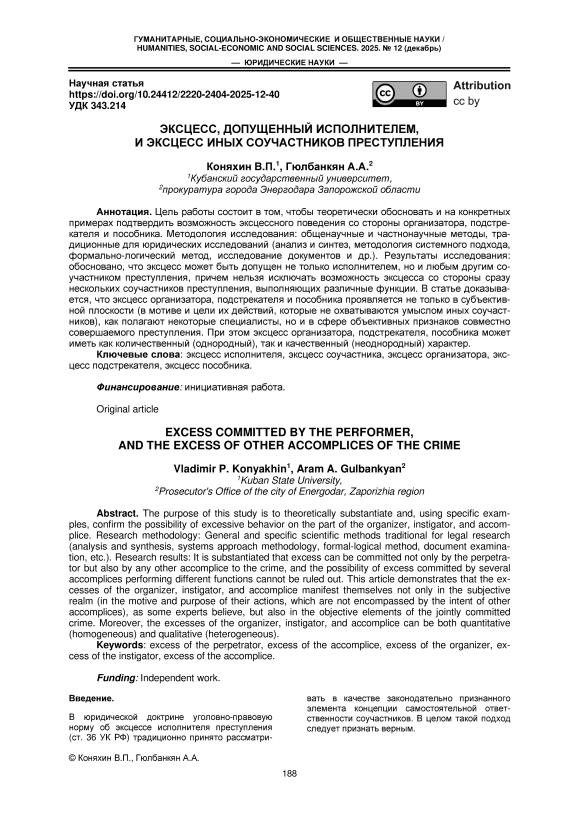
Цель работы состоит в том, чтобы теоретически обосновать и на конкретных примерах подтвердить возможность эксцессного поведения со стороны организатора, подстрекателя и пособника. Методология исследования: общенаучные и частнонаучные методы, традиционные для юридических исследований (анализ и синтез, методология системного подхода, формально-логический метод, исследование документов и др.). Результаты исследования: обосновано, что эксцесс может быть допущен не только исполнителем, но и любым другим соучастником преступления, причем нельзя исключать возможность эксцесса со стороны сразу нескольких соучастников преступления, выполняющих различные функции. В статье доказывается, что эксцесс организатора, подстрекателя и пособника проявляется не только в субъективной плоскости (в мотиве и цели их действий, которые не охватываются умыслом иных соучастников), как полагают некоторые специалисты, но и в сфере объективных признаков совместно совершаемого преступления. При этом эксцесс организатора, подстрекателя, пособника может иметь как количественный (однородный), так и качественный (неоднородный) характер.
Похожие статьи в разделе Общая часть уголовного права
Короткий адрес: https://sciup.org/14137043
IDS: 14137043 | УДК: 343.214 | DOI: 10.24412/2220-2404-2025-12-40
Excess committed by the performer, and the excess of other accomplices of the crime
The purpose of this study is to theoretically substantiate and, using specific examples, confirm the possibility of excessive behavior on the part of the organizer, instigator, and accomplice. Research methodology: General and specific scientific methods traditional for legal research (analysis and synthesis, systems approach methodology, formal-logical method, document examination, etc.). Research results: It is substantiated that excess can be committed not only by the perpetrator but also by any other accomplice to the crime, and the possibility of excess committed by several accomplices performing different functions cannot be ruled out. This article demonstrates that the excesses of the organizer, instigator, and accomplice manifest themselves not only in the subjective realm (in the motive and purpose of their actions, which are not encompassed by the intent of other accomplices), as some experts believe, but also in the objective elements of the jointly committed crime. Moreover, the excesses of the organizer, instigator, and accomplice can be both quantitative (homogeneous) and qualitative (heterogeneous).
Текст научной статьи Эксцесс, допущенный исполнителем, и эксцесс иных соучастников преступления
Введение.
В юридической доктрине уголовно-правовую норму об эксцессе исполнителя преступления (ст. 36 УК РФ) традиционно принято рассматри- вать в качестве законодательно признанного элемента концепции самостоятельной ответственности соучастников. В целом такой подход следует признать верным.
Однако, как представляется, ст. 36 УК РФ несет также отпечаток акцессорной теории, ведь в ней регламентируются правила квалификации эксцесса, допущенного только «главным» (с точки зрения акцессорности) соучастником, т.е. исполнителем преступления. Об эксцессе со стороны иных соучастников преступления ст. 36 УК РФ даже не упоминает.
Умолчав об эксцессе иных соучастников преступления, законодатель вольно или невольно придал ст. 36 УК РФ определенный акцессорный оттенок. Таким образом, дуализм концептуальных начал института соучастия в преступлении проявляется даже в уголовно-правовой норме об эксцессе исполнителя [11, с. 39–42], что неизбежно порождает правоприменительные проблемы, связанные с квалификацией эксцессного поведения организатора, подстрекателя, пособника.
Результаты.
Представители отечественной уголовноправовая доктрины неоднократно обращали внимание на пробельность уголовного закона в части регламентации эксцесса организатора, подстрекателя и пособника преступления. Одним из первых вопрос об уголовно-правовой оценке эксцесса иных соучастников, не принимавших участия в выполнении объективной стороны преступления, поставил П.Ф. Тельнов. Он справедливо указывал, что «в процессе реализации общего преступного замысла не только исполнитель, но и другие соучастники могут нарушить согласованную линию поведения: совершить преступление, не санкционированное их сообщниками; исполнить намеченное деяние более опасными способами, средствами; совершить преступление, менее опасное, нежели намечалось при сговоре. Поэтому вернее было бы не ограничиваться разбирательством эксцесса одного исполнителя» [14, с. 152].
В современной науке уголовного права этот тезис практически не вызывает возражений. Большинство исследователей института соучастия в преступлении отмечают, что эксцессное поведение может проявиться у любого соучастника преступления [1, с. 271; 2, с. 18; 3, с. 131–135; 4, с. 7; 6, с. 552]. Правда, при этом среди ученых наблюдаются определенные расхождения в части возможных форм проявления эксцесса иных соучастников и уголовно-правовых последствий такого эксцесса.
Некоторые исследователи полагают, что эксцесс организатора, подстрекателя и пособника имеет исключительно или преимущественно субъективную «окраску», т.е. проявляется в наличии у них специальных мотивов или целей, не охватывающихся умыслом иных соучастников преступления. Именно в таком субъективном ракурсе рассматривается проблематика эксцесса иных соучастников в совместной публикации О.С. Ка-пинус и К.В. Ображиева [5, с. 49–51], в комментариях к УК РФ [7, с. 212–214], в курсе уголовно- го права для магистрантов и аспирантов. В частности, в упомянутом курсе отмечается, что «в процессе совместного преступления за пределы умысла могут выходить действия не только исполнителей, но и других соучастников. Как правило, такие эксцессы связаны с мотивами совершения одним из соучастников преступления. Например, только один из соучастников убийства (организатор, подстрекатель или пособник) действует из корыстных побуждений» [15, с. 643].
Однако столь узкая трактовка эксцесса организатора, подстрекателя и пособника представляется неоправданной. Эксцесс перечисленных соучастников преступлений может проявляться не только в субъективной плоскости (в мотиве и цели их действий, которые не охватываются умыслом иных соучастников), но и в сфере объективных признаков совместно совершаемого преступления [3, с. 134–135].
На страницах юридической печати приведено немало подобных примеров, причем чаще всего обсуждаются различные проявления эксцесса, допущенного пособником преступления. Доказывая тезис о возможности эксцесса со стороны пособника, сторонники этой точки зрения, в частности, указывают, что пособник при подготовке разбойного нападения может предоставить боевые патроны вместо холостых [10, с. 83], передать исполнителю ядовитое вещество вместо оговоренного снотворного для совершения хищения [16, с. 475].
Впрочем, далеко не все специалисты усматривают здесь эксцесс пособника. По мнению Л.В. Ивановой, «в подобных ситуациях, когда исполнителю предоставляются какие-либо средства совершения преступления, которые могут вызвать более значительные преступные последствия, и при этом исполнитель не поставлен в известность о таких свойствах орудия преступления, имеется эксцесс со стороны посредственного причинителя. Но это не эксцесс соучастника (в данном случае пособника), так как предшествующая деятельность не является соучастием, а представляет собой стечение нескольких лиц в преступлении» [3, с. 135].
Согласиться с логикой рассуждений Л.В. Ивановой вряд ли возможно. Если применение полученных от пособника орудий привело к причинению смерти потерпевшего от разбойного нападения, то пособник разбоя одновременно становится опосредованным исполнителем убийства, сопряженного с разбоем. Но это вовсе не исключает его ответственности за пособничество в совершении разбойного нападения, ведь все признаки соучастия в разбое имеются. Умысел исполнителя и пособника направлен на совершение разбоя, но пособник при этом, выходя за пределы предварительного сговора, инициативно решает «усилить» поражающие свойства орудий разбоя (как говорится, «для надежности»), не сообщая об этом исполнителю. В этом случае пособник будет привлечен к ответствен ности за пособничество в разбое, совершенном с причинением тяжкого вреда здоровью (п. «в» ч. 4 ст. 162 УК РФ), а также за опосредованное исполнение убийства, сопряженного с разбоем (п. «з» ч. 2 ст. 105 УК РФ). А исполнитель, не осведомленный о летальных поражающих способностях полученных от пособника орудий, будет нести ответственность за разбой, причем без квалифицирующего признака, предусмотренного п. «в» ч. 4 ст. 162 УК РФ. Поэтому эксцесс со стороны пособника разбоя в рассматриваемой ситуации все-таки прослеживается.
В авторитетном комментарии к УК РФ под редакцией Председателя Верховного Суда Российской Федерации В.М. Лебедева приведены следующие примеры объективного эксцесса со стороны соучастников, не принимавших участия в выполнении объективной стороны преступления: «Подстрекатель, выполняя свою роль по привлечению к преступлению новых участников, может применить к ним насилие или сбыть им наркотические средства, т.е. совершить действия, которые не охватывались общим умыслом иных соучастников. Равным образом пособник, обеспечивая соучастников средствами совершения преступления, может, например, совершить хищение оружия». При этом в комментарии подчеркивается, что «эксцесс подстрекателя и пособника возможен при условии, что: а) соответствующие несогласованные с иными соучастниками действия выполнялись ими во исполнение общего плана, сговора (в противном случае содеянное ими не связано рамками соучастия); б) иные соучастники не совершили каких-либо действий, субъективно и причинно связанных с эксцессом (в противном случае имеет место трансформация умысла и «перерастание» преступления у всех соучастников)» [8].
Допуская эксцесс иных, помимо исполнителя, соучастников преступления, авторы процитированного комментария к УК РФ сопровождают этот тезис оговоркой, что такой эксцесс со стороны организатора невозможен. В обоснование этого вывода они ссылаются на то, что «изменение первоначальных субъективных намерений организатора и совершение в связи с этим соответствующих деяний представляют собой составление нового сговора на совершение преступления. В случае, если остальные соучастники соглашаются с изменившимися условиями сговора, содеянное составляет содержательную трансформацию общего умысла. Если остальные участники сговора не соглашаются на изменение первоначальных параметров общей договоренности, действия организатора квалифицируются как приготовление к преступлению в форме приискания соучастников» [8].
Однако, как представляется, для выведения организатора из числа возможных субъектов экс-цессного поведения нет достаточных оснований.
Во-первых, организатор преступления может допустить субъективный эксцесс, т.е. выполнять организаторские функции, руководствуясь уголовно-значимым мотивом или целью, о которой
не известно иным соучастникам. В качестве примера можно привести уголовное дело в отношении Гамзатова, который организовал убийство своей жены с целью скрыть другое преступление, не сообщив истинные цели своих действий исполнителю, совершившему убийство по мотиву личной неприязни [12].
Во-вторых, не исключена возможность эксцесса организатора в части объективных обстоятельств совместно совершаемого преступления. Соответствующий пример приводит П.Ф. Тельнов: «Организатор и подстрекатель, взявшиеся по сговору с другими соучастниками склонить еще одного человека к преступлению, могут в попытке принуждения к соучастию применить непредусмотренное насилие» [13, с. 96]. Очевидно, что в этом случае эксцессные действия организатора, выразившиеся, скажем, в угрозе убийства, в умышленном причинении легкого вреда здоровью, иным соучастникам не вменяются.
Итак, подводя промежуточные итоги, констатируем, что эксцесс может быть допущен не только исполнителем, но и любым другим соучастником преступления. Причем нельзя исключать возможность эксцесса со стороны сразу нескольких соучастников преступления, выполняющих различные функции. Например, подстрекатель к убийству по найму скрыл от исполнителя корыстный мотив своих действий, а исполнитель без согласования с подстрекателем привлек соисполнителя, и совершил совместно с ним убийство группой лиц по предварительному сговору. В этом случае эксцесс подстрекателя в части корыстного мотива совершения преступления сочетается с эксцессом исполнителя в части группового способа совершения убийства.
Следует отметить, что эксцесс организатора, подстрекателя, пособника может иметь как количественный (однородный), так и качественный (неоднородный) характер.
Количественный эксцесс иных соучастников преступления чаще всего проявляется в субъективной плоскости (в части мотива или цели, отягчающих ответственность, о которых не было известно исполнителю). Объективный количественный эксцесс встречается намного реже, лишь в единичных случаях. В качестве примера количественного объективного эксцесса пособника можно привести следующую ситуацию. По просьбе исполнителя пособник предоставил ядовитое вещество для убийства, не сообщив ему, что это вещество действует медленно и вызывает сильнейшие боли. В результате потерпевшему были причинены длительные физические страдания, свидетельствующие об особой жестокости убийства, что не охватывалось умыслом исполнителя.
Что же касается качественного эксцесса иных соучастников преступления , то он может иметь только объективные проявления. Характерные примеры такого эксцесса достаточно давно обсуждаются на страницах юридической печати:
«Лицо обещает достать транспортное средство для перевозки похищенного имущества и с этой целью может совершить убийство владельца автомобиля или, пообещав отвлечь внимание сторожа, может причинить ему смерть» [9, с. 102]. В этом случае эксцессное деяние пособника выражается в совершении дополнительного преступления, посягающего на иной объект уголовно-правовой охраны, что позволяет констатировать качественный объективный эксцесс.
В отличие от количественного эксцесса, качественный эксцесс иного соучастника может иметь не только умышленный, но и неосторожный характер. Например, пособник забрал соисполнителей на автомобиле с места совершения хищения. Скрываясь от преследователей, пособник нарушил правила дорожного движения и совершил наезд на пешехода, причинив ему смерть. В рассматриваемой ситуации эксцессное поведение пособника выразилось в совершении неосторожного преступления, предусмотренного ч. 3 ст. 264 УК РФ.
Заключение.
Подводя итог проведенному исследованию, кратко резюмируем, что эксцесс может быть допущен не только исполнителем, но и любым другим соучастником преступления, причем нельзя исключать возможность эксцесса со стороны сразу нескольких соучастников преступления, выполняющих различные функции. Эксцесс организатора, подстрекателя и пособника проявляется не только в субъективной плоскости (в мотиве и цели их действий, которые не охватываются умыслом иных соучастников), как полагают некоторые специалисты, но и в сфере объективных признаков совместно совершаемого преступления. При этом эксцесс организатора, подстрекателя, пособника может иметь как количественный (однородный), так и качественный (неоднородный) характер.
