
Leadership as a micro-innovation in new business models in the era of platformization and entrepreneurship 5.0
Journal: International Journal of Management Trends: Key Concepts and Research @journal-ijmt
Article in issue: 1 vol.5, 2026.
Free access
The contemporary business environment is characterized by accelerated digital transformation, the development of platform economies and the emergence of new business models based on technology, network interactions and flexible forms of organization. Under such conditions, the role of leadership is also changing, as leadership is increasingly viewed as an important factor in organizational adaptation, innovation and the development of employees’ digital competences. The aim of this paper is to analyze, on the basis of a review of relevant literature, leadership, with a particular focus on transformational leadership, as a micro-innovation that contributes to the development and implementation of new business models in the context of platformization and Entrepreneurship 5.0. The methodological approach is based on a narrative literature review and a conceptual synthesis of studies in the fields of leadership, organizational culture, innovation, digital competences and the digital economy. The findings of the literature review indicate that transformational leadership may play a significant role in encouraging innovative behavior, developing an organizational culture that supports change, strengthening employee engagement and connecting digital competences with the innovative capabilities of an organization. The paper proposes a conceptual framework in which leadership is viewed as a micro-innovation and an integrative mechanism between digital competences, organizational culture, employee engagement and the development of new business models. It is concluded that the development of leadership competences in the digital environment represents an important prerequisite for the adaptability, sustainability and competitiveness of contemporary organizations.
Similar articles in the section Management
Short address: https://sciup.org/170213192
IDS: 170213192 | UDC: 005.32:316.46:004.738.5 | DOI: 10.58898/ijmt.v5i1.72-82
Text of the scientific article Leadership as a micro-innovation in new business models in the era of platformization and entrepreneurship 5.0

© 2026 by the authors. This article is an open access article distributed under the terms and conditions of the Creative Commons Attribution (CC BY) license .
data, network interactions and flexible forms of organization. Unlike traditional linear business models, contemporary business models increasingly function through digital platforms that enable the connection of different actors, the exchange of information in real time and the development of new forms of cooperation. Such changes affect not only markets and business processes, but also the way organizations are managed, organizational culture, the role of employees and leadership styles.
In the context of platformization and the digital economy, organizations are faced with the need to develop greater flexibility, innovativeness and the ability to adapt rapidly to change. Traditional management models, based on hierarchy, control and stable organizational structures, are increasingly giving way to models that encourage cooperation, knowledge exchange, creativity, digital competences and continuous learning. In such an environment, leadership assumes a new role, as leaders are no longer only holders of formal power and decision-makers, but become drivers of change, facilitators of innovation and creators of an organizational culture that supports the development of new business models.
A particularly important framework for understanding these changes is the concept of Entrepreneurship 5.0, which emphasizes the need to connect technological development, human potential, sustainability and social responsibility. In this context, organizational success does not depend solely on the availability of digital technologies, but also on leaders’ ability to direct employees towards learning, innovative behavior and the active use of digital competences. Leadership can therefore be viewed as one of the key mechanisms for connecting technology, people and organizational processes. Based on the above, this paper problematizes the role of leadership in contemporary organizations, with a particular focus on its potential to act as a micro-innovation within organizational systems. This approach implies viewing leadership not only as a management function, but as a dynamic mechanism that influences employees’ ways of thinking, behavior, engagement and innovative capacities. Leadership as a micro-innovation is reflected in small, continuous and development-oriented changes that leaders introduce into the everyday practice of an organization by encouraging trust, cooperation, creativity and readiness for change.
The aim of this paper is to analyze, on the basis of a review of relevant literature, the role of leadership, with particular emphasis on transformational leadership, as a micro-innovation that contributes to the development and implementation of new business models in the context of platformization and Entrepreneurship 5.0. In line with this aim, the paper seeks to examine the importance of leadership in contemporary digital and platform-based organizations, to highlight the relationship between leadership and innovation in the development of business models, and to consider the role of digital competences, employee engagement and organizational culture in this process.
The paper is designed as a review article that systematizes existing knowledge on the role of leadership in the development of new business models in the context of digital transformation and platformization. The focus of the paper is not on the empirical measurement of the effects of leadership, but on the theoretical consideration and conceptual connection of leadership, digital competences, organizational culture, employee engagement and the innovative capabilities of an organization. In this way, the paper provides a basis for further empirical examination of the relationships between these elements in contemporary, technology-mediated organizations.
Literature Review Methodology
The paper is based on a narrative literature review and a conceptual analysis of sources related to leadership, transformational leadership, innovation, digital competences, organizational culture, employee engagement, platformization and new business models. This approach was applied because the aim of the paper is to theoretically connect several interrelated areas and formulate a conceptual framework for understanding leadership as a micro-innovation in contemporary organizational systems. The literature review included scientific papers, books, monographic sources and contemporary studies in the fields of management, leadership, innovation management and the digital economy. Particular attention was paid to sources that analyze transformational leadership, the relationship between leadership and organizational culture, the role of digital competences in employee innovativeness, as well as changes in business models in the context of platformization and Entrepreneurship 5.0.
The criteria for including sources were: thematic relevance to the subject of the paper, relevance to the field of leadership and organizational behavior, connection with innovation and digital transformation, and contribution to understanding the development of new business models. Priority was given to sources that connect leadership with innovativeness, organizational culture, employee engagement and digital competences. Sources dealing exclusively with the technical aspects of digital platforms, without a clear connection to leadership, organizational change or the development of business models, were excluded from the analysis.
The analysis was carried out through the identification of key thematic areas, comparison of theoretical approaches and conceptual synthesis of findings from previous studies. On the basis of the literature review, the following thematic dimensions were identified: leadership in the digital and platformbased environment, transformational leadership as support for change, the relationship between leadership and innovation, leadership as a micro-innovation, the importance of digital competences, the role of employee engagement and the moderating importance of organizational culture. The review findings are presented through narrative analysis and a tabular presentation of the conceptual relationship between the key elements.
Leadership in the Contemporary Digital and Platform-Based Environment
Leadership is a complex and dynamic process that involves influencing individuals and groups in order to achieve common organizational goals. In the literature, leadership is defined as a process of directing and influencing the activities of organizational members (Mašić, 2009), or as a process through which individuals influence others towards the achievement of shared goals (Bobera et al., 2017).
In the contemporary context of digital transformation, this process acquires a new dimension. Organizations no longer function as closed systems, but as part of a broader digital and platform-based ecosystem. The platformization of business implies a shift from traditional, hierarchical models towards network structures based on the exchange of information and interaction between different actors.
In such an environment, the role of leaders becomes more complex and requires new competences. Leaders are no longer only holders of authority, but interpreters of reality and creators of meaning within organizations, which is reflected in their ability to manage attention, trust and their own behavior (Grubić-Nešić, 2008).
A contemporary leader must possess the ability to adapt to change, manage uncertainty and encourage innovative behavior among employees. This transformation of the leader’s role is particularly evident in the context of Entrepreneurship 5.0, where the integration of technology and human potential is emphasized as a means of achieving sustainable development.
Transformational Leadership as a Dominant Model in the Context of Platformization
Transformational leadership is highlighted in contemporary literature as one of the most effective leadership styles in conditions of rapid change and digital transformation. According to Avolio et al. (1999), leadership includes different styles of behavior, but transformational leadership has proven particularly important in the context of organizational effectiveness.
As Pradhan and Pradhan (2015) point out, transformational leaders influence employees’ perceptions, values and aspirations, thereby contributing to their greater commitment and engagement. This approach is particularly important in a digital environment, where employees are expected to learn continuously and adapt to new technologies.
In the context of platformization, transformational leadership has a key role in shaping an organizational culture that supports innovation, encouraging cooperation and knowledge exchange, and developing employees’ digital competences. Transformational leaders act as agents of change who not only adapt to the environment, but actively create changes and innovations within the organization. Innovation and the Development of New Business Models
Innovation is a key factor in the survival and development of contemporary organizations. It is defined as the application of new knowledge for the purpose of creating new or improved products, services or processes (Bajić, 2020).
In the context of the contemporary economy, innovation goes beyond the technological framework and includes organizational and business model innovation. Entrepreneurship is largely based on innovation because it involves the creation of new value and the transformation of existing resources into new forms (Nikolić, 2014).
Platform-based business models represent a specific form of innovation, as they enable the connection of different actors and the creation of value through interaction. These models require a high level of flexibility, adaptability and the ability to manage complex relationships.
Innovations in organizations may take different forms, including product and service innovations, process innovations, organizational innovations and business model innovations. As Bajić (2020) points out, organizations that do not innovate lose their competitive advantage and, in the long term, disappear from the market.
Leadership as a Micro-Innovation in Organizational Systems
Contemporary approaches to leadership increasingly emphasize its role as a micro-innovation within the organization. Leadership is not only a management function, but also a mechanism that influences organizational culture, employee behavior and the innovative capabilities of the organization.
According to Bass and Avolio (2004), leaders shape organizational norms and values through their behavior, and these are gradually transmitted to employees. This process has a direct impact on organizational innovativeness and performance.
In this sense, leadership as a micro-innovation contributes to the development of an innovative organizational culture, encourages employee engagement and supports the development of new business models.
Digital Competences, Employee Engagement and Organizational Culture
Digital competences represent a key resource in contemporary organizations, particularly in the context of Entrepreneurship 5.0. They enable employees to use technologies effectively and develop innovative solutions (Celenta et al., 2024).
Organizational culture has a moderating role in the relationship between leadership, digital competences and innovation. A culture that encourages cooperation, openness and knowledge exchange strengthens the effect of leadership on the innovative capabilities of the organization (Chatterjee et al., 2023).
As Lam et al. (2021) indicate, a supportive organizational culture further enhances the positive impact of digital competences and employee engagement on innovation.
Synthesis of Literature Review Findings
The findings of the literature review indicate that the role of leadership is changing significantly in the context of digital transformation, platformization and the development of new business models. Leadership is increasingly viewed not solely as a formal management function, but as a developmental and integrative process that connects people, technology, organizational culture and innovation. In this sense, leadership plays an important role in shaping organizational conditions that enable employees to develop digital competences, participate in innovative processes and contribute to the transformation of business models.
The importance of transformational leadership is particularly emphasized, as it is associated in the literature with inspiring employees, developing a shared vision, encouraging creativity and creating an organizational culture open to change. In the digital and platform-based environment, this leadership style gains additional importance because organizations operate under conditions of increased uncertainty, rapid technological change and the need for continuous learning. Transformational leaders can contribute to ensuring that employees are not merely task executors, but active participants in the development of innovative solutions and new forms of value creation.
The literature review also indicates that employees’ digital competences are an important prerequisite for successful functioning in platform-based and technology-mediated business models. However, digital competences alone are not sufficient if there is no organizational context that directs them towards innovation and business improvement. For this reason, leadership has an integrative role, as it connects the individual capacities of employees with the strategic goals of the organization.
Employee engagement is another important element in the development of the innovative capabilities of an organization. Motivated, involved and professionally committed employees more readily accept change, participate more actively in knowledge exchange and more often contribute to the development of new ideas. In this process, organizational culture has a moderating role, as it can either encourage or limit the influence of leadership on innovation. A culture based on trust, cooperation, openness and learning creates favorable conditions for the development of micro-innovations and new business models.
Based on the analyzed sources, it can be concluded that leadership as a micro-innovation represents a conceptual framework for understanding how small, continuous and development-oriented changes in leadership behavior can contribute to broader organizational change. Such an approach does not imply that leadership automatically produces innovation by itself, but rather that it can act as a driving and connecting mechanism between digital competences, employee engagement, organizational culture and the innovative capabilities of an organization.
In order to systematize the findings of the literature review, Table 1 presents the relationship between the key elements that connect leadership, digital competences, employee engagement, organizational culture and the development of new business models.
Table 1 The relationship between leadership, digital competences and innovation in the context of platformization
|
Element |
Description |
Role in the organization |
Effect on business models |
|
Transformational leadership |
A leadership style that inspires, motivates and encourages employee development (Bass & Riggio, 2006) |
Shapes organizational culture and encourages innovation |
Enables the development of flexible and adaptive business models |
|
Employees’ digital competences |
The ability to use digital tools and technologies (Celenta et al., 2024) |
Enables effective functioning in the digital environment |
Supports the development of platform-based and technology-mediated models |
|
Employee engagement |
Emotional and professional commitment to work (Kahn, 1990) |
Increases productivity and innovativeness |
Contributes to the development of innovative solutions and service improvement. |
|
Organizational culture |
A system of values, norms and behaviors in the organization (Ogbonna & Harris, 2000) |
Moderates the relationship between leadership and innovation |
Strengthens or limits the development of new business models |
|
Innovative capabilities |
The ability of an organization to develop and apply new ideas, processes, products, services and business models |
Represent the result of the interconnected effects of leadership, digital competences, employee engagement and organizational culture |
Enable the transformation of existing business models and the development of new, flexible and sustainable ones |
Table 1 shows that the development of new business models cannot be explained solely by the introduction of digital technologies, but requires the interconnected action of leadership, employee competences, organizational culture and innovative capabilities. Transformational leadership has a central role because it directs digital competences and employee engagement towards innovative activities, while organizational culture determines whether such activities will be supported, accepted and developed in everyday organizational practice.
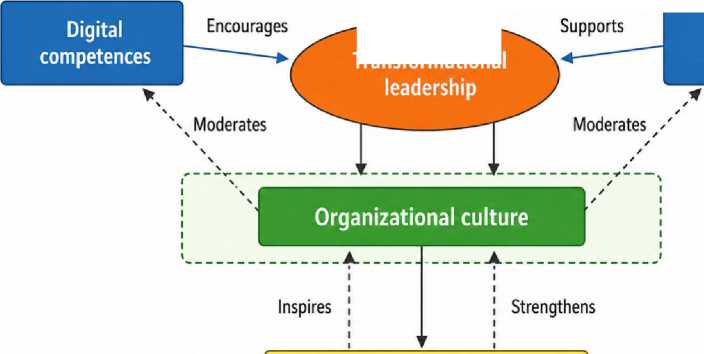
If the relationship presented in Table 1 is represented graphically, leadership can be positioned as the central connecting element between employees’ digital competences, employee engagement, organizational culture and the innovative capabilities of the organization.
Transformational
Employee engagement
Innovation and new business models
Figure 1. Conceptual model of the relationship between leadership, digital competences, employee engagement, organizational culture and innovative capabilities
Figure 1. Conceptual framework of leadership as a micro-innovation in new business models.
Figure 1 shows that leadership can be viewed as the central and connecting element in the process of developing new business models. Employees’ digital competences and employee engagement represent important individual and group resources, while organizational culture has a contextual role because it can support or limit their orientation towards innovation. The innovative capabilities of the organization represent the result of the interaction between these elements and the basis for the development of flexible, adaptive and sustainable business models in the context of platformization.
Discussion
The findings of the literature review indicate that leadership has an increasingly important role in the context of digital transformation, platformization and the development of new business models. In contemporary organizations, leaders no longer act solely as holders of formal authority and decisionmakers, but also as drivers of change, facilitators of learning and creators of an organizational culture that enables innovative employee behavior. This change in the role of leadership is particularly important in organizations operating within digital and platform-based ecosystems, where value is increasingly created through the connection of actors, knowledge exchange, the use of digital technologies and rapid adaptation to change.
Transformational leadership can be viewed as a particularly significant approach in this context, as it emphasizes vision, inspiration, support for employees and the encouragement of creative thinking. In the context of platformization, where organizations must respond quickly to changes in technology, user behavior and market expectations, transformational leaders can contribute to the development of flexible and adaptive business models. Their role is not limited to making strategic decisions, but also includes creating an environment in which employees develop digital competences, exchange knowledge and participate in innovative processes.
The concept of leadership as a micro-innovation provides additional theoretical value because it enables leadership to be viewed as an internal mechanism of gradual organizational change. Unlike large and formalized innovation processes, micro-innovations often develop through everyday practice, communication, problem-solving, support for employees and the creation of a culture of trust. In this sense, leadership operates not only at the strategic level, but also through small, repeated and development-oriented interventions that can change the way employees think, cooperate and contribute to innovation.
The relationship between leadership, digital competences, employee engagement and organizational culture indicates that the development of new business models is not exclusively a technological issue. Digital technologies and platforms represent important resources, but their effective application depends on people, organizational values and the ability of leaders to connect individual competences with organizational goals. For this reason, leadership can be interpreted as an integrative factor that connects technological change with employee development and the innovative capabilities of the organization.
Organizational culture appears in this relationship as a key contextual factor. A culture that supports cooperation, open communication, experimentation and learning can strengthen the influence of leadership on innovation and the development of new business models. In contrast, rigid and closed organizational structures can limit the potential of transformational leadership and slow down the process of adaptation. Therefore, the development of leadership cannot be viewed separately from the development of organizational culture and a system of values that supports change.
The practical implications of this review refer to the need for organizations to approach the development of leadership competences in the digital environment strategically. This includes strengthening leaders’ ability to manage change, support the development of employees’ digital competences, encourage innovative behavior and build an organizational culture based on trust, cooperation and continuous learning. In this sense, leadership as a micro-innovation may represent an important mechanism for developing sustainable competitive advantage in a platform-based environment.
However, it should be emphasized that this paper is based on a literature review and conceptual synthesis, and therefore the presented relationships cannot be interpreted as empirically proven. They represent a theoretical framework that may serve as a basis for further research. Future studies should empirically examine the relationship between transformational leadership, digital competences, organizational culture, employee engagement and the innovative capabilities of organizations in different sectors and forms of platform-based business.
Conclusion
On the basis of the conducted literature review, it can be concluded that leadership, and particularly transformational leadership, plays an important role in the development of new business models in the context of digital transformation, platformization and Entrepreneurship 5.0. The contemporary business environment requires organizations to demonstrate a high degree of adaptability, innovativeness and the ability to manage complex relationships, with leadership becoming one of the key factors connecting technology, people and organizational processes.
The findings of the literature review indicate that leadership should not be viewed solely as a management function, but as a dynamic and developmental process with the potential to act as a microinnovation within the organization. Through its influence on organizational culture, employee engagement and the development of digital competences, leadership can contribute to strengthening the innovative capabilities of the organization and creating conditions for the development of flexible and sustainable business models.
Transformational leadership is of particular importance because it enables the connection of employees’ individual potential with the strategic goals of the organization. In the context of platformization, where organizations function as part of a broader digital ecosystem, leadership has an integrative role in aligning technology, employees, organizational culture and innovation. Such an approach contributes to understanding leadership as a mechanism that not only supports change, but also creates conditions for its gradual and sustainable implementation.
The concept of leadership as a micro-innovation provides an opportunity to view small, continuous and development-oriented changes in leadership behavior as part of the broader transformation of organizational systems. This approach indicates that innovations do not emerge exclusively through major technological changes or formal strategic projects, but also through the everyday practice of leaders, patterns of communication, support for employees, the building of trust and the encouragement of learning.
In practical terms, the paper points to the need for organizations to approach the development of leadership competences in the digital environment strategically. This includes strengthening leaders’ ability to support the development of employees’ digital competences, encourage innovative behavior, build an organizational culture open to change and connect technological resources with human potential. Future research should focus on the empirical examination of the relationships between transformational leadership, digital competences, employee engagement, organizational culture and the innovative capabilities of organizations. It would be particularly important to analyze these relationships across different sectors, organizational sizes and forms of platform-based business in order to determine more precisely how leadership contributes to the development of new business models in the contemporary digital environment.
Acknowledgments
The authors would like to thank all institutions and authors whose publicly available scientific and professional sources were used in the preparation of this review article.
Conflict of Interests
The authors declare no conflict of interest.
