
Методика определения оптимального размера города
Журнал: Проблемы развития территории @pdt-vscc-ac
Рубрика: Устойчивое развитие территорий, отраслей и производственных комплексов
Статья в выпуске: 3 (107), 2020 года.
Бесплатный доступ
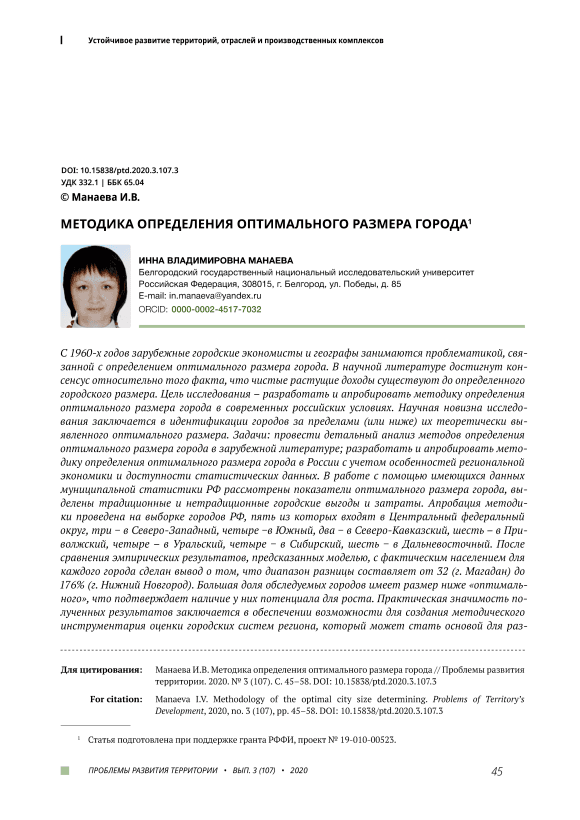
С 1960-х годов зарубежные городские экономисты и географы занимаются проблематикой, связанной с определением оптимального размера города. В научной литературе достигнут консенсус относительно того факта, что чистые растущие доходы существуют до определенного городского размера. Цель исследования - разработать и апробировать методику определения оптимального размера города в современных российских условиях. Научная новизна исследования заключается в идентификации городов за пределами (или ниже) их теоретически выявленного оптимального размера. Задачи: провести детальный анализ методов определения оптимального размера города в зарубежной литературе; разработать и апробировать методику определения оптимального размера города в России с учетом особенностей региональной экономики и доступности статистических данных. В работе с помощью имеющихся данных муниципальной статистики РФ рассмотрены показатели оптимального размера города, выделены традиционные и нетрадиционные городские выгоды и затраты. Апробация методики проведена на выборке городов РФ, пять из которых входят в Центральный федеральный округ, три - в Северо-Западный, четыре - в Южный, два - в Северо-Кавказский, шесть - в Приволжский, четыре - в Уральский, четыре - в Сибирский, шесть - в Дальневосточный. После сравнения эмпирических результатов, предсказанных моделью, с фактическим населением для каждого города сделан вывод о том, что диапазон разницы составляет от 32 (г. Магадан) до 176% (г. Нижний Новгород). Большая доля обследуемых городов имеет размер ниже «оптимального», что подтверждает наличие у них потенциала для роста. Практическая значимость полученных результатов заключается в обеспечении возможности для создания методического инструментария оценки городских систем региона, который может стать основой для разработки алгоритма стратегического планирования пространственного развития городов РФ. Применение методики оценки оптимального размера города для создания такого алгоритма станет одним из перспективных направлений будущих исследований.
Похожие статьи в разделе Региональная экономика. Территориальная экономика


Короткий адрес: https://sciup.org/147225348
IDS: 147225348 | УДК: 332.1 | DOI: 10.15838/ptd.2020.3.107.3
Methodology of the optimal city size determining
Since the 1960s, foreign urban economists and geographers have been working on the problems related to the determining the optimal size of a city. There is a consensus in the scientific literature that net rising incomes exist until a certain urban size. The purpose of the research is to develop and test a methodology of determining the optimal size of a city in modern Russian conditions. The scientific novelty of the study consists in the identification of cities beyond (or below) their theoretically identified optimal size. The tasks of the research are to conduct a detailed analysis of methods for the optimal city size determining in foreign literature; to develop and test a methodology for determining the optimal size of a city in Russia, taking into account the characteristics of the regional economy and the availability of statistical data. Using the available data from the municipal statistics of the Russian Federation, the authors consider the indicators of the optimal city size, and identify traditional and non-traditional urban benefits and costs. The method was tested on a sample of Russian cities, five of which are located in the Central Federal district, three in the North-Western, four in the Southern, two in the North Caucasus, six in the Volga, four in the Ural, four in the Siberian, and six in the Far Eastern Federal districts. After comparing the empirical results predicted by the model with the actual population for each city, the authors conclude that the difference range is from 32 (the city of Magadan) to 176% (the city of Nizhny Novgorod). A large proportion of the cities surveyed are below the “optimal” size, which confirms that they have potential for growth. The practical significance of the results obtained is to provide the possibility to create a methodological tool for evaluating urban systems in the region, which can become the basis for developing an algorithm for strategic planning of spatial development of cities in the Russian Federation. Using the methodology of the optimal city size estimating to create such an algorithm will be one of the promising areas of future research.
Список литературы Методика определения оптимального размера города
- Henderson J. Evaluating Consumer Amenities and Interregional Welfare Differences. Journal of Urban Economics, 1982, vol. 11, pp. 32-59.
- Camagni R., Capello R., Caragliu A. One or infinite optimal city sizes? In search of an equilibrium size for cities. Scienze Regionali, 2013, vol. 12 (3), pp. 53-88.
- Camagni R., Diappi L., Leonardi G. Urban growth and decline in a hierarchical system: a supply-oriented dynamic approach. Regional Science and Urban Economics, 1986, vol.16 (1), pp. 145-160.
- Capello R., Nijkamp P. Urban dynamics and growth: Advances in urban economics. Amsterdam, 2004. 899 p.
- Alonso W. The Economics of Urban Size. Papers and Proceedings of the Regional Science Association, 1971, vol. 26, pp. 67-83.
- Hirsch W.Z. The Supply of Urban Public Services. In: H. Perloff, L. Wingo (eds.). Issues in Urban Economics. Baltimore: The Johns Hopkins Press, 1968. Available at: https://sci-hub.tw/https://doi. org/10.1111/j.1467-9299.1992.tb00942.x
- Mera K. On the urban agglomeration and economic efficiency. Economic Development and Cultural Change, 1973, vol. 21, pp. 309-324.
- Henderson J. The sizes and types of cities. The American Economic Review, 1974, vol. 64, pp. 640-656.
- Mills E. Urban density functions. Urban Studies, 1970, vol. 7, pp. 5-20.
- Shefer D. Localization economies in SMSA'S: a production function analysis. Journal of Regional Science, 1973, vol. 13, pp. 55-64.
- Carlino G. Constrast in agglomeration: New York and Pittsburgh reconsidered. Urban Studies, 1980, vol. 17, pp. 343-351.
- Moomaw R. Is population scale worthless surrogate for business agglomeration economies? Regional Science and Urban Economics, 1983, vol. 13, pp. 525-545.
- Sveiskauskas L., Gowdy J., Funk M. Urban productivity: city size or industry size. Journal of Regional Science, 1988, vol. 28 (2), pp. 185-202.
- Fuchs V. Differentials in hourly earnings by regions and city size. Available at: https://www.nber.org/ chapters/c1257.pdf
- Hoch I. Income and city size. Urban Studies, 1972, vol. 9, pp. 299-328.
- Rosen S. Wage-based indices of urban quality of life. P. Mieszkowski, M. Straszheim (eds.). Current Issues in Urban Economics, Johns Hopkins University Press, Baltimore, 1979. Pp. 74-104.
- Henderson J. Evaluating consumer amenities and interregional welfare differences. Journal of Urban Economics, 1982, vol. 11, pp. 32-59.
- Burnell J., Galster G. Ouality-of-life measurements and urban size: an empirical note. Urban Studies, 1992, vol. 29 (5), pp. 727-735.
- Herzog H., Schlottmann A. Valuing amenities and disamenities of urban scale: can bigger be better? Journal of Regional Science, 1993, vol. 33 (2), pp. 145-165.
- Burnett P. Overpopulation, optimal city size and the efficiency of urban sprawl. Rev. Review of Urban and Regional Development Studies, 2016, vol. 28 (3), pp. 143-161. DOI: 10.1111/rurd.12051
