
Навигационное обеспечение беспилотных летательных аппаратов для организации их группового применения
Журнал: Журнал Сибирского федерального университета. Серия: Техника и технологии @technologies-sfu
Рубрика: Исследования. Проектирование. Опыт эксплуатации
Статья в выпуске: 4 т.18, 2025 года.
Бесплатный доступ
Методом синтеза из расплава на солнечной печи может быть получен материал СоFe2O4 со структурой шпинели Fd3m сингонии с параметром элементарной ячейки a = 8,39 Å. Показано, что такой материал проявляет стойкость к воздействию водяных паров, имеет низкое водопоглощение. Выявлено, что механизм электрической проводимости перовскитового материала состава СоFe2O4 является электронным и связан с прыжками поляронов. Сделано предположение о том, что CoFe2O4 может быть использован как катализатор при получении синтез-газа. В результате проделанной работы получена зависимость выхода синтез-газа от массы катализатора. При некаталитической газификации шелухи риса выход газообразных продуктов составил 34 %, а твердый остаток образовался в количестве 37 %. В случае каталитической газификации наблюдается увеличение выхода газовой фазы до 60 %. Также наблюдается ускорение процесса газификации
Похожие статьи в разделе Техника средств транспорта
Короткий адрес: https://sciup.org/146283103
IDS: 146283103 | УДК: 629.7.054.07
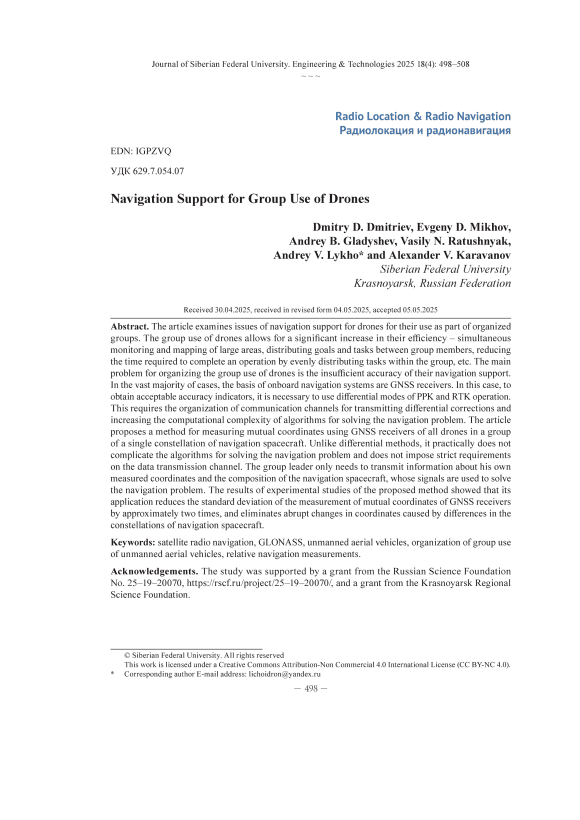
Navigation Support for Group Use of Drones
The article examines issues of navigation support for drones for their use as part of organized groups. The group use of drones allows for a significant increase in their efficiency – simultaneous monitoring and mapping of large areas, distributing goals and tasks between group members, reducing the time required to complete an operation by evenly distributing tasks within the group, etc. The main problem for organizing the group use of drones is the insufficient accuracy of their navigation support. In the vast majority of cases, the basis of onboard navigation systems are GNSS receivers. In this case, to obtain acceptable accuracy indicators, it is necessary to use differential modes of PPK and RTK operation. This requires the organization of communication channels for transmitting differential corrections and increasing the computational complexity of algorithms for solving the navigation problem. The article proposes a method for measuring mutual coordinates using GNSS receivers of all drones in a group of a single constellation of navigation spacecraft. Unlike differential methods, it practically does not complicate the algorithms for solving the navigation problem and does not impose strict requirements on the data transmission channel. The group leader only needs to transmit information about his own measured coordinates and the composition of the navigation spacecraft, whose signals are used to solve the navigation problem. The results of experimental studies of the proposed method showed that its application reduces the standard deviation of the measurement of mutual coordinates of GNSS receivers by approximately two times, and eliminates abrupt changes in coordinates caused by differences in the constellations of navigation spacecraft.
