
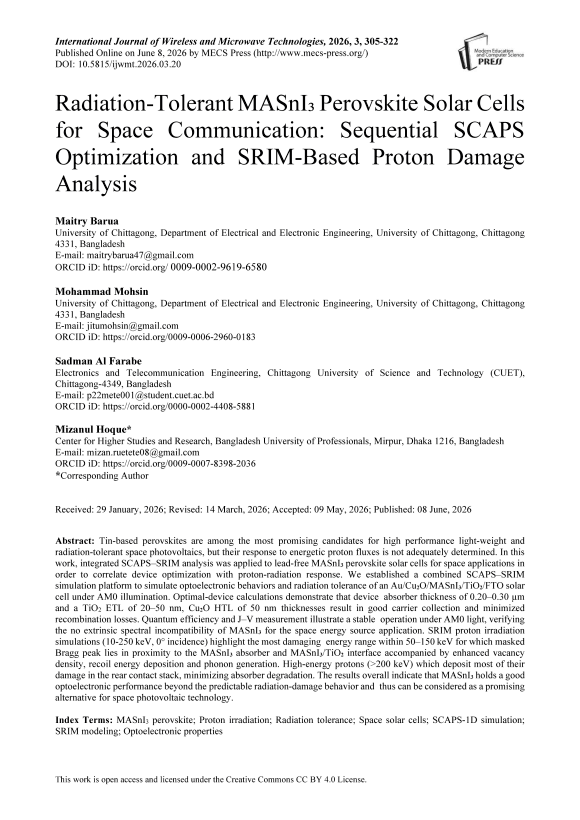
Radiation-Tolerant MASnI₃ Perovskite Solar Cells for Space Communication: Sequential SCAPS Optimization and SRIM-Based Proton Damage Analysis
Journal: International Journal of Wireless and Microwave Technologies @ijwmt
Article in issue: 3 Vol.16, 2026.
Free access
Tin-based perovskites are among the most promising candidates for high performance light-weight and radiation-tolerant space photovoltaics, but their response to energetic proton fluxes is not adequately determined. In this work, integrated SCAPS–SRIM analysis was applied to lead-free MASnI3 perovskite solar cells for space applications in order to correlate device optimization with proton-radiation response. We established a combined SCAPS–SRIM simulation platform to simulate optoelectronic behaviors and radiation tolerance of an Au/Cu2O/MASnI3/TiO2/FTO solar cell under AM0 illumination. Optimal-device calculations demonstrate that device absorber thickness of 0.20–0.30 µm and a TiO2 ETL of 20–50 nm, Cu2O HTL of 50 nm thicknesses result in good carrier collection and minimized recombination losses. Quantum efficiency and J–V measurement illustrate a stable operation under AM0 light, verifying the no extrinsic spectral incompatibility of MASnI3 for the space energy source application. SRIM proton irradiation simulations (10-250 keV, 0° incidence) highlight the most damaging energy range within 50–150 keV for which masked Bragg peak lies in proximity to the MASnI3 absorber and MASnI3/TiO2 interface accompanied by enhanced vacancy density, recoil energy deposition and phonon generation. High-energy protons (>200 keV) which deposit most of their damage in the rear contact stack, minimizing absorber degradation. The results overall indicate that MASnI3 holds a good optoelectronic performance beyond the predictable radiation-damage behavior and thus can be considered as a promising alternative for space photovoltaic technology
Similar articles in the section Electrical engineering
Short address: https://sciup.org/15020466
IDS: 15020466 | DOI: 10.5815/ijwmt.2026.03.20
