
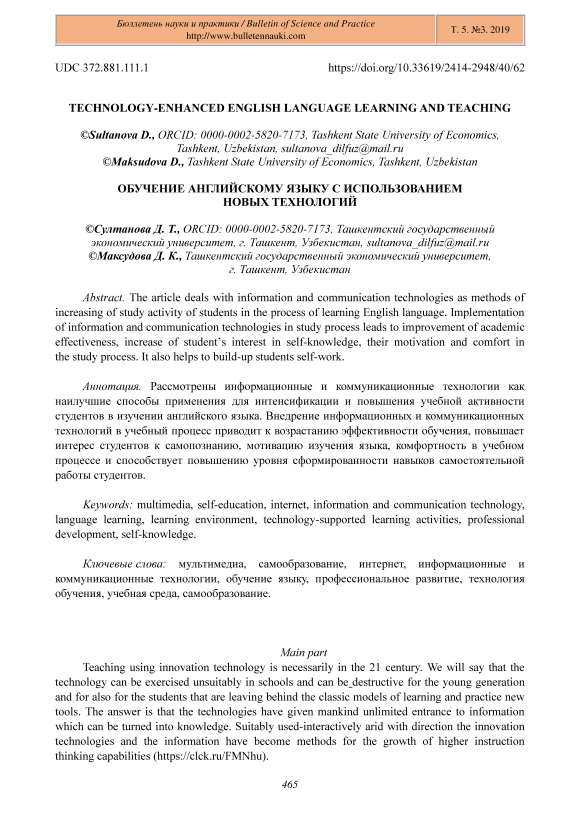
Technology-enhanced English language learning and teaching
Journal: Bulletin of Science and Practice @bulletennauki
Section: Педагогические науки
Article in issue: 3 т.5, 2019.
Free access
The article deals with information and communication technologies as methods of increasing of study activity of students in the process of learning English language. Implementation of information and communication technologies in study process leads to improvement of academic effectiveness, increase of student’s interest in self-knowledge, their motivation and comfort in the study process. It also helps to build-up students self-work.
Similar articles in the section Education
Short address: https://sciup.org/14115318
IDS: 14115318 | UDC: 372.881.111.1 | DOI: 10.33619/2414-2948/40/62
Обучение английскому языку с использованием новых технологий
Рассмотрены информационные и коммуникационные технологии как наилучшие способы применения для интенсификации и повышения учебной активности студентов в изучении английского языка. Внедрение информационных и коммуникационных технологий в учебный процесс приводит к возрастанию эффективности обучения, повышает интерес студентов к самопознанию, мотивацию изучения языка, комфортность в учебном процессе и способствует повышению уровня сформированности навыков самостоятельной работы студентов.
References Technology-enhanced English language learning and teaching
- Bajcsy R. Technology and learning. In Visions 2020: Transforming education and training through advanced technologies. Washington, DC: U.S. Department of Commerce. 2009.
- Bennett D., Culp K. M., Honey M., Tally B., Spielvogel B. It all depends: Strategies for designing technologies for educational change. Paper presented at the International Conference on Learning Technology, Philadelphia, PA. 2008.
- Davies G. Introduction to multimedia CALL. Module 2.2 in Davies G. (ed.) Information and Communications Technology for Language Teachers (ICT4LT), Slough, Thames Valley University. 2011.
- Renaud J. Davies. Second-Language Acquisition and the Information Age: How Social Software has Created a New Model of Learning // TESL Canada Journal/Revue TESL du Canada, 2011. V. 28. №2. P. 11-19.
- Ramachandran S. Integrating New Technologies into Language Teaching: Two Activities for EAP Classroom // TESL Canada Journal/Revue TESL du Canada. 2004. V. 22. (1).
- Means, B. (2000). Accountability in preparing teachers to use technology. In Council of Chief State School Officers, State Educational Technology Conference Papers. Washington, DC: Council of Chief State School Officers.
- Shanker M., Michael Y. Hu. Improving Teaching Effectiveness Using Distance // Education Tools. 2008. P. 102-120.
- Wells, G. Using the tool-kit of discourse in the activity of learning and teaching // Mind, Culture and Activity. 2008. V. 3. №2, P. 74-101.
- Michael DezuanniRemixing Media Literacy Education: Students 'Writing' with New Media Technologies. 2010.
- Hartoyo Individual Differences in Computer-Assisted Language Learning. Semarang: Pelita Insani Semarang. 2008.
