
The effect of molecular hydrogen on the quality and shelf life of soft brined cheese
Journal: Bulletin of Almaty Technological University @vestnik-atu
Section: Технология пищевой и перерабатывающей промышленности
Article in issue: 2 (152), 2026.
Free access
The high moisture content and short shelf life of soft brined cheeses create a serious problem of rapid spoilage, necessitating the search for effective natural stabilizers to preserve product quality and safety. The aim of this study was to improve stability and extend the shelf life of soft brined cheese through the combined application of hop extract during production and subsequent storage in brine enriched with molecular hydrogen (H₂). The main idea was to investigate the synergistic antioxidant effect arising from the combined use of these two natural factors. The scientific significance lies in substantiating a new approach to stabilizing soft brined cheeses using natural antioxidants, while the practical significance lies in improving the technology to extend shelf life without synthetic additives. The methodology was based on controlled experimental modeling with comparative groups of cheese samples (control and experimental variants), including hop extract and hydrogen-enriched brine. Physicochemical (oxidation-reduction potential, water activity, pH), microbiological, and organoleptic indicators were evaluated during storage. It was established that hydrogen-enriched brine reduces oxidation-reduction potential compared to the control, stabilizes water activity at 0.638–0.640 (control: 0.781–0.888), and maintains pH within 4.96–5.08 (control: 5.30–5.77), indicating a more stable environment and improved product stability. Microbiological indicators meet regulatory requirements: pathogenic microflora was not detected, and the total count of mesophilic aerobic and facultative anaerobic microorganisms (TAMC) is 1.0–1.2 log CFU/g. The results indicate an antioxidant effect that improves product stability and may extend shelf life without deterioration of organoleptic and functional characteristics. The study contributes to the development of technologies for functional and environmentally safe dairy products using natural stabilizing systems. The results have practical significance for the dairy industry and can be used to improve quality stability and extend the shelf life of soft brined cheeses.
Similar articles in the section Communication and transport industries. Accountancy. Business management. Public relations
Short address: https://sciup.org/140315563
IDS: 140315563 | UDC: 65.63.39 | DOI: 10.48184/2304-568X-2026-2-68-76
Влияние молекулярного водорода на качество и срок хранения мягкого рассольного сыра
Высокая влажность и короткий срок хранения мягких рассольных сыров создают серьёзную проблему их быстрой порчи, что обусловливает острую необходимость поиска эффективных природных стабилизаторов для сохранения качества и безопасности этих продуктов. Целью настоящего исследования являлось повышение стабильности и увеличение срока годности мягкого рассольного сыра за счёт комплексного применения экстракта хмеля на стадии производства и последующей выдержки продукта в рассоле, обогащённом молекулярным водородом (H₂). Основная идея работы заключалась в изучении синергетического антиоксидантного эффекта, возникающего при совместном использовании этих двух природных факторов. Научная значимость работы состоит в обосновании нового подхода к стабилизации мягких рассольных сыров с использованием природных антиоксидантов, а практическая значимость – совершенствование технологии, позволяющей существенно продлить срок хранения продукта без применения синтетических добавок. Методология исследования основывалась на проведении контролируемого экспериментального моделирования с формированием сравнительных групп образцов мягкого рассольного сыра (контроль и опытные варианты), включающих применение экстракта хмеля и рассола, обогащённого молекулярным водородом. Оценивались физико-химические (окислительно восстановительный потенциал, активность воды, pH), микробиологические и органолептические показатели качества сыра в процессе хранения. Установлено, что применение водород-обогащённого рассола приводит к снижению окислительно-восстановительного потенциала до низких значений по сравнению с контрольным образцом, стабилизации активности воды на уровне 0,638–0,640 (в контроле 0,781–0,888) и поддержанию pH в узком диапазоне 4,96–5,08 (в контроле 5,30–5,77), что свидетельствует о формировании более стабильной среды и повышении устойчивости продукта при хранении. Микробиологические показатели соответствуют нормативным требованиям: патогенная микрофлора не обнаружена, общее количество мезофильных аэробных и факультативно-анаэробных микроорганизмов (КМАФАнМ) составляет 1,0–1,2 log КОЕ/г. Полученные результаты указывают на антиоксидантный эффект, способствующий повышению стабильности продукта и потенциальному увеличению срока хранения без ухудшения его органолептических и функциональных характеристик. Проведённое исследование вносит вклад в развитие технологий производства функциональных и экологически безопасных молочных продуктов с использованием природных стабилизирующих систем. Полученные результаты имеют практическое значение для молочной промышленности и могут быть использованы для повышения стабильности качества и увеличения срока хранения мягких рассольных сыров.
Жұмсақ тұздық ірімшіктің сапасы мен сақтау мерзіміне молекулалық сутегінің әсері
Жоғары ылғалдылық және жұмсақ тұздықты ірімшіктердің сақтау мерзімінің қысқалығы олардың тез бұзылу мәселесін туындатады, бұл осы өнімдердің сапасы мен қауіпсіздігін сақтау үшін тиімді табиғи тұрақтандырғыштарды іздеудің өзектілігін арттырады. зерттеудің мақсаты – өндіріс кезеңінде құлмақ сығындысын кешенді қолдану және өнімді молекулалық сутекпен (H₂) байытылған тұздықта сақтау арқылы жұмсақ тұздықты ірімшіктің тұрақтылығын арттыру және сақтау мерзімін ұзарту болып табылады. Жұмыстың негізгі идеясы осы екі табиғи факторды бірге қолдану нәтижесінде туындайтын синергетикалық антиоксиданттық әсерді зерттеуге негізделген. Жұмыстың ғылыми маңыздылығы табиғи антиоксиданттарды қолдану арқылы жұмсақ тұздықты ірімшіктерді тұрақтандырудың жаңа тәсілін негіздеуде көрінеді, ал практикалық маңыздылығы - синтетикалық қоспаларды қолданбай-ақ өнімнің сақтау мерзімін едәуір ұзартуға мүмкіндік беретін технологияны жетілдіруде. Зерттеу әдістемесі бақылау және тәжірибелік нұсқаларды қамтитын жұмсақ тұздықты ірімшік үлгілерінің салыстырмалы топтарын қалыптастыру арқылы жүргізілген бақыланатын эксперименттік модельдеуге негізделді, онда құлмақ сығындысы мен молекулалық сутекпен байытылған тұздық қолданылды. Сақтау процесінде ірімшіктің физика-химиялық (тотығу-тотықсыздану потенциалы, су белсенділігі, pH), микробиологиялық және органолептикалық сапа көрсеткіштері бағаланды. Молекулалық сутекпен байытылған тұздықты қолдану бақылау үлгісімен салыстырғанда тотығу-тотықсыздану потенциалының төмен деңгейлерге дейін төмендеуіне, су белсенділігінің 0,638–0,640 деңгейінде тұрақтануына (бақылауда 0,781–0,888) және pH мәнінің 4,96–5,08 аралығында сақталуына (бақылауда 5,30–5,77) алып келетіні анықталды, бұл сақтау кезінде анағұрлым тұрақты ортаның қалыптасқанын және өнімнің тұрақтылығының артқанын көрсетеді. Микробиологиялық көрсеткіштер нормативтік талаптарға сәйкес келеді: патогенді микрофлора анықталмады, мезофильді аэробты және факультативті анаэробты микроорганизмдердің жалпы саны (КМАФАнМ) 1,0–1,2 log КОЕ/г құрайды. Алынған нәтижелер өнімнің тұрақтылығын арттыруға және органолептикалық әрі функционалдық қасиеттерін нашарлатпай сақтау мерзімін ұзартуға ықпал ететін антиоксиданттық әсердің бар екенін көрсетеді. Жүргізілген зерттеу табиғи тұрақтандыру жүйелерін қолдана отырып, функционалдық және экологиялық қауіпсіз сүт өнімдерін өндіру технологияларын дамытуға үлес қосады. Алынған нәтижелер сүт өнеркәсібі үшін практикалық маңызға ие және жұмсақ тұздықты ірімшіктердің сапа тұрақтылығын арттыру мен сақтау мерзімін ұзарту үшін қолданылуы мүмкін.
Text of the scientific article The effect of molecular hydrogen on the quality and shelf life of soft brined cheese
IRSTI: 65.63.39
The dairy industry of Kazakhstan demonstrates steady growth: cheese production in 2024–2026 is increasing by 20–24% annually, with high demand for soft brined cheeses (sales growth up to 15% per year in certain segments). These products, traditional for Central Asia, face challenges related to milk seasonality, microbiological and oxidative spoilage, as well as consumer demand for natural functional products without synthetic additives [1, 2].
A promising direction is the enrichment of cheeses with natural plant components. Common hop ( Humulus lupulus ) — an accessible local raw material — contains iso-α-acids with pronounced antimicrobial and antioxidant activity. These compounds inhibit the growth of pathogens ( Staphylococcus aureus, Salmonella spp., Listeria monocytogenes ), stabilize pH and water activity (a_w), slow down lipid and protein peroxidation, extend shelf life, and enhance flavor [3–5].
Additional opportunities are provided by the use of brine prepared with water enriched with molecular hydrogen (H₂) — a selective antioxidant. H₂ neutralizes the most dangerous reactive oxygen species (•OH, ONOO⁻), converting them into water without by-products, while not affecting beneficial radicals (H₂O₂, NO•, O₂•⁻). Due to its small size and high penetration ability, H₂ effectively reduces lipid peroxidation (LPO), prevents rancidity of the fat phase, stabilizes protein structures, maintains a low oxidation-reduction potential (Eh) of the brine, and slows oxidative reactions during storage[6–9]. In dairy products (butter, fresh cheese), the use of H₂ reduces peroxide value, titratable acidity, the formation of biogenic amines, and extends shelf life without residues in the product[10].
The synergistic combination of hop extract and molecular hydrogen is particularly promising, since the antimicrobial and antioxidant properties of hop are enhanced in the reducing environment created by H₂. This makes it possible to significantly increase the stability of soft brined cheeses, preserve their organoleptic and functional characteristics, and expand the possibilities of “clean label” in the dairy industry of Kazakhstan [11–13].
Soft brined cheeses are characterized by high moisture content (60–70%) and a relatively short shelf life, which creates the need to search for effective natural stabilizers. Under the conditions of Kazakhstan, the problem is aggravated by seasonal fluctuations in the quality of raw milk, temperature variations during storage, and the traditional technology of brine maturation. The use of synthetic preservatives increasingly negative consumer response, therefore the development of technologies based on natural components of local origin acquires strategic importance [14].
Despite individual studies on the antimicrobial properties of hop extract and the antioxidant effect of molecular hydrogen in the food industry, their combined application in the technology of production and storage of soft brined cheeses has been scarcely studied. Particularly relevant remains the issue of adapting these technologies to the conditions of Kazakhstani production, taking into account the characteristics of local raw materials and climatic factors [15–17].
Thus, the study of the combined effect of hop extract introduced at the production stage and storage of the product in brine enriched with molecular hydrogen is of scientific and practical interest.
Materials and methods
Raw materials and their evaluation. Fresh cow’s milk obtained from three farms of the Abai region—“Steklyanka” LLP (Sample 1), “Nur” LLP (Sample 2), and “Kazpravda” LLP (Sample 3)— was used as the initial raw material. Milk was delivered to the “Aisha” workshop of “Kalikhanyly” LLP in compliance with sanitary and veterinary requirements and accompanied by official documentation. Sampling was conducted monthly over one year, with three samplings per month and five replicates per analysis to ensure statistical reliability. Organoleptic properties were evaluated according to GOST 52054-2003. Physicochemical parameters (density, titratable acidity, total solids, fat, protein, and somatic cell count) were determined in accordance with GOST 31449-2013 and ST RK 1760-2019.
Preparation of hop extract. Dried hop cones were ground to a powder. Extraction was performed with distilled water (100 g of raw material) at room temperature for 5–7 h using a laboratory shaker. The extract was filtered through filter paper. To determine the optimal dosage, concentrations of 100, 200, and 300 mL per 10 L of milk were applied.
Organoleptic evaluation. Sensory evaluation was carried out by a panel of 5–7 trained assessors using a 50-point scale according to GOST 336302015. The evaluated parameters included appearance (5 points), taste and aroma (20 points), consistency (10 points), color (5 points), structure (5 points), and packaging (5 points). Samples were presented in anonymized form at 10–12 °C.
Physicochemical analysis. The mass fraction of dry matter, fat in dry matter, and moisture content were determined using standard gravimetric and refractometric methods. pH was measured potentiometrically. Oxidation–reduction potential (ORP) and water activity (a w ) were measured using a Smart Water Activity Meter HD-6. Color coordinates (L*, a*, b*) were determined using a digital colorimeter. All measurements were performed in triplicate.
Microbiological analysis. Microbiological assessment included determination of total viable count (TVC, log CFU/g), coliform bacteria (GOST 9225-84), Salmonella spp. (GOST 31659-2012), and Staphylococcus aureus (GOST 30347-2016). Cultivation was performed on standard nutrient media at 30–37 °C.
Storage study and brine analysis. Storage stability was evaluated at 0–2 °C, 3–5 °C, and 6–8 °C for 40 days. Parameters including a w , pH, ORP, and TVC were monitored on days 0, 10, 20, 30, and 40. Brine parameters (pH, ORP, a w , and color coordinates L*, a*, b*) were monitored over 72 h at 0, 1, 24, 48, and 72 h.
Results and discussion
The results of the study showed that the addition of hop extract to soft brined cheese and the subsequent storage of the product in hydrogen-enriched brine affect its physicochemical, organoleptic, microbiological characteristics, and storage stability. The effect of the additive was evaluated by comparing the experimental sample (with hop extract at 200 mL per 10 L of milk and storage in H₂ brine) with the control sample (without hop extract, stored in conventional brine). The dosage of hop extract was optimized not only based on organoleptic indicators but also considering its influence on microbiological stability and shelf life of the product [8].
Physicochemical parameters of raw cow’s milk.
During the study, the physicochemical parameters of raw cow’s milk obtained from three farms fully complied with the requirements of GOST 31449-2013 and ST RK 1760-2019. The average values are presented in Table 1.
Table 1. Physicochemical parameters of raw cow’s milk (annual average values)
|
Parameter |
GOST 31449-2013 |
Sample 1 |
Sample 2 |
Sample 3 |
|
Density, kg/m³ |
1027,0 |
1030,0 |
1028,0 |
1029,0 |
|
Acidity, °T |
16,0–21,0 |
18,2 |
18,5 |
19,0 |
|
Total solids, % |
≥ 8,2 |
10,4 |
10,1 |
10,0 |
|
Fat content, % |
≥ 2,8 |
3,14 |
3,0 |
3,11 |
|
Protein content, % |
≥ 2,8 |
3,98 |
3,95 |
3,92 |
|
Somatic cell count, thousand/cm³ |
≤ 500 |
285 |
265 |
268 |
Milk samples were characterized by an increased content of total solids, fat, and protein. The somatic cell count was below the threshold value (≤ 500 thousand/cm³), indicating high sanitary quality of the raw material.
Organoleptic characteristics complied with standards: taste and odor were clean, color ranged from white to light cream, and consistency was homogeneous. Seasonal variations were leveled during pasteurization.
The obtained data confirm the compliance of raw materials with GOST 52054–2003 requirements and their suitability for processing.
Optimization of hop extract dosage
To determine the optimal dosage of hop extract, three variants of its addition were studied: 100, 200, and 300 mL per 10 L of milk. Evaluation was carried out based on the organoleptic characteristics of the finished product.
According to the results presented in Table 2, it was concluded that the addition of 100 mL of extract had a weak effect on the taste characteristics of the cheese. When using a dose of 300 mL, an intensification of the hop note and the appearance of bitterness were observed, which negatively affected the organoleptic evaluation of the product.
Table 2. Effect of hop extract dosage on organoleptic characteristics (average values)
|
Hop extract dose, mL |
Total score (out of 50) |
Taste and aroma (out of 20) |
Consistency (out of 10) |
Intensity of hop note |
Overall assessment |
|
100 |
47,2 |
18,5 |
9,0 |
Weak |
Satisfactory |
|
200 |
48,7 |
19,8 |
8,9 |
Optimal |
Excellent |
|
300 |
46,8 |
17,9 |
8,2 |
Strong, with bitterness |
Average |
The optimal dose was 200 mL of hop extract per 10 L of milk, providing a harmonious combination of milk taste and a light aromatic hop note. At this concentration, the cheese was characterized by the highest sensory score — 48.7 out of 50.
The obtained results indicate the feasibility of using this dosage of extract in further experiments.
Organoleptic quality indicators of cheese
Organoleptic evaluation of samples was carried out using a 50-point scale in accordance with GOST 33630–2015. The samples were characterized by a smooth surface without rind, uniform lightyellow color, clean moderately acidic taste (pH 5.9), and dense, elastic consistency without defects. In the experimental sample, the formation of a slightly expressed hop aroma note was observed.
Table 3. Organoleptic evaluation of samples
|
Sample |
Taste and aroma (20) |
Consistency (10) |
Pattern (5) |
Color (5) |
Appearance (5) |
Packaging (5) |
Total (50) |
|
Control (without hop) |
19,0 ± 0,3 |
9,5 ± 0,2 |
5,0 ± 0,0 |
5,0 ± 0,0 |
5,0 ± 0,0 |
5,0 ± 0,0 |
48,5 ± 0,4 |
|
Sample (with hop 200 mL) |
19,8 ± 0,2 |
8,9 ± 0,3 |
5,0 ± 0,0 |
5,0 ± 0,0 |
5,0 ± 0,0 |
5,0 ± 0,0 |
48,7 ± 0,3 |
|
According to the presented data, the The obtained results indicate the experimental sample is characterized by an increase in preservation of high organoleptic properties when the score for “taste and aroma,” with a slight decrease introducing the studied additive. in the consistency parameter. These changes remain Physicochemical parameters of finished cheese within regulatory limits and are not accompanied by Physicochemical parameters of cheese are deterioration of other organoleptic characteristics. important indicators characterizing its technological Maximum scores for “color,” “appearance,” and properties and stability during storage. “packaging” were recorded for both samples. |
|||||||
Table 4. Physicochemical parameters of cheese and control sample (mean ± SD, n=3)
|
Parameter |
Sample (with hop) |
Control (without hop) |
Difference (%) |
Comment |
|
Total solids, % |
32,09 ± 1,16 |
34,06 ± 1,64 |
-5,8 |
Lower due to hydrophilicity of hop |
|
Fat in dry matter, % |
42,27 ± 3,40 |
43,57 ± 3,19 |
-3,0 |
Comparable |
|
Moisture content, % |
67,91 ± 1,16 |
65,94 ± 1,64 |
+3,0 |
Softer texture |
|
pH |
5,90 ± 0,03 |
5,75 ± 0,02 |
+0,15 units |
Milder acidity |
The analysis results showed that the total solids content in the experimental sample was 32.09 ± 1.16%, which is slightly lower than that of the control sample (34.06 ± 1.64%). Accordingly, the moisture content in the experimental cheese was higher — 67.91 ± 1.16% compared to 65.94 ± 1.64% in the control.
The increased moisture content is explained by the hydrophilic properties of bioactive components of hop, capable of binding additional water within the protein matrix of cheese.
The fat content in dry matter was practically the same between the samples, amounting to 42.27 ± 3.40% in the experimental sample and 43.57 ± 3.19% in the control.
The active acidity of the experimental cheese was pH 5.90 ± 0.03, which is slightly higher than that of the control sample (pH 5.75 ± 0.02). This indicator falls within the range typical for soft brined cheeses.
Thus, the addition of hop extract has a moderate effect on the physicochemical characteristics of the product without violating regulatory requirements.
Microbiological safety of cheese
Microbiological safety is a critical aspect for high-moisture products such as soft brined cheese.
The indicators of the experimental cheese fully comply with the requirements of Technical Regulation TR CU 033/2013 (Table 6). Coliform bacteria (in 0.001 g), Salmonella spp. (in 25 g), and Staphylococcus aureus (in 0.001 g) were not detected. The total viable count (TVC) at the beginning of storage was 1.0–1.2 log CFU/g.
Table 5. Microbiological parameters of cheese (average values, n=3)
|
Parameter |
Standard (TR CU 033/2013) |
Result |
Note |
|
Coliforms (in 0.001 g) |
Absence |
Absence |
Full safety |
|
Salmonella spp. (in 25 g) |
Absence |
Absence |
Full safety |
|
Staphylococcus aureus (in 0.001 g) |
Absence |
Absence |
Full safety |
|
TVC at the beginning of storage, log CFU/g |
≤ 5,0 (recommended) |
1,0–1,2 |
Very low level |
The absence of pathogens indicates the effectiveness of the technological process, including milk pasteurization and compliance with sanitary and hygienic regimes. Hop extract likely enhances the antimicrobial effect due to organic acids, phytoncides, and polyphenols that inhibit bacterial growth. Similar effects are described in the literature: plant extracts reduce microbial load in dairy products by 1–2 orders of magnitude.
Dynamics of аw
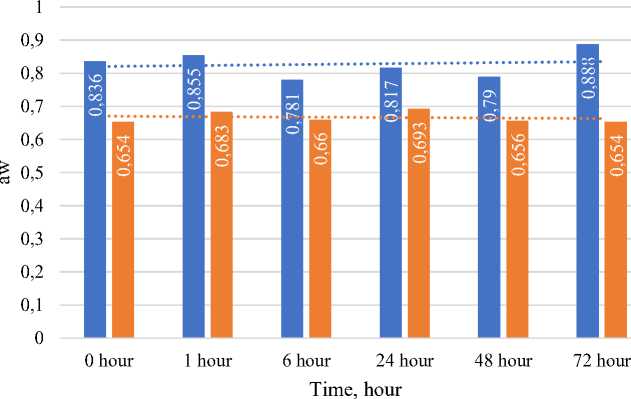
■ Control sample ■ Sample with hydrogen-enriched water
-
Figure 1. Dynamics of water activity (a w ) in cheese at different storage temperatures
The figure 1 shows the dynamics of water activity in the control sample and the sample treated with hydrogen-enriched water over 72 hours. It was found that the control exhibits higher aw values (0.781–0.888) with an increasing trend toward the end of storage, whereas the hydrogen- treated sample shows lower and more stable values (0.654–0.693). The use of hydrogen-enriched water reduces aw by 0.12–0.20 units and limits its fluctuations, indicating a pronounced stabilizing and antimicrobial effect, contributing to improved product preservation.
Dynamics of рН
■ Control sample ■ Sample with hydrogen-enriched water
-
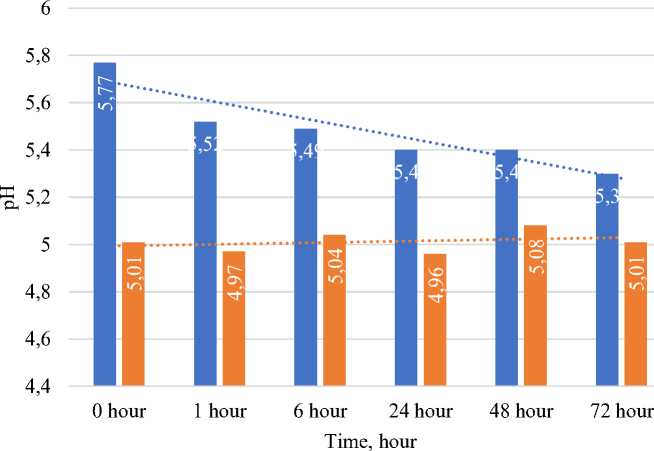
Figure 2. Changes in cheese pH at different storage temperatures
The figure 2 illustrates the pH dynamics of the control sample and the sample treated with hydrogen-enriched water over 72 hours. The control sample shows higher pH values (5.77–5.30) with a gradual decrease during storage, while the hydrogen-treated sample maintains lower and more stable pH values (4.96–5.08). The application of hydrogen-enriched water results in a slight acidification and reduced pH fluctuations, indicating a stabilizing effect and creating less favorable conditions for microbial growth, thereby enhancing product stability during storage.
Dynamics of oxidation-reduction potential (ORP)
w 80
■ Control sample ■ Sample with hydrogen-enriched water
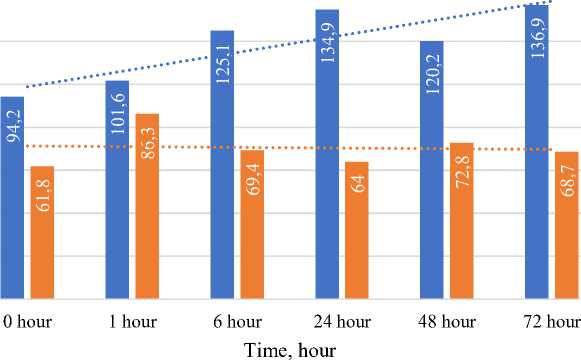
Figure 3. Dynamics of brine ORP over 72 h (mV, mean ± SD)
The figure shows the dynamics of oxidation–reduction potential (ORP) in the control sample and the sample treated with hydrogen-enriched water over 72 hours. The control sample exhibits higher ORP values (94.2– 136.9 mV) with a steady increase during storage, indicating progressive oxidative conditions. In contrast, the hydrogen-treated sample demon- strates significantly lower ORP values (61.8–72.8 mV) with minor fluctuations. The use of hydrogen-enriched water reduces ORP by approximately 30–70 mV, confirming its pronounced reducing and antioxidant effect, which contributes to the inhibition of oxidative processes and improves product stability during storage.
■ 0 hour’ ■ 1 hour’ ■ 6 hour 24 hour’ ■ 48 hour’ ■ 72 hour
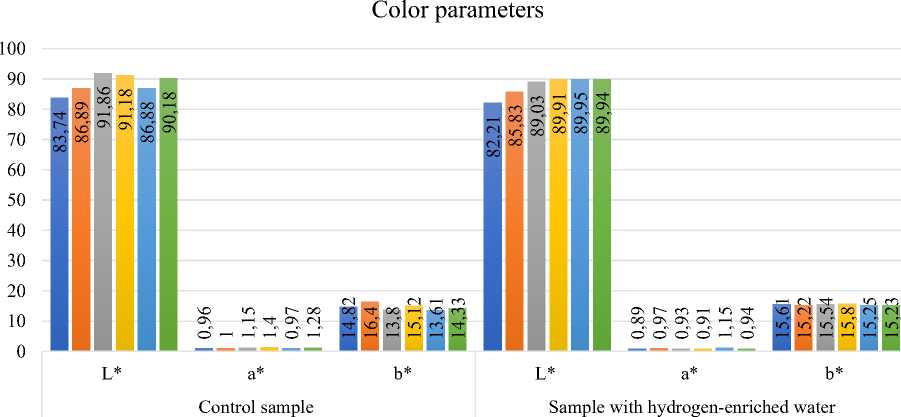
Figure 4. Color dynamics over 72 h of contact with brine
Changes in color parameters (L*, a* , b*) during contact with brine
Color is an important quality indicator of soft brined cheese, reflecting both product freshness and the degree of oxidation. The color coordinates L* (lightness), a* (red–green), and b* (yellow–blue) were measured for all samples of soft brined cheese: in water-based brine and hydrogen-enriched brine.
The figure presents the changes in color parameters (L*, a*, b*) of the control sample and the sample treated with hydrogen-enriched water over 72 hours. In the control, a slight decrease in lightness (L*) and minor fluctuations in a* and b* values are observed, indicating gradual color changes during storage. In contrast, the hydrogen-treated sample shows more stable L* values and lower variability in a* and b*. The use of hydrogen-enriched water helps preserve color characteristics, demonstrating an antioxidant effect and reducing pigment degradation, thereby maintaining product visual quality during storage.
Conclusion
The conducted study demonstrated that the incorporation of hop extract during the production of soft brined cheese, followed by storage in hydrogen-enriched brine, represents an effective technological approach for improving product stability. The application of hop extract at a dose of
200 mL per 10 L of milk in combination with hydrogen-enriched brine contributes to the reduction of oxidative processes, stabilization of physicochemical parameters (a w 0.638–0.640, pH 4.96–5.08), and maintenance of low redox potential values. Microbiological analysis showed that the total viable count (TVC) in experimental samples remained at a low level (1.0–1.2 log CFU/g), while pathogenic microflora were not detected. In addition, improved stability of color characteristics was observed during storage. Thus, the combined use of hop extract and molecular hydrogen can be considered a promising approach for enhancing the stability of soft brined cheese and potentially extending its shelf life without the use of synthetic preservatives.
Funding information: This research was funded by the Committee of Science of the Ministry of Science and Higher Education of the Republic of Kazakhstan (grant No. BR24992914).
