
The Effects of NTC Methods on Vocabulary Acquisition in Preschool Children
Journal: International Journal of Cognitive Research in Science, Engineering and Education @ijcrsee
Article in issue: 2 vol.14, 2026.
Free access
Introduction/Objective: Lexical development in early childhood is important for later literacy and academic success. This experimental study investigated the effectiveness of the NTC (Nikola Tesla Center) learning system, a pedagogical approach integrating movement, associative thinking, and play, on mother tongue vocabulary acquisition in preschool-age children. Methodology: A pre-test/post-test control group design was employed with 40 children (aged 22–34 months; 20 boys and 20 girls), equally divided into experimental and control groups. Participants completed a 20-item picture vocabulary test at three time points: initial, middle, and final. During four weeks, the experimental group participated in 12 NTC-based workshops involving motor-cognitive polygons, riddles, and associations, while the control group received standard curricular activities covering the same concepts. Due to non-normal data distribution, non-parametric statistics were used. Results: Groups did not differ significantly at initial testing (p > .05). Significant improvement over time was found for 19 of 20 target words in the experimental group (p < .05). The experimental group also demonstrated significantly greater vocabulary gains than the control group (p < .05), particularly for initially less familiar concepts, including iron, garlic, hyacinth, and nail. Progress was independent of age and gender, while dialectal forms were frequently replaced with standard forms by final testing. Conclusion: The findings suggest that integrating movement, associative thinking, and cognitive challenges may support vocabulary acquisition in early childhood. The greatest progress on less familiar words indicates potential benefits for deeper semantic learning. NTC-based activities may therefore represent a useful pedagogical approach for supporting lexical development and standard language competence in preschool children.
Short address: https://sciup.org/170213609
IDS: 170213609 | UDC: 811.163.41’373-053.4 | DOI: 10.23947/2334-8496-2026-14-2-331-341
Text of the scientific article The Effects of NTC Methods on Vocabulary Acquisition in Preschool Children
Mother tongue acquisition represents one of the most important developmental processes in early childhood and is connected with the overall cognitive, emotional, and social development of the child. Language development includes not only the acquisition of new words but also the development of meaning comprehension, symbolic thinking, connecting concepts, attention, memory, and communication ability. In the period of early and preschool age, the child’s brain shows a high degree of neuroplasticity, which is why experiences from the environment have a significant impact on the formation of neural networks responsible for speech, thinking, and learning ( Kolb and Gibb, 2011 ).

© 2026 by the authors. This article is an open access article distributed under the terms and conditions of the Creative Commons Attribution (CC BY) license .
language comprehension and vocabulary development.
Numerous studies ( Pavličević-Franić, 2005 ; Jelaska, 2007 ; Aladrović Slovaček, 2019 ) confirm the connection between motor development and the development of higher cognitive functions. Diamond (2000) points out that motor activities are connected with the development of executive functions, attention, and learning abilities, while Piaget (1977) emphasizes that the development of thinking and language in children is based on active interaction with the environment. Vygotsky (1978) further indicates the importance of social interaction and play in the development of speech and thinking, believing that a child develops higher mental functions through joint activities and problem-solving situations.
In contemporary education, problems related to reduced attention, weaker vocabulary development, and difficulties in functional comprehension of read text among school-age children are increasingly pointed out. Therefore, the need for innovative learning approaches that actively involve the child and encourage thought processes instead of passive memorization of facts is growing.
The NTC Child Development Support System (abbreviated as NTC system) represents a pedagogical approach. The NTC system is based on activities designed to stimulate cognitive processes involved in learning, through activities that integrate movement, associative thinking, symbolic connection, problem-solving situations, and learning through play ( Rajović, 2013 ). Activities such as hidden words, associations, illogical stories, puzzles, and motor-cognitive tasks have special importance in NTC as they encourage the activation of cognitive processes involved in learning.
In the area of mother tongue acquisition, NTC methods can have special significance because the child does not acquire new words through mechanical repetition but through connecting concepts, emotions, movements, and experiences. Such an approach can contribute to better understanding of word meanings, more efficient memorization, and greater functional use of language in everyday situations. The child’s active participation in learning further increases motivation, attention, and interest in language activities.
Starting from these theoretical foundations, the main aim of this research is to examine the effects of NTC methods on vocabulary acquisition and lexical development in preschool children.
Lexical and Semantic Development
Parallel to grammatical development, lexical development also occurs, i.e., the process of word acquisition and the gradual construction of the child’s mental lexicon. This is the most dynamic process of language development, which does not end when the child starts school but continues to develop almost throughout life ( Hržica et al., 2015 ). Lexical development begins with the first word to which the child gives meaning and continues, with the child understanding many more words during the first year of life than they can independently pronounce. By the age of two, the child’s vocabulary expands to approximately 50 to 200 expressions. During the second and third years of life, many children experience a rapid increase in vocabulary known as lexical spurt, when the child almost daily includes new words in their active vocabulary, often after just one encounter with them ( Fenson et al., 1994 ). Vocabulary acquisition can be observed through receptive vocabulary, i.e., words the child understands, expressive vocabulary, i.e., words the child actively uses, thematic and lexical categories, i.e., types of words, and strategies for learning new words, which refers to inferring meaning from context, imitation, explicit teaching, and the like.
A significant stimulus for vocabulary development is provided by everyday situations in which the child actively participates – such as feeding, dressing, playing, and symbolic activities – as well as purposefully designed language situations in the family and preschool environment. Precisely through such interactions, the child connects words with concrete experiences, which contributes to deeper understanding and more permanent acquisition of concepts. Research shows that parents and educators who use a diverse and rich vocabulary, clearly name objects, describe actions and emotional states, and encourage the child to express themselves verbally significantly accelerate the lexical development process (Hoff, 2006). During this process, various language errors are common and are considered an integral part of natural language acquisition. Such errors, including overly broad or overly narrow use of words, indicate the child’s attempt to actively apply new knowledge, which is a sign of cognitive processing and formation of lexical categories. Thus, in lexical development, neologisms appear, i.e., new words the child uses to cover their so-called “lexical gaps,” i.e., ignorance of certain words, so they invent them, with examples from Croatian/Serbian child language that include strujakač for utikač (plug), pišalica for olovka (pencil), tepihač for otirač (doormat), and the like (Pavličević-Franić, 2005). From all these examples, it can be seen that the child understands word formation but lacks semantic knowledge, which they gradually acquire. Also, the child hypergeneralizes in this process, calling all four-legged animals, for example, “dog,” or hypospecifics by using limited word use in a familiar context. All these errors show that the child is actively building and testing their linguistic system and should be viewed as an integral part of the process of natural language acquisition, not as developmental difficulties. Lexical development in preschool age has long-term implications because it is strongly correlated with later literacy development, comprehension of read content, and school achievement. Children who acquire a richer vocabulary in early childhood are associated with more advanced cognitive strategies, more pronounced verbal abilities, and a higher degree of social competence (Tabors et al., 2001). Furthermore, vocabulary development is directly connected with the reading process, and reading comprehension will greatly depend on vocabulary development and knowledge of semantic categories. The results of standardized tests (PISA, 2018 and PIRLS, 2021) show that reading competencies and skills are directly connected with vocabulary development because reading diverse texts and exposure to different words in various functional styles yields better results, as does motivation, which is built as early as the early language period. Although this research focuses on the vocabulary of early and preschool children, these results of international research on reading competence confirm that poorer reading habits, which are developed precisely at this age, consequently have a poorer vocabulary and, consequently, poorer reading competence. Namely, if a child does not understand 90-95% of the words in a text, he or she has difficulty in reading comprehension, which is an increasingly common problem for children of primary school age. Therefore, the development of vocabulary at an early age is important as a predictor of, among other things, reading competence.
Finally, the importance of lexical development in preschool age is reflected not only in the number of acquired words but also in the way the child uses language to express thoughts, emotions, and needs. Through everyday situations and interactions, the child gradually builds their own vocabulary and develops increasingly complex language patterns. The role of adults in this process is extremely important because they, through their example, patience, and encouragement, shape the language environment that can accelerate or slow down this development. Precisely for this reason, it is necessary to be aware of how valuable every word, question, or comment addressed to the child is as an opportunity for learning and progress, i.e., the richer and more sensitive the environment is to the child’s communication needs, the more long-term and significant the results in vocabulary development will be.
NTC Child Development Support System
The NTC (Nikola Tesla Center) learning system represents a neuro-pedagogical approach that integrates cognitive, motor, and language development through play, movement, and thought activation ( Rajović, 2018 ). The underlying mechanism of this approach can be conceptualized as follows: NTC activities → active child engagement → connection between concepts and experiential learning → enhanced word retention → richer vocabulary development. Through carefully designed tasks, children acquire language structures spontaneously during play and interaction, simultaneously expanding vocabulary and developing syntactic and semantic competence ( Rajović, 2013 ).
The core mechanisms of the NTC method include: creating associations (connecting words with movements, objects, or situations); developing thought categories (classification and differentiation of concepts); learning through puzzles and logical problems (verbal problem-solving); word play (rhyme, rhythm, and homonyms for phonological awareness); and movement as language support (verbal expression accompanying physical activity) ( Rajović, 2013 ). In practice, children are encouraged to express themselves through complete sentences during play—describing situations, conveying information, or reacting to verbal instructions—within emotionally engaging contexts that enhance attention and motivation ( Rajović, 2018 ).
The NTC system is grounded in several key principles: early stimulation of developmental potential through activities targeting critical periods of neuroplasticity; active learning through play and movement that connects motor and cognitive development; associative and divergent thinking that encourages concept connection and meaning creation; emotional engagement through humor and interactive tasks; and coordination between family and institutional environments to ensure optimal development ( Rajović, 2018 ). Special emphasis is placed on developing functional knowledge—the child’s ability to apply acquired language skills in real situations rather than merely reproducing them mechanically.
Practical applications include activities such as visual-verbal integration (recognizing and naming moving objects), word play (rhymes, opposites, syllable combinations), and motor-cognitive games. A typical example involves children performing physical tasks (e.g., jumping over marked fields) while simultaneously responding to verbal prompts—classifying words by grammatical category, naming objects, or creating sentences. Other activities encourage spatial-temporal orientation (“Stand below, go above”) or logical sequencing (“First take... then put... finally show...”). The “language path”—a physical polygon where children complete motor tasks while responding to verbal challenges—exemplifies tasks integrated into daily practice (Rajović, 2013). And it is of great importance to mention, although NTC methods have gained popularity in educational practice, empirical evidence regarding their effectiveness remains limited and requires systematic evaluation. And, to be more specific, empirical evidence regarding the effectiveness of NTC methods in early vocabulary acquisition remains limited.
Aim, Problems, and Hypotheses of the Research
The main aim of this research is to examine the effects of NTC methods on vocabulary acquisition and lexical development in preschool children
The following research tasks arise from the main aim:
-
1. To assess children’s ability to name target concepts based on visual stimuli.
-
2. To examine whether the use of NTC methods has a statistically significant effect on the lexical development of early-age children in terms of the number of correctly named terms before and after of using NTC methods in preschool teaching
-
3. To determine whether there is a statistically significant difference in results with respect to the group to which participants belong: control and experimental.
In accordance with the main aim and research tasks, the following hypotheses are set:
-
H1 : It is expected that the experimental group will be more successful in acquiring lexical concepts than the control group precisely due to exposure to NTC teaching methods.
-
H2 : Children will achieve higher initial scores for familiar everyday concepts compared with less frequently encountered concepts.
-
H3 : Children exposed to NTC activities will show improvement in naming target concepts after the intervention.
Methodology
Description of the Sample and Research Implementation Method
The research was conducted in two toddler educational groups with a total of 40 children in one kindergarten in Slavonia, Croatia with children from the age of 2 to 3 years old. One group was the control group and the other the experimental group, with 20 children tested in each group. The sample included a total of 20 boys and 20 girls, evenly distributed in both groups. Before the start of the research, consent forms were distributed to parents for participation in the research, and only those children whose parents signed the consent form participated in the research, in accordance with the Code of Ethics for Research with Children.
In the experimental group, activities were conducted three times a week within a time frame of 4 weeks, from March 17, 2025, to April 17, 2025. Participants were tested before the start of the research, after two weeks, and after the completion of the research, and all their answers were recorded in a research table created for the purposes of this research. Participants in both the control and experimental groups were tested at the same time intervals, and only participants in the experimental group were exposed to NTC activities during the month of experiment implementation. The design of the conducted research was quasi-experimental pretest-posttest control group design
Due to a small sample (N = 40), the Shapiro-Wilk test was used to determine the distibution of the data.
Research Instrument
For the purposes of this research, a test was created in which students were required to name a concept after the researcher showed them a picture containing that concept. The terms were selected from picture books that are read to children of this age in accordance with the Early Childhood and Preschool Education Curriculum. A pilot study was conducted to check the appropriateness of the se- lected items. Based on the results of the pilot study, an analysis of the items was conducted, including an assessment of their discriminativeness, and the internal consistency of the test was assessed using Cronbach’s alpha coefficient (α = 0.84). In accordance with the results of the analyses, some items were excluded, and the final version of the test was used in the main study.All forms of the stated concept with possible mispronunciations or naming of the concept in dialect were taken as correct answers. The concepts were chosen from the children’s immediate reality, from picture books that were read during that period, and were connected to categories of words that participants were more intensively producing and encountering during that period. The selected concepts that were tested and later processed through NTC methods were the following: glista, šešir, jaglac, visibaba, oblak, grablje, tepih, šuma, planina, kotač, vješalica, glačalo, češnjak, merkat, šiljilo, zumbul, gumb, košara, kupus, čavao. These concepts translate to: earthworm, hat, primrose, snowdrop, cloud, rake, carpet, woods, mountain, wheel, hanger, iron, garlic, meerkat, sharpener, hyacinth, button, basket, cabbage, nail. A total of 20 concepts were tested, several of which contain palatal consonants and are therefore more difficult to pronounce (e.g., čavao, češnjak, šiljilo). Also, these are representable concepts that are easy to depict visually. The words were selected from stories that are read to children of that age according to the Curriculum for Early and Preschool Education. Given that the words need to represent both terms that appear more frequently and those that appear less frequently in order for the test to be valid, the term “merk” was chosen as a term that is not common in children’s vocabulary of that age, but that is precisely why it is a good example of a term that can be acquired using different working methods or through reading, given that it appears in a story, and children of that age are happy to name terms from the animal category.
To conduct the research in the experimental group, participants were exposed to NTC methods for one month, three times a week. These activities were most often implemented in the form of a polygon with stations that participants had to follow and, during the performance, perform other language tasks, such as naming a concept from a card, listing concepts, categorizing concepts, naming concepts, and the like. The polygons contained elements of crawling, walking, climbing, descending, jumping, threading, throwing, and the performance required coordination, balance, precision, and flexibility. Three different types of polygon setups were used. Also, before the polygon, there was always a warm-up and familiarization with the concepts that participants had to place in different contexts (The earthworm comes out in the rain., There is a wolf in the forest., The button is on the shirt.). All activities were implemented by educators. In the experimental group, educators prepared activities using the NTC method, and in the control group, educators prepared activities in the classic, or standard, way that is usually done with children of that age. Each activity lasted about 20 minutes, which is how long activities in kindergarten usually last, in accordance with the children’s attention span and other tasks that are carried out during a pedagogical day. In the control group, the teacher simultaneously encouraged the children to acquire the same target words in the classic way, as is usually done in preschool institutions, following the given plan and program, but without using the NTC teaching method. The control group spent around the same time partaking in activities for learning the words with the teacher. During the experiment implementation, participants were tested three times: at the beginning, in the middle, and at the end, and the results were compared in this way.
Results
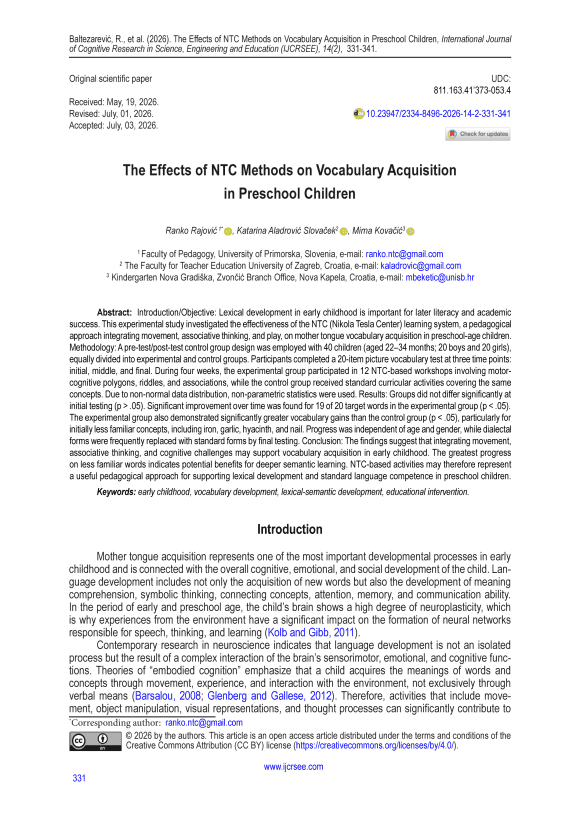
The first research task was to determine the knowledge of target words at the recognition level. Namely, the initial word knowledge test was done in both groups to see if they differed in initial knowledge [Graph 1]. The Shapiro-Wilk test showed that there was no statistically significant difference in knowledge of each target word (p > 0.05, df = 39).
■ control group ■ experimental group
Graph 1. Display of arithmetic means – knowledge of target words (initial testing)
Initial results showed that participants were most successful in knowing the target words: basket, hat, cloud, and cabbage. The findings may indicate that familiarity with everyday experiences contributes to better initial word knowledge. Basket is a word often associated with the fairy tale Little Red Riding Hood, cabbage is often on their daily menu, hat they associate with a clown, and clouds are often mentioned in the context of weather conversations, and children of that age often draw them. The concepts primrose, garlic, market, sharpener, hyacinth, button were words whose meaning most participants could not determine, probably because they were not used in their speech environment. These results confirm the first set hypothesis, which expected that children in the initial testing would be more familiar with concepts from their everyday environment than with other concepts, such as, e.g., market.
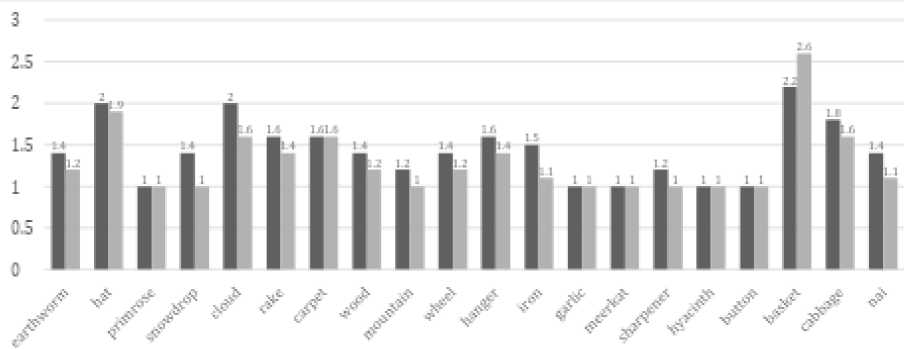
The second research problem was to examine whether the use of NTC methods has a statistically significant effect on the lexical development of early-age children. The results of the initial, middle (after 2 weeks of experiment implementation), and final testing are presented. The first display [Graph 2] shows the results of the first six tested words: earthworm, hat, primrose, snowdrop, cloud, rake. For all six words, the Kruskal-Wallis test (p < 0.05, df = 39) shows that there is a statistically significant difference between the initial, middle, and final testing. Namely, during the experimental implementation of the program that included NTC methods, children demonstrated improved retrieval of target words.
Graph 2. Display of initial, middle, and final results of word recognition testing: earthworm, hat, primrose, snowdrop, cloud, and rake
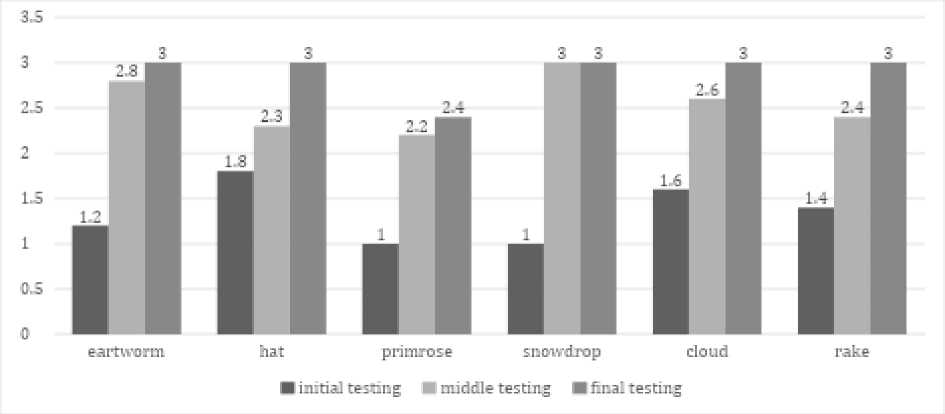
The second display [Graph 3] shows the results of the other seven tested words: carpet, forest, mountain, wheel, hanger, iron, and garlic. For all seven words, the Kruskal-Wallis test (p < 0.05, df = 39) shows that there is a statistically significant difference between the initial, middle, and final testing. These findings suggest that the use of NTC methods may be associated with lexical development.
3 5
carpet wood mountain wheel hanger iron garlic
■ initial testing ■ middle testing ■ final testing
Graph 3. Display of initial, middle, and final results of word recognition testing: carpet, forest, mountain, wheel, iron, hanger, garlic
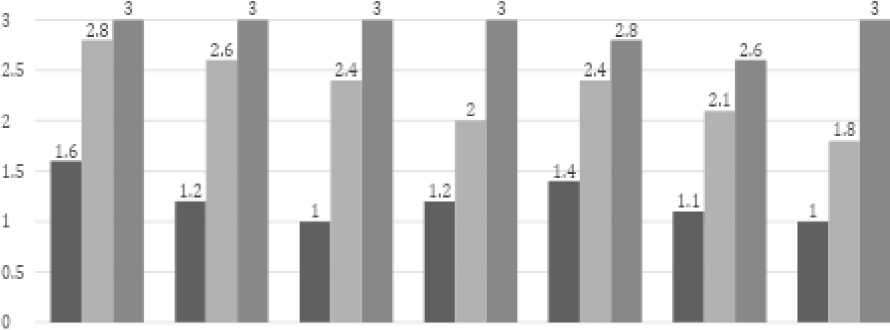
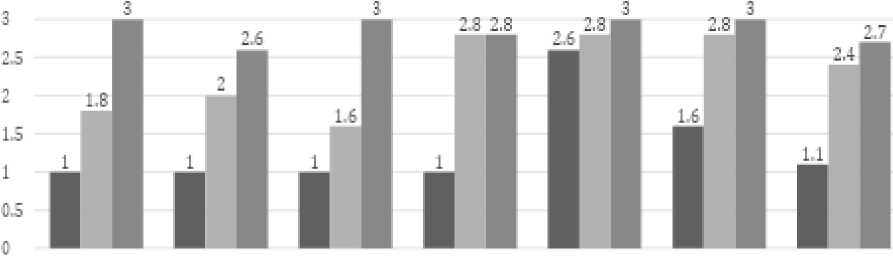
The third display [Graph 4] shows the results of the last seven of the twenty tested words: market, sharpener, hyacinth, button, basket, cabbage, and nail. For six of the seven words, the Kruskal-Wallis test (p < 0.05, df = 39) shows that there is a statistically significant difference between the initial, middle, and final testing. There is no statistically significant difference only for the word “basket” (p > 0.05, df = 39). For these seven words, the findings suggest a positive association between the use of NTC methods and lexical diversity, indicating their potential to support the development of lexical competence.
3.5
meerkat sharpener hyacinth button basket cabbage nail
■ initial testing ■ middle testing ■ final testing
Graph 4. Display of initial, middle, and final results of word recognition testing: market, sharpener, hyacinth, button, basket, cabbage, nail
The analysis of the conducted tests on target words shows that all concepts have a tendency to grow during the research. The arithmetic mean values in the initial testing vary between 1.0 and 2.6, while in the final testing almost all reach 3.0. Concepts such as hanger, iron, and garlic do not reach the maximum value of 3, but still record significant progress. In accordance with the obtained results, the second set of hypotheses was partially supported. The findings suggest that children demonstrated progress in lexical development after participating in activities based on NTC teaching methods.
The third research problem was to determine whether there is a statistically significant difference in results with respect to the group to which participants belong: control and experimental. The results of the Mann-U-Whitney test show that there is a statistically significant difference in the overall results of the control and experimental groups (p < 0.05, df = 39) [Graph 5]. If we look at individual words, a statistically significant difference between the control and experimental groups exists for the words iron, garlic, market, hyacinth, nail (p < 0.05, df = 39) and in the overall result (p < 0.05, df = 39). The results show that children in the experimental group successfully acquired all concepts, especially those that were less familiar to them in the initial testing. The obtained results are consistent with the hypothesis that the experimental group demonstrated greater success in acquiring lexical concepts than the control group after participating in activities based on NTC teaching methods.
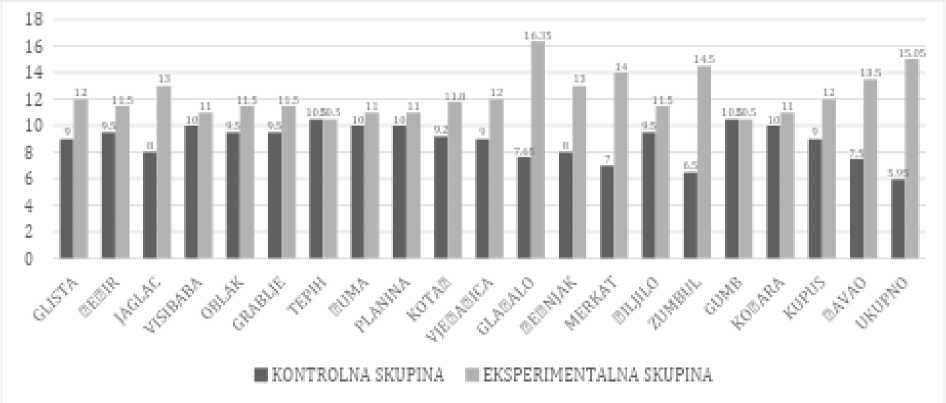
Graph 5. Display of results for each target concept – results of the control and experimental groups
During all three testing points, it was observed that children name concepts in their organic idiom, which is completely expected and in accordance with developmental age. During the early period, children are “immersed” in the language and speech of their environment, which significantly affects the development of lexical competence. For example, instead of glačalo (the standard word for iron), a very common answer was pegla, a foreign word very often used in dialect in spoken language. Also, participants often used the dialectal expression točak instead of kotač (wheel). When naming the concept čavao (nail), they also often used the dialectal form ekser. Dialectal words appeared significantly more often in the initial testing, while by the end of the research children gradually acquired additional standard-language labels alongside familiar dialect forms, given that during the encouragement of children’s lexical development using NTC methods and approach, standard forms of these words were used. Half of the participants who used regional lexical forms in the initial testing used standard forms of these words in the final testing. This research also partially supported that dialect, especially in early age, affects the learning of concepts from the immediate environment, i.e., that children name some concepts in their organic idiom.
Discussion
Based on the presented results, it can be concluded that the research provided preliminary evidence of the potential contribution of NTC methods on the lexical development of early-age children. The findings confirm all four set hypotheses and indicate the importance of systematically encouraging vocabulary development through activities that include play, connecting concepts, and active cognitive engagement of the child.
Initial Level of Knowledge of Target Words
The results of the initial testing showed that there were no statistically significant differences between the control and experimental groups in knowledge of target words, indicating comparable initial levels of performance between groups. and enabling reliable monitoring of the effects of the experimental program. Children best recognize concepts belonging to their everyday experience and immediate environment, such as basket, hat, cloud, and cabbage. In contrast, they were less familiar with less common concepts such as primrose, hyacinth, market, or sharpener. This pattern confirms that early lexical development predominantly relies on the frequency of contact with certain concepts and their use in the family and peer environment. The findings are in accordance with theoretical assumptions about situational and experiential language learning, according to which words are first acquired through everyday communication, which is consistent with the findings of other research (Filipe et al., 2023).
Effectiveness of NTC Methods in Lexicon Development
The results obtained during the middle and final measurements showed statistically significant improvement in knowledge of almost all target words. For most concepts, a continuous increase in scores from the initial to the final testing was observed, with arithmetic means reaching or approaching the maximum value. This pattern suggests that children demonstrated an improved ability to retrieve and use newly introduced lexical items, which is consistent with the findings reported by Spataro et al. (2024) and Scionti et al. (2023) .
Particularly noteworthy is the finding that the greatest improvement was observed for the words that were least familiar to children at the beginning of the study. This pattern suggests that NTC methods may have supported not only the consolidation of existing knowledge but also the acquisition of new and less familiar concepts. It is possible that activities based on connecting information, associative learning, movement, and problem-solving contributed to children’s ability to acquire and recognize new lexical units. This interpretation is consistent with the findings of Filipe et al. (2023) , Spataro et al. (2024) , and Scionti et al. (2023) , who reported associations between working memory, cognitive flexibility, executive functions, and language and vocabulary development.
The only exception was the word basket , for which no statistically significant difference between measurements was observed. One possible explanation is that this concept was already familiar to most participants at the beginning of the study, leaving limited opportunity for further improvement. This pattern may reflect a ceiling effect, whereby high initial performance reduces the likelihood of detecting statistically significant gains, a phenomenon also reported by Flores et al. (2020) .
Differences Between the Experimental and Control Groups
Comparison of the control and experimental groups showed a statistically significant advantage of the experimental group in overall achievement, as well as with several individual concepts that were less familiar to children at the beginning of the research (iron, garlic, market, hyacinth, and nail). These findings suggest that the observed improvement may be associated with NTC activities. This finding can be connected with Flores et al. (2020) , which shows that children acquire new meanings by connecting new words with already existing lexical networks.
It is especially important that differences between groups are most clearly observed precisely with more complex and less familiar concepts. This shows that the NTC approach has its greatest effect in situations where it is necessary to expand children’s vocabulary beyond everyday experience. Such results partially support the notion that the NTC program represents an effective model for encouraging lexical diversity and enriching the vocabulary of preschool-age children. This finding is supported by Anderson et al. (2025) , who emphasize that a rich language environment contributes to vocabulary development and school readiness.
Influence of Dialect on Lexical Development
The research results also indicate a significant role of dialect in early language development. During the initial testing, children often used local or regional lexical forms, such as pegla instead of glačalo (iron), točak instead of kotač (wheel), and ekser instead of čavao (nail). This phenomenon is expected at an early age because lexical development occurs primarily within the language environment in which the child grows up.
However, it is interesting that during the research, there was a gradual increase in the use of standard language forms. Since standard words were consistently used during NTC activities, a significant number of children gradually acquired additional standard-language labels alongside familiar dialect forms. This finding may be related to the phenomenon that NTC methods, in addition to contributing to vocabulary enrichment, could possibly also have an important role in the development of standard language competence, without suppressing the child’s natural dialectal identity. This is in accordance with the findings of Muir et al. (2023) and Kellens et al. (2023), which indicate that programs based on active participation, interaction, and self-regulation have positive effects on the cognitive and language development of preschool children.
Overall, the research results confirm that the lexical development of early-age children is strongly connected with experience, frequency of exposure to concepts, and the quality of pedagogical stimuli. The application of NTC methods proved to be an effective approach for expanding vocabulary, acquiring new concepts, and improving lexical competence. It is especially significant that the greatest effects were achieved with less familiar words, indicating the potential of the NTC approach to encourage the development of higher levels of language functioning. At the same time, the results confirm the importance of the dialectal environment in early language acquisition, but also the possibility that through planned educational activities, standard language expression can be successfully developed. These findings indicate that NTC methods deserve further empirical evaluation, as a means of encouraging the child’s linguistic, cognitive, and overall development. The previous findings are in accordance with the findings of Torppa et al. (2021) and the review by Dilla and Jayadinata (2025) , which emphasize the importance of a stimulating family and educational environment for early language acquisition.
Conclusion
The present study provides preliminary evidence that the NTC learning system may support lexical development in early childhood. The experimental group demonstrated significantly greater vocabulary gains than the control group, particularly for less familiar concepts. These findings suggest that pedagogical activities integrating movement, associative thinking, and play may facilitate the acquisition and integration of new lexical units.
The findings are consistent with theoretical frameworks emphasizing the interconnection between motor, cognitive, and linguistic development ( Diamond, 2000 ; Glenberg and Gallese, 2012 ). By engaging children in activities requiring simultaneous physical coordination and verbal production, the NTC method may support cognitive processes involved in vocabulary learning while fostering intrinsic motivation and curiosity, both of which have been identified as important factors in children’s later literacy development.
Nevertheless, the findings should be interpreted with caution due to the limited sample size, relatively short intervention period, and focus on typically developing children within a single preschool setting. Consequently, the results cannot be readily generalized to children with diagnosed language difficulties, different educational contexts, or older age groups. Future research should employ longitudinal designs, larger and more diverse samples, and additional outcome measures to examine the durability of vocabulary gains and the extent to which they transfer to broader language and literacy skills, such as reading comprehension and expressive writing.
Despite these limitations, the findings suggest that the NTC method may represent a valuable addition to preschool educational practice. If supported by further research, its systematic integration into preschool curricula could contribute to vocabulary enrichment and the development of foundational communication competencies that underpin later learning.
