
The Mosaicity of Habitats as a Factor Of Stability of the Population of Dimorphopterus spinolae (Heteroptera, Lygaeidae) in the Process of Postpyrogenic Succession in the East-European Forest-Steppe
Journal: Bulletin of Nizhnevartovsk State University @vestnik-nvsu
Section: Экология животных
Article in issue: 2 (74), 2026.
Free access
Based on the results of quantitative surveys conducted from 2021 to 2024, the dynamics of abundance and spatial distribution of the xerophilic species – the bug Dimorphopterus spinolae Signoret (1857) (Heteroptera, Lygaeidae) – were studied on a former fire site in the Usmansky Forest (Voronezh Region), formed after the 2010 fire. The formation of a stable population grouping of the species was established. Significant interannual fluctuations in abundance were revealed, with a peak in 2021 followed by a subsequent decline. During the period of maximum abundance, its average values ranged from 10.88 (in the Calamagrostis-Chenopodium association) to 17.88 (in the Festuca-Calamagrostis association) individuals per 100 sweeps with a standard net. In 2023, with the minimum abundance of the species in different plant associations, it decreased by 2.6–11 times. The main limiting factors for the abundance of D. spinolae were high temperature maxima and prolonged drought periods. These factors led to premature drying and hardening of the vegetative parts of the main food plant, Calamagrostis epigeios, which worsened its quality for feeding the nymphs and adults of the bug. The greatest decline in the abundance of D. spinolae was noted in the most xerophilic area occupied by the Festuca-Calamagrostis association (1.63 individuals per 100 sweeps). Under prolonged abiotic stress towards xerophily, more mesophytic conditions ensured better preservation of the food base and a more favorable microclimate, providing for the preservation of the local population grouping of the species. The obtained data indicate the naturalization of the typical meadow-steppe species, the bug D. spinolae, in the conditions of a forming xerophilic biotope in place of the fire site and reflect the general trend of xerophily in the post-fire ecosystem in the Eastern European forest-steppe zone.
Similar articles in the section Articulata
Short address: https://sciup.org/14138399
IDS: 14138399 | UDC: 595.754:574.34 (470.324) | DOI: 10.36906/2311-4444/26-2/01
Мозаичность местообитаний как фактор устойчивости популяции Dimorphopterus spinolae (Heteroptera, Lygaeidae) в процессе постпирогенной сукцессии в Восточноевропейской лесостепи
На основе результатов количественных учетов 2021–2024 гг. прослежены динамика численности и пространственное распределение ксерофильного вида – клопа Dimorphopterus spinolae Signoret (1857) (Heteroptera, Lygaeidae) на участке бывшей гари в Усманском бору (Воронежская область), образовавшейся после пожара 2010 г. Установлено формирование устойчивой популяционной группировки вида. Выявлены значительные межгодовые колебания численности с ее пиком в 2021 г. и последующим снижением. В период с максимальной численностью ее средние значения находились в пределах от 10,88 (вейниково-маревая ассоциация) до 17,88 (типчаково-вейниковая ассоциация) экз./100 взмахов стандартным сачком. В 2023 году с минимальной численностью вида в разных растительных ассоциациях она снизилась в 2,6–11 раз. Основными лимитирующими факторами численности D. spinolae явились высокие температурные максимумы и длительные периоды засухи. Эти факторы привели к преждевременному усыханию и жесткости вегетативных частей основного кормового растения, Calamagrostis epigeios, что ухудшило его качества для питания личинок и имаго клопа. Наибольшее снижение численности D. spinolae отмечено на наиболее ксерофитном участке, занятом типчаково-вейниковой ассоциацией (1,63 экз./100 взмахов). При длительном абиотическом стрессе в направлении ксерофилизации более мезофитные условия обеспечили лучшую сохранность кормовой базы и более благоприятный микроклимат, обеспечив сохранение локальной популяционной группировки вида. Полученные данные свидетельствуют о натурализации типичного лугово-степного вида, клопа D. spinolae, в условиях формирующегося на месте гари ксерофитного биотопа и отражают общую тенденцию ксерофилизации постпирогенной экосистемы в Восточноевропейской лесостепи.
Text of the scientific article The Mosaicity of Habitats as a Factor Of Stability of the Population of Dimorphopterus spinolae (Heteroptera, Lygaeidae) in the Process of Postpyrogenic Succession in the East-European Forest-Steppe
Post-fire successions are among the most evident and important manifestations of the transformation of natural ecosystems, and their study is of considerable theoretical and practical interest. Most research on this process has traditionally been focused on coniferous and mixed forest zones, which are the most vulnerable ones to fire disturbance [3; 6; 8]. At the same time, the specific features of recovery processes in the forest steppe zone remain insufficiently studied. In forest steppe areas affected by fire, forestry practice is generally oriented toward artificial reforestation. However, it remains unclear to what extent natural ecosystems in forest steppe conditions are capable of self-recovery after the large-scale loss of the tree and shrub layers, and what new features they acquire during this process.
The 2010 wildfires, which represented a large-scale natural disaster, affected vast areas of the Central Russian forest steppe, causing a profound transformation of forest biocenoses that had developed over centuries and inflicting substantial ecological damage. In the Usmansky Forest (Voronezh Region), the fire had a destructive effect on the soil cover, litter layer, root systems of woody and shrubby vegetation, and the aboveground forest strata. In most of the burned area, complete sanitary logging was subsequently carried out, followed by reforestation through mixed plantations of Scots pine and silver birch. However, artificial reforestation was not implemented on a large area of 84 ha. The greater part of this territory, which retained its initial post-fire appearance after the removal of the remnants of the burned stand, was designated by researchers of Voronezh State University as a permanent monitoring site for a long-term study. The research conducted there is aimed at investigating post-fire succession, the dynamics of developing

phytocoenoses and faunal communities, and in particular assemblages of phytophagous insects under the conditions of natural forest regeneration.
The aim of the study was a comprehensive assessment of the mechanisms maintaining the stability of the population of the xerophilic phytophagous bug Dimorphopterus spinolae (Heteroptera, Lygaeidae) through analyzing a long-term dynamics of its abundance and spatial distribution in the heterogeneous conditions of a post-fire ecosystem.
Materials and Methods
The study was conducted in the southwestern part of the Usmansky Forest (Voronezh Region), within the territory of the Voronezhsky Federal Nature Reserve, in the vicinity of the Venevitinovo Biocenter of Voronezh State University (20 km northeast of Voronezh; the coordinates of the centre of the study site: 51°48’43.8” N, 39°23’40.9” E; Fig. 1). In zonal terms, the surveyed territory belongs to the Eastern European forest steppe [7]. A mixture of pine and broad-leaved species dominates the unburned forest area, primarily oak, aspen, birch, and black alder. In 2021–2024, we collected material and carried out quantitative surveys of heteropteran insects on former burn sites in order to determine species composition, dominance structure, and population dynamics. Sampling was conducted from May to October, twice a month. Quantitative surveys were performed by using sweep-net sampling, with 100 sweeps on each of the three transects established in different parts of the study site:
-
1. Transect 1 was located along the southern boundary of the compartment, in close proximity (20–40 m) to the edge of the unburned forest stand (51°48’39.4” N, 39°23’37.8” E). The transect was characterized by a pronounced ecotone effect, with increased shading and humidity due to its proximity to the forest stand. The plant association: Calamagrostis epigeios (L.) Roth – Chenopodium album L.
-
2. Transect 2 was located in the central part of the compartment, the most open and well-sunlit area, on sandy and sandy loam soils (51°48’42.0” N, 39°23’42.8” E). The transect represented the most xerophytic biotope within the study site. The plant association comprises Festuca valesiaca Schleich. ex Gaudin and Calamagrostis epigeios (L.) Roth.3. Transect 3 was located along the northern boundary of the compartment, near the Klyukvennoye-1 sphagnum bog (51°48’47.3” N, 39°23’42.8” E). The transect exhibits specific microclimatic conditions due to its position at the boundary between the xerophytic burned area and the mesophytic area adjacent to the bog. The plant community comprises Calamagrostis epigeios (L.) Roth, Chenopodium album L., and Festuca valesiaca Schleich. ex Gaudin. In addition to the burned areas, control biotopes unaffected by the 2010 fire were also surveyed:
-
1. A steppe-like site with the elements of ruderal vegetation (vicinity of Maklok settlement; 51°48’29.2” N, 39°24’46.5” E). The open biotope. The phytocoenosis is dominated by xerophytic species: baby's breath ( Gypsophila paniculata L.), field wormwood ( Artemisia campestris L.), mugwort ( Artemisia vulgaris L.), and sandy immortelle ( Helichrysum arenarium (L.) Moench), motherwort ( Leonurus quinquelobatus Gilib.), corn brome ( Bromus squarrosus L.), hill cinquefoil ( Potentilla collina Wibel), and desert madwort ( Alyssum desertorum Stapf).
-
2. The forest edge adjacent to the study site (51°48’35.0” N, 39°23’34.3” E). The tree layer is mixed, with the dominance of Scots pine ( Pinus sylvestris L.) and pedunculate oak ( Quercus robur L.). The shrub layer is well developed; common species included Russian broom ( Chamaecytisus ruthenicus (Fisch. ex Wol.) Klásk.), red elder ( Sambucus racemosa L.), verrucose spindle tree ( Euonymus verrucosus Scop.), and low serviceberry ( Amelanchier spicata (Lam.) K. Koch). The herb layer comprised grass–forb and Aegopodium–Chelidonium associations.
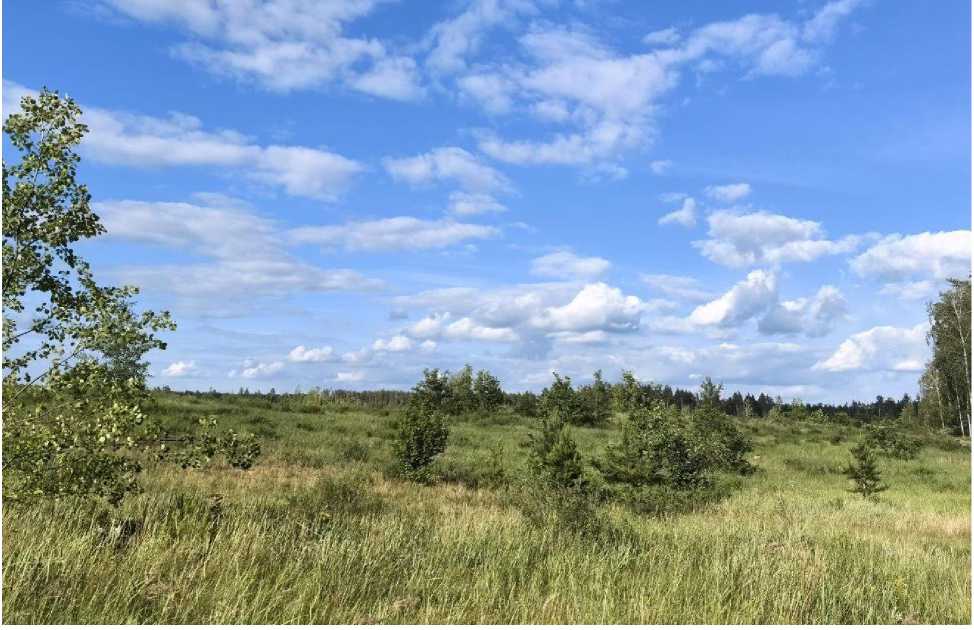
Fig. 1. Post-fire ecosystem with natural vegetation recovery in the Usmansky Forest (Voronezh Region, 2024)
Additional sampling of heteropteran insects was carried out in areas with artificial forest plantations (51°47’46.7” N, 39°23’05.3” E). The tree layer is formed by mixed plantations of Scots pine ( Pinus sylvestris L.) and silver birch ( Betula pendula Roth), with a minor admixture of aspen ( Populus tremula L.). The shrub layer is sparse, represented by single individuals of dyer’s greenweed ( Genista tinctoria L.), Russian broom ( Chamaecytisus ruthenicus (Fisch. ex Wol.) Klásk.), and red elder ( Sambucus racemosa L.). The herb layer is dominated by grasses, primarily wood small-reed ( Calamagrostis epigeios (L.) Roth) and purple small-reed ( Calamagrostis arundinacea (L.) Roth).
The spatial arrangement of the surveyed biotopes and sampling transects, as well as a photograph of the dominant heteropteran species recorded in the samples, are presented in Figure 2.

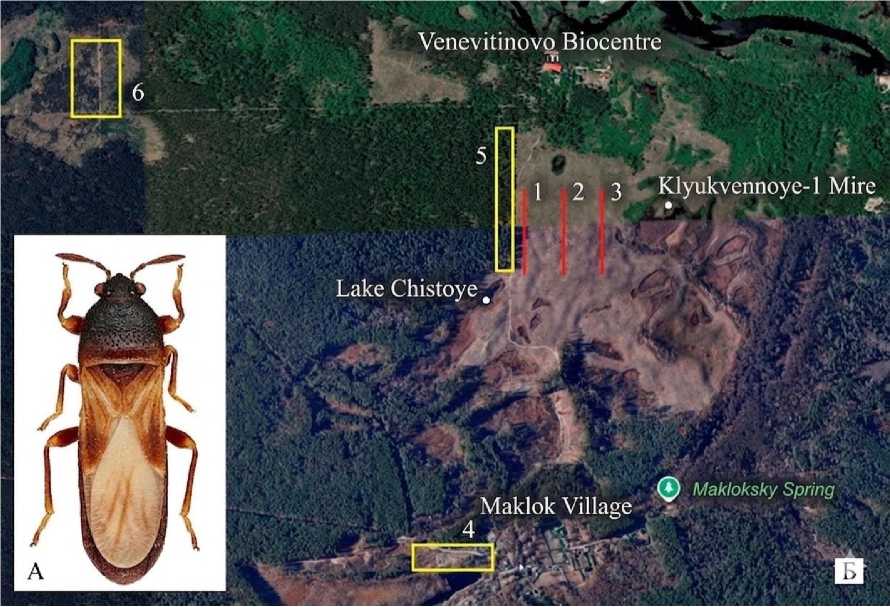
Fig. 2. Study object – the bug Dimorphopterus spinolae Signoret (A) and the layout of sampling transects and control biotopes (B) in the Usmansky Forest, Voronezh Region
1 – Transect 1; 2 – Transect 2; 3 – Transect 3; 4 – steppe-like site (vicinity of Maklok settlement);
5 – forest edge; 6 – artificial forest plantations
Meteorological conditions (mean daily temperatures and snow cover depth) were obtained from the Kordon Usmansky meteorological station by using the data from the weather service RP5 weather service (rp5.ru). Statistical processing of the quantitative data was performed by using the Microsoft Excel software.
Results and Discussion
Long-term surveys (2021–2024) revealed that the dominant species in the heteropteran assemblage of the studied post-fire area in the Usmansky Forest is the bug Dimorphopterus spinolae (Signoret, 1857), belonging to the family Lygaeidae (ground bugs). This trans-Palaearctic species is widely distributed across the southern half of Europe, reaching northwards to Denmark, Germany, Austria, the Czech Republic, Poland, and the forest zone of European Russia. In Asia, it occurs as far as Kazakhstan, southern Siberia, the Russian Far East, Mongolia, and the Korean Peninsula. The southern boundary of its European range runs through Italy, the former Yugoslavia, Moldova, and southern Ukraine, while in Asia it extends through Azerbaijan, Iran, Kyrgyzstan, and Tajikistan [9-11; 14;]. In Voronezh Region, the species was previously recorded from the vicinity of Ramon settlement [2; 11] and the Tellerman Forest [13].
In the Usmansky Forest, single individuals of D. spinolae were first recorded by us in 2016 [12]. A gradual increase in abundance of the species made it possible, starting from 2021, to conduct statistically reliable estimates of the population assemblage within the model site.
According to the published data [10; 11] and the authors’ own observations, the species is associated with relatively extensive open steppe-like habitats, light and sparsely forested stands, large clearings, and forest edges, mainly on light sandy and sandy loam soils. Trophically, the species is strictly associated with grasses, primarily wood small-reed ( Calamagrostis epigeios (L.) Roth) [4; 10; 11]. In addition, various grass species have been reported as host plants in different regions, including bearded oat-grass ( Melica nutans L.), northern wheatgrass ( Leymus angustus (Trin.) Pilg.), sea lyme grass ( Leymus arenarius (L.) Hochst.), and marram grass ( Ammophila arenaria (L.) Link) [11; 1; 5; 10; 15]. Almost all of these grass species currently occur on the postfire model site affected by the 2010 fire, with the dominance of C. epigeios .
Our analysis of species abundance across different biotopes revealed a pronounced spatial heterogeneity, correlating with the composition of vegetation formations and microclimatic conditions established on different transects (Table 1).
Table 1 Mean abundance of Dimorphopterus spinolae (Signoret, 1857) on sampling transects of the post-fire succession site in the Usmansky Forest and adjacent areas (Voronezh Region) in 2021–2024 (individuals per 100 sweeps)
|
Date of Research |
Transect 1 ( Calamagrostis-Chenopodium association) |
Transect 2 ( Festuca-Calamagrostis association) |
Transect 3 ( Calamagrostis-Chenopodium - Festuca association) |
Steppelike site |
Forest edge |
Artificial forest plantations |
|
2021 |
10.88 ± 1.61 |
17.88 ± 2.54 |
11.13 ± 1.63 |
0.71 ± 0.23 |
2.62 ± 0.73 |
2.33 ± 0.32 |
|
2022 |
4.78 ± 0.45 |
4.56 ± 1.06 |
4.33 ± 1.08 |
|||
|
2023 |
2.88 ± 0.31 |
1.63 ± 0.46 |
4.25 ± 1.06 |
|||
|
2024 |
4.86 ± 0.46 |
3.29 ± 1.01 |
5.29 ± 1.26 |
Within the post-fire area, the peak abundance of the population was recorded in 2021. By the time the quantitative surveys were initiated at the model site, more than ten years had passed since the large-scale wildfires of 2010. Over the period, stable and extensive forb-grass phytocoenoses had formed on the burned areas, with a strong dominance of wood small-reed ( Calamagrostis epigeios (L.) Roth), the main host plant of the studied species. The biotopes had developed a structure optimal for D. spinolae : open, well sun-exposed sites on light sandy soils. The highest abundance of the species was recorded on Transect 2, characterized by the most xerophytic conditions, which corresponds to the ecological preferences of the species. The weather conditions during the spring-summer period of 2021 were also favourable for overwintering adults and larval development, contributing to high survival and successful reproduction.
In 2022, a sharp decline in abundance was observed across all sampling transects. On the one hand, this may reflect natural cyclic fluctuations in population size. On the other hand, unfavourable weather conditions during critical developmental periods acted as a limiting factor. Conditions during the vegetation period, namely high temperature maxima and prolonged droughts, led to premature drying and increased rigidity of shoots of the main host plant, thereby
reducing their nutritional quality for both larvae and adults. Low precipitation conditions were also recorded during the winter. The mean snow cover depth in the winter of 2022 did not exceed 6.6 cm (Table 2).
Table 2
Temperature conditions during vegetation periods and snow cover depth in the Usmansky Forest (2021–2024)
|
Mean daily temperature, °С |
Maximum temperature, °С |
|||||||
|
2021 |
2022 |
2023 |
2024 |
2021 |
2022 |
2023 |
2024 |
|
|
April |
+8.9 |
+10.2 |
+9.9 |
+14.6 |
+24.1 |
+23.1 |
+19.9 |
+28.2 |
|
May |
+16.2 |
+11.9 |
+14.8 |
+14.0 |
+31.5 |
+27.2 |
+26.1 |
+29.5 |
|
June |
+21.0 |
+20.5 |
+17.5 |
+21.4 |
+35.0 |
+30.9 |
+27.6 |
+32.1 |
|
July |
+24.0 |
+20.9 |
+20.5 |
+23.7 |
+34.4 |
+32.6 |
+31.6 |
+34.9 |
|
August |
+23.8 |
+23.4 |
+21.6 |
+21.8 |
+35.7 |
+31.7 |
+32.4 |
+33.5 |
|
September |
+12.6 |
+11.9 |
+16.1 |
+18.6 |
+25.9 |
+22.6 |
+28.8 |
+29.3 |
|
October |
+6.8 |
+8.6 |
+7.8 |
+10.0 |
+16.7 |
+21.1 |
+24.4 |
+25.4 |
|
Mean snow cover depth, cm |
23.5 |
6.6 |
22.0 |
20.6 |
||||
The negative trend continued in 2023, when D. spinolae abundance reached its lowest values over the entire observation period. The decline was especially pronounced on the most xerophytic Transect 2. This indicates the long-term consequences of the 2022 population depression, expressed in reduced reproductive potential. A decrease in the number of adults in the previous season must have resulted in a reduced number of eggs laid and, consequently, low abundance of the 2023 generation. Notably, on Transect 3, influenced by the nearby sphagnum bog, the population density remained substantially higher. This suggests that under a continued abiotic stress, more mesophytic conditions provided better preservation of the food base and a more favourable microclimate, thereby supporting the persistence of the local population.
In 2024, a positive trend in the abundance of D. spinolae was observed, expressed as an increase across all sampling transects. A particularly marked rise in abundance was recorded on Transect 3. This increase may indicate the onset of a population recovery phase as a result of adaptation to altered environmental conditions. In addition, the weather conditions during the spring-summer period of 2024 were close to optimal for the species, providing sufficient moisture for host plant development and the absence of extreme temperatures.
The spatial distribution of D. spinolae within the study site over the entire observation period was heterogeneous, which is directly associated with the ecological requirements of the species and the specific characteristics of the three sampling transects.
The most suitable habitat for the studied xerophilic species was the Festuca-Calamagrostis association along Transect 2. It was the transect, characterized by maximum insolation, sandy soils, and dominance of wood small-reed ( Calamagrostis epigeios (L.) Roth), where the absolute peak abundance was recorded in 2021. However, that habitat also proved to be the least stable under the prolonged climatic stress of 2022–2023, when the most pronounced decline in abundance was observed. Sparse woody and shrub vegetation does not form a reliable wind barrier and does not promote the accumulation and retention of a stable snow cover. This leads to early

snowmelt in spring and, more importantly, to the absence of a stable thermal insulating layer during winter temperature minima. As a result, overwintering adults located in the litter layer or at the bases of grasses are more vulnerable to mortality during frosts and sharp temperature fluctuations in early spring.
Transect 1 ( Calamagrostis-Chenopodium association) occupied an intermediate position in terms of species abundance during the peak year of 2021. Proximity to the undisturbed forest stand, which provided increased shading and humidity, created conditions that were less optimal for the xerophilic D. spinolae compared to Transect 2. However, during the critical periods of 2022–2023, the decline in abundance was not so severe as in the central part of the study site. The ecotone effect must have played a stabilizing role, ensuring a more buffered microclimate and possibly better preservation of host plants during dry periods. The dynamics on this transect reflect a balance between suboptimal conditions in favourable years and greater stability under adverse conditions.
Transect 3 (Calamagrostis-Chenopodium-Festuca association) proved to be the most stable habitat for the population persistence during unfavourable periods. In 2021, its abundance values were comparable to those of Transect 1, while remaining lower than those of Transect 2. However, that transect exhibited the smallest amplitude of fluctuations in subsequent years. In 2023, when the abundance reached minimum values on the other transects, it remained the highest across the entire study site, and in 2024 it showed the most pronounced recovery. The boundary position between open xerophytic habitats and the mesophytic area adjacent to the Klyukvennoye-1 sphagnum bog creates a unique microclimatic regime. This suggests that under drought conditions such xeromesophytic sites function as refugia where host plants stay preserved and conditions remain suitable for the survival of both adults and larvae. Thus, this transect acts as an ecological buffer, contributing to the stability of the population at the scale of the entire study area.
In 2021–2024, we conducted population surveys of Dimorphopterus spinolae on control sites unaffected by the 2010 fire, as well as in young plantations established on former burned areas. The habitats were characterized by consistently low abundance of the species, with no significant interannual fluctuations.
The steppe-like site in the vicinity of Maklok settlement is an open xerophytic habitat, generally corresponding to the ecological preferences of the studied species. However, its abundance there was extremely low (0.71 ± 0.23 individuals per 100 sweeps), and occurrences were sporadic. This allows us to consider this biotope to be a peripheral habitat. The main reason is likely to be the structure of the phytocoenosis: although host grasses are present, they do not form extensive and dense stands comparable to those of Calamagrostis epigeios on burned sites.
The forest edge and artificial forest plantations function as buffer refugia with consistently low, but slightly higher than in the steppe-like site, population abundance (2.62 ± 0.73 and 2.33 ± 0.32 individuals per 100 sweeps, respectively). Their key importance lies in the combination of two factors: the presence of a food base (wood small-reed dominates the herb layer in plantations and is present at the forest edge) and a more moderate microclimate compared to open burned areas. Shading and wind protection ensure more stable temperature and humidity conditions, thereby reducing the stress caused by weather anomalies. These habitats are not capable of supporting the high population densities typical of post-fire sites during their optimal phase, but they reliably maintain a small resident population of D. spinolae.
Conclusions
Based on the long-term study (2021–2024) of the dynamics of the xerophilic dominant species Dimorphopterus spinolae under the conditions of post-fire succession in the Usmansky Forest, the following main conclusions can be drawn.
-
1. The population of D. spinolae exhibits abundance dynamics shaped by the combined influence of successional habitat stages and climatic factors. The population peak observed in 2021 resulted from the formation of extensive grass-dominated communities on burned areas, with the dominance of the main host plant – wood small-reed ( Calamagrostis epigeios (L.) Roth), which created optimal conditions for the species at a specific stage of post-fire recovery. The subsequent sharp decline in 2022–2023 indicates a high sensitivity of the population to abiotic factors, which exert a long-term depressive effect.
-
2. The key factor ensuring population stability under such dynamics is the habitat heterogeneity. The study revealed a clear functional differentiation of biotopes: open xerophytic sites (Transect 2) act as “corridors”, supporting high abundance during favourable periods but leading to the greatest population losses under stress conditions. At the same time, Transect 1 has been undergoing an active ecotone succession process: woody and shrub vegetation has been expanding from the forest edge, altering microclimatic conditions toward increased shading and humidity. This leads to a gradual replacement of grasses by forest species and an overall thinning of the herb layer, creating increasingly unfavourable conditions for the light- and heat-loving D. spinolae . As a result, the population core is being gradually shifted from the forest edge toward open areas. Under these conditions, xeromesophytic ecotones (Transect 3) perform an important function as stable refugia. They provide a buffered microclimate and preserve the food base during stress periods, thereby maintaining a stable population core.
-
3. Control biotopes unaffected by fire (forest edges and plantations) form a stable low-density population background, functioning as buffer zones.
Thus, the stability of the Dimorphopterus spinolae population in forest steppe landscapes is ensured not by a single habitat type, but by a network of functionally diverse environments – from post-fire open habitats to stable mesophytic and xeromesophytic ecotones and buffer forest plantations. The preservation of landscape heterogeneity is a necessary condition for maintaining biodiversity and the stability of populations of specialized species under post-fire ecosystem conditions.
