
Typology of internet memes as iconic linguacultural symbols
Journal: Bulletin of Volgograd State University. Series 2: Linguistics @jvolsu-linguistics
Section: Материалы и сообщения
Article in issue: 1 т.25, 2026.
Free access
The article discusses Internet memes as a novel folklore genre of the digital environment, which is becoming more relevant due to the emergence of new types of visual communication. The units of digital folklore - memes - represent a valuable source of cultural information due to their tendency to reflect, keep, store and convey the essential concepts and elements of a specific ethnoculture. The given typology is based on the analysis of Russian and American Internet memes issued between January 2020 and April 2022. The typology includes various aspects of memes: form and genre, variety, type, distribution, topics, novelty of information, images, comic techniques. This information helps to identify the linguacultural specificity of memes. The language used in memes is usually original and also reflects some cultural information which is presented by word order, diminutive units, elliptical forms, precedent names, various forms of direct address, etc. Comic devices differ from culture to culture, demonstrating certain attitudes and specificities. The visual images used in memes also carry cultural information. The topics covered by memes are often relevant to some specific nation and may not be perceived or interpreted correctly by other nations. Thus, the suggested typology, the analysis and comparing ethnically-oriented memes can contribute to revealing up-to-date similarities and differences of the compared cultures, which can be used for further development of cultural linguistics.
Similar articles in the section Text linguistics, Discourse analysis. Typological linguistics
Short address: https://sciup.org/149151031
IDS: 149151031 | UDC: 81’42:004.738.5 | DOI: 10.15688/jvolsu2.2026.1.12
Типология интернет-мемов как иконических лингвокультурных символов
В статье интернет-мемы описаны как новый фольклорный жанр цифровой среды, актуализируемый в связи с изменением и появлением новых видов визуальной коммуникации. Рассматривается потенциал изучения интернет-мемов, представляющих собой многогранным источником культурной информации благодаря способности отражать, сохранять и передавать значимые понятия и элементы конкретной этнокультуры. Разработанная типология основана на анализе российских и американских интернет-мемов, созданных в период с января 2020 г. по апрель 2022 г., и включает различные аспекты мемов: форму и жанр, структуру, происхождение, распространение, темы, новизну информации, используемые образы, комические приемы. Данная информация помогает устанавливать лингвокультурную специфику исследуемых единиц сетевого жанра. Язык мемов обычно оригинален и передает некоторые культурные особенности (обращения, порядок слов, уменьшительно-ласкательные формы, эллиптические конструкции, прецедентные имена и т. д.). Используемые в мемах образы также несут культурную информацию. Темы, затрагиваемые мемами, часто актуальны для определенной нации и могут неправильно интерпретироваться или вообще не восприниматься другими нациями. Комические приемы различаются в разных культурах, демонстрируя те или иные специфические установки. Предложенная типология мемов способствует выделению сходств и различий сравниваемых культур, что составляет перспективу для дальнейшего развития лингвокультурологии.
Text of the scientific article Typology of internet memes as iconic linguacultural symbols
DOI:
Linguacultural studies enable us to see into different aspects of culture hidden within linguistic units, therefore, we can acquire a deeper understanding of varied cultures. Thorough research of the texts from both previous centuries and the current one enables discovery that some cultural elements have long been forgotten, whereas others are still relevant. However, with the development of digital technologies, it has become clear that the subject of the current research can be represented by unconventional units of language or culture. Due to high usage and relevance of such units within online and offline communication, they convey a more detailed picture of the current culture and their analysis can offer an in-depth insight into preferences, values, and even the daily routine of a member of a particular culture. This knowledge has many applications in the fields of varied human sciences (linguistics, cultural studies, cross-cultural communication, language pedagogy, etc.) and is continually developing.
Both linguistic and cultural researchers often define folklore as a valuable source for understanding cultures, due to its tendency to reflect, keep and convey significant concepts and elements of a separate ethnoculture. Verbal culture is understood as a part of general ethnic culture, including language and forms of literature based on it, and, on the other hand, as a reproducible component of social and linguistic practice. Thus, verbal culture has a depth and includes at least three layers: language, folklore, and literature [Dampilova et al., 2020, p. 10]. The main limitation of folklore is that it falls into waning phenomena and is mostly present in rural habitats with a patriarchal model of living [Neklyudov, 1995, p. 2]. According to the Federal State Statistics Service records, the population of the Russian Federation is mainly urban (74.7%). Still the ability to create and to replicate folklore pieces and elements has not disappeared, but has transformed into new types of folklore: post-folklore and digital lore. The generally accepted use of the term post-folklore refers to a folk culture of city residents, while digital lore stands for amateur creative activities within internet communication [Neklyudov, 2010]. The etymology of “folklore” reflects “folk” (people) and “lore” (traditional knowledge). Memes can be considered as units of folklore as they are created by people and reflect their knowledge, however, not always traditional. Prototypes of both memes and folklore units can be represented by inanimate objects, animals, man, their words, their images and others. Obviously, memes have a narrower range of implications than folklore, and their popularity has a shorter period of existence. Nevertheless, they always address people’s emotions, experience and sociocultural peculiarities. Memes, as well as folklore units, transfer information and imply some acting force on the recipient.
The technological progress has given internet users the ability to be more creative during their online communication, and that led to the emergence of new information units – “memes”. The term meme was introduced by a British ethologist Richard Dawkins in “The Selfish Gene” (1976), in which the term (a neologism combining the word gene with the Greek mimema – something which is imitated) is used as a cultural counterpart of a gene. According to R. Dawkins, memes encode cultural information which can be replicated and evolve in the same way genes do [Dawkins, 2013, p. 109]. However, the term acquired its worldwide-recognized definition after Mike Godwin’s article for “Wired” in 1994 [Mayer, 2018]. “Memes in modern studies have been analyzed from the positions of ethology and evolutionary epistemology, cybernetics, medialogy, memetics, political PR, principled computing, evolutionary, cognitive and visual sociology, cultural hermeneutics, multimodality and precedent concept in mass culture, translatology, cultural linguistics and linguistic creativity” [Rebrina, Shamne, 2022, p. 40]. One of the most detailed research findings on memes has been presented in Limor Shifman’s book “Memes in Digital Culture” where he defined Internet memes as: “(a) a group of digital items sharing common characteristics of content, form, and/or stance, which (b) were created with awareness of each other, and (c) were circulated, imitated, and/or transformed via the Internet by many users” [Shifman, 2014, p. 41]. It is obvious that the development of this new phenomenon will evolve rapidly, as visual communication is gaining momentum. Today, universities offer courses on the study of visual communication in general and Internet memes in particular. For example, a course “Memes and the Language of the Internet” is now available at Brown University in the USA.
Materials and methods
The methodological basis of this paper is formed by scientific views of foreign and domestic researchers. In this study, we adopted the definition formulated by S.A. Shomova, which defines a meme (or medimeme) as a distinct type of media message. It is characterized by a short excerpt of media text, which is notable for the real and/ or prescribed-by-the-audience symbolic meaning that combines informational content with a vivid “package.” Due to these characteristics memes tend to be copied by the audience. Such memes can serve as the expression of the values belonging to a particular group, memes create the “inner” language of the group, record and keep significant symbols, rituals, moments of history etc.” [Shomova, 2018, p. 13]. Within Shomova’s definition the term is understood to be a complex structure, which should be studied. Therefore, we suggest researching and formulating a typology of memes for a more efficient comprehension of this phenomenon.
The main downside with a significant portion of literature on memes is that this unit is a recent invention and the majority of papers are still devoted to the definition of memes, their characteristics or analysis of a specific meme. The first investigations into meme typology were carried out by Douglas Rushkoff. In his book, Rushkoff equates memes to media viruses and differentiates them according to their origin: 1) artificially created ones (initiated on purpose), 2) coopted ones (appeared organically but then were used by concerned parties); 3) autogenic ones (created and spared without other parties being involved) [Rushkoff, 2003, p. 14].
Another example of early attempts to systematize memes into categories belongs to Michele Knobell and Colin Lankshear. They analyzed and made a typology of popular Internet memes based on the type of meme purpose [Knobel, Lankshear, 2007, p. 218], distinguishing social commentary purposes ; absurdist humor purposes ; otaku or manga fan purposes ; hoax purposes.
A.G. Kvyat has investigated Internet memes from a PR angle and suggested a typology based on the way the memes are actualized in media objects: 1) speech clichés (quotations, proverbs); 2) visual and audiovisual objects (photos, drawings, videos); 3) images of real and fictional characters of media space; 4) company or product brands; 5) thematically dominant ideas within the media space (Olympic games, Eurovision) [Kvyat, 2013].
L. Shifman [2014] has developed the typology centered on genres of memes: 1) documentation on “real-life” (Reaction Photoshops; Photo Fads; Flash Mob); 2) explicit manipulations of visual or audiovisual mass-mediated content (Lipsync; Misheard Lyrics; Recut Trailers); 3) a new universe of digital and meme-oriented content (LOLCats; Stock Character Macros; Rage Comics).
Much work on the potential classification of memes has been carried out since 2015, however, there are still some crucial issues – all of those typologies focus on one-two features of memes. If M.I. Gromovaya based the typology on their sources [Gromovaya, 2015, p. 28], N.S. Kirdeeva and A. N. Romaniuk on the chronology [Kirdeeva, Romaniuk, 2015], V. Kozulya chose the content and spread [Kozulya, 2018], S.-Y. Her and M. Zharova focused on types of irony [Her, Zharova, 2015], V. Chagas et al. on the types of political memes [Chagas et al., 2019].
Having analyzed the scope of academic publications on memes we came to the conclusion that the most detailed research of meme typology has been carried out in Russia [Shchurina, 2014; Zinovyeva, 2015; Shomova, 2018]. They have paid attention to the complexity of memes and made their classifications keeping that in mind, thus, while creating our own typology, we will ground it on their works.
In the course of research various methods were used: the selection of relevant empirical material (memes presented in Russian and
American media), the classification of the memes according to different principles on the basis of meaning explication and interpretation; discursive analysis; content analysis; the method of linguistic and cultural analysis. We have cross-referenced various attempts of classifications conducted by different sources (even though not all of them were made by linguists due to the novelty of the memes as a unique phenomenon worth studying). The overall principle of material selection is based on the content of linguistic and cultural information reflected in the memes. The proposed typology of memes includes different aspects: their structure, origin, expansion, distribution, thematic reference, novelty, comic techniques, visual representation. It is worth mentioning that due to the specifics of the meme structural peculiarities, one Internet meme may simultaneously be reflected in several categories. As has been mentioned above, the works by Yu.V. Shchurina, N.A. Zinovyeva, S.A. Shomova are the main backbone for the classification presented in this paper.
Our method of Internet memes studying relies mainly on perceiving memes as linguacultural units, since they carry some information about cultures or subcultures within complex and unusual units. The selection under analysis includes 1071 units of Russian memes and 871 American memes issued between January 2020 and April 2022, they were selected from the Internet sources (social networks, forums, memes collections): Know Your Meme, Memepedia, Reddit, 2ch, VK. The majority of the units contain a linguistic aspect (whether it’s a written or oral speech), the only exceptions are “ultimate” visual memes (represented only by a picture) or audio memes (represented by a tune). However, we still can find cultural information in the units without any words. For example, the music track “Voland” from the film “Master and Margarita” can be found in videos (with mice, hedgehogs or strange yard decorations in Russia). This clash of visuals and music creates a comic effect, and an ordinary object or activity starts referring to the Satan’s ball of M.A. Bulgakov’s work. This example shows that even audio can have precedent features and keep cultural information. Hence, our aim in this research is to offer a typology with cultural information in mind, so it would be effective in further studies in the fields of other humanities. In the course of this research we have collected, analyzed and classified Russian and American memes according to the linguistic and cultural elements hidden in different elements of memes.
Results and discussion
Memes represent complex phenomena whose main characteristics include place and date, types of addressing, origin and initiator, object and subject of ironic-critical interpretation, the level of inclusion in culture, replicated components, functioning specifics of the precedent phenomenon, interaction paths between visual and verbal, patterns of meaning generation, means of creating comic effect, resulting impact, field structure, genre varieties [Rebrina, Shamne, 2022, p. 38].
In order to find out how cultural information can be conveyed by memes, we have studied some of their aspects: 1) themes the joke is about; 2) visual images used for the illustration of the events or actions in the joke; 3) comical techniques used in memes.
Within the current research, the author proposes the multilateral classification (taking into account the complexity of the digital phenomenon) which can be used as the way to systematize memes according to different criteria. The linguistic and cultural peculiarities of the analyzed memes can be researched further in the studies devoted to different ethnicities, their culture and mentality.
The classification we propose includes memes grouped according to various criteria: by form and genre, by origin, by structure, by distribution area, by distribution method, by theme, by information novelty, by image type, and by comism forms. Thus, the following typology of memes is suggested:
-
1. According to the form and genre of meme actualization:
-
a) verbal/textual (written or oral constructions with variable quotations or proverbial phrases, interjections, onomatopoeia, borrowings, coinages, intentional violation of the language norms, occasionalisms);
-
b) audial (Songs, Tunes, Echoism);
-
c) visual (Photos, Photo edits, GIF);
-
d) creolized (Comparatives, Demotivators, Advice, Comics);
-
e) multimedia (Videos, Coubs, Challenges).
-
2. According to the structure:
-
a) monomeme (minimal, self-contained memes including recognizable information);
-
b) complex meme (a meme that combines more than one piece of meme information);
-
c) cluster (a meme, which is a combination of different variations of meme units in one example).
-
3. According to their origin:
-
a) original (a meme that was created in the culture in which it is mostly spread);
-
b) borrowed (a meme that was created in a certain culture but borrowed by another without much change);
-
c) adapted (a meme that was created in a certain culture but borrowed by another one and adapted to it with some changes).
-
4. According to their expansion:
-
a) local (memes, whose ideas are understandable and close to the representatives of social groups united by certain principles (place of work, place of study, place of residence));
-
b) territorial (memes, whose ideas are understandable and close to the representatives of a certain territory);
-
c) global (memes that are understandable and close to the residents of different countries/ cultures).
-
5. According to their distribution:
-
a) forced (memes, which are created and deliberately launched to motivate the public to take certain actions (often to purchase a certain product or service));
-
b) co-opted (memes that were originally created “naturally” but then used by third parties for their own purposes (commercial or political));
-
c) spontaneous (memes, which are created and distributed by Internet users spontaneously due to their qualities (humor, relevance, reaction, etc.)).
-
6. According to the topic:
-
a) global (memes that reveal global problems of a socio-natural character (global disasters, social inequality, environmental problems, political problems, etc.));
-
b) common (memes that reveal problems of everyday life (interpersonal relationships, study, work, entertainment, etc.));
-
c) specialized (memes that can be relevant for the representatives of a certain group (professional, religious, etc.)).
-
7. According to the novelty of information:
-
a) background (memes, the relevance of which is based on the background knowledge of the recipients);
-
b) current (memes, the relevance of which is based on current news).
-
8. According to the images used (Real people, Meme characters, Animals, Literature, Films, Cartoons, Series and TV Shows, Video games, Historical or cultural figures).
-
9. According to the comical technique (Humor, Sarcasm, Irony, Post-irony, Meta-irony, Satire, Parody, Pun, Abstract humor, Dark humor).
The linguacultural information can be revealed at different levels and types of the proposed typology either explicitly or implicitly. First of all, belonging to a specific culture, creators of memes definitely have some background information and a specific world view which may be reflected in the memes. Secondly, the language used for text messages is normally original. At that, some language structures display the peculiarities of the original language (direct addresses, word order, punctuation, abbreviations, diminutives, elliptical constructions, precedent names, etc.). The used images (real people, animals, literature, cartoon and movie characters, political or cultural figures) can also render cultural information (US, Russian, Belorussian presidents; Bill Gates; Elon Musk; Harry Potter; Dolly Parton; Eminem; Sally from American comedy “Monsters University”; Leonardo DiCaprio; Mark Zuckerberg; Valentina Tereshkova; Russian singers; a Russian military male, et al.). The themes covered by memes can be transparent only to a specific nation and may be misinterpreted by the representatives of other cultures. For example, the meme “Card declined” illustrates a situation in which an American male is unable to pay for medical services as his card is declined, and he gets deprived of what has been achieved (a psychologist is trying to put the patient back into depression, a doctor is cutting off a recently attached limb, etc.). This creolized meme appeared on the website Reddit and was picked up by other social networks and countries. The meme raises a pressing issue more relevant for America than for Russia: the cost of medical services. In the Russian community, this format was used to mock one of the main problems of the country: roads, namely their poor quality.
The usage of comical techniques can also differ from culture to culture. For example, the English are fond of puns more than the Russians, and they use puns in memes quite often (the image of a disheveled dog, saying: “ Today is ruff (rough) ”;
the image of a buffalo-father and buffalo-son and the text, “ What did the buffalo say to his son when he left for college? ” – “ Bison ” (Bye, Son!)).
The effectiveness of the proposed typology will be shown through the analysis of the meme, which was popular in Russia in 2019–2020 (see Figure) and its numerous variations which have appeared in the Internet discourse since then.
This particular meme has a creolized form of actualization: the visual part is represented by a photo of cats (and the angle of it makes us think of the regular habit of these pets – waking the owner in the morning in order to ask for food); in the textual part we can see the following phrases:
Natash, are you sleeping? It’s 6 a.m. already, Natash. Oil costs 32$. $ is 72₽. € is 82₽. Get up, we’ve dropped everything. We have dropped pretty much every single thing, Natash, honestly (Natasha, We Dropped…).
According to the structure, this meme is a complex one, due to the current form not being an original one and it’s a combination of an older meme-comic with the new form revealing more than one piece of information (oil crisis and currency depreciation). This meme was made by Russian Internet users during COVID-19 pandemic and was used originally only within the country (and some of the CIS countries) which makes the meme original and territorial. We ascribe the meme to the co-opted ones because it was created and spread by regular users, but then some big corporations used it for marketing (yoghurt “Sloboda”, online shop “Ozon”, “Alfabank”). According to the themes, this meme is more global since it was repeatedly transformed in reference to new events, for example, the economic oil crisis of 2020, the depreciation of the Russian currency, eventually acquiring an overall meaning “loss of control over a situation.” This makes the unit under analysis a based-on-current-information meme, since it initially would be clear only to people who are interested in the news and only within some limited time period (2019–2020). It is clear that the expansion of memes can cause new interpretations within the given classification and the question about the boundary type of memes remains open, since there are still no clear criteria for assigning memes to separate groups, classes, families. A meme is a recent phenomenon, and we cannot predict its “life expectancy” and the number of its transformations and expansions. The further it transforms, the harder it is to trace their etymology. For the time being we will consider all the variations of the original meme “Natash, are you sleeping?” as family members after Segev et al. [2015] since they are represented by “numerous visible versions” and “are bound by two forces: specific quiddities and general attributes that derive from the context of meme culture” [Segev et al., 2015, p. 419].
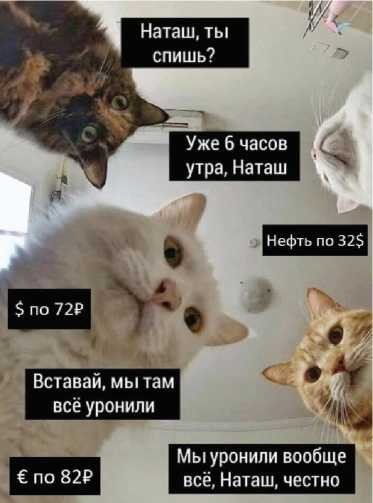
A complex meme type “Natasha, We Dropped Everything There”
The cats from the meme have already turned into meme characters , but it also should be pointed out that the choice of the animal might be culturally driven, because the studies show that Russians prefer to have cats as pets (54% in 2019 according to All-Russian Center for the Study of Public Opinion). That aspect gives us an insight into daily routine of the citizens. The name Natasha is also chosen by the creator on purpose: this Russian name is often used worldwide for denoting any Russian woman. According to the comical technique, this meme belongs to satire, because it mocks both the situation with the cats and the situation in the economy.
The meme analysis shows how the typology works and how effectively it can be used for finding specific features of the meme and culture. It is worth mentioning that the featured typology allows us to considerably review more different aspects of memes which other attempts of meme classifications lack. Moreover, by performing the detailed analysis with various memes and comparing them with the memes of some other countries we can find up-to-date similarities and differences of the compared cultures.
Conclusion
The prevalence of audiovisual communication and the use of recording devices, the Internet and other ways of distant communication have contributed to creation of new communication environment. We have witnessed the formation of a new type of communication: network or Internet communication, whose texts are organized into “Internetlore” (with memes having become a part of it) which is characterized by some properties of folklore (reproducibility, changeability, anonymity or loss of authorship, use of clichés, etc.).
It is necessary to emphasize that the thorough study of Internet memes enables getting confirmation for both the existing knowledge of cultures and new, undocumented ones. The typology presented in this article points to various aspects of memes (form and genre, structure, origin, expansion, theme, novelty of the information, used images, comical techniques) which definitely reveals units of linguacultural information. Thus, creators of memes are representatives of a certain culture and their world view is being reflected in the memes. Besides, the language used in memes is usually original with its linguistic peculiarities conveying some cultural specificities (addresses, word order, diminutives, elliptical constructions, precedent names, etc.). The used images in memes also render cultural information. The themes touched upon by memes are often relevant to one national community and may not be perceived or may be misinterpreted by other nations. Comical techniques also differ from one culture to another. Consequently, the further development and usage of the aforementioned typology can help with the meme analysis and its applications in modern cultural linguistics.
