
A New Approach to the Study of Flaking Sequence Integrity Based on the Chagyrskaya Cave Assemblage, Northwestern Altai
Journal: Archaeology, Ethnology & Anthropology of Eurasia @journal-aeae-en
Section: Paleoenvironment, the stone age
Article in issue: 4 т.52, 2024.
Free access
This paper presents a new approach to assessing the integrity of flaking sequences at Paleolithic sites. It combines experimental modeling with subsequent attribute analysis of the archaeological collection. The method is based on changes in the proportion of various technical spalls at different stages of core and bifacial reduction, as well as changes in the sizes of cortical flakes. This methodology was applied to reconstruct the strategy of the use of lithic raw material by late Neanderthals of the Altai, on the basis of the Chagyrskaya Cave assemblage. The study has shown that the most common method, using the proportion of cortical spalls, is not universal, and has limitations due to the structure of lithic industry and the specificity of raw material. When pebbles and boulders of various sizes are used, as in the assemblage from layer 6c/2 of Chagyrskaya Cave, a high proportion of cortical spalls can result from the production of bifacial tools at the site. The study demonstrates that the first stage in core reduction occurred outside the cave. The high proportion of cortical spalls in the assemblage is due to the fact that bifaces were manufactured in situ, whereas tools on cortical flakes and cortical tool blanks had been transported to the site. The study reveals a connection of various technical spalls with stages in core and biface flaking sequences, and their number is evaluated in the cases of complete versus reduced flaking cycles.
Similar articles in the section Prehistory. Prehistoric remains, artefacts, antiquities
Short address: https://sciup.org/145147481
IDS: 145147481 | DOI: 10.17746/1563-0110.2024.52.4.039-049
Text of the scientific article A New Approach to the Study of Flaking Sequence Integrity Based on the Chagyrskaya Cave Assemblage, Northwestern Altai
The use of lithic raw materials is among the important aspects of the subsistence strategy of prehistoric humans. This issue is associated with a wide range of features determining the functionality of a site, the specifics of primary reduction strategy, and stone tool manufacture (Chabay, 2004: 205–212; Rybin, Kolobova, 2009; Deschamps, Martín-Lerma, Linares-Matás, 2022; Marchenko et al., 2023). In other words, the strategy of selection and utilization of rocks has a strong effect on the typology of a lithic industry. The use of raw materials is determined by such factors as the availability of rocks, their quality, and the types and sizes of pieces (pebbles, nodules, boulders, tablets, etc.) (Chabay, 2004: 211–212; Khatsenovich et al., 2023; Pavlenok et al., 2024).
The primary topic of any analysis of the strategy of lithic raw material use is the integrity of the flaking sequence observed at a site. Primary attention is usually paid to the proportion of artifacts retaining pebble cortex (Dibble, 1995; Lin, 2014: 106–111; Weiss, Otcherednoy, Wisniewski, 2017; Delpiano, Heasley, Peresani, 2018).
It is generally accepted that the proportion of ~50 % of spalls with pebble cortex (Doronicheva et al., 2018; Weiss, Otcherednoy, Wisniewski, 2017), the location of cortex on dorsal surfaces, and the proportion of primary removals exceeding 10 % (Chabai, 2008) point to the primary stages of flaking in situ. In this case, the original form of the rock (pebble, tablet, flint nodule) and its dimensions (and the dimensions of the cortical spalls accordingly) are not usually taken into account.
In this study, we propose a methodological approach based on establishing the dynamics of changes in the proportion of technical flakes at different stages of core and bifacial reduction, as well as changes in the size of cortical spalls. We will show that the accepted criteria for determining the integrity of the primary flaking sequence are not universal. The proposed approach is used to reconstruct the strategy of lithic raw material use by late Neanderthals of the Altai using the materials from Chagyrskaya Cave.
Material and methods
Chagyrskaya Cave is located on the left bank of the Charysh River in the northwestern Altai (Southern Siberia). During excavations in 2007–2020, an archaeological collection containing more than 120 thousand artifacts was assembled. The Middle Paleolithic artifacts were recovered from several archaeological layers (5–6c/2) and formed a single technocomplex. The most common finds were associated with the subdivisions of layer 6 (6a–c/2). The available absolute dates indicate that this layer was accumulated during the terminal stage of MIS 4 to early MIS 3 (Kolobova et al., 2019). Analysis of archaeological and genetic data has shown that the Chagyrskaya Neanderthals arrived in the Altai from Eastern Europe; the population practiced a material culture that was technologically and morphologically similar to the Micoquian/Keilmessergruppen technocomplex of Central and Eastern Europe (Ibid.; Derevianko et al., 2018: 275).
The industry under study is based on the reduction of radial (Levallois “recurrent centripetal”, after (Boëda, Geneste, Meignen, 1990)), and orthogonal cores, as well as on the production of plano-convex bifacial tools, including specific backed knives of the Keilmesser type (Kolobova et al., 2019). The Chagyrskaya Neanderthals used local pebbles (effusive rocks, sandstones, hornfels, jasperoids, and other) (Derevianko et al., 2015). The highest quality jasperoids and chalcedonolites of local origin were used in the production of bifacial and some unifacial retouched tools (Kolobova et al., 2019). In addition to the lithic industry, the site yielded numerous bone tools (Kolobova et al., 2020).
We present the analysis of archaeological materials from an area of 12 m2 in layer 6c/2 of Chagyrskaya Cave during the excavations of 2008–2017. This layer has been chosen because it is characterized as an in situ one, with the smallest post-depositional disturbances of sediments as compared to other layers. The total of 796 flakes exceeding 3 cm in the largest dimension has been analyzed.
The analysis has been carried out through a combination of attribute and experimental methods. The experiments were based on the published results of the flaking sequence analysis and technical-typological data providing the information on the Chagyrskaya reduction techniques ( Derevianko et al., 2018: 153–186; Kolobova et al., 2019; Shalagina et al., 2020; Kharevich, 2022: 140–143). The experimental flaking was focused on the creation of reference collections associated with two techniques of blank production (radial and orthogonal), and manufacturing plano-convex bifaces, typical of the Sibiryachikha complexes. Knapping was carried out through direct percussion using hard hammerstones of pebbles and boulders from the Charysh alluvium, as well as bone retouchers for trimming the edges of bifacial tools. Cores were mainly small (up to 40 × 30 × 25 cm) boulders of effusive rocks and chalcedonolites. Small boulders and pebbles of jasperoid and chalcedonolite rocks were used in preference in bifacial tool manufacture.
Cataloguing of the experimental flaking was executed through assigning to every removal a code that recorded the serial number of the removal and the surface (flaking surface or striking platform) from which it was detached. All the spalls detached from cores were subdivided into three equal parts by the order of their removal. The first category included the products of the initial stages of flaking (stage 1), mostly those spalls that were detached during the preparation of striking platforms and core flaking surfaces. The other two categories (stages 2 and 3) included removals associated with the serial production of spalls up to the completion of core utilization (exhaustion or discard). Only complete specimens exceeding 3 cm along one of the axes were taken for the analysis. In accordance with the typology adopted for Eastern European Micoquian complexes (Chabai, Demidenko, 1998), spalls of <3 cm are chips. These were excluded from the analysis. The reconstruction of the Sibiryachikha bifacial technology (Shalagina et al., 2019) suggests several stages identified in the manufacturing of bifacial tools: plane and convex façonage and retouching. However, the analysis sample included only the façonage removals, since there were practically no flakes >3 cm at the retouching stage.
The experimental collection includes 190 spalls (target and technical) from four radial cores, 103 removals from three orthogonal cores, and 76 specimens obtained in the manufacture of nine bifacial tools.
An attribute approach was used to describe the archaeological and experimental collections. This approach was based on the typology of technical spalls, used in the analyses of the Micoquian technocomplex (Derevianko et al., 2018: 151–152; Chabai, Demidenko, 1998), as well as such characteristics as spall sizes and the presence of pebble cortex on their dorsal surfaces.
The Mann-Whitney (U) and Pearson (χ2) criteria were used in the comparative analysis of the archaeological and experimental collections. The Pearson’s test is applied to compare the empirical distributions of one or more features in two or more samples. The nonparametric Mann-Whitney test is used to compare the average values of three or more independent samples with a non-normal distribution of quantitative data. It can be applied to extremely small samples ( N ≥ 5) (Lund R.E., Lund J.R., 1983). All statistical tests were carried out in the PAST 3 program (Hammer, Harper, Ryan, 2001).
Technical spalls have a morphology that suggests their position in the flaking sequence of a core or bifacial tool; these are an important and sometimes dominant part of the industry. A characteristic feature of most technical spalls is a subtriangular cross-section (symmetrical or asymmetrical). In Paleolithic studies, two large groups of technical spalls with asymmetric crosssections are distinguished: core-edge flakes (éclats débordants) and coreedge flakes with a limited back (éclats débordants à dos limité) (Meignen, 1996; Derevianko et al., 2018: 168–171; Bustos-
Pérez et al., 2024).
The core-edge flakes are those with one sharp and one lateral steep edge, with the technological flaking axis coinciding with the long axis of flaking (Fig. 1, 1–3). The lateral steep edge is the result of removal of the core face, and may bear a cortical surface (cortical core-edge flake; Fig. 1, 4, 5), a single negative scar of the previous removal (lateral core-edge flake; Fig. 1, 1–3), or traces of preparation of the core striking-platform (crested or semi-crested core-edge flake; Fig. 1, 6, 7) or of the initial crest.
Core-edge flakes with a limited back are characterized by an obtuse angle between the surface of the striking platform and the lateral steep edge, which retains part of the striking platform (Fig. 1, 8 ). The long axis of the flake does not coincide with the technological flaking axis (Meignen, 1996; Derevianko et al., 2018: 163; Bustos-Pérez et al., 2024). Such flakes with cortical surfaces of the lateral steep edge are defined as core-edge flakes with a limited back (Fig. 1, 9 ), and the triangularshaped flakes are defined as pseudo-Levallois points (Fig. 1, 10 , 11 ).
A technical flake (Kantenabschläge) has a striking platform that is parallel to the surface of the distal part of the flake (Fig. 1, 12 , 13 ) (Richter, 1997: 186–187). Such flakes were usually detached during preparation of striking platform.
Fig. 1. Technical spalls from layer 6c/2 at Chagyrskaya Cave.
1–3 – lateral core-edge flakes; 4 , 5 – cortical coreedge flakes; 6 , 7 – crested core-edge flakes; 8 – coreedge flake with a limited back; 9 – cortical core-edge flake with a limited back; 10 , 11 – pseudo-Levallois points; 12 , 13 – technical flakes (Kantenabschläge).
0 3 cm
Primary spalls retaining pebble cortex over 76–100 % of the overall surface are also classified as technical spalls.
Results of the experimental collection analysis
The general typological composition of the flakes detached through orthogonal, radial, and bifacial reduction is similar to the above (Fig. 2–4). Statistical tests show that the differences existing between them are not significant (see Table ).
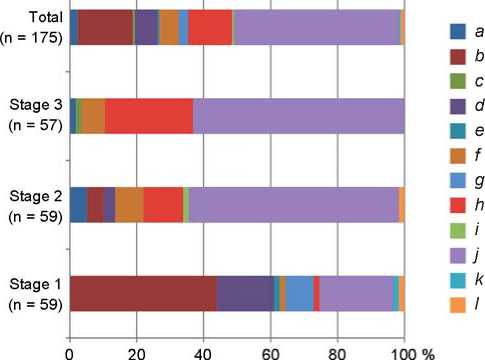
Flakes from radial and orthogonal cores. In the course of the complete flaking sequence, the proportion of flakes (target removals) reaches up to 50 % of the total collection. The category of technical spalls is dominated by primary spalls, core-edge flakes with a limited back, and cortical core-edge flakes (Fig. 2–4).
The main variations in the typological composition of the flakes are linked to the flaking stages; each stage shows a clear pattern. At stage 1, with both the radial and orthogonal methods, primary spalls, flakes, and cortical core-edge flakes predominate; the category of cortical core-edge flakes with a limited back is also significant (see Fig. 2).
At stage 2, with radial flaking, the proportion of flakes increases sharply (by up to 63 %), while the number of various technical spalls retaining pebble cortex (primary spalls, cortical core-edge flakes) decreases. At the same time, there appears a significant number of core-edge flakes with a limited back and lateral core-edge flakes (see Fig. 2). In case of orthogonal flaking, there is no such a sharp increase in the proportion of flakes (44 %), but in general the same trends are noted: the number of primary spalls and cortical core-edge flakes decreases; the numbers of core-edge flakes with a limited back and lateral core-edge flakes are significant. The number of technical flakes (Kantenabschläge) also increases; such flakes are usually the result of striking-platform trimming (see Fig. 3). In the case of radial flaking, the number of technical flakes is minor.
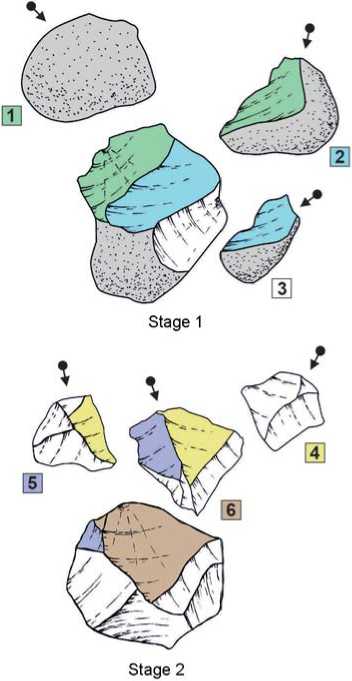
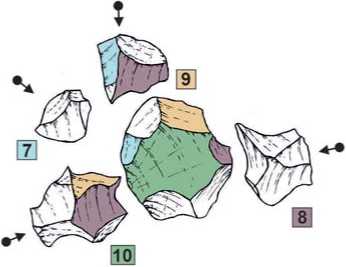
Fig. 2. Reduction pattern for the production of blanks in radial reduction technique, and the typological composition of spalls by stages.
1 – primary spall; 2 – cortical core-edge flake with a limited back; 3 – lateral core-edge flake; 4, 7, 8, 10 – flakes; 5, 9 – core-edge flakes with a limited back; 6 – pseudo-Levallois spall.
a – blades; b – primary spalls; c – crested spalls; d – cortical core-edge flakes; e – crested core-edge flakes; f – lateral core-edge flakes; g – cortical core-edge flakes with a limited back; h – core-edge flakes with a limited back; i – core-edge flakes with a limited back/technical flakes; j – flakes; k – pseudo-Levallois spalls; l – technical flakes.
Stage 3
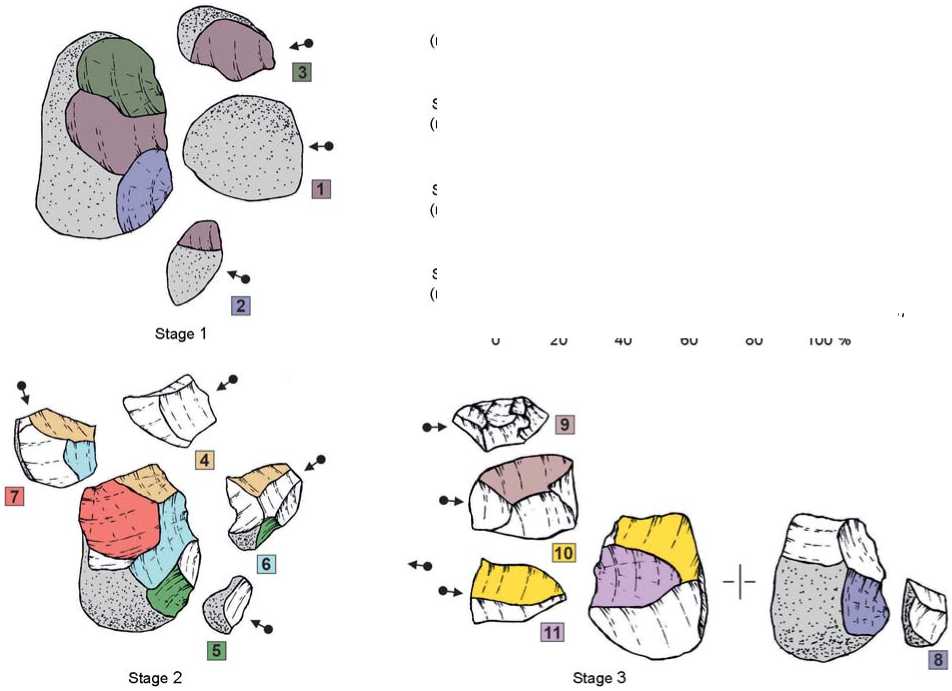
Fig. 3. Reduction pattern for the production of blanks in orthogonal reduction technique, and the typological composition of spalls by stages.
1 – primary spall; 2 – cortical core-edge flake with a limited back; 3, 7 – cortical core-edge flakes; 4–6, 10, 11 – flakes; 8 – technical flake;
9 – semi-crested spall.
a–l – see legend for Fig. 2; m – semi-crested spalls.
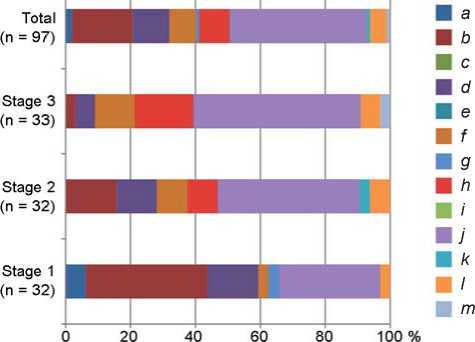
At stage 3, with radial flaking, the proportion of flakes is stable (63 %), while primary spalls and cortical core-edge flakes disappear completely. Among the technical spalls, core-edge flakes with a limited back predominate, while lateral core-edge flakes are next numerous (see Fig. 2). In the case of orthogonal flaking, there is a tendency towards increasing the number of flakes (52 %), core-edge flakes with a limited back, and lateral core-edge flakes. In contrast to the radial reduction technique, primary spalls and cortical coreedge flakes do not disappear, but their number only decreases. Technical flakes (Kantenabschläge) are also present, and disappear at this stage of radial flaking (see Fig. 3).
Fig. 4. Reduction pattern for the production of blanks planoconvex processing of bifacial tools, and the typological composition of spalls.
1 – primary spall; 2, 3 – flakes; 4 – cortical core-edge flake with a limited back. Other – see legend for Fig. 2.
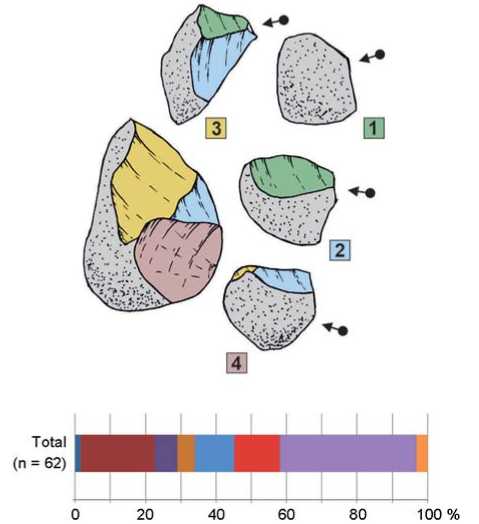
Table. The ratio of the typological composition* of experimental spalls obtained by different reduction methods
|
Spalls |
Spalls |
||
|
from radial cores |
from orthogonal cores |
from bifaces |
|
|
from radial cores |
_______ |
χ2 = 12.162 Df = 12 p = 0.43279 Cramer’s V = 0.21145 |
χ2 = 10.773 Df = 11 p = 0.4625 Cramer’s V = 0.2132 |
|
from orthogonal cores |
χ2 = 12.162 Df = 12 p = 0.43279 Cramer’s V = 0.21145 |
_______ |
χ2 = 11.839 Df = 9 p = 0.22253 Cramer’s V = 0.27287 |
|
from bifaces |
χ2 = 10.773 Df = 11 p = 0.4625 Cramer’s V = 0.2132 |
χ2 = 11.839 Df = 9 p = 0.22253 Cramer’s V = 0.27287 |
_______ |
*Blades, primary spalls, crested spalls, cortical core-edge flakes, crested and lateral spalls, core-edge flakes, cortical coreedge and technical spalls from radial cores, flakes, pseudo-Levallois spalls, technical and semi-crested spalls.
Typologically, the flakes detached from flaking surfaces and striking platforms are almost identical. The sizes of spalls from the orthogonal and radial cores are the same. At the same time, their number decreases gradually from the first to the third stage.
Certain patterns have been revealed through the analysis of cortical surfaces on the flakes. In the case of radial flaking, the total of 42 % of flakes retain pebble cortex on their dorsal faces. At stage 1, such flakes amount to 88 %; at stage 2, 27 %; at stage 3, 14 %. Notably, at stage 1, pebble cortex is recorded on the flakes detached from the flaking surfaces and striking platforms; while at stage 2, cortical flakes from the flaking surfaces are quite few; and at stage 3, there are no such flakes.
In the case of orthogonal flaking, the proportion of flakes bearing pebble cortex on their dorsal surfaces is higher than that in radial flaking strategy, that is 66 %. Accordingly, the distribution of such flakes by stages is somewhat different: at stage 1, they make up 94 %; at stage 2, 78 %; and at stage 3, 33 %.
Spalls from bifacial tools. During bifacial reduction, spalls >3 cm were obtained at the stage of plane and convex façonage. The general typological composition of the spalls is similar to that during primary flaking (see Fig. 4). The collection of spalls >3 cm is dominated by flakes (39 %), primary spalls (21 %), lateral core-edge flakes (13 %), and cortical core-edge flakes with a limited back (11 %). Spalls retaining pebble cortex make up 61 %; without it, 39 %. No typological differences were noted between the removals from the plane and convex sides. Also, no significant difference was observed in their attribute features. Spalls from bifaces differ markedly in size from those from cores. The ranges of their metric parameters overlap, but in general, bifacial spalls are smaller than flakes made at the final stages of core reduction (Fig. 5). The same applies to the spalls retaining pebble cortex over some part or entire surface.
The above analysis has proved that the typological composition of spalls obtained through various techniques of lithic reduction (orthogonal, radial, and bifacial) shows no significant variations. However, certain changes in the typological composition of the removals associated with the stages of flaking sequence have still been recorded.
The analysis of the experimental collection has made it possible to establish the origin of certain types of technical spalls, and to determine their position in assessing the flaking sequence integrity at the site. Primary spalls were produced at almost all stages of flaking, except for stage 3 of the radial-flaking technique. Cortical coreedge flakes with a limited back were recorded only at stage 1 in both flaking techniques. The same applies to cortical core-edge flakes in the case of radial flaking. The orthogonal flaking technique produces cortical core-edge flakes at all stages. Core-edge flakes with a limited back, in contrast, have not been recorded at flaking stage 1, and the proportion of these products increases towards stage 3 in both flaking techniques. A similar trend is observed for lateral core-edge flakes; these are few at stage 1, but their number gradually increases towards the third stage. Such a peculiar type as technical flake (Kantenabschläge) is more typical of platform preparation in the orthogonal flaking method, where it is present at all three stages. In the case of radial flaking, such technical flakes are quite few, and are noted at stages 1 and 2. Crested and semicrested removals are recorded only at stage 3. All the listed types of technical spalls, with the exception of the latter, are also observed in bifacial flaking.
Since bifacial debitage demonstrates a similar typology of spalls, the assessment of the flaking sequence integrity at a site is based on the sizes of removals. As
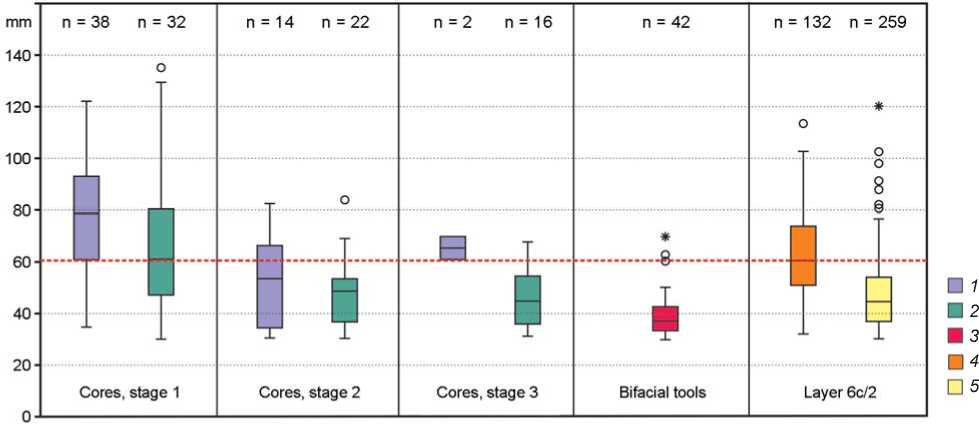
Fig. 5. Comparison of the sizes of archaeological spalls with pebble cortex (tools and spalls without retouch) and experimental ones obtained by bifacial and core reduction.
1 – spalls retaining pebble cortex from flaking surface; 2 – striking platform rejuvenation flakes with pebble cortex; 3 – spalls of plane and convex façonage with pebble cortex; 4 – tools on spalls with pebble cortex; 5 – spalls with pebble cortex without traces of retouch.
already noted, the spalls obtained by bifacial façonage are noticeably smaller than those detached from cores, which is due to the smaller sizes of pebbles used in biface manufacturing. Important patterns were recorded in the change of the sizes of primary spalls and, in general, spalls with cortical surfaces. The largest spalls with pebble cortex were detached at stage 1 and partially at stage 2 of core reduction sequence, and small ones were obtained by bifacial façonage and sometimes by rejuvenation of platforms at the terminal stages of core utilization (Fig. 5).
Discussion
The traditional assessment of the integrity of the flaking sequence at a site based on the presence of core preforms, large primary and secondary removals, the proportion of spalls with pebble cortex, and the ratio of cores to spalls (Inizan et al., 1999: 26–27; Chabai, Uthmeier, 2006; Grace, 2012: 12–15; Roth, Dibble, 1998; Lin, 2014: 106–111; Weiss, Otcherednoy, Wiśniewski, 2017) does not suit the features of the lithic industry of layer 6b/2 at Chagyrskaya Cave. This is due mainly to the fact that there are three main techniques of flaking in this industry: radial and orthogonal core flaking, plus façonage of planoconvex bifacial tools.
Formerly, the analysis of the proportion of spalls with cortical surfaces and the ratio of cores to flakes has led to the conclusion that a complete sequence of lithic reduction was carried out at Chagyrskaya Cave (Derevianko et al., 2018: 166; Kolobova et al., 2019). Layer 6c/2 yielded 386 spalls with pebble cortex on dorsal faces, and 432 spalls without it (47.1/52.9 %). In the experimental collection, containing only the products of core reduction, the relevant ratio was 142/130 specimens (52.6/47.4 %). The Pearson χ2 criterion shows that there is no significant difference between these samples (χ2 = 2.0577, Df = 1, p = 0.15144). The proportion of spalls with pebble cortex in the experimental sample, which does not include the initial stages of reduction (stage 1), is significantly lower, 60/121 specimens (33.1/66.9 %), which would seem to confirm the conclusion about the flaking sequence integrity. However, a more detailed study of the experimental collection makes it possible to reconsider these results.
The main drawback of this approach to the study of the Chagyrskaya lithic industry is that it does not take into account the proportion of spalls with pebble cortex detached during biface production. Most bifacial tools are made on large pebble spalls and pebble fragments (Kolobova et al., 2019; Shalagina et al., 2020). Moreover, according to experimental data, up to 60 % of production waste (>3 cm) retains pebble cortex on the dorsal surface (Kharevich A.V., Kharevich V.M., Kolobova, 2022). Hence, the presence of traces of bifacial flaking at the site prevents the use of generally accepted indicators of the proportion of spalls with cortex in determining the integrity of production sequence at Chagyrskaya Cave. Fortunately, bifacial removals are significantly smaller in size than core-edge flakes, and it is possible to detect the proportion of such removals with pebble cortex by analyzing metric parameters.
In order to identify a particular stage of a flaking sequence at the site, in addition to the indicators of pebble cortex on flake surfaces, we used the data on metric parameters of flakes at various stages of flaking and on typology of removals in the experimental and archaeological collections. When assessing the role of bifacial reduction, we proceeded from the fact that the previous studies had proven the presence of its complete sequence at Chagyrskaya Cave (Kharevich, 2022: 129).
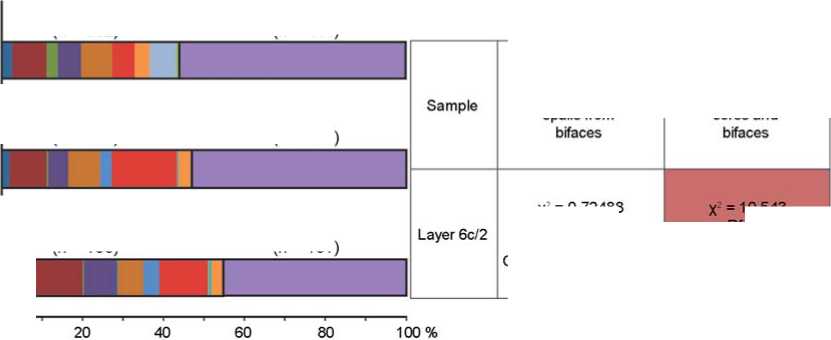
The analysis of the experimental collection has shown that flakes, primary spalls, cortical core-edge flakes with a limited back, and cortical core-edge flakes are the most representative categories in the identification of the initial stages of core reduction. The comparison of the experimental data with the collection from layer 6c/2 has demonstrated that the ratio of flakes to technical spalls in the industry does not statistically correspond to the complete flaking sequence (Fig. 6). The proportion of flakes in this collection is higher than that of technical spalls. Since the largest number of the latter is associated with the early stages of reduction, it is logical to assume that layer 6c/2 does not contain spalls produced at this stage. The archaeological collection corresponds to the experimental sample that contains no removals of stage 1 of core reduction (there is no statistically significant difference between them) (Fig. 6).
Noteworthy is the small proportion of primary spalls in layer 6c/2 (Fig. 6), which decreases towards the final stage of core reduction (see Fig. 2, 3). Furthermore, in terms of size, the available primary spalls without traces of preparation correspond most closely to bifacial debitage. Also, in layer 6c/2, there are quite few cortical core-edge flakes with a limited back, which are recorded only at stage 1 of core reduction and sometimes during bifacial façonage (see Fig. 2–4).
The comparative analysis of sizes of the long axis of spalls with pebble cortex shows that statistically these sizes are significantly smaller in the archaeological collection than in the experimental sample of the complete flaking sequence (Fig. 7). Considering the clear tendency
Experiment, stages 2, 3, spalls from
Experiment, spalls from cores and
Flakes (n = 444)
Technical spalls (n = 352)
Layer 6c/2 (n = 796)
Flakes (n = 128)
Flakes (n = 151)
Experiment, stages 2,3, spalls from bifaces (n = 243)
Technical spalls (n = 115)
Technical spalls (n = 183)
Experiment, spalls from . cores and I bifaces I (n = 334) I 0
X = 0.72488 Df= 1 p = 0.39455 Cramer's V = 0.026413
10.543 Df= 1 p = 0.0011563 Cramer's V = 0.096
Fig. 6. Comparison of the typological composition of spalls in archaeological and experimental collections. a–l – see legend for Fig. 2; m – bifacial thinning flakes.
■а
■b
■c
■d
■e
■f
■g
■h
j
■k
■l
■m
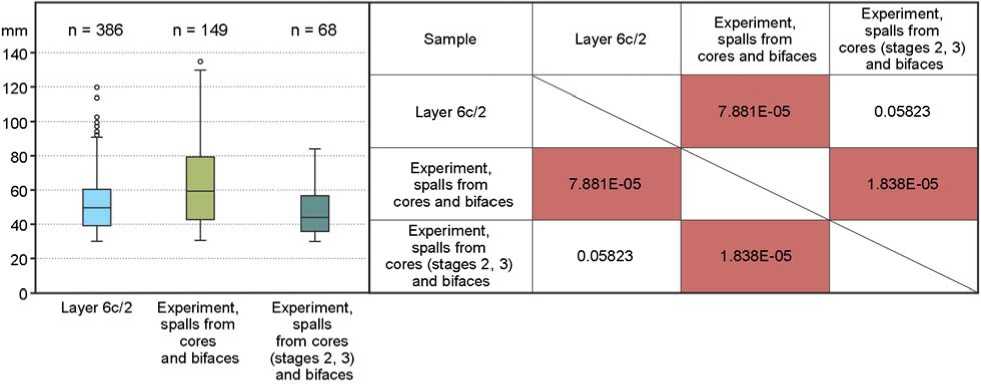
Fig. 7. Comparison of archaeological and general experimental collections by the sizes of spalls retaining cortex.
for the decrease of the spalls’ sizes by reduction stages, this can be explained by the fact that the initial stages of core reduction were executed beyond the site. In terms of length, the spalls and tools with pebble cortex from layer 6c/2 correspond most closely to the experimental sample, which includes stages 2 and 3 of primary reduction and bifacial debitage (Fig. 7). The presence in the archaeological collection of solitary large spalls with cortical surfaces, typical of the initial stages of reduction, is explained by the fact that the largest of them (up to 11 cm) are tools; therefore, they could have been brought to the cave as finished tools or tool blanks.
The comparative analysis of tools on spalls with cortical surfaces and removals with cortex without traces of retouch from layer 6c/2 with the experimental items (see Fig. 5) shows that the median length of the tools corresponds to that of the spalls obtained at stage 1. At the same time, spalls not exceeding 8 cm could also be removed from the core flaking surface at stages 2 and 3. Only a small proportion of tool blanks could be detached at stage 1 exclusively. In turn, spalls with cortex without traces of retouch correspond rather to removals from the striking platform at stages 2 and 3 of core reduction or to bifacial debitage. This suggests that such products should be considered as production waste (see Fig. 5).
All the above facts indicate that the initial stages of core reduction were carried out beyond the cave, while the high proportion of cortical spalls in the collection is explained by the production of bifaces at the site (Kharevich, 2022: 129) and the delivery of such spalls to the cave as tools and blanks.
Thus, the study findings have shown that the method most frequently used for the analysis of the flaking sequence’s integrity, based on the proportion of spalls with pebble cortex, (Lin, 2014: 144; Weiss, Otcherednoy, Wisniewski, 2017; Chabai, 2008), is not universal and has limitations due to the structure of lithic industry and the specificity of raw materials. When pebbles and boulders of various sizes are used, a high proportion of spalls retaining cortical surface can be provided by one of the methods of the reduction strategy; in the case of the assemblage of layer 6c/2, by the production of bifacial tools.
Conclusions
The presence and dimensions of the cortical surfaces on flakes are regarded as an important feature in assessing the integrity of flaking sequence at a site in the Paleolithic studies (Dibble, 1995; Weiss, Otcherednoy, Wisniewski, 2017; Delpiano, Heasley, Peresani, 2018). Researchers often use generally accepted indicators that do not always take into account the characteristics and metric parameters of the original rocks in each particular complex (Roth,
Dibble, 1998; Lin, 2014: 144–145). According to the results derived in this study, the proportions and sizes of cortical flakes in primary and bifacial reduction can vary significantly. Hence, such indicators as the proportions of primary removals and spalls with cortex require adjustments related to the size of the raw material and reduction techniques.
Technical spalls are an important source of information not only about the flaking sequence integrity, but also about the shapes of the rocks and blanks that were brought to the site. Experimental modeling of radial, orthogonal, and bifacial flaking suggests the following conclusions.
-
1. The typological compositions of technical spalls flaked from radial and orthogonal cores are identical.
-
2. In case of complete core reduction sequence, the proportion of technical spalls (primary and steep-lateral) makes up ca 50 %.
-
3. Lateral steep technical spalls were obtained not only by preparation of flaking surface, but also by creation and rejuvenation of striking platforms.
-
4. During core reduction, cortical core-edge flakes with a limited back were detached only at the decortication stage, while core-edge flakes with a limited back were characteristic only of final stages.
-
5. Crested and semi-crested spalls are recorded only at the last stage of core reduction.
-
6. All the lateral steep spalls, except for crested and semi-crested ones, are typical of bifacial flaking.
-
7. Technical flakes (Kantenabschläge) are more common in the case of preparation of the striking platforms of orthogonal cores than those of radial ones.
-
8. If the stage of core decortication is recorded at a site, the proportion of primary spalls (76–100 % of cortical surface) >3 cm should be ca 16 %. In the production of bifacial tools, the proportion of primary spalls is 21 %.
-
9. Primary spalls, cortical core-edge flakes with a limited back, and cortical core-edge flakes are most indicative categories for the identification of the initial stages of core reduction.
The application of the new approach has shown that the occurrence of a high proportion of spalls retaining pebble cortex in the industry of layer 6c/2 is explained not by the complete flaking sequence, but by the intense production of bifaces at the site and the delivery of finished tools and spall-blanks to the cave. This model of exploitation of raw material, in which the initial stages of core reduction occurred outside the site, corresponds to the variability of Eastern European Micoquian complexes, and in particular to the materials of the sites located in close proximity to sources of raw material (Chabai, 2004: 239; Chabai, Uthmeier, 2006).
The applied approach has provided for a new insight into the study of the integrity of the flaking sequence at a site, and has shown the importance of such factors as flaking techniques and the type of raw material. This approach and the findings can be used in analysis of non-Levallois lithic industries based on pebble flaking.
Acknowledgement
The study was supported by the Russian Science Foundation, Project No. 24-67-00033.
