
Industry of Okladnikov Cave Layer 3 in the Context of the Sibiryachikha Complexes of the Altai Mountains
Journal: Archaeology, Ethnology & Anthropology of Eurasia @journal-aeae-en
Section: Paleoenvironment, the stone age
Article in issue: 4 т.52, 2024.
Free access
This paper presents the results of a comprehensive analysis of lithics from layer 3 of Okladnikov Cave and their relevance to the Sibiryachikha industries of the Altai Mountains. Attribute analysis has shown that the industry of layer 3 demonstrates technological and typological similarities with the Sibiryachikha industries. These include radial flaking with an offset technological axis, a predominance of convergent side-scrapers, and a series of planoconvex bifacial tools. Functionally, the site was a camp where horse and rhinoceros carcasses were butchered and consumed. The analysis of flaking sequence integrity revealed similarity between Okladnikov layer 3 and Chagyrskaya industries in terms of primary and bifacial reduction. The initial stages of core decortication were carried out outside the cave, at the rock outcrops. Subsequent stages of core utilization and all stages of bifacial flaking were carried out in situ. The main difference between Okladnikov layer 3 and Chagyrskaya layer 6c/2 industries concerns only the stage of manufacturing and modifying stone tools. At Okladnikov Cave, these processes were much more intense than at Chagyrskaya, which may indicate transportation of numerous tools and blanks made of high-quality raw material from more distant sources.
Similar articles in the section Prehistory. Prehistoric remains, artefacts, antiquities
Short address: https://sciup.org/145147482
IDS: 145147482 | DOI: 10.17746/1563-0110.2024.52.4.050-058
Text of the scientific article Industry of Okladnikov Cave Layer 3 in the Context of the Sibiryachikha Complexes of the Altai Mountains
Late European Neanderthals that migrated from Central and Eastern Europe to the Altai inhabited mainly low-mountain areas with available water and hunting resources (Derevianko, 2024; Kolobova et al., 2019). They produced Sibiryachikha complexes of the Middle
Paleolithic characterized by the use of radial core flaking and plano-convex bifacial flaking, and the predominance of simple and convergent side-scrapers in tool-kits. These complexes show variability resembling the Micoquian industries: with the increase of distance to raw material sources, the degree of tool modification and bifaces also increased (Chabai, 2004; Derevianko, Markin, Shunkov,
S.V. Markin, A.P. Derevianko
2013). For example, in the assemblages of layers 1 and 2 from Okladnikov Cave, the large number of convergent scrapers, small sizes of tools with two or more working edges, and bifacial tools (Kolobova et al., 2023) suggest a shortage of lithic raw materials. Both Okladnikov and Chagyrskaya caves are located close to raw material outcrops in the Sibiryachikha and Charysh river valleys (Derevianko et al., 2015), which does not imply different attitudes to the economy of resources. However, in Chagyrskaya, in contrast to Okladnikov, a deficit was recorded only in high-quality raw materials. In this situation, it is necessary to apply new research approaches that make it possible to identify the behavioral features of the inhabitants at the sites, and to explain the differences between the assemblages. At present, the reasons for the noted variability are unknown; the stage of chaîne opératoire that determined the differences between the industries of these
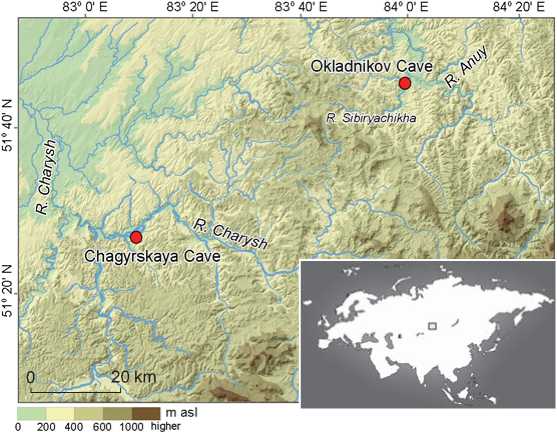
Fig. 1. Location of the Okladnikov and Chagyrskaya caves.
caves is
Material and methods
unclear. There is a question as to whether it relates to the core reduction technique, or only to the stages of modification of bifaces and tools. To resolve this issue, we carried out a study of the assemblage of Okladnikov layer 3, using the technical-typological and the attributive methods, and a detailed technological and statistical comparison of this assemblage with that of layer 6c/2 of Chagyrskaya Cave, using experimental data (Kharevich et al., 2024).
The Okladnikov layer 3 lithic industry is the richest among the assemblages of the site; it is dominated by the elements of primary reduction and retouch: lateral technical spalls, various bifacial thinning flakes, cores and core blanks, and numerous chips. This suggests that layer 3 has undergone the fewest disturbances as compared to overlying layers 1 and 2. Chagyrskaya Cave is a key site of the Middle Paleolithic Sibiryachikha variant; its stratigraphic column contains four cultural layers dating back to 60–49 ka BP. We compare the industry of layer 3 of Okladnikov Cave with the assemblage of undisturbed Chagyrskaya layer 6c/2 (Kolobova et al., 2020).
Okladnikov Cave is located on the left bank of the Sibiryachikha River in the Anuy River valley (Fig. 1). The site was discovered by A.P. Derevianko and V.I. Molodin in 1984 and was studied under the supervision of A.P. Derevianko and S.V. Markin. Nine lithological layers were identified in the stratigraphic sequence. Layers 1–3, 6, and 7 are culture-bearing horizons (Derevianko, Markin, 1992). The cave was inhabited by Neanderthals in the chronological range of >40,000->44,000 BP (Kolobova et al., 2023).
The study of the collection was carried out by the technical-typological and attributive methods, which takes into account technologically and typologically significant features for each typologically determinable artifact, with the exception of waste products. The main features were established as follows: type of blank and artifact’s fragmentation; type of technical flake and its attribution to either core or bifacial flaking sequence; proportion of cortical surface on the dorsal face (0 %, 1–25 %, 26– 50 %, 51–75 %, 76–100 %); dorsal scar-pattern; type of residual striking platform; and main metrics. The typological affiliation of the tools was determined through the method proposed by V.N. Gladilin (Gladilin, 1976; Chabai, Demidenko, 1998), which describes the diversity of blank shapes and retouch on side-scrapers, points, and bifacial tools. The published data on lithic assemblages from Chagyrskaya (layer 6c/1) and Okladnikov (layers 1 and 2) caves were used for comparison (Kolobova et al., 2020, 2022, 2023).
The flaking sequence integrity shown by the industry of layer 3 was determined by the features identified during the experimental modeling of primary and bifacial reduction in the Chagyrskaya lithic industries (Kharevich et al., 2024). The sizes of removals retaining pebble cortex and the ratio of the proportion of flakes and technical spalls are the most indicative features in pebble industries.
The following mathematical statistic methods were used in the comparative analysis of the assemblages: the nonparametric Mann-Whitney test, the Kruskal-Wallis
Table 1. Composition of the Okladnikov layer 3 lithic industry
Results
Attribute approach . The lithic collection from Okladnikov Cave layer 3 contains 2027 items. The main part of the collection is made up of spalls, 864 spec. (97.6 % (excluding waste products)): 326 flakes (36.8 % (excluding waste products)), 262 technical spalls (29.6 % (excluding waste products), 9 blades (1.0 %), and 267 tools on flakes (30.2 %) (Table 1).
Waste products total 56.3 % of the collection, most of which are chips (45.4 %). The chips include small spalls detached in the course of fashioning bifacial tools (26.8 % of the identifiable chips) (Table 1).
The collection contains flake cores – 10 spec., radial cores – 3 spec. (including a Levallois centripetal core) (Fig. 2, 1 , 9 ), orthogonal cores – 3 spec., flat parallel cores – 2 spec., and bidirectional cores – 2 spec. A pre-core modified into a scraper was also identified.
The set of technical spalls is well correlated with the typology of cores, and includes lateral core-edge flakes (33.7 %*), core-edge flakes with a limited back (29.6 %) (Fig. 2, 10 ), primary spalls (20.4 %), bifacial thinning flakes (11.6 %) (Fig. 2, 2–4 ), crested and semi-crested flakes (3.3 %), overpassed flakes (0.8 %), citron and semi-citron flakes (0.6 %) (Fig. 2, 5 ). Among the bifacial thinning flakes, a tranchet blow was recorded (Fig. 2, 6 ) (Frick et al., 2017).
*Hereinafter, percentage of the total number of technical spalls, including tools.
The group of spalls also includes pseudo-Levallois spalls (15 spec.) (Fig. 2, 10 ), which were defined by F. Bordes as lateral steep spalls of triangular shape with the technological axis offset (1953). At the initial study of the collection, such technical spalls were described as Levallois, in accordance with the prevailing research paradigm (Derevianko, Markin, 1992: 122, fig. 42, 9 , 10 ).
Primary spalls and blades make up 8.6 % of the spalls collection*. Almost 3/4 of the spalls (70.5 %) from layer 3 have not retained cortical surface; only 12.4 % of them bear pebble cortex over more than 50 %.
Most spalls (62.2 % (excluding unidentifiable ones)) from layer 3, show an offset technological axis. The spalls demonstrate predominantly (40.5 %) trapezoid shape. The most numerous spall categories have longitudinal (29.9 %), radial/cross (20.7 %), and orthogonal (18.3 %) faceting.
More than a third of the spalls (37.2 %) show a straight lateral profile. Equal proportions of spalls have lateral twisted (25.5 %) and curved (25.0 %) profiles. Spalls triangular in cross-section predominate (33 %); other spalls are lateral-steep (29.8 %), trapezoid (20.5 %), or convex (10.1 %) in cross-section. Numerous are plain striking platforms (67.5 %), and various forms of faceted (16.8 %) and polihedrial (10.6 %) platforms.
An absent or diffuse bulb is observed in more than a half of the spalls (59.5 %). Almost 1/4 of the spalls show a pronounced lip or semi-lip (24 %). The total of 92.1 % of the spalls with lip (or semi-lip) have a diffuse or absent bulb; the latter may be due to the use of a soft hammer.
The typological structure of the layer 3 tool assemblage is dominated by side-scrapers of various types (82.6 %) and retouched points (10.7 %) (Fig. 3, 7 , 8 ); bifacial tools have also been noted (4.0 %) (Table 2).
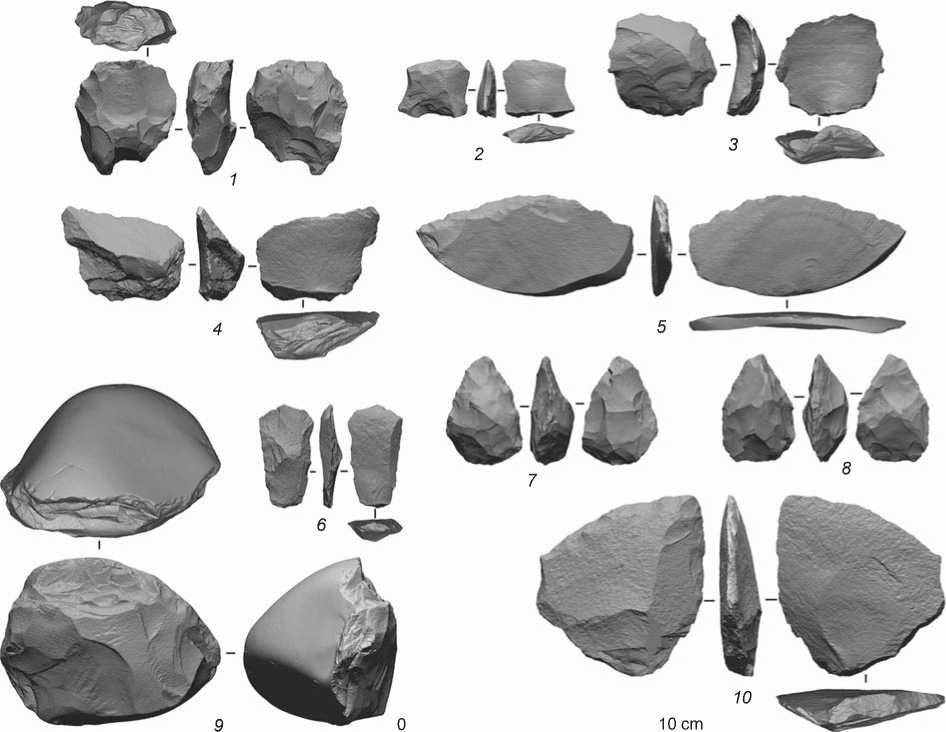
Fig. 2. Artifacts from the assemblage of Okladnikov Cave layer 3.
1 , 9 – cores; 2–4 , 6 – bifacial thinning flakes; 5 – tool on semi-citrus slice; 7 , 8 – bifacial tools; 10 – tool on a core-edge flake with a limited back.
Table 2. Typological composition of the tools in the Okladnikov layer 3 lithic industry
|
Tool type |
Spec. |
% |
% without undeterminable pieces |
|
Retouched points |
24 |
8.70 |
10.71 |
|
Side-scrapers: |
185 |
67.03 |
82.59 |
|
simple |
49 |
17.75 |
21.88 |
|
convergent |
96 |
34.78 |
42.86 |
|
undeterminable |
40 |
14.49 |
17.86 |
|
Bifacial tools |
9 |
3.26 |
4.02 |
|
Truncated-faceted tools |
3 |
1.09 |
1.34 |
|
Perforators |
3 |
1.09 |
1.34 |
|
Retouched flakes |
45 |
16.30 |
– |
|
Retouched blades |
2 |
0.72 |
– |
|
Undeterminable tool parts |
5 |
1.81 |
– |
|
Total |
276 |
100 |
100 |
The proportion of convergent side-scrapers (42.9 % of the total number of tools) (Fig. 3, 1–6 ) is higher than that of the simple ones (21.9 %). After fragmentation, 8.3 % of the tools had been reshaped. Two perforators were fashioned from side-scraper fragments. A total of 3.3 % of the tools was made on bifacial thinning flakes (see Fig. 2, 3 ).
The collection of bifacial tools from layer 3 includes 9 items. These are seven complete tools and two fragmentary specimens. The blanks of most of the tools are undeterminable, since they were subjected to intense modification. Four bifacial tools are backed, with three of them being morphologically close to European backed knives of the Keilmesser type (Jöris, 2006). The majority of the items either show continuous retouch or have two working edges (see Fig. 2, 7 , 8 ).
Bifacial tools were made through the plano-convex flaking technique typical of the Sibiryachikha industries (Shalagina et al., 2020; Kolobova et al., 2019), which involves the sequential working of plane and convex faces at both the façonage and faceting stages. Most tools show intense flaking. One tool bears traces of reshaping after fragmentation. The category of complete bifaces includes simple (29 %) and convergent (71 %) tools (see Fig. 2, 7, 8) (Kharevich, 2022).
The only hammerstone made on a complete pebble of coarse-grained sandstone, corresponding to the middle stage of processing, demonstrates traces of microflaking and edge fractures in its working area (see Fig. 3, 10 ).
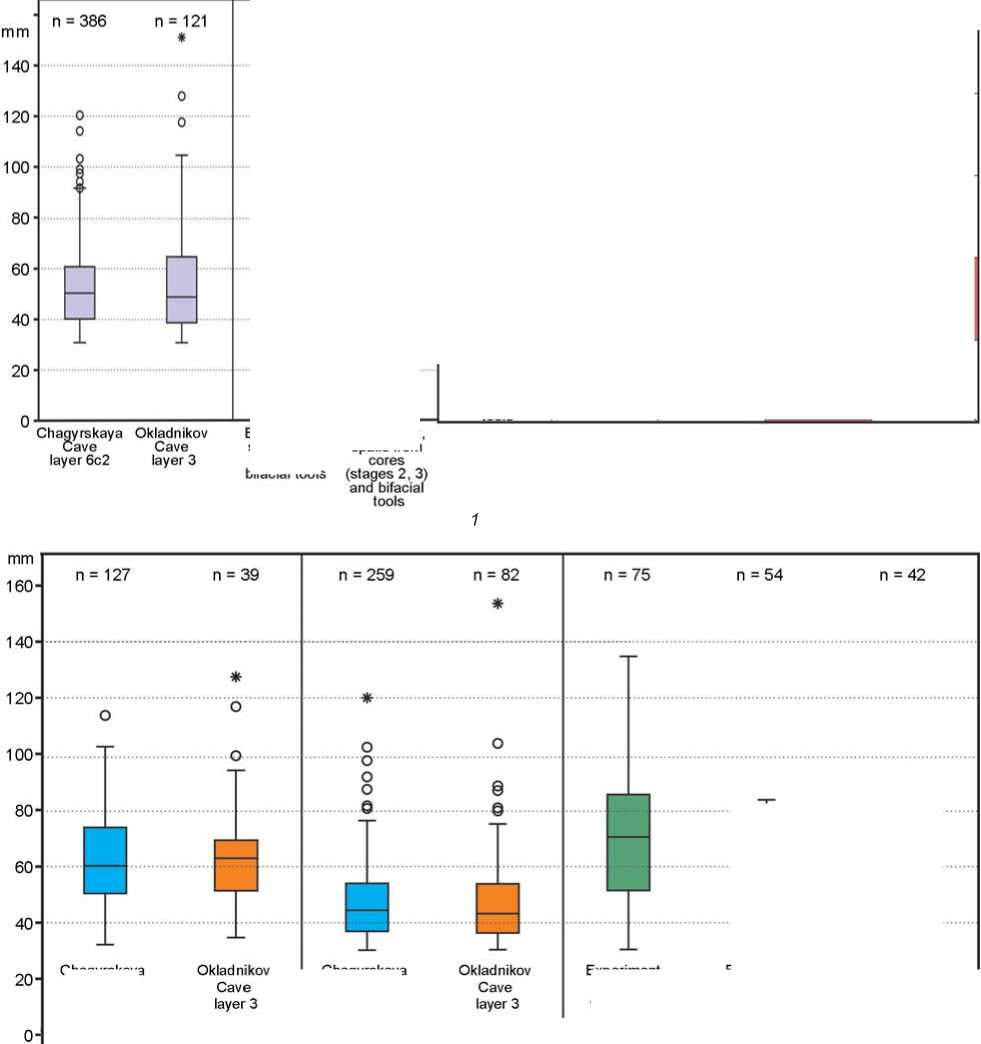
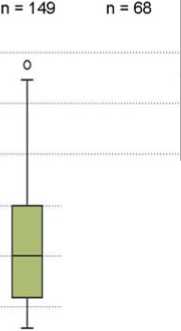
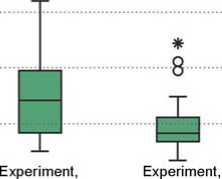
Assessment of flaking sequence integrity. A comparative analysis on the sizes of cortical spalls determined along their long axes, from the assemblages of Okladnikov layer 3 and Chagyrskaya layer 6c/2, has shown that the parameters coincide, and correspond to those of the removals obtained during reduction of cores (final stages of reduction: serial detachment of blankspalls and completion of reduction) and bifaces from the experimental sample (Fig. 4, 1 ). The experimental sample of the complete core- and bifacial flaking sequence demonstrates the larger sizes of cortical flakes than those of the spalls from the caves’ assemblages (Fig. 4, 2 ). Such a ratio suggests that the initial core reduction was carried out outside the cave sites.
The comparison between the sizes of cortical spalls/tools and unretouched spalls has revealed a
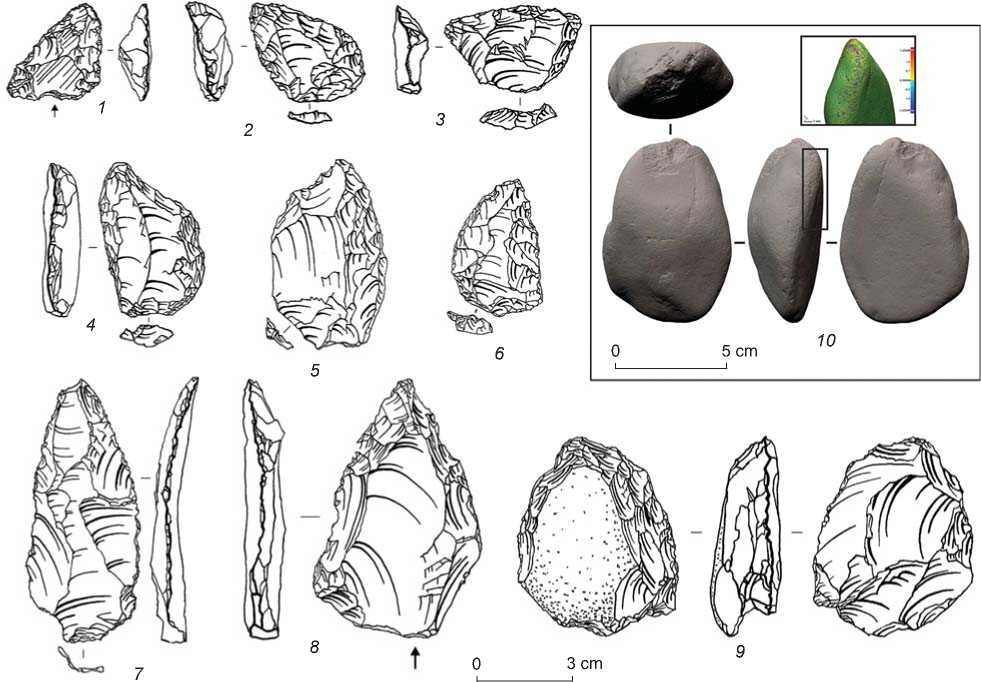
Fig. 3. Tools from Okladnikov Cave.
1 – triangular side-scraper; 2 , 4 – sub-trapezoid side-scrapers; 3 – semi-trapezoid side-scraper; 5 – semi-crescent side-scraper; 6 – sub-crescent side-scraper; 7 – sub-leaf point; 8 – semi-leaf point; 9 – bifacial side-scraper on primary spall; 10 – hammerstone.
|
Mann-Whitney |
Chagyrskaya Cave layer 6c2 |
Okladnikov Cave layer 3 |
Experiment, spalls from cores and bifacial tools |
Experiment, spalls from cores (stages 2, 3) ana bifacial tools |
|
Chagyrskaya Cave layer 6c2 |
1 |
0.0001576 |
0.1165 |
|
|
Okladnikov Cave layer 3 |
1 |
0.01104 |
0.2979 |
|
|
Experiment, spalls from cores and bifacial tools |
0 0001576 |
0.01104 |
3.677E-05 |
|
|
Experiment, spalls from cores (staaes 2, 3) ana bifacial |
0.1165 |
0.2979 |
3.677E-05 |
Experiment, spalls from
Experiment, spalls from cores and bifacial tools
Experiment, spalls from cores (stage 1)
spalls from cores (stages 2,3) and bifacial tools
Chagyrskaya Cave layer 6c2
Chagyrskaya Cave layer 6c2

spalls from bifacial tools
Tools on spalls with pebble cortex
Non-retouched spalls with pebble cortex
Experimental spalls with pebble cortex
Fig. 4. Comparison of the sizes of spalls from archaeological (Okladnikov Cave, Chagyrskaya Cave) and experimental collections.
1 – the ratio of the length of spalls and tools with pebble cortex from archaeological and experimental collections; 2 – the ratio of the length of tools with pebble cortex, blank-spalls with pebble cortex, and experimental spalls with pebble cortex.
correspondence in the sizes of tool blanks to the experimental removals obtained during the initial core reduction (Fig. 4, 2). The cortical flakes without retouch correspond to the removals from the experimental sample illustrating the final stages of core reduction (serial production of blanks and completion of reduction) and bifacial flaking. These data indicate that there were no operations relating to the initial stages of core reduction at Okladnikov Cave, and no intense modifications of bifacial and unifacial tools at Chagyrskaya Cave (Kharevich et al., 2024). This observation is evidenced by numerous bifacial thinning spalls and chips in layer 3.
Discussion
Okladnikov Cave is located in the river valley; because of that, the Neanderthal inhabitants could have hunted primarily horses and bison during their annual migrations (Derevianko et al., 1990). In the faunal collection from layer 3, there are bone remains of at least three horses, one bison, and four rhinoceroses. Traces of anthropogenic impact were noted on fragments of tubular bones belonging to medium-sized ungulates and rhinoceros, which may have been hunted by the cave’s inhabitants.
The lithic industry of Okladnikov layer 3 shows almost complete parallels with the collections from layers 1 and 2 in terms of technical and typological features. All assemblages demonstrate the predominantly trapezoidal flake detachment with plain and faceted striking platforms from radial, parallel, and orthogonal cores. The assemblages are characterized by a small proportion of flakes with straight profiles and feathering distal ends, which shape is due to the peculiarities of bifacial flaking that produced spalls with curved profiles and hinge ends. The only difference is the predominance of flakes with offset technological and morphological axes in layer 3 (62.2 %), and flakes with matching axes in layers 1 and 2 (59.2 and 65.6 % respectively). According to the first indicator, the assemblage from Okladnikov layer 3 shows similarity to those from Chagyrskaya layers 6c/1 and 6c/2.
All the layers yielded numerous tool-kits. For example, in layer 3, the proportion of tools in the typologically determinable collection reaches 30.2 %. Assemblages of layers 1–3, in which the majority of tools are convergent side-scrapers (41.8, 48.5, and 42.9 %, respectively), are identical in composition, but in layer 3 the proportion of remodified tools is higher and reaches 8.3 %; the relevant proportion in layer 1 is 3.3 %, and in layer 2, 2.3 %. The comparison of tools from the three layers by length and width did not reveal statistically significant differences by the Kruskal-Wallis criterion (length: H = 1.87, p = 0.39; width: H = 3.51, p = 0.17).
The comparison of convergent tools from Okladnikov layer 3 and those from Chagyrskaya layer 6c/2 by the main metrics has revealed a statistically significant difference. Convergent tools from Okladnikov layer 3 are significantly smaller (length: U = 6433, p = 0.001, width: U = 5578, p = 1.97E; thickness: U = 6514, p = 0.0007) than those from Chagyrskaya. This confirms the assumption about a more intense tool re-shaping at Okladnikov Cave, and indicates their heavier reduction.
The study of the typological structure of bifacial tools from Okladnikov layer 3 has shown the prevalence of convergent products with intensely retouched blades all over the margins. Layer 3 contains simple bifacial tools with one blade; in layers 1 and 2, more intensely modified convergent side-scrapers and points predominate among bifacial tools (Kharevich, Markin, Derevianko, 2022). The analysis of the Chagyrskaya bifacial tools has shown that this typological structure reflects intense lithic processing (Kharevich, 2022).
The lithic industry of Okladnikov layer 3 represents a primary reduction strategy identical to that of the assemblage from Chagyrskaya layer 6c/2, and leads us to the conclusion that the initial core reduction was carried out beyond the site limits. Some large flakes with pebble cortex detached at the initial stage of core reduction, along with the prepared cores, were transported to the site as tools and blanks. The sizes of the unretouched flakes with pebble cortex correspond to the stages of serial production of blanks/completion of reduction and bifacial flaking.
However, the ratio of the proportions of flakes and technical spalls from Okladnikov layer 3 differs significantly from that of Chagyrskaya layer 6c/2: 41.8 / 58.2 % and 55.8 / 44.2 %. This difference is due to the greater number of bifacial thinning flakes and core-edge flakes with a limited back in the Okladnikov layer 3 collection—their cumulative share is 26.5 % of the total number of spalls, and in Chagyrskaya Cave it is 12 %. The Okladnikov inhabitants probably reshaped side-scrapers and bifacial tools more intensely, which is confirmed by the data on the sizes of convergent sidescrapers and bifacial tools. Convergent and bifacial tools at the Sibiryachikha sites were made mainly from high-quality raw materials (Derevianko et al., 2015); the heaviest modifications were noted on the artifacts made from Zasurye jasperoids and chalcedonolites. Since the proportion of such raw materials among the pebbles of the Charysh and Sibiryachikha rivers near the caves under study does not exceed 2 %, it can be assumed that the Neanderthals searched for these rocks among other beach pebbles up and down the riverbeds, at a considerable distance from the sites (Kolobova et al., 2019).
Conclusions
The assemblages from the Sibiryachikha variant of the Altai Middle Paleolithic are homogeneous in terms of primary reduction strategy, bifacial flaking, and tool manufacturing. Artifacts found in layer 3 at Okladnikov Cave suggest the existence of a base camp where the prey was butchered and consumed. The number of prey (four horses and one bison) shows that the inhabitants of this cave were inferior hunters to those from Chagyrskaya Cave (in all subdivisions of layer 6c, at least 14 bison carcasses with butchering traces were identified) (Koliasnikova et al., in press). Operations relating to the initial decortication were probably carried out at raw material outcrops. Cores and flakes, including primary ones, were transported to the sites. In both caves, operations were carried out, corresponding to the middle and final stages of core reduction and to the complete bifacial flaking sequence. The main difference between the Okladnikov and Chagyrskaya assemblages is recorded at the stage of stone-tool production and modification. In Okladnikov Cave, these activities were more intense (possibly owing to the transportation of numerous tools and blanks made of high-quality raw materials from more distant sources) than in Chagyrskaya Cave. Undoubtedly, a small number of the jasperoid and chalcedonolite tools were made from local rocks; but at present it is hardly possible to determine the place of raw material origin within the river beds and the share of export in the industry.
Acknowledgements
The analysis of the lithic collection from Okladnikov layer 3 and the analysis of the flaking sequence integrity were supported by the Russian Science Foundation, Project No. 24-67-00033. The comparison of the lithic industries of the Sibiryachikha variant was supported by the Project “Interdisciplinary Study of Ancient and Medieval Societies of the Altai”, Project No. FZMW-2023-0009, under the State Assignment of the Ministry of Science and Higher Education of the Russian Federation.
