
Fine-grained concrete with recycled polyvinyl chloride fiber
Journal: Nanotechnologies in Construction: A Scientific Internet-Journal @nanobuild-en
Section: The results of the specialists’ and scientists’ researches
Article in issue: 2 Vol.18, 2026.
Free access
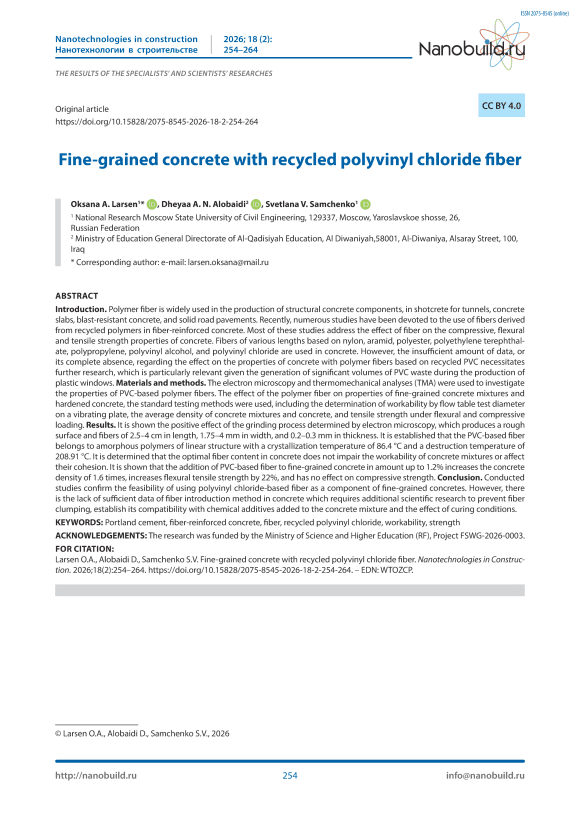
Introduction. Polymer fiber is widely used in the production of structural concrete components, in shotcrete for tunnels, concrete slabs, blast-resistant concrete, and solid road pavements. Recently, numerous studies have been devoted to the use of fibers derived from recycled polymers in fiber-reinforced concrete. Most of these studies address the effect of fiber on the compressive, flexural and tensile strength properties of concrete. Fibers of various lengths based on nylon, aramid, polyester, polyethylene terephthalate, polypropylene, polyvinyl alcohol, and polyvinyl chloride are used in concrete. However, the insufficient amount of data, or its complete absence, regarding the effect on the properties of concrete with polymer fibers based on recycled PVC necessitates further research, which is particularly relevant given the generation of significant volumes of PVC waste during the production of plastic windows. Materials and methods. The electron microscopy and thermomechanical analyses (TMA) were used to investigate the properties of PVC-based polymer fibers. The effect of the polymer fiber on properties of fine-grained concrete mixtures and hardened concrete, the standard testing methods were used, including the determination of workability by flow table test diameter on a vibrating plate, the average density of concrete mixtures and concrete, and tensile strength under flexural and compressive loading. Results. It is shown the positive effect of the grinding process determined by electron microscopy, which produces a rough surface and fibers of 2.5–4 cm in length, 1.75–4 mm in width, and 0.2–0.3 mm in thickness. It is established that the PVC-based fiber belongs to amorphous polymers of linear structure with a crystallization temperature of 86.4 °C and a destruction temperature of 208.91 °C. It is determined that the optimal fiber content in concrete does not impair the workability of concrete mixtures or affect their cohesion. It is shown that the addition of PVC-based fiber to fine-grained concrete in amount up to 1.2% increases the concrete density of 1.6 times, increases flexural tensile strength by 22%, and has no effect on compressive strength. Conclusion. Conducted studies confirm the feasibility of using polyvinyl chloride-based fiber as a component of fine-grained concretes. However, there is the lack of sufficient data of fiber introduction method in concrete which requires additional scientific research to prevent fiber clumping, establish its compatibility with chemical additives added to the concrete mixture and the effect of curing conditions.
Similar articles in the section Various industries, trades and crafts
Short address: https://sciup.org/142247643
IDS: 142247643 | DOI: 10.15828/2075-8545-2026-18-2-254-264
