
Innovative method for strengthening and reconstructing foundations of buildings and structures with nanocomposite
Journal: Nanotechnologies in Construction: A Scientific Internet-Journal @nanobuild-en
Section: Application of nanomaterials and nanotechnologies in construction
Article in issue: 3 Vol.18, 2026.
Free access
Introduction. An urgent problem today is determining the rational composition of an injection solution to improve the quality of soil stabilization and strengthening of foundations of buildings and structures subject to renovation, without impact, vibration, and mechanical effects. The aim of the study is to substantiate the possibility of using a composite solution modified with an ANT additive to increase the stability of foundations. Methods and materials. To strengthen soils to increase the stability of building foundations, injection is carried out with composite solutions based on various materials. In composite injection solutions, in addition to the main component – cement – various additives capable of accelerating structure formation and reducing its consumption in the recipe are used. Such additives include aluminosilicate nanotubes. Results. The value of the optimal concentration of the nano-aluminum-containing additive, which maximizes the strength of the composite system, was revealed. An approximating plane was constructed, representing a two-factor regression model of experimental data, depending on time and concentration, representing a polynomial with a degree of 5 in x and a degree of 3 in t. The data were implemented in the MathWorks MATLAB program. Discussion. It was found that the maximum structuring rate of the composite system occurs at an additive content of 0.125% ANT. The appearance of this effect can be explained by the formation of a new phase of cement stone with increased adhesion. Conclusion. The introduction of the optimal concentration of aluminosilicate nanotube additive into the composite solution allows it to be used as a composite solution to increase the stability of foundations.
Similar articles in the section Civil and structural engineering in general
Short address: https://sciup.org/142248068
IDS: 142248068 | DOI: 10.15828/2075-8545-2026-18-3-341-348
Text of the scientific article Innovative method for strengthening and reconstructing foundations of buildings and structures with nanocomposite
Original article
Modern construction requires the use of high-strength and durable materials, especially in the construction of foundations, which are the basis of any building. The construction of the foundation is complicated by the limited territory, soil characteristics, the need to work with neighboring buildings, and the need to complete work in a short time. As a supporting structure of any building, the foundation experiences enormous loads, being under the pressure of the entire structure located above it. Strength indicators and bearing capacity weaken over time under the influence of a number of destructive factors. There are several reasons, and they are of natural and man-made nature. The matter comes to violations of the integrity of the foundation, destruction of concrete protection. Settlement occurs, cracks appear. Only timely strengthening of the foundation will stop the vertical spread of cracks along the walls, undesirable deformations in the form of skewed window and door blocks, and floor subsidence.
The need for reconstruction of buildings is due to a decrease in the strength of the foundation material during operation, mainly due to an increase in loads on structures, the appearance of cracks in walls or foundations, deformation of foundation soils, subsidence or changes in soil properties (for example, due to flooding or drying, construction of a new building complex next to an existing building).
Technologies for strengthening foundations have various solutions due to their dependence on various factors.
Nanotechnologies in construction 2026; 18 (3):
Нанотехнологии в строительстве 341–348
Nanob
APPLICATION OF NANOMATERIALS AND NANOTECHNOLOGIES IN CONSTRUCTION
These include soil quality, climatic conditions, groundwater levels, and seismic activity of the area.
There are various methods of strengthening foundations [1]. The most promising among them is the injection method, in which a cement solution with various additives is injected under pressure [2].
The advantages of this method are: minimal intervention in the structure (no large-scale earthworks are required); the possibility of carrying out work without stopping the operation of the building; high efficiency (injection compositions penetrate into the smallest cracks and pores, providing comprehensive strengthening of the foundation and soil); versatility of application (suitable for various types of foundations and soils); speed of work (takes significantly less time than traditional reconstruction methods); durability of the result (modern injection compositions provide a long-term strengthening effect); environmental friendliness (many injection materials are environmentally friendly and do not have a negative impact on the environment).
Currently, for strengthening foundations during reconstruction, various additives based on polymer composite materials (hereinafter PCM) and various fibers, such as carbon fibers, are introduced into injection solutions [3, 4].
It has been established that the addition of carbon nanotubes (CNTs) and surfactants during the restoration of reinforced concrete structures increases their crack resistance and increases strength by 115%.
Improvement in the technological parameters of structures was obtained by adding CNTs to the structure of composite concrete. This makes it possible to reduce cracking and increase the strength indicators of concrete [5–8]. To increase the efficiency of using carbon nanotubes, the adhesion of the hydrophilic concrete matrix to the hydrophobic surface of the nanotubes is increased by increasing the hydrophilicity of CNTs through their surface modification, which ensures the formation of polar groups on the surface of CNTs [9]. This problem is solved using liquid-phase oxidation technology, for example, in an acidic environment. Oxidized CNTs form stable dispersions in an aqueous medium, which makes it possible to achieve high uniformity of filler distribution in the aqueous phase and matrix [10–21].
An urgent problem today is determining the rational composition of an injection solution to improve the quality of soil stabilization and strengthening of foundations of buildings and structures subject to renovation, without impact, vibration and mechanical effects.
The technological quality of injection grouting solutions is determined by easy pumping by pumps, low density, water-solid ratio, and the addition of plasticizers and hardening accelerators.
The use of an injection solution is determined by geological and hydrogeological conditions, the technical capabilities of the enterprise, its efficiency, and environmental feasibility.
The main components of the injection solution are cement and bentonite, which serves as a plasticizer and viscosity stabilizer.
Innovative construction places increased demands on the materials used, especially in terms of their strength, durability and resistance to external influences. This is due both to the increasing complexity of the engineering and geological conditions of development, and to the need to ensure the safety and reliability of buildings and structures throughout their entire life cycle. Foundations, as the basis of any building, perceive the entire range of loads from the overlying structures, and also experience constant exposure to groundwater, seasonal temperature changes, frost heaving and aggressive components contained in the soil. Therefore, improving the performance characteristics of foundation structures is one of the key tasks of construction materials science.
Traditional cement mixtures, despite their widespread use and time-tested technology, have a number of disadvantages. These include relatively low tensile and bending strength, susceptibility to shrinkage and cracking, insufficient water resistance, and susceptibility to corrosion in aggressive environments. These limitations reduce the durability of structures, require expensive repair and restoration work, and limit the scope of traditional concretes in difficult operating conditions. In this regard, there is an objective need to modify cement systems in order to give them improved physical, mechanical and operational properties.
The introduction of nanotechnologies into building materials opens up fundamentally new possibilities for creating composite materials with specified properties. Nanosized additives introduced into the cement matrix can actively influence the processes of hydration, structure formation and formation of the contact zone between the binder and the filler. Due to their high specific surface area and increased reactivity, nanoparticles act as crystallization centers, accelerating hardening and promoting the formation of a denser and more uniform microstructure of cement stone. This, in turn, leads to an increase in strength characteristics, a decrease in porosity and permeability, as well as an improvement in the deformation properties of the material [22–24].
It is known that the introduction of a complex microdispersed additive of sulfoaluminate clinker crystal hydrates (SAC) and a hyperplasticizer into the cement composition not only increases the strength of the cement stone, but also compensates for shrinkage deformations, ensuring high crack resistance and durability of the stone. The expansion of the cement stone even with small amounts of the complex additive ensures a reduction in the consumption of the expanding additive in the pro-
Nanotechnologies in construction 2026; 18 (3):
Нанотехнологии в строительстве 341–348
Nanob
APPLICATION OF NANOMATERIALS AND NANOTECHNOLOGIES IN CONSTRUCTION
duction of stress cements, which increases the economic indicators of their production.
To strengthen soils to increase the stability of building foundations, injection with composite solutions based on various materials is carried out.
For this, an injector is inserted into the soil near the foundation through pre-drilled holes, through which the solution is pumped, and the soil mass is strengthened within a radius of 0.6–1.2 m around the injector (Fig. 1).
By injecting a composite solution by modifying the properties of the artificial base, it is possible to reduce the impact of seismicity on the stability of structures. Such a change is achieved by strengthening the structure and continuity of the cement stone and, as a result, increasing its resistance to various deformations.
In composite injection solutions, in addition to the main component – cement – various additives that can accelerate structure formation and reduce its consumption in the recipe are used. Such additives include aluminosilicate nanotubes (ANTs).
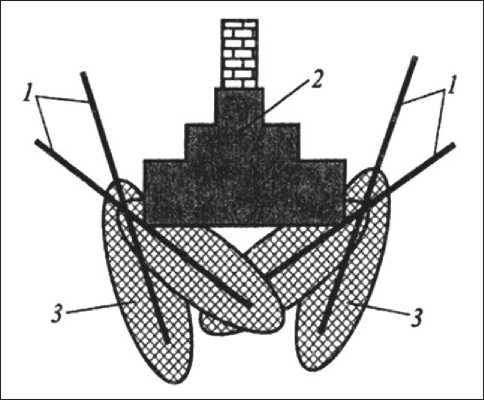
Fig. 1. Strengthening of the foundation: 1 – injector; 2 – foundation; 3 – reinforced area
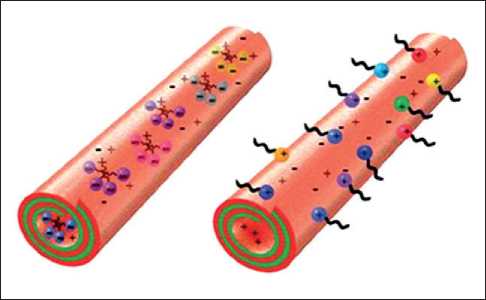
Fig. 2. Structure of aluminosilicate nanotubes
ANTs consist mainly of silicon and aluminum oxides, the content of which reaches 75%. They are hollow tubes with an inner diameter of 15 nm and an outer diameter of about 50 nm. On the inner surface of the spiral-twisted wall there is aluminum oxide with a negative charge, and on the outer surface there is silicon oxide with a positive charge (Fig. 2).
METHODOLOGY
The study used: grade 500 cement, modified bentonite, ANTs and liquid glass. The composite solution with a water-cement ratio of 2:1 was prepared by mixing bentonite with water and ANT additives, after which cement and liquid glass were added. To determine the strength of the mixture, samples were prepared, which were removed from the molds after one day. Before testing, they were stored in a room at a temperature of (20 ± 3) °C and a relative humidity of (65 ± 10) %. The samples were removed from the mold and, by crushing the cubes, the strength was determined on a Controls 50-C0050/CAL50 press for 28 days.
The structure formation in composite solutions with different ANT contents over time was studied. The content of ANTs relative to the cement mass varied from 0.000% (control sample) to 0.450%.
Figure 3 shows the structure formation of the composite solution with ANT additives upon storage with bentonite grade P2T2A at 1, 3, 7, 9, 14, and 28 days of storage.
Based on the study conducted, it was found that on days 7, 14, 21 and 28, the highest strength of the composite solution is achieved when using ANT additives in an amount of 0.125% by weight of cement.
In order to comprehensively analyze the relationship between the concentration of modifying additives, the holding time and the strength properties of the material, a three-dimensional approximation of the experimental data was performed. The constructed mathematical model establishes the functional dependence of the compressive strength f ( x , t ) on two independent variables: the mass fraction of the ANT additive x and the time parameter t , which is formally expressed by the relationship equation (1).
The graph shown in Figure 4 can be approximated by the following function:
f ( x , t ) = 0.2452 – 21.4025 x + 0.1539 t +
+ 424.2941 x 2 + 1.0078 xt – 0.0071 t 2 –
– 2.59 × 103 x 3 – 3.985 x 2 t – 0.0259 xt 2 +
+ 1.1558 × 10⁴ t 3 + 6.1655 × 103 x 4 + 6.7885 x 3 t +
+ 0.0527 x 2 t 2 + 4.5646 × 10⁻⁴ xt 3 – 5.023 ×
× 103 x 5 – 9.0763 x 4 t + 0.0907 x 3 t 2 – 0.0016 x 2 t 3. (1)
The above function describes the graph with sufficient accuracy, as indicated by the coefficient of determina-
Nanotechnologies in construction 2026; 18 (3):
Нанотехнологии в строительстве 341–348
Nanob
APPLICATION OF NANOMATERIALS AND NANOTECHNOLOGIES IN CONSTRUCTION
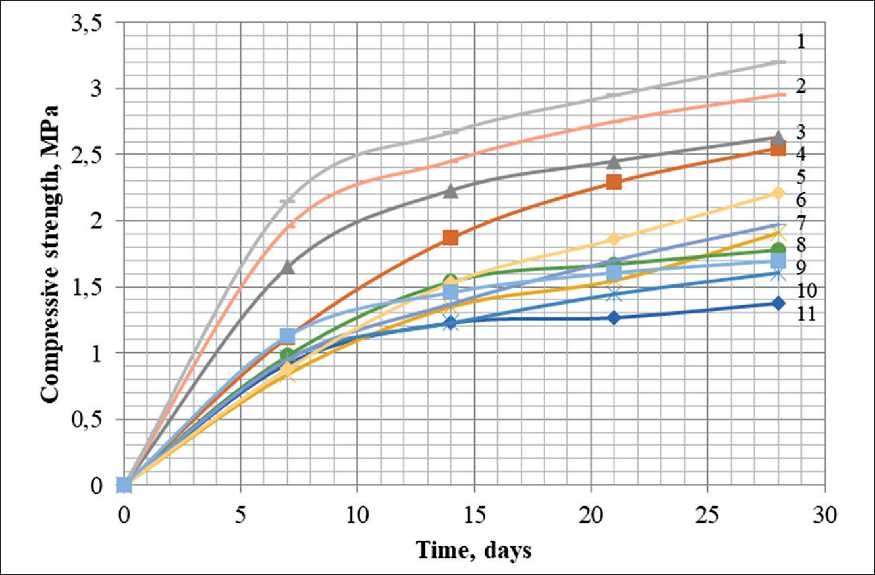
Fig. 3. Strength of composite solutions as a function of storage time at different ANT contents relative to cement mass, %: 1 – 0.125; 2 – 0.100; 3 – 0.150; 4 – 0.250; 5 – 0.080; 6 – 0.300; 7 – 0.075; 8 – 0.400; 9 – 0.006; 10 – 0.450; 11 – 0.000
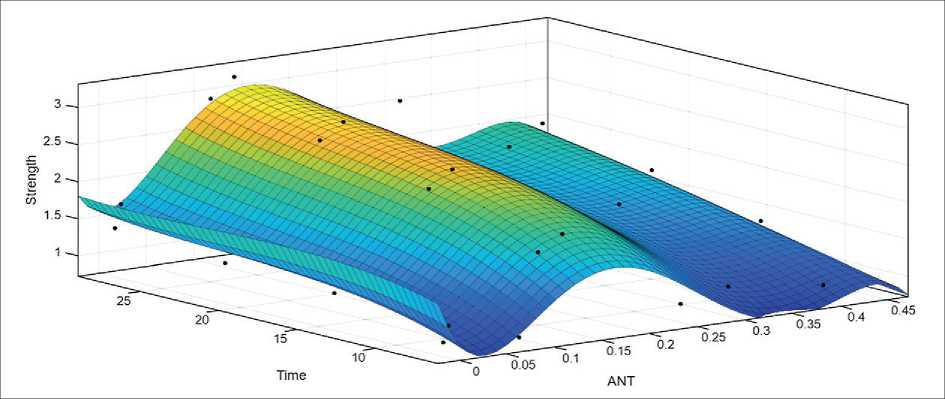
Fig. 4. Strength of composite solutions as a function of storage time at different ANT contents relative to cement mass
tion equal to 0.72191, which indicates that the function describes the graph with good accuracy — it captures the main pattern of the data.
Based on the experimental data obtained, Figure 5 shows the calculated structure formation rate of the composite solution for the studied concentrations of ANT additives. Based on the data obtained, a graph of the de- pendence of the structure formation rate of composite solutions on the modifier content was constructed.
It has been experimentally and graphically confirmed that the introduction of the ANT additive at a dosage of 0.125% by weight of cement leads to a significant improvement in the strength characteristics of the composite material: the strength increases by 2.8 times relative to
Nanotechnologies in construction 2026; 18 (3):
Нанотехнологии в строительстве 341–348
Nanob
APPLICATION OF NANOMATERIALS AND NANOTECHNOLOGIES IN CONSTRUCTION
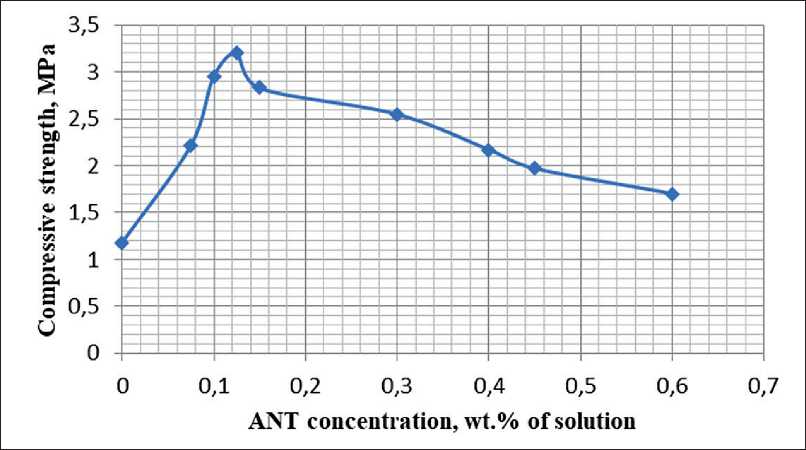
Fig. 5. Strength of the composite solution at different modifier concentrations after 28 days
the control sample without additives. This effect is due to the complex effect of the additive on cement hydration processes: the formation of a denser and more uniform microstructure of cement stone, the formation of additional crystalline phases that strengthen the matrix [25].
RESULTS AND DISCUSSION
It was found that with an increase in the modifier content, the increase in strength of the composite material occurs according to a complex nonlinear pattern.
The optimal concentration of ANT was determined at which the strength of the composite solution after 28 days of storage reaches its maximum value. It corresponds to 0.125% by volume of the solution. At higher and lower modifier concentrations, the strength of the composite solution tended to decrease.
The increase in the strength of the composite system, apparently, occurs due to the appearance of a new additional phase with increased hardness, providing better adhesion to the hydration products of the modified bentonite-cement system.
Thus, as a result of the conducted research, it was found that the modification of the composite solution with ANTs under normal conditions leads to anomalous changes in the structure, increases its strength and changes the kinetics of structure formation.
The above solutions make it possible to significantly change the structural and mechanical properties of the base. The use of a composite solution with an ANT additive, depending on the depth of processing of the existing base, will solve the issue of foundation stability. Studies are planned to prove the possibility of using other manmade waste in the considered field of application.
The proposed mechanism of the structure formation process of the cement matrix of a composite solution consists of modifying the structure of the composite solution with ANTs with the formation of new crystallization centers in the phase solution of cement stone. As a result of such a transformation, a composite system with increased density and strength is formed, which makes it possible to use it to reduce the impact of various deformations.
The optimal concentration values of the nano-alumi-num-containing additive, which maximizes the strength of the composite system, were identified. The approximating plane, which is a two-factor regression model of experimental data, is shown in Figure 4. The approximating plane function, depending on time and concentration, is a polynomial with a degree of 5 in x and a degree of 3 in t (Figure 4). These results were implemented in the MathWorks MATLAB program. It was found that the maximum structuring rate of the composite system occurs at an additive content of 0.125% ANT. The appearance of this effect can be explained by the formation of a new phase of cement stone with increased adhesion.
The introduction of the optimal concentration of the ANT additive into the composite solution will allow it to be used as a composite solution to increase the stability of foundations.
CONCLUSION
Thus, the results of the conducted research indicate that the use of composite solutions modified with aluminosilicate nanotubes (ANTs) is a promising direction in the field of construction materials science and building construction technology. The introduction of nanosized additives makes it possible to purposefully influence the
Nanotechnologies in construction 2026; 18 (3):
Нанотехнологии в строительстве 341–348
Nanob
APPLICATION OF NANOMATERIALS AND NANOTECHNOLOGIES IN CONSTRUCTION
processes of structure formation of cement systems, ensuring the formation of a denser and more uniform microstructure of the composite. This, in turn, contributes to an increase in the strength characteristics of the material, a decrease in its water absorption, and an improvement in its deformation properties.
The experimental data obtained in the work confirm the potential of modified composite solutions to ensure long-term reliability and operational safety of buildings and structures. The formation of additional crystalline phases in the structure of the material, possessing increased hardness and resistance to external influences, creates prerequisites for increasing the service life of reinforced structures.
At the same time, for the full-scale implementation of the developed compositions into the practice of construction production, further research is needed to study the long-term stability of the properties of modified solutions in aggressive environments. Of particular attention are the issues of corrosion resistance of composites under the influence of sulfate, chloride and biogenic factors, as well as assessment of their frost resistance under conditions of variable water saturation. It also seems advisable to conduct field tests of experimental sections of foundation strengthening with monitoring of the stress-strain state over a long period of operation.
In addition, a promising direction for further research is the optimization of the compositions of composite solutions, taking into account economic efficiency and environmental safety, including the possibility of using secondary raw materials as components of modifying additives. Solving these problems will expand the scope of the developed technology and ensure its implementation in the practice of construction and reconstruction of buildings for various purposes.
